


A digital marketer opens five different tabs before 9 a.m. one for keyword research, one for writing ad copy, one for drafting emails, one for building a client report, and one for scheduling social media posts. Hours go by, and half the work is still not done, because none of these tools talk to each other. This is a common problem for marketers in 2026, and AI tools are built to fix it.
This guide lists the best AI tools every digital marketer should learn in 2026. It covers tools for content writing, SEO, social media, email marketing, paid ads, and reporting, so you can build a simple AI tool stack that actually helps your daily work, not one that adds more confusion.
In this blog
What Are AI Tools for Digital Marketers?
AI tools for digital marketers are software applications that use machine learning, generative models, and predictive analytics to perform or assist with marketing tasks. They differ from traditional marketing software because they generate, predict, and adapt rather than just store and display data. A traditional email platform sends a newsletter on schedule; an AI-powered one can also write the subject line, segment the list, and predict which version will get more opens.
These tools now touch nearly every stage of a marketing workflow. Common applications include:
- Content creation (blogs, ads, social captions)
- SEO and keyword research
- Social media planning and scheduling
- Email marketing and segmentation
- Paid advertising and bid management
- Data analysis and reporting
- Customer personalization
- Marketing automation
Why Should Digital Marketers Learn AI Tools in 2026?
Digital marketers should learn AI tools in 2026 because campaigns now run faster, generate more data, and demand more content than any human team can produce manually. Agencies and in-house teams that adopt AI are cutting research and drafting time significantly, which frees up hours for strategy, testing, and client relationships. Marketers who skip this shift are not just working slower; they are increasingly unable to compete for the same roles and clients.
The practical benefits break down into a few clear categories:
- Time savings on repetitive tasks like first-draft writing, resizing images, and pulling reports
- Faster content production across blogs, ads, and social posts
- Sharper personalisation using behavioural and purchase data
- Better decision-making through predictive analytics and pattern detection
- Career resilience: AI fluency is now a baseline hiring expectation, not a bonus skill
What AI Tools Should Every Digital Marketer Learn in 2026?
Every digital marketer should learn a mix of generative AI assistants, SEO intelligence platforms, design tools, and automation software rather than mastering one single app. Different tools solve different bottlenecks; writing, research, design, and reporting all require different capabilities. The list below covers the tools with the widest real-world adoption across marketing teams in 2026.
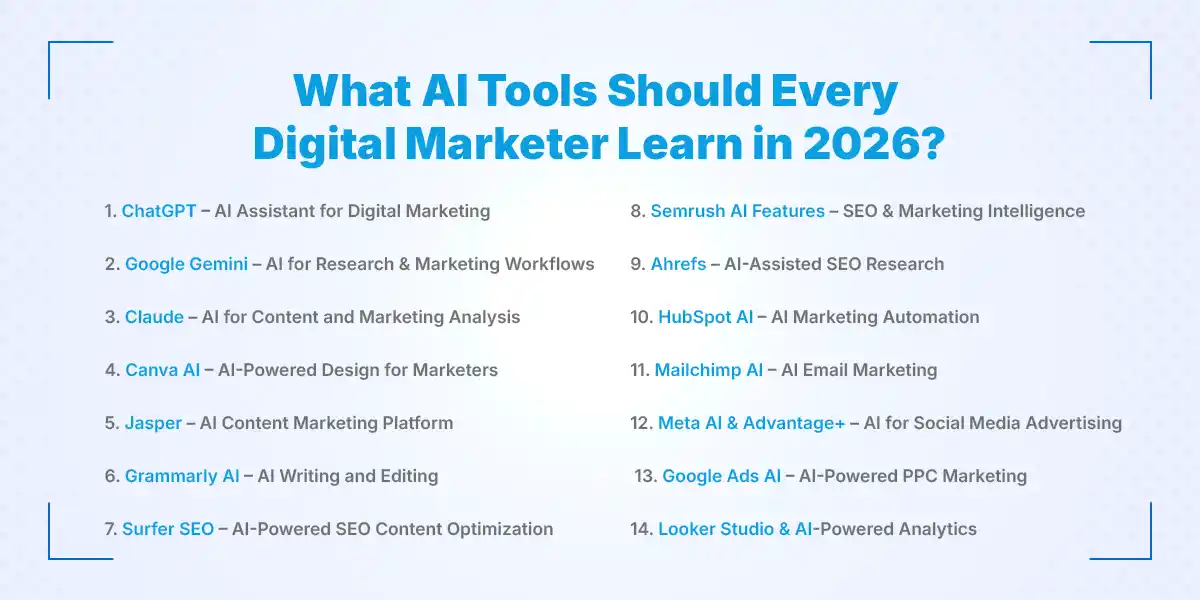
1. ChatGPT, Gemini, and Claude: General-Purpose AI Assistants
These three large language models function as an always-available research and drafting partner for almost any marketing task. ChatGPT is widely used for brainstorming, ad copy, and quick SEO briefs because of its speed and plugin ecosystem. Gemini integrates directly with Google Search and Workspace, making it useful for research that needs to stay close to Google's own data. Claude tends to outperform the others on long-form writing and document analysis, which makes it a strong choice for competitor teardown reports and content briefs that run several thousand words.
2. Canva AI Design Without a Design Team
Canva AI extends a familiar drag-and-drop editor with generative image tools, background removal, and brand-kit automation. It solves the problem most marketers face: needing polished visuals without a dedicated designer or a Photoshop license. Marketers use it to produce social graphics, ad creatives, and presentation decks in a fraction of the time manual design takes. Its Magic Studio features also let non-designers resize a single creative into a dozen ad formats automatically.
3. Jasper Brand-Consistent Content at Scale
Jasper is built specifically for marketing teams that need content to match a defined brand voice across many writers and channels. It stores brand guidelines, tone rules, and past campaigns so every output stays consistent even when five different people are generating drafts. Agencies use it heavily for client work because it reduces the editing pass needed before content ships. The tradeoff is cost: Jasper's pricing targets teams and businesses, not solo freelancers.
4. Grammarly AI: The Editing Safety Net
Grammarly AI checks grammar, tone, and clarity, but its 2026 version goes further by rewriting sentences for a specific audience or reading level. Marketing copy that reads well internally often falls flat with a general audience, and Grammarly's tone detection catches that mismatch before publishing. It works as a browser extension across nearly every platform marketers already use, from Gmail to CMS editors. This makes it one of the lowest-effort, highest-value tools on this list.
5. Surfer SEO Content Optimization Against Real SERPs
Surfer SEO analyzes the top-ranking pages for a target keyword and scores a draft against that competitive set in real time. It flags missing subtopics, thin sections, and keyword gaps that a writer would otherwise miss without manually reading ten competing articles. Content teams use it to plan briefs before writing starts, not just to edit after the fact. Pairing Surfer with a drafting tool like ChatGPT or Claude closes the loop between research and writing.
6. Semrush AI Features: SEO and Competitive Intelligence
Semrush combines keyword research, competitor tracking, and AI-assisted content recommendations inside one platform. Its AI toolkit now includes automated topic clustering, which groups related keywords into content pillars instead of leaving marketers to sort them by hand. Agencies rely on Semrush for client reporting because it consolidates SEO, PPC, and traffic data into a single exportable view. It remains one of the more expensive tools on this list, but the depth of data usually justifies it for teams managing multiple sites.
7. Ahrefs Backlink and Keyword Research
Ahrefs is best known for its backlink index, which remains one of the most accurate in the industry for identifying link-building opportunities and toxic links. Its keyword tool now layers AI-generated content ideas on top of raw search volume and difficulty data. SEO specialists use Ahrefs alongside Surfer or Semrush rather than as a replacement, since each platform pulls slightly different data sets. For technical audits and link analysis specifically, it remains a category leader.
8. HubSpot AI and Mailchimp AI: Automation and Email
HubSpot AI sits inside a full CRM, so its content, email, and lead-scoring suggestions are built on actual customer behaviour rather than generic templates. Mailchimp AI focuses more narrowly on email, using send-time optimisation and subject-line testing to lift open rates without manual A/B setup. Marketing teams running multi-channel campaigns typically pick HubSpot for its automation depth, while solo marketers and small businesses lean toward Mailchimp for its lower learning curve. Both platforms now auto-segment audiences based on engagement patterns instead of static list rules.
9. Meta Advantage+ and Google Ads AI Paid Media Automation
Meta Advantage+ and Google's AI-driven Performance Max campaigns automate audience targeting, bidding, and creative testing across their respective ad networks. Instead of manually building dozens of audience segments, marketers feed the systems a handful of creative assets and let the algorithm find the best-performing combinations. This shift means the marketer's job moves from micromanaging bids to producing enough creative variety for the algorithm to test. Campaigns that feed these systems weak or repetitive creative tend to plateau quickly, regardless of budget.
10. Looker Studio AI-Assisted Reporting
Looker Studio pulls data from multiple marketing platforms into a single live dashboard, and its newer AI features can generate plain-language summaries of performance trends automatically. This removes the manual work of exporting spreadsheets from five tools and stitching them together before a client call. Marketers use it to build recurring reports once and let the data refresh automatically each week. It is free to use, which makes it one of the more accessible tools on this list for freelancers and small teams.
Best AI Tools for Different Digital Marketing Tasks
| Digital Marketing Task | Recommended AI Tools |
|---|---|
| Content Writing | ChatGPT, Claude, Jasper |
| SEO | Semrush, Ahrefs, Surfer SEO |
| Keyword Research | Semrush, Ahrefs, ChatGPT |
| Graphic Design | Canva AI |
| Social Media | Canva AI, ChatGPT, Meta AI |
| Email Marketing | Mailchimp AI, HubSpot AI |
| PPC Advertising | Google Ads AI, Meta Advantage+ |
| Marketing Analytics | Looker Studio, HubSpot |
| Content Editing | Grammarly AI |
| Marketing Automation | HubSpot AI, Mailchimp AI |
How Can Digital Marketers Use AI Tools Effectively?
Digital marketers get the most value from AI tools when they treat the output as a first draft, not a finished product. Every AI-generated claim, statistic, or competitor detail needs a human fact-check before publishing, since these models can generate confident but inaccurate information. Effective use comes down to a few consistent habits:
- Write specific prompts with real context, not vague one-line requests
- Combine tools for different stages research in one, drafting in another, editing in a third
- Add first-party data and brand voice the AI cannot know on its own
- Track which prompts and workflows actually improve output quality over time
- Keep a human editorial pass before anything goes live
Free vs Paid AI Marketing Tools
| Feature | Free AI Tools | Paid AI Tools |
|---|---|---|
| Basic AI Features | Usually available | Available |
| Advanced Features | Limited | More extensive |
| Usage Limits | Often restricted | Higher limits |
| Team Collaboration | Limited | Better |
| Automation | Basic | Advanced |
| Analytics | Basic | Advanced |
| Best For | Beginners, freelancers testing tools | Professionals and businesses at scale |
What Skills Should Digital Marketers Learn Alongside AI Tools?
AI tools amplify skill; they do not replace it. A marketer who does not understand SEO fundamentals will not know if Surfer's recommendations actually make sense for the business. The skills worth building alongside any AI tool include:
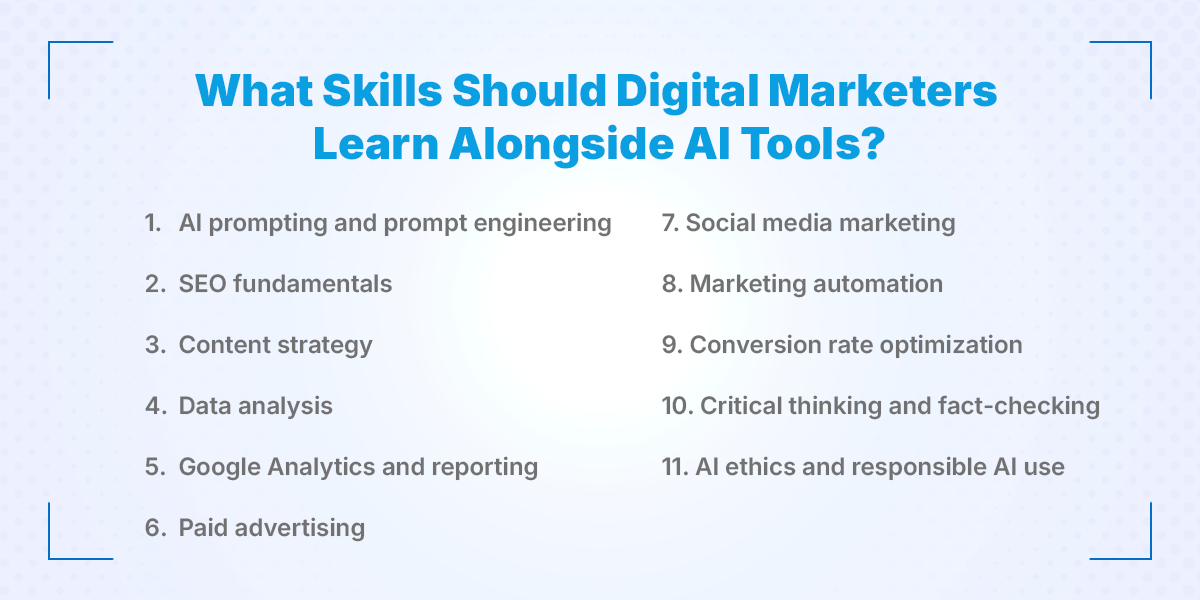
- Prompt writing and prompt refinement
- SEO fundamentals and technical SEO basics
- Content strategy and audience research
- Data analysis and Google Analytics reporting
- Paid advertising fundamentals
- Marketing automation logic
- Conversion rate optimization
- Critical thinking and fact-checking
- Responsible and ethical AI use
Benefits of Learning AI Tools for a Digital Marketing Career
Marketers who build AI fluency see gains that go beyond individual task speed. They typically produce more content per week, run more experiments per campaign, and can take on client work that would otherwise require a bigger team. Recruiters and clients increasingly list AI tool experience as a job requirement rather than a nice-to-have, particularly for content, SEO, and paid media roles. Building a portfolio that shows real AI-assisted campaigns, not just tool familiarity,y has become one of the strongest differentiators for freelancers competing for the same contracts.
How to Start Learning AI Tools for Digital Marketing in 2026?
Starting with too many tools at once is the most common mistake new learners make, and it usually leads to shallow knowledge of everything and mastery of nothing. A more effective path follows this order:
- Learn core digital marketing fundamentals first. AI tools amplify existing skills; they don't substitute for them.
- Pick one general-purpose AI assistant (ChatGPT, Gemini, or Claude) and get comfortable with prompting.
- Choose two or three specialized tools based on your specialization: SEO, content, or paid ads.
- Apply them to a real project, even a personal blog or a mock campaign, instead of only watching tutorials.
- Track results and refine your prompts and workflows based on what actually improves output.
- Build a portfolio piece showing the before-and-after of an AI-assisted project.
AI Tools and Digital Marketing Training
Structured digital marketing training with AI matters most for beginners who don't yet have the marketing fundamentals to judge whether an AI's output is actually good. The strongest training programs combine AI tool instruction with core skills like SEO, content marketing, social media, and Google Ads, rather than teaching AI in isolation. Effective AI-powered digital marketing training should also focus on hands-on projects, not just tutorial videos, helping students develop the skills needed to apply AI tools effectively under real deadlines. Students, freshers, freelancers, and working professionals can all benefit from this type of training, although the right entry point depends on their existing marketing experience.
Conclusion
The marketers who win in 2026 are not the ones who use the most AI tools; they are the ones who use a small, well-understood set of tools consistently and pair them with real marketing judgment. Chasing every new AI launch wastes more time than it saves, while going deep on four or five tools that match your actual workflow compounds into a real skill advantage over a year of practice.
If you're building this skill set from scratch or looking for your next role as an AI-fluent digital marketer, Kumarijob connects job seekers with companies actively hiring for these exact capabilities. Explore current digital marketing openings on Kumarijob and take the next step in your career.
Frequently Asked Questions
Submit your comments

Get Our App On



SEO Training for Freshers in Nepal: Skills, Career & Job Opportunities
VIEW DETAILS
SEO Training vs. Self-Learning: Which Is Right for You?
VIEW DETAILS
How to Choose Between Two Job Offers
VIEW DETAILS
Digital Marketing Training Interview Questions and Answers for Freshers
VIEW DETAILS


Loading Comments...