


Many candidates feel nervous before a bank interview because they don't know what to expect. Bank interviews often mix easy questions like "Tell me about yourself" with harder ones about loans, accounting, and Nepal Rastra Bank. Without a clear plan, it's easy to freeze or give weak answers.
This guide shows you how to prepare for a bank interview in a simple way. You will learn banking questions, accounting questions, HR questions, and tips for freshers. This guide works for anyone applying for a job in banking, whether it's your first interview or not.
In this blog
How Can I Prepare for a Bank Interview?
Candidates can prepare for a bank interview by studying the job description, researching the bank, reviewing core banking concepts, and practising both technical and HR questions. This preparation matters because banks look for candidates who understand the role and the organisation, not just general finance knowledge. A structured plan also reduces nervousness, since candidates walk in knowing exactly what to expect.
- Understand the job description thoroughly.
- Research the bank and its services.
- Review basic banking concepts.
- Study current financial and economic issues
- Revise accounting and finance fundamentals
- Practice common HR questions
- Prepare examples from education or experience
- Practice answering questions confidently, out loud
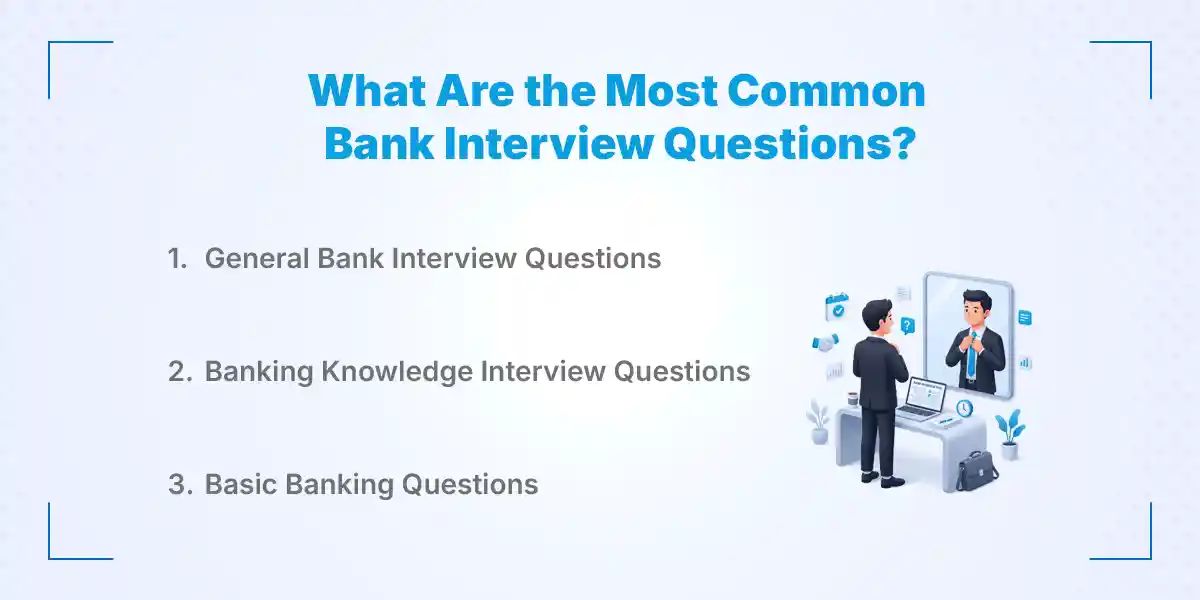
What Are the Most Common Bank Interview Questions?
Bank interviews commonly ask about your education, skills, banking knowledge, career goals, and communication skills. Some common questions include:
General Bank Interview Questions
- Tell me about yourself: Briefly introduce your education, skills, experience, and career goals related to banking.
- Why do you want to work in banking? Explain your interest in finance, customer service, and building a stable banking career.
- Why do you want to work for our bank? Mention the bank’s reputation, services, work culture, and opportunities for career growth.
- What are your strengths and weaknesses? Highlight relevant strengths such as communication and accuracy, and mention a genuine weakness you are actively improving.
- Where do you see yourself in five years? Show that you want to develop your banking skills, take on greater responsibilities, and grow within the organisation.
- Why should we hire you? Explain how your skills, attitude, knowledge, and willingness to learn can contribute to the bank.
Banking Knowledge Interview Questions
Banking knowledge questions test whether a candidate understands the basic products and operations of a bank before starting the job. Interviewers ask about accounts, deposits, loans, interest rates, and digital banking to confirm the candidate isn't walking in with zero foundation. This knowledge is expected even from freshers, since most of it is covered in basic finance education.
- Basic banking concepts
- Types of bank accounts
- Deposits and loans
- Interest rates
- Credit and lending
- Banking products and services
- Digital banking
- Risk management
Basic Banking Questions
- What is a commercial bank?
A commercial bank is a financial institution that accepts deposits, provides loans, and offers banking services to customers. - What are the main functions of a bank?
The main functions include accepting deposits, providing loans, facilitating payments, and offering financial services. - What is the difference between a savings account and a current account?
A savings account is mainly for saving money and earning interest, while a current account is designed for frequent business transactions. - What is a fixed deposit?
A fixed deposit allows customers to deposit money for a specific period and earn interest on it. - What is credit risk?
Credit risk is the possibility that a borrower may fail to repay a loan or interest on time. - Why are interest rates important in banking?
Interest rates affect the cost of borrowing and the return customers earn on their deposits.
Bank Interview Questions About Nepal Rastra Bank
Nepal Rastra Bank questions test whether a candidate understands the country's central banking authority and how it affects commercial banks. This topic comes up often because every commercial bank in Nepal operates under Nepal Rastra Bank's regulations and monetary policy. Candidates who understand this relationship show a deeper, more professional grasp of the banking system.
- Role of Nepal Rastra Bank
- Monetary policy
- Banking regulation
- Financial stability
- Interest rates
- Foreign exchange
- Bank licensing and supervision
Nepal Rastra Bank Interview Questions
- What is the role of Nepal Rastra Bank?
Nepal Rastra Bank regulates and supervises banks and financial institutions in Nepal. - What is monetary policy?
Monetary policy manages money supply and interest rates to support economic stability. - Why is Nepal Rastra Bank important to commercial banks?
Its policies influence lending rates, liquidity, and reserve requirements for commercial banks. - What is the difference between monetary policy and fiscal policy?
Monetary policy is managed by the central bank, while fiscal policy involves government spending and taxation.
Accounting and Finance Questions for Bank Interviews
Accounting and finance questions test whether a candidate can read and understand basic financial statements. Banks deal constantly with numbers, so interviewers expect candidates to know core concepts like balance sheets, assets, liabilities, and profit and loss, regardless of the exact position. This knowledge matters most for roles involving lending, credit assessment, or financial analysis.
- Balance sheet
- Income statement
- Assets and liabilities
- Profit and loss
- Financial ratios
- Working capital
- Basic financial analysis
Accounting Interview Questions
- What is a balance sheet?
A balance sheet shows a company’s financial position, including its assets, liabilities, and equity, at a specific time. - What is the difference between assets and liabilities?
Assets are resources owned by a company, while liabilities are amounts the company owes. - What is depreciation?
Depreciation is the gradual decrease in an asset’s recorded value over its useful life. - What is working capital?
Working capital is the difference between a company’s current assets and current liabilities. - What is a profit and loss statement?
A profit and loss statement shows a company’s income, expenses, and profit or loss over a specific period.
Bank Interview Questions About Loans and Credit
Loan and credit questions test whether a candidate understands how banks manage risk while lending money. This topic matters heavily for roles like Credit Officer and Relationship Manager, where evaluating loan applications is a core daily responsibility. Interviewers look for candidates who can explain both the theory and the practical judgment behind lending decisions.
- Loan types
- Credit assessment
- Collateral
- Loan repayment
- Credit risk
- Non-performing loans
- Loan-to-value ratio
Loan and Credit Questions
- What is the difference between a secured and unsecured loan?
A secured loan requires collateral, while an unsecured loan does not require collateral. - What is collateral?
Collateral is an asset pledged by a borrower to secure a loan. - What is a non-performing loan (NPL)?
An NPL is a loan where the borrower has stopped making repayments as agreed. - How does a bank assess a loan applicant?
A bank checks factors such as income, credit history, repayment capacity, and financial stability.
KYC, AML and Banking Compliance Interview Questions
KYC and AML questions test whether a candidate understands how banks prevent fraud and financial crime. These topics matter because banks are legally required to verify customer identities and monitor transactions for suspicious activity, making compliance knowledge essential for almost every banking role. Interviewers often pair these questions with practical scenarios, such as asking how a candidate would react to an unusual, high-value transaction from a new customer.
- Know Your Customer (KYC) requirements
- Anti-Money Laundering (AML) procedures
- Customer identity verification
- Identifying suspicious transactions
- General compliance responsibilities
- Fraud prevention practices
Customer Service Questions in a Bank Interview
Customer service questions test how a candidate handles real interactions with bank customers, since most banking roles involve direct public contact. Interviewers focus on this area because a technically strong candidate who handles complaints poorly can still damage the bank's reputation. These questions usually combine communication skills with a calm, solution-focused attitude.
- Handling difficult customers
- Resolving complaints
- Maintaining confidentiality
- Communication skills
- Cross-selling banking products
- Customer satisfaction
Customer Service Interview Questions
- How would you handle an angry customer?
Stay calm, listen carefully, understand the problem, and provide a suitable solution. - How would you handle a customer complaint about a bank service?
Listen professionally, apologise when appropriate, identify the issue, and explain the next steps clearly. - How would you protect customer information?
Keep customer information confidential and follow the bank’s data security and privacy policies. - How would you explain a banking product to a customer?
Explain the product in simple language, highlight its key benefits and conditions, and answer the customer’s questions clearly.
Digital Banking and Technology Interview Questions
Digital banking questions test whether a candidate understands how technology has changed the way customers interact with banks in Nepal. Mobile banking, internet banking, and digital payments have grown quickly, and banks want employees who can support customers using these tools confidently. Interviewers also raise cybersecurity and online fraud risks, since digital convenience comes with new security challenges that staff must understand.
- Mobile banking
- Internet banking
- Digital payments
- ATMs
- Online security
- Fintech
- Cybersecurity risks
Current Affairs and Economic Questions for Bank Interviews
Current affairs questions test whether a candidate stays informed about Nepal's economy and banking sector beyond textbook knowledge. Interviewers ask about inflation, remittance, foreign exchange reserves, and GDP because these factors directly affect how banks operate day to day. Following recent economic and financial news before an interview, especially banking-sector developments, significantly improves a candidate's confidence in this section.
- Nepal's economy and growth trends
- Inflation and its effect on banking
- Interest rate changes
- Remittance inflows
- Foreign exchange reserves
- GDP basics
- Recent monetary policy updates
- Banking-sector news and developments
Bank Interview Questions for Freshers
Fresher interviews focus more on potential, communication, and basic knowledge than on years of experience. Interviewers expect freshers to show strong motivation, a clear understanding of banking basics, and the ability to learn quickly on the job. Academic background and any internship experience become especially important talking points in these interviews.
- Educational background
- Basic banking knowledge
- Career motivation
- Communication skills
- Basic finance and accounting
- Internship or academic projects
Common Fresher Bank Interview Questions
- Why do you want to start your career in banking?
I want to build a stable career in banking, develop financial skills, and gain experience in customer service. - What have you learned about our bank?
I have researched the bank’s services, values, products, and recent activities to understand its work and customers. - What skills are important for a banking job?
Communication, customer service, basic financial knowledge, accuracy, teamwork, and problem-solving are important. - How would you help a customer with no banking knowledge?
I would explain the banking service in simple language, listen to the customer’s needs, and answer their questions clearly. - How do you manage pressure?
I stay organised, prioritise tasks, and remain calm while completing work accurately under pressure.
Bank Interview Questions by Job Position
Different banking roles come with different focus areas, so interview questions shift depending on the position. A Bank Teller interview leans heavily on cash handling and customer interaction, while a Credit Officer interview focuses on risk assessment and financial judgment. Understanding this difference helps candidates prepare more precisely for their specific target role.
- Bank Teller
- Banking Assistant
- Junior Assistant
- Customer Service Representative
- Credit Officer
- Relationship Manager
- Banking Officer
Bank Teller Interview Questions
- How would you handle a cash shortage?
I would recount the cash, check the transactions, identify the error, and report the discrepancy to my supervisor. - How do you verify a customer's identity?
I would check the customer’s identification documents and follow the bank’s KYC and verification procedures. - How would you handle a long queue of customers?
I would stay calm, work efficiently, and serve each customer accurately while managing my time properly. - Why is accuracy important for a bank teller?
Accuracy helps prevent cash-handling errors, protect customer funds, and maintain the bank’s financial records.
Credit Officer Interview Questions
- How do you evaluate a loan application?
I review the applicant’s income, credit history, existing debt, and repayment capacity before making a decision. - What factors determine creditworthiness?
Key factors include income, credit history, existing debts, repayment history, and financial stability. - How do you assess credit risk?
I analyse the borrower’s financial situation and repayment ability to determine the risk of potential default. - What skills are important for a Credit Officer?
Financial analysis, attention to detail, risk assessment, and sound decision-making are important skills.
Bank Interview Preparation Checklist
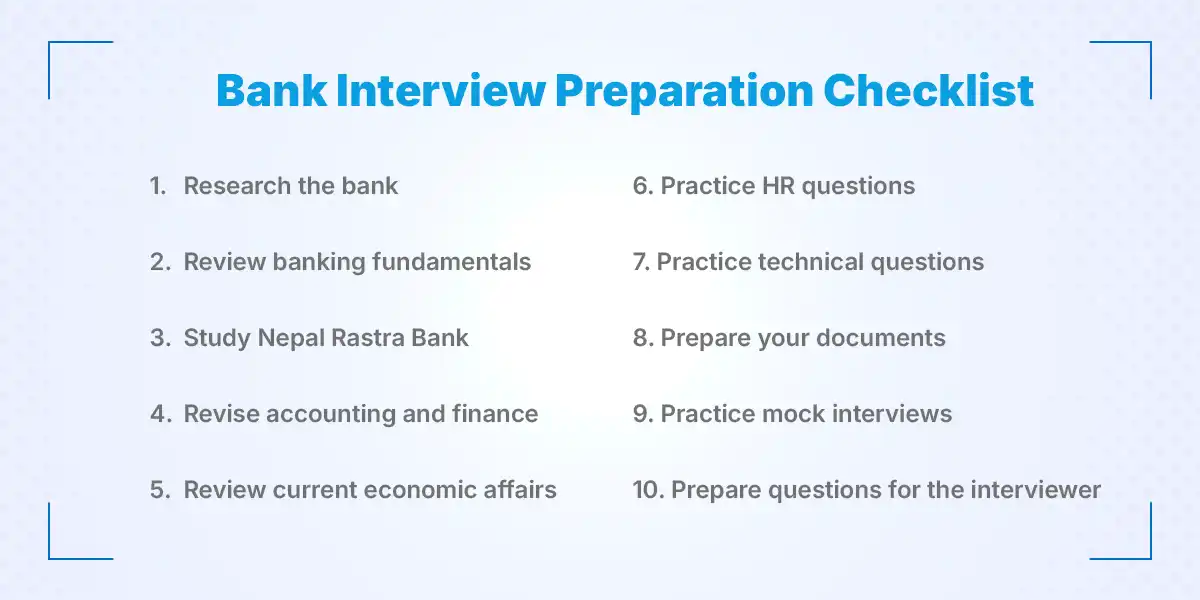
- Research the bank thoroughly
- Review banking fundamentals
- Study Nepal Rastra Bank's role and policies
- Revise accounting and finance basics
- Review current economic affairs
- Practice common HR questions
- Practice technical and role-specific questions
- Prepare all required documents in advance
- Practice mock interviews with a friend or mentor
- Prepare a few thoughtful questions for the interviewer
Career Opportunities in Banking in Nepal
- Bank Teller
- Banking Assistant
- Junior Officer
- Credit Officer
- Relationship Manager
- Operations Officer
- Branch Manager
- Risk and Compliance Officer
Conclusion
Bank interviews reward candidates who can move confidently between two very different skill sets: technical banking knowledge and calm, clear communication. The candidates who stand out are rarely the ones who memorised the most definitions; they are the ones who researched the specific bank, understood the role, and could explain their thinking clearly under pressure. For candidates ready to apply this preparation, Kumarijob lists current banking job openings across Nepal, making it a practical next step for turning interview readiness into a real offer.
Frequently Asked Questions
Submit your comments

Get Our App On



SEO Training for Freshers in Nepal: Skills, Career & Job Opportunities
VIEW DETAILS
SEO Training vs. Self-Learning: Which Is Right for You?
VIEW DETAILS
How to Choose Between Two Job Offers
VIEW DETAILS
Digital Marketing Training Interview Questions and Answers for Freshers
VIEW DETAILS


Loading Comments...