


Many people feel nervous before a Data Analyst interview because they don't know what questions to expect. Some interviews focus on SQL and Excel, while others test statistics, Python, or how you explain your projects. Without a clear plan, it's easy to get confused and give weak answers.
This guide lists the most common Data Analyst interview questions in one place. You will learn SQL questions, Excel questions, Python questions, statistics questions, and behavioral questions. This guide is useful for both freshers and experienced candidates who want to prepare in a simple and clear way.
In this blog
What Are the Most Common Data Analyst Interview Questions?
The most common Data Analyst interview questions fall into eight categories: basic concepts, SQL, Excel, Python, statistics, data visualization, behavioral, and scenario-based questions. Interviewers use this mix to test both technical ability and real-world judgment, not just memorized definitions. A candidate who can explain a SQL query but cannot describe how they would handle messy data will still struggle in the actual job.
- Basic Data Analyst questions
- Technical questions (SQL, Excel, Python)
- Statistics questions
- Data visualization questions
- Behavioral questions
- Scenario-based questions
Basic Data Analyst Interview Questions
- What does a Data Analyst do?
A Data Analyst collects, cleans, analyzes, and interprets data to help businesses make better decisions. - What is the difference between Data Analysis and Data Science?
Data analysis focuses on understanding existing data, while data science often involves building predictive models and using advanced techniques. - What are the main responsibilities of a Data Analyst?
A Data Analyst collects data, cleans it, analyzes it, identifies insights, and presents findings clearly to stakeholders. - What steps do you follow when analyzing data?
The common process is collecting data, cleaning it, analyzing it, finding insights, and presenting the results. - What are common challenges faced by Data Analysts?
Common challenges include messy or incomplete datasets, inaccurate data, and unclear business questions.
Data Analyst Interview Questions for Freshers
Fresher interviews focus less on advanced tools and more on foundational thinking, communication, and willingness to learn. Since freshers usually lack full-time work experience, interviewers pay close attention to academic projects, internships, and how clearly a candidate can explain their reasoning. The categories below cover what freshers should expect most often.
- Questions about education and background
- Basic data concepts
- Analytical thinking
- Tools and software knowledge
- Academic or personal projects
- Problem-solving ability
Beginner Data Analyst Interview Questions
- Why do you want to become a Data Analyst?
I want to become a Data Analyst because I enjoy working with data, finding useful insights, and helping businesses make better decisions. - What is data cleaning?
Data cleaning is the process of finding and correcting errors, duplicates, missing values, and inconsistencies in a dataset. - What is data visualization?
Data visualization means presenting data using charts, graphs, and dashboards to make information easier to understand. - What is the difference between structured and unstructured data?
Structured data is organized in a fixed format, such as rows and columns, while unstructured data includes information like text, images, videos, and emails. - How do you handle missing data?
I first identify the missing values and then decide whether to remove them, replace them with suitable values, or use another appropriate method based on the dataset
SQL Interview Questions for Data Analysts
SQL is the single most tested skill in Data Analyst interviews, since almost every company stores its data in some form of relational database. Interviewers use SQL questions to check not just syntax knowledge, but whether a candidate can think through a business problem and translate it into a working query. This section covers SELECT statements, filtering, joins, subqueries, and more advanced concepts like window functions and CTEs.
Common SQL Interview Questions
- What is SQL?
SQL is used to retrieve, manage, and analyze data from databases. - What is the difference between WHERE and HAVING?
WHERE filters rows before grouping, while HAVING filters grouped results. - What is the difference between INNER JOIN and LEFT JOIN?
INNER JOIN returns matching records, while LEFT JOIN returns all records from the left table. - What are CTEs and window functions?
CTEs simplify complex SQL queries, while window functions perform calculations across related rows. - How do you find duplicate records in SQL?
Use GROUP BY and COUNT() to identify duplicate values.
Excel Interview Questions for Data Analysts
Excel remains one of the most practical tools tested in Data Analyst interviews because so many companies still rely on it for daily reporting. Interviewers usually mix conceptual questions with quick hands-on tasks, asking candidates to explain a formula and then apply it. The list below covers the Excel features that come up most often.
- VLOOKUP and XLOOKUP
- Pivot Tables
- Conditional formatting
- IF functions
- COUNTIF and SUMIF
- Data cleaning
- Charts and Excel formulas
Common Excel Interview Questions
- Which Excel functions do you use for data analysis?
Common functions include VLOOKUP, XLOOKUP, IF, SUMIF, and COUNTIF. - What is a Pivot Table?
A Pivot Table summarizes and analyzes large datasets quickly without using complex formulas. - What is the difference between VLOOKUP and XLOOKUP?
VLOOKUP mainly searches from left to right, while XLOOKUP can search in both directions and is more flexible. - How do you remove duplicates in Excel?
Use Excel’s Remove Duplicates feature to identify and delete duplicate records. - How do you handle missing data in Excel?
Identify blank values first, then fill, replace, or remove them based on the analysis requirements.
Python Interview Questions for Data Analysts
Python interview questions focus on data manipulation and analysis rather than software engineering, since Data Analysts use Python as a tool, not a full programming specialty. Interviewers commonly test knowledge of Pandas for handling tabular data and NumPy for numerical operations. Candidates should also be ready to discuss basic data cleaning, data visualization, and how they typically work with real datasets.
- Python basics (variables, loops, functions)
- Pandas for data manipulation
- NumPy for numerical operations
- Data cleaning with Python
- Data visualization using Matplotlib and Seaborn
- Working with real-world datasets
Statistics Interview Questions for Data Analysts
Statistics questions test whether a candidate can interpret data correctly, not just calculate numbers. Interviewers use these questions to see if a candidate understands what a result actually means for a business decision, since a wrong interpretation can be more damaging than a wrong formula. Common topics include central tendency, variability, correlation, regression, and hypothesis testing.
Common Statistics Interview Questions
- What is the difference between mean, median, and mode?
Mean is the average, median is the middle value, and mode is the most frequently occurring value. - What is standard deviation?
Standard deviation measures how spread out data points are from the average. - What is the difference between correlation and regression?
Correlation measures how two variables move together, while regression helps predict one variable using another. - What is hypothesis testing?
Hypothesis testing uses statistical methods to determine whether there is enough evidence to support a claim about data. - How do you identify outliers?
Outliers are unusual data points that differ significantly from the rest of the dataset and can be identified using methods such as the IQR or standard deviation.
Data Cleaning and Data Visualization Interview Questions
Data cleaning and visualization questions test whether a candidate can prepare messy data and then present it in a way that makes sense to others. Interviewers care about this because raw data is rarely usable as-is, and a poorly designed chart can mislead decision-makers even when the underlying analysis is correct. This category often overlaps with SQL, Excel, and Python questions already covered.
- Handling missing values
- Removing duplicate data
- Identifying incorrect or inconsistent data
- Formatting data for analysis
- Choosing appropriate chart types for different data
- Creating meaningful, easy-to-read dashboards
- Presenting insights clearly to non-technical audiences
Behavioral Data Analyst Interview Questions
Behavioral questions test communication, self-awareness, and how well a candidate fits into a team, alongside technical skill. Interviewers ask these questions because strong technical ability means little if a candidate cannot explain findings clearly or handle pressure professionally. Candidates should prepare specific, honest examples rather than generic answers.
- Tell me about yourself.
- Why should we hire you as a Data Analyst?
- What is your biggest strength?
- What is your biggest weakness?
- Tell me about a difficult data problem you solved.
- How do you communicate complex data to non-technical people?
- How do you handle deadlines?
How Can Freshers Prepare for a Data Analyst Interview?
Freshers can prepare for a Data Analyst interview by mastering SQL and Excel fundamentals, learning basic statistics, and building two to three real projects. This combination proves practical ability, which matters more to most interviewers than certificates alone. A candidate who can walk through a real project confidently often outperforms one who only has theoretical knowledge.
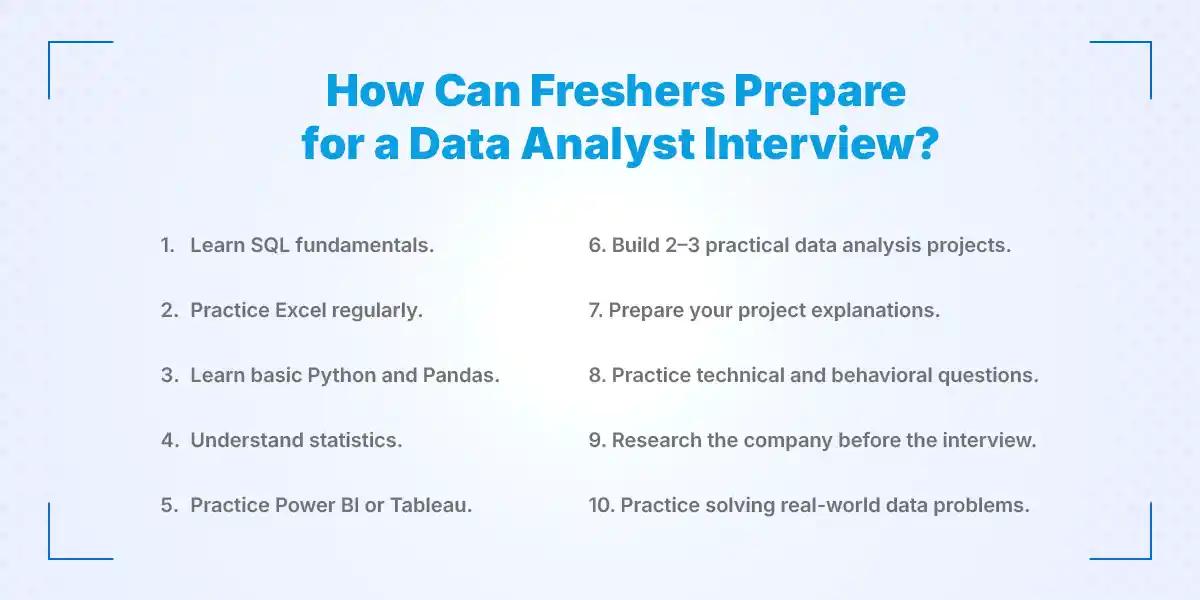
- Learn SQL fundamentals thoroughly
- Practice Excel regularly with real datasets
- Learn basic Python and Pandas
- Understand core statistics concepts
- Practice Power BI or Tableau
- Build 2–3 practical data analysis projects
- Prepare clear explanations for each project
- Practice both technical and behavioral questions
- Research the company before the interview
- Practice solving real-world data problems under time pressure
Data Analyst Projects to Prepare for an Interview
Real projects give candidates something concrete to discuss, which is often more convincing to interviewers than a list of skills on a resume. Showing dashboards, SQL queries, and business insights from a project proves the candidate can apply their knowledge, not just describe it. The project ideas below cover common business use cases that interviewers recognize immediately.
- Sales analysis dashboard
- Customer churn analysis
- E-commerce data analysis
- Marketing campaign analysis
- Employee data analysis
- Financial data analysis
- Website traffic analysis
Data Analyst Interview Preparation Checklist
- Review SQL concepts and practice writing queries
- Practice Excel formulas and Pivot Tables
- Revise core statistics concepts
- Practice Python, especially Pandas
- Review Power BI or Tableau basics
- Prepare clear explanations for each project
- Practice answering behavioral questions out loud
- Research the company and its industry
- Prepare a few thoughtful questions for the interviewer
Data Analyst Career Opportunities and Salary in Nepal
Data analytics offers several career opportunities in Nepal, from entry-level roles to senior positions. Data Analyst salary in Nepal generally increases with experience, technical skills, industry, and job responsibilities.
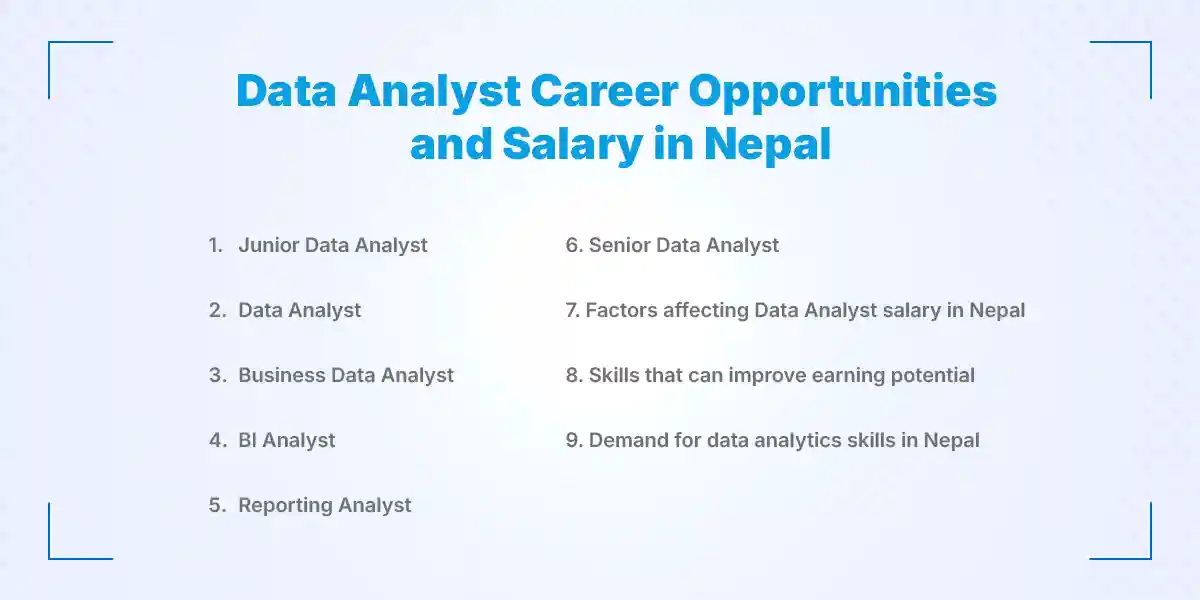
Data Analyst Salary in Nepal by Job Role
- Junior Data Analyst: NPR 20,000–35,000 per month
- Data Analyst: NPR 30,000–60,000 per month
- Business Data Analyst: NPR 35,000–70,000 per month
- BI Analyst: NPR 40,000–80,000 per month
- Reporting Analyst: NPR 30,000–60,000 per month
- Senior Data Analyst: NPR 60,000–120,000+ per month
Salary ranges are approximate and can vary by company, location, experience, and skills.
Factors Affecting Data Analyst Salary in Nepal
- Work experience and seniority
- Technical and analytical skills
- Company size and industry
- Location, especially Kathmandu
- Educational qualifications
- Knowledge of advanced data tools
- Ability to communicate insights clearly
Skills That Can Improve Data Analyst Earning Potential
- SQL
- Microsoft Excel
- Python
- Power BI
- Tableau
- Data visualization
- Statistics
- Business intelligence
- Machine learning basics
Demand for Data Analytics Skills in Nepal
The demand for data analytics skills in Nepal is growing as businesses use data for decision-making, reporting, customer analysis, and business planning. Professionals with strong SQL, Excel, Power BI, Python, and data visualization skills can access more career opportunities and potentially higher salaries.
Conclusion
Passing a Data Analyst interview comes down to one thing more than any other: proving the ability to turn raw, messy data into a clear answer a business can act on. Memorizing SQL syntax or statistics definitions only goes so far interviewers consistently favor candidates who can walk through a real project, explain their reasoning, and stay calm when a scenario question has no obvious answer.
For candidates ready to put this preparation into practice, Kumarijob lists current Data Analyst openings across Nepal, making it a practical next step for turning interview readiness into an actual job offer.
Frequently Asked Questions
Submit your comments

Get Our App On



SEO Training for Freshers in Nepal: Skills, Career & Job Opportunities
VIEW DETAILS
SEO Training vs. Self-Learning: Which Is Right for You?
VIEW DETAILS
How to Choose Between Two Job Offers
VIEW DETAILS
Digital Marketing Training Interview Questions and Answers for Freshers
VIEW DETAILS


Loading Comments...