


A finance graduate sits down for an accountant interview, answers the first two questions well, and then gets asked to explain a bank reconciliation on the spot- and freezes. Accounting interviews rarely stop at "tell me about yourself." They move quickly into technical territory: journal entries, Excel formulas, Tally workflows, and in Nepal, VAT, PAN, and TDS compliance questions that catch unprepared candidates off guard.
This guide covers the most common accountant interview questions, organized by category b: behavioral, technical, practical, Excel, software, and Nepal-specific tax questions al,ong with behavioral questions and preparation tips. By the end, you'll have a clear map of what to expect and how to answer with confidence, whether you're a fresher or an experienced accountant.
In this blog
What Are the Most Common Accountant Interview Questions?
The most common accountant interview questions cover your background, motivation, and fit for the role before moving into technical territory. These five questions appear in almost every accounting interview, regardless of company size or industry. They're designed to test communication and self-awareness before the interview shifts to harder technical ground.
1. Tell Me About Yourself
This question wants a short, structured summary of your education, certifications, and relevant accounting experience, not a full resume readout. Lead with your current role or degree, mention one or two relevant achievements or coursework, and connect it to why you're applying for this specific position. Keep the answer under two minutes and stay focused on accounting-related background. Ending with genuine interest in the role ties the answer together cleanly.
2. Why Do You Want to Become an Accountant?
This question checks whether your interest in accounting is genuine or just a fallback career choice. A strong answer connects a specific reason, such as enjoying structured problem-solving, an interest in financial systems, or early exposure through coursework or a family business, to your long-term career direction. Avoid vague answers like "I'm good with numbers" without backing them up. Personal, specific reasons stand out far more than generic ones.
3. Why Should We Hire You?
This question asks you to make a direct business case for yourself in under a minute. Pick two or three skills that match the job description closely, and explain how they solve a problem this company likely has. Avoid broad claims like "I'm hardworking" without a specific example attached. The goal is to sound like a solution to a need, not just another applicant.
4. What Are Your Accounting Strengths?
This question checks whether your self-assessment matches what the role actually requires. Choose strengths directly relevant to accounting work accuracy, reconciliation skills, and software proficiency instead of generic traits. Back each strength with a short, real example from coursework, an internship, or a previous job. Two well-supported strengths carry more weight than five vague ones.
5. What Are Your Career Goals?
This question checks whether your goals align with what the company can realistically offer over the next few years. Give a grounded answer focused on skill growth, increasing responsibility, or a relevant certification you're working toward, such as CA or ACCA. Avoid naming a specific job title that may not exist at this company. Connecting your growth path to the company's own direction signals genuine long-term interest.
What Are Basic Accounting Interview Questions?
Basic accounting questions confirm that a candidate understands core concepts before an interview moves into harder technical or software-specific territory. These questions are common across all experience levels, since even senior candidates need to demonstrate they haven't lost touch with fundamentals.
- What is accounting? The process of recording, classifying, and summarizing financial transactions to support business decisions.
- What is bookkeeping? The day-to-day recording of financial transactions, which forms the raw data accounting reports are built from.
- What is a journal entry? The first formal record of a financial transaction, showing which accounts are debited and credited.
- What is a ledger? A book or system that organizes journal entries by account, showing the running balance of each one.
- What is a trial balance? A report listing all ledger balances to confirm that total debits equal total credits before preparing financial statements.
- What are debit and credit? The two sides of every accounting entry, where debits increase assets and expenses, and credits increase liabilities, equity, and income.
- What is depreciation? The gradual reduction in the recorded value of a fixed asset over its useful life, reflecting wear and usage.
What Accountant Interview Questions Are Asked to Freshers?
Fresher-focused questions test foundational knowledge, motivation, and willingness to learn, since freshers usually can't draw on years of work experience. Interviewers use these questions to judge potential rather than a finished skill set.
- Why did you choose accounting as a career?
- What accounting skills do you already have, from coursework or internships?
- Which accounting software have you learned or practiced with?
- How do you handle accounting errors when you find one?
- What are your career goals for the next few years?
What Are Technical Accounting Interview Questions?
Technical questions confirm that a candidate's stated knowledge holds up under direct, applied questioning rather than just resume claims. These questions get more detailed as seniority increases, but the core set below appears at nearly every level.
- What are financial statements? The balance sheet, income statement, and cash flow statement, which together summarize a company's financial position and performance.
- What is bank reconciliation? The process of matching a company's cash records against its bank statement to identify and resolve any differences.
- What are accounts payable and receivable? Accounts payable is money the company owes to suppliers; accounts receivable is money owed to the company by customers.
- What is accrual accounting? A method that records revenue and expenses when they're earned or incurred, not when cash actually changes hands.
- What is double-entry bookkeeping? A system where every transaction affects at least two accounts, keeping the accounting equation in balance.
What Are Practical Accountant Interview Questions?
Practical questions move past definitions and test how a candidate would actually handle a real accounting task. These questions matter most for day-to-day roles like bookkeeping, reconciliation, and accounts management.
- How do you correct an accounting error once you've identified it?
- How do you handle a cash discrepancy at the end of the day or month?
- How do you prepare a bank reconciliation from start to finish?
- How do you verify an invoice before processing payment?
- How do you organize and manage financial records for easy retrieval?
What Excel Questions Are Asked in Accountant Interviews?
Excel questions confirm that a candidate can work efficiently with the tool most accounting roles rely on daily, regardless of what dedicated software the company uses. Interviewers often ask candidates to describe or demonstrate these skills directly.
- Which Excel formulas do you use most in accounting work (VLOOKUP, SUMIF, IF, XLOOKUP)?
- How do you use PivotTables to summarize large sets of financial data?
- How do you find and remove duplicate records in a spreadsheet?
- How do you prepare a financial report or summary directly in Excel?
What Tally and Accounting Software Questions Are Asked?
Software questions check whether a candidate can be productive with minimal retraining, since most accounting roles run on a specific platform. Tally remains one of the most commonly required tools across accounting roles in Nepal and India.
- Which accounting software have you used, and at what level of proficiency?
- How do you record a transaction step by step in Tally?
- How do you create and manage a ledger in Tally?
- How do you generate financial reports, like a profit and loss statement, from the software?
What Accountant Interview Questions Are Asked in Nepal?
Accountant interviews in Nepal typically include VAT, PAN, and TDS questions alongside standard accounting topics, since compliance with Nepal's tax system is a core part of most accounting roles. These questions confirm that a candidate can handle real local compliance work, not just accounting theory.
- What is VAT? Value Added Tax, a consumption tax applied at each stage of the supply chain and currently set at 13% in Nepal.
- What is PAN? Permanent Account Number, a unique identifier issued by Nepal's Inland Revenue Department for tax registration and filing.
- What is TDS? Tax Deducted at Source, an advance tax deduction applied to specific payments like salaries, rent, and contractor fees.
- How do you maintain tax records to stay compliant with Nepal's Inland Revenue requirements?
- How do you ensure ongoing tax compliance across VAT filing, PAN documentation, and TDS deductions?
What Behavioral Questions Do Accountant Interviews Include?
Behavioral questions test how a candidate handles pressure, deadlines, and confidential information, since these situations come up regularly in accounting roles. Preparing specific past examples in advance makes these answers far stronger than generic statements.
- How do you handle work pressure during busy periods like month-end or year-end closing?
- How do you consistently meet tight deadlines without sacrificing accuracy?
- How do you handle confidential financial information, both internally and with clients?
- Tell me about a specific problem you solved in a previous accounting role.
How Can You Prepare for an Accountant Interview?
Preparing well means covering both technical accuracy and practical software skills, since strong theoretical knowledge alone isn't enough to pass a modern accounting interview. Along with practicing common accounting interview questions, candidates should develop hands-on skills in accounting software, financial reporting, taxation, and day-to-day accounting tasks. Kumari Job’s Accounting Training can help students and job seekers build these practical skills through industry-focused learning and prepare more confidently for accounting roles. The checklist below covers the areas that matter most.
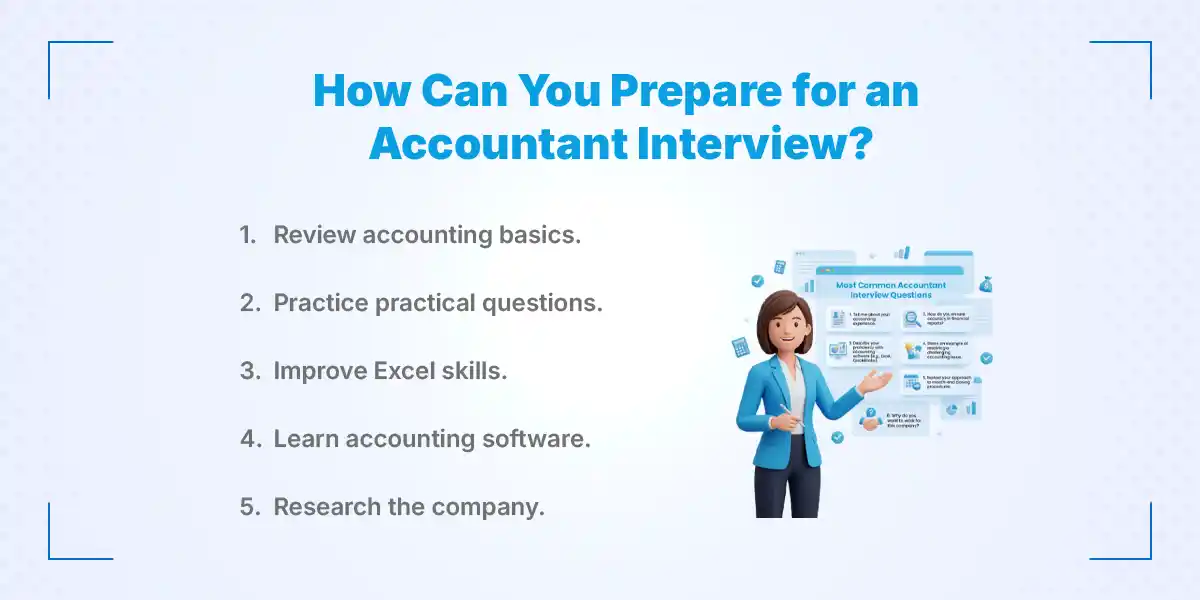
- Review accounting basics: journal entries, ledgers, trial balances, financial statements. Practice answering practical, scenario-based questions out loud
- Sharpen your Excel skills, especially formulas and PivotTables
- Get comfortable with the accounting software listed in the job posting, particularly Tally
- Refresh your knowledge of VAT, PAN, and TDS requirements if applying in Nepal
- Research the company's industry and size before the interview
Conclusion
Accounting interviews reward candidates who can move fluidly between theory and application, explaining what a trial balance is, then immediately describing how they'd actually prepare one. The strongest candidates aren't the ones who memorized definitions the night before; they're the ones who've practiced applying those concepts to real scenarios, including local compliance topics like VAT and TDS that many candidates skip over.
If you're preparing for accounting interviews or looking for your next role, Kumarijob lists current accounting and finance openings across Nepal and connects candidates directly with hiring companies. Browse active listings on Kumarijob and walk into your next interview ready for both the numbers and the conversation.
Frequently Asked Questions
Submit your comments

Get Our App On



SEO Training for Freshers in Nepal: Skills, Career & Job Opportunities
VIEW DETAILS
SEO Training vs. Self-Learning: Which Is Right for You?
VIEW DETAILS
How to Choose Between Two Job Offers
VIEW DETAILS
Digital Marketing Training Interview Questions and Answers for Freshers
VIEW DETAILS


Loading Comments...