


"Should you choose Chartered Accountancy (CA) or start with a Practical Accounting job?" It's a common question, but the answer isn't always straightforward.
Both paths can lead to a successful accounting career, yet they take you in very different directions. One focuses on earning a professional qualification over several years, while the other prepares you to enter the workforce much sooner with practical, job-ready skills.
So, which one is the better choice for you?
That depends on your career goals, budget, timeline, and learning style. In this guide, we'll compare CA and Practical Accounting side by side, break down the key differences, and help you understand which path fits your situation best so you can make a confident decision.
In this blog
What Is Chartered Accountancy (CA)?
A Chartered Accountant (CA) is a top-level finance leader. They are the experts who check big company books to make sure the money is real and taxes are paid correctly. In fact, they are the only people legally allowed to sign and approve official financial reports for large businesses. This is why they are highly respected and trusted in the corporate world.
To become a CA, you do not need a normal college degree. Instead, you have to pass very tough exams from boards like ICAN in Nepal or ACCA. It takes a lot of hard study, but it prepares you to lead big business decisions.
What Is a Practical Accounting Career?
A practical accountant is a hands-on office money manager. They do the daily tasks that keep a business running, like writing down expenses, making bills, and paying staff salaries. They also use computer software like Tally to manage tax filings every month. Every single school, local shop, and hospital in Nepal needs an accountant for these daily chores. This means you are always in demand. Unlike the long CA path, you can start this job very quickly. You just need a basic commerce background (like +2 or BBA) and a few months of practical accounting training to get hired.
CA vs Practical Accounting: Key Differences at a Glance
The main differences between a CA and a practical accountant lie in their study duration, course costs, exam difficulty, and job locations. CA requires a long-term commitment to pass highly competitive exams, whereas practical accounting gets you into the workforce within a few months. Here is a side-by-side comparison table to help you see these differences clearly:
| Feature | Chartered Accountancy | Practical Accounting |
|---|---|---|
| Duration | 5 to 7 years on average | 3 to 6 months of training and instant job |
| Average Cost | High, from 3 Lakhs to 8 Lakhs plus exam fees | Low, from 10,000 to 30,000 for training |
| Difficulty Level | Very High because passing rates are low | Moderate based on practice and systems |
| Required Qualification | Plus Two Graduate or Bachelor's Degree | Plus Two Graduate or Bachelor's Degree |
| Learning Approach | High theory, memorization, and laws | Hands-on, computer-based, practical |
| Job Readiness | Ready after clearing final exams and articleship | Ready in a few months with targeted training |
| Time to First Job | 5 to 7 years | 3 to 6 months |
| Typical Employers | Banks, Audit Firms, MNCs, Large Corporates | Small businesses, schools, NGOs, local offices |
| Career Growth | High potential to reach CFO or Executive level | Starts at Junior Clerk, can grow to Finance Manager |
| Salary Potential | Very High especially with experience | Moderate to Good and grows with skills |
| Best Suited For | Students who love deep study and corporate leadership | Students who want to start earning quickly |
How Long Does It Take to Become an Accountant in Nepal?
Becoming a certified Chartered Accountant takes five to seven years, while becoming a practical accountant takes only three to six months. The CA route requires clearing three levels of exams and doing a long internship, but the practical route only requires targeted skills training. Let us break down the exact timeline for both options so you can plan your future.
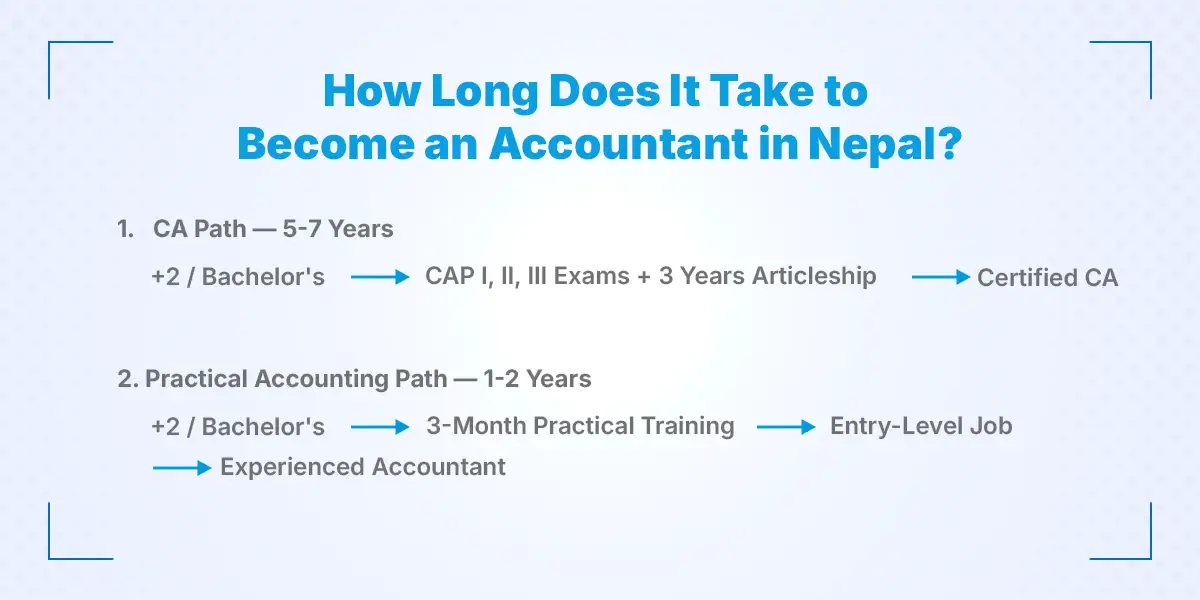
1. CA Timeline
The CA duration is famous for being long. CA involves three examination levels called CAP-I, CAP-II, and CAP-III and a mandatory 3-year articleship, which is an internship at an audit firm. Most students complete the journey in 5 to 7 years, although it can take longer depending on exam performance. Since the exams are highly competitive, taking multiple attempts to pass is normal.
2. Practical Accounting Timeline
On the other hand, the timeline for a practical accountant is much shorter. If you already have a basic education in commerce, you already know basic accounting theories. To bridge the gap between college books and real office work, you only need to take a job-oriented accounting training program. This training usually takes 3 to 6 months. Once you complete it, you can apply for jobs and start working as an accountant right away.
What You Will Learn: CA vs. Practical Accounting in Nepal
Choosing between CA and practical accounting determines whether you will study deep financial laws or learn hands-on office skills. While CA classes focus heavily on complex theories and legal standards, practical training teaches you how to handle daily bills and use accounting software. Let us look at this comparison table to see exactly what you will learn in each path:
| What You'll Learn | CA Path | Practical Accounting |
|---|---|---|
| Accounting Theory | Deep and Complex | Basic Concepts |
| Auditing | Advanced Standards | Basic Checking Only |
| Corporate Law | In-depth Legal Acts | Not Covered |
| Financial Reporting | Rules like NFRS and IFRS | Company Reports |
| Tally Software | Rarely in syllabus | In-depth Training |
| Microsoft Excel | Basic Concepts | Advanced Formulas |
| VAT and TDS Filing | Theoretical Law | Practical IRD Portal |
| Office Payroll | Theoretical Concepts | Salary and Tax Calculation |
| Bookkeeping | Limited Practice | Real Bills and Vouchers |
The main takeaway is simple: CA is a long-distance marathon that leads to high-level corporate authority. Practical accounting is a fast sprint that gets you working, earning money, and building real-world experience almost immediately.
Career Growth: Where Can CA vs Practical Accounting Take You?
Both career paths offer great promotion opportunities, but they lead to very different job titles and responsibilities over time. A Chartered Accountant can grow into a high-level corporate leader like a Chief Financial Officer, while a practical accountant can easily climb the ladder to become a respected Finance Manager. Let us look at the career steps for both paths to see where you could be in a few years:
1. CA Career Path:
- CA Student
- Articleship Intern
- Chartered Accountant
- Audit Manager
- Finance Manager
- Chief Financial Officer
CA generally leads to specialist finance and leadership positions. Because of their rigorous training, CAs often step directly into managerial, auditing, or financial advisory roles.
2. Practical Accounting Career Path:
- Accounts Assistant
- Junior Accountant
- Accountant
- Senior Accountant
- Finance Officer
- Finance Manager
Practical accounting offers gradual career growth through experience, software expertise, taxation knowledge, and management responsibilities. A practical accountant starts with simple bookkeeping, but by mastering complex tax filings, payroll, and budgeting, they can easily climb the ladder to become a respected Finance Manager.
Did You Know?
Many finance managers, chief accountants, and business owners in Nepal are not Chartered Accountants. They built highly successful careers by gaining practical experience, mastering accounting software, understanding taxation, and continuously upgrading their skills.
Accountant Salary in Nepal: CA vs Practical Accounting
Chartered Accountants in Nepal earn higher starting salaries due to their rigorous studies, but experienced practical accountants also make highly competitive wages. Your actual pay will depend heavily on your daily software skills, your knowledge of tax laws, and the size of your employer. Let us look at the average monthly salaries for different experience levels in Nepal:
| Experience Level | Chartered Accountant (CA) | Practical Accountant |
|---|---|---|
| Entry-Level (0–2 Years) | NRs. 35,000 – NRs. 70,000 per month | NRs. 19,500 – NRs. 25,000 per month |
| Mid-Level (3–5 Years) | NRs. 70,000 – NRs. 1,50,000 per month | NRs. 30,000 – NRs. 60,000 per month |
| Senior-Level (5+ Years) | NRs. 1,50,000 – NRs. 3,00,000+ per month | NRs. 60,000 – NRs. 1,00,000 per month |
Your actual salary in Nepal depends heavily on your hands-on experience, the specific industry (like IT, manufacturing, or banking), your software skills, and how well you negotiate. While CAs command higher starting salaries due to their intense study and mandatory internships, practical accountants can also earn excellent packages as they build deep, specialized knowledge of local tax laws and office operations.
Can You Become an Accountant Without CA in Nepal?
Yes, absolutely! This is one of the biggest secrets of the job market. Many people assume you must be a CA to work in finance, but the vast majority of accountants in Nepal are not CAs.
In the real world, businesses hire based on your practical skills, software knowledge, experience, accuracy, and communication. Small businesses, local schools, NGOs, hospitals, and mid-sized corporate offices do not need, and often cannot afford a full-time CA for their daily operations. They need skilled practical accountants who can record transactions, manage cash flow, and file taxes accurately.
This is why many students begin with practical accounting training before deciding whether to pursue CA later. It gives them immediate job security and real-world confidence.
Can You Start with Practical Accounting and Study CA Later?
Starting with practical accounting is a smart strategy that gives you real work experience before you decide to pursue CA studies later. This flexible route allows you to build office confidence, earn your own income, and test your interest in the finance field early. Here is how this step-by-step career pathway works for many successful professionals in Nepal:
Step 1: Learn Practical Accounting and Tax Laws
Start by taking a short practical training program to learn essential skills like Tally Prime, VAT filing, and daily bookkeeping. This gives you direct, hands-on office knowledge that regular college textbooks rarely teach.
Step 2: Get a Job and Earn Real Office Experience
Use your practical software skills to land an entry-level position as an accounts assistant or junior accountant. Working inside a real business helps you understand how company cash flow and daily transactions operate in the real world.
Step 3: Gain Financial Freedom and Professional Confidence
Earning your own monthly salary gives you true financial independence and takes money pressure off your family. Seeing live tax filings and real financial statements every day will also make dry, theoretical accounting concepts much easier to understand.
Step 4: Start Studying CA or ACCA Later
Once you feel stable, confident, and financially secure, you can enroll in CA or ACCA classes using your own earned money. Even if you decide later that CA is not right for you, you will still have a valuable, practical accounting skill and a steady job to fall back on.
There are three great reasons to follow this route:
First, you build real confidence. Working in a real office makes dry, theoretical CA textbooks much easier to understand later.
Second, you secure your own income. You can earn your own salary to pay for your expensive CA classes and books, taking the financial pressure off your parents.
Third, you gain valuable experience. You build a strong resume early. Even if you decide CA is too difficult for you, you will still have a highly valued, practical skill to rely on.
Which Practical Accounting Course Should You Choose in Nepal?
Choosing the right practical accounting course depends on whether you are completely new to the field or looking to upgrade your existing career. Beginner programs build foundational software and bookkeeping skills, while advanced courses teach high-level tax compliance and corporate financial management. Kumari Job offers two specialized training roadmaps designed to guide both fresh job seekers and experienced accountants toward fast professional success.
1. Job-Oriented Accounting Training for Freshers
If you are a fresher, a Plus Two graduate, or a BBS student with zero office experience, the Job-Oriented Accounting Course is your perfect entry ticket into the job market. This practical course type transforms theoretical college concepts into active, real-world skills so you can pass job interviews with confidence.
Kumari Job provides a dedicated Job-Oriented Accounting Training program in Nepal, designed specifically for Nepalese students. It serves as a step-by-step roadmap that bridges the gap between textbooks and daily office expectations:
Master Essential Software: Learn Tally Prime and Tally ERP in depth, which are the most widely used accounting applications in Nepalese companies.
Hands-On Taxation: Practice live VAT, TDS, and PAN entries directly on the official IRD portal so you are completely job-ready on day one.
Core Office Bookkeeping: Build real vouchers, maintain petty cash, and construct automated financial sheets using Microsoft Excel.
Career Placement Support: Receive customized resume building, mock interview coaching, and direct connections to hiring employers across Nepal.
2. Advanced Accounting Training for Experienced Accountants:
If you are already working as a junior accountant, or if you hold a Bachelor degree and feel your salary growth has stalled, the Advanced Accounting Course is built for your next career step. This high-level course type focuses on strategic financial management, legal compliance, and corporate tax auditing.
Kumari Job’s Advanced Accounting Training program in Nepal is designed to elevate working professionals into high-paying management roles. It provides an expert roadmap to help you master senior-level workplace responsibilities:
Complex Tax Compliance: Learn how to manage official tax audits, handle IRD notices, and design legal tax-saving strategies for corporate clients.
Automated Payroll Systems: Master company payroll structures, CIT and EPF retirement funds, labor laws, and employee bonus calculations.
Executive Financial Reporting: Gain the expertise to prepare comprehensive balance sheets, cash flow models, and board reports for business directors.
Common Myths About CA and Accounting Careers
Let us clear up some of the common rumors and misconceptions about this field.
| Myth | Reality |
|---|---|
| Only CAs can earn good money in Nepal. | False. Experienced practical accountants who master advanced taxes, payroll, and financial software can easily earn over NRs. 70,000 to NRs. 1,00,000 per month. |
| Practical accounting has no future. | False. Every single business in Nepal needs an accountant to survive. Practical accounting is a highly stable, evergreen career. |
| You must choose only one path. | False. You can start working as a practical accountant today, gain financial independence, and study CA or ACCA later in life if you choose. |
Conclusion
At the end of the day, both Chartered Accountancy and Practical Accounting are fantastic career paths with excellent futures in Nepal. Every business, from a small local shop to a massive bank, needs financial experts to manage its money.
Remember, your long-term success does not depend on a single degree or title. It depends on your work ethic, your willingness to learn, and how well you solve real problems for your employers. Choose the path that fits your current life situation, stay curious, and never stop upgrading your skills.
Still unsure which path is right for you? Talk to our career advisors for free, and we'll help you choose the accounting career that best matches your goals, budget, and timeline.
Frequently Asked Questions
Submit your comments

Get Our App On



How to Make a Police Report (Police Clearance Certificate) in Nepal?
VIEW DETAILS
Types of SEO and How They Work: Complete Beginner's Guide
VIEW DETAILS
Government Restricts New Lok Sewa Vacancy Requests 2083/84 — Or Not?
VIEW DETAILS
How to Apply for Tattoo Artist Jobs in Nepal?
VIEW DETAILS


Loading Comments...