



Accounting has become one of the most essential and dependable career fields in Nepal, playing a major role in how businesses manage money, plan growth, and stay compliant with regulations. From small enterprises to large corporate houses, every organization needs skilled accountants who can keep financial records accurate and support better decision-making.
This demand makes accounting a stable, long-term career choice for Nepali professionals. As companies expand their operations and focus more on financial transparency, the need for qualified accounting talent continues to rise across the country. Today, private businesses, NGOs, INGOs, banks, audit firms, and growing startups are all hiring accounting staff at different levels. With the right skills, practical training, and a solid understanding of modern accounting tools, anyone can start a successful accounting career in Nepal.
In this guide, we cover what accountants do, the qualifications you need, step-by-step path to become an accountant, salaries, essential skills, workplaces, and tips to land your first accounting job in Nepal.
In this blog
What Does an Accountant Do in Nepal?
An accountant in Nepal keeps a company’s financial records accurate and organized. They handle bookkeeping, taxes, and other financial tasks to help the business run smoothly. Accountants work with management, auditors, and different teams to ensure transparency. Their role is essential for any company that wants to stay efficient and follow the rules.
1. Core Responsibilities & Daily Tasks
An accountant’s day in Nepal usually revolves around keeping financial data clean, updated, and error-free. Their work helps businesses stay compliant, make smart decisions, and avoid financial mistakes. While the tasks may seem routine, each one plays a vital role in keeping the company’s finances healthy and transparent. Your daily roles as an accountant in Nepal will include:
- Recording daily transactions
- Preparing financial statements
- Handling tax & VAT filings
- Managing payroll entries
- Reconciling bank statements
- Maintaining ledgers
- Supporting audits
- Tracking expenses
- Verifying invoices
- Preparing reports
These tasks may look simple on paper, but they require consistency, accuracy, and a sharp eye for numbers. Becoming an accountant is about combining technical knowledge with the right mindset. Employers look for people who can manage financial data confidently while communicating clearly with teams and management.
2. Technical Skills
Technical skills for accountants in Nepal include knowing accounting software like Tally and QuickBooks, understanding VAT and TDS rules, and preparing financial statements following Nepal Financial Reporting Standards (NFRS). These skills help accountants handle daily tasks accurately and support business decisions. These are the most important technical skills required to become an accounting professional.
- Strong understanding of accounting principles
- Accurate bookkeeping and ledger management
- Tally, QuickBooks, and Advanced Excel proficiency
- Knowledge of VAT, TDS, and tax filing
- Ability to prepare financial statements and reports
- Auditing knowledge & Payroll management
These technical skills help you handle real accounting duties from day one, especially in busy firms.
3. Soft Skills
Accountants in Nepal need attention to detail, good time management, problem-solving ability, and clear communication. They also need to work ethically and responsibly. These soft skills help you communicate, collaborate, and maintain professionalism in every situation.
- Attention to detail
- Good time management
- Problem-solving ability
- Clear communication
- Ethical and responsible work habits
Soft skills matter because accountants often work with multiple departments, handle confidential financial data, and explain numbers in a simple way to non-finance teams.
4. Bonus Skills
Extra skills like analytical thinking, working under deadlines, and understanding basic business operations give accountants an edge. These skills allow you to take on more responsibility and contribute to strategic decisions.
What Qualifications Do You Need to Become an Accountant in Nepal?
To become an accountant in Nepal, you need a combination of formal education and practical knowledge. Most start with +2 Management or a bachelor’s degree in accounting, finance, or business-related fields to build a strong foundation. Adding professional certifications like CA, ACCA, or software training in Tally, QuickBooks, and Excel makes you job-ready and more competitive in the market.
Minimum Academic Qualifications
To become an accountant in Nepal, most companies expect you to start with +2 Management and a relevant bachelor’s degree. Common bachelor’s options include BBS, BBA, BSc. Finance, or BCom, which provides a strong foundation in accounting, finance, taxation, and business management. Professional certifications like CA or ACCA further enhance your qualifications and open doors to higher-level roles. Here’s what most Nepali companies expect when hiring accountants:
1. 10+2 Management
This is the most common starting point for anyone entering the accounting field. Students are introduced to basic accounting, economics, and business math. These subjects lay the foundation for future specialization and help learners understand how financial systems work inside a business.
2. Bachelor’s in Accounting / Finance
Degrees like BBS, BBA, or BSc. Finance, all cover core accounting and finance subjects. Students learn accounting, auditing, taxation, financial analysis, and business management. These programs provide both theory and practical knowledge, preparing graduates for roles in corporate offices, banks, audit firms, and other organizations.
3. Chartered Accountant (CA)
CA is a professional qualification focused on accounting, auditing, taxation, and financial management. It is highly respected in Nepal and opens doors to senior roles in accounting, auditing, and finance. CA holders often work in big firms, banks, or manage high-level financial functions in corporations.
4. Association of Chartered Certified Accountants (ACCA)
ACCA is an international professional qualification recognized globally. It covers financial reporting, management accounting, taxation, and strategic business skills. ACCA-certified accountants can work in multinational companies, audit firms, banks, and global finance roles, offering high career growth potential.
Academic qualifications give you the foundation, but practical skills and real-world tools are what truly shape a successful accounting career in Nepal.
Additional Certifications (Optional but Highly Helpful)
Completing a few short courses can boost your employability and help you handle day-to-day accounting tasks confidently:
- Diploma in Accounting
- Tally Training
- Advanced Excel
- QuickBooks, Sage
- Taxation & VAT Training
Even after you’ve secured a junior to mid-level position in accounting, you should continue upskilling yourself with advanced accounting training in Nepal. These courses hone your skills and confidence in bookkeeping, taxation, payroll, and software through real business scenarios. With the right qualifications and practical exposure, you’ll be well-prepared to start your journey as an accountant in Nepal.
How to Become an Accountant in Nepal (Step-by-Step Process)
To become an accountant in Nepal, start by choosing the right academic path, building strong accounting basics, gaining practical training, and learning key software. Create a clean CV, apply for internships or entry-level jobs, and gradually gain experience to grow in your accounting career. The steps below will help you build skills, gain confidence, and enter the job market with real value:
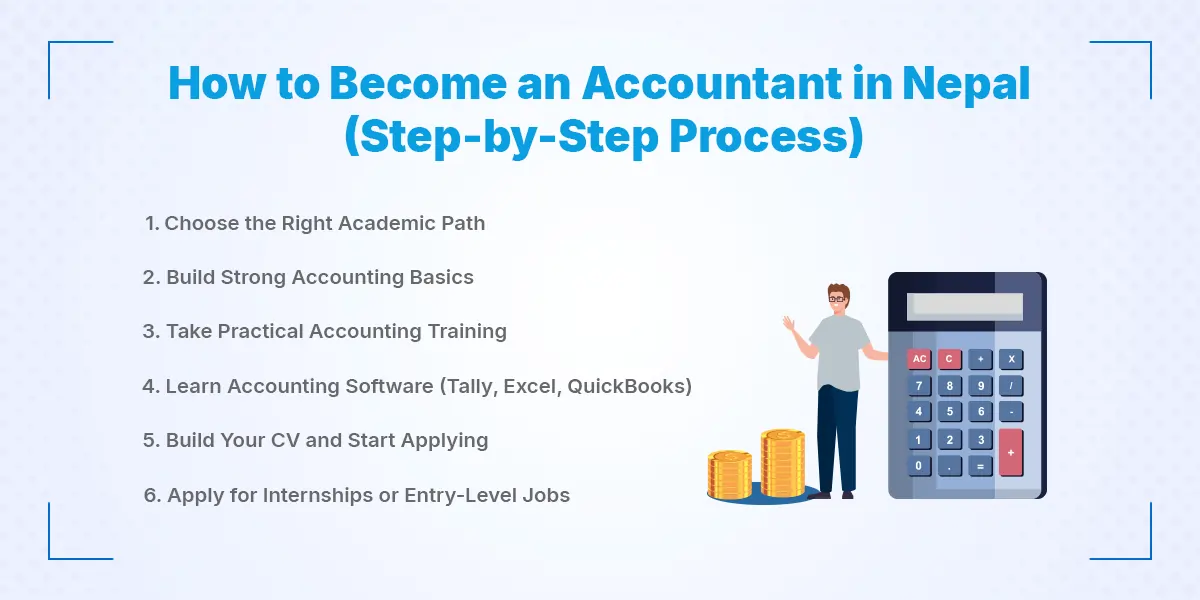
Step 1: Choose the Right Academic Path
Your academic background is the starting point of your accounting career. If you’ve completed 10+2 Management or hold a bachelor’s degree in BBS, BBA, BSc. Finance, or similar fields, you’re already aligned with what Nepali employers expect.
If you want to pursue a more advanced career, you can also aim for CA (Chartered Accountancy) through ICAN. CA is a tougher path, but it opens doors to high-level roles in auditing, taxation, and financial consulting.
Even if your degree isn’t business-related, you can still shift to accounting with the right training and software skills.
Step 2: Build Strong Accounting Basics
You should have a solid grip on the fundamentals before commencing your accounting career. Strong basics help you understand every transaction, every report, and every financial decision inside a business. Start with journal entries, ledgers, trial balance, balance sheet, income statement, and cash flow concepts. Gain familiarity with accounting tools and software like Tally and Excel. When you understand these clearly, handling real accounting tasks becomes far easier.
Step 3: Take Practical Accounting Training
This is the step that separates job-ready candidates from everyone else. Practical training gives you hands-on experience with day-to-day tasks like VAT filing, TDS calculation, bank reconciliation, payroll entries, and financial reporting. A job-oriented accounting training combined with your Bachelor’s education instantly makes you stand out in front of companies.
Step 4: Learn Accounting Software (Tally, Excel, QuickBooks)
Software skills are non-negotiable for accountants today. Every company, small or large, relies on tools to maintain financial data. You should aim to learn:
- Tally for bookkeeping, inventory, and ledgers
- QuickBooks or Sage for corporate and international workflows
- Advanced Excel for analysis, reporting, formulas, and dashboards
The more tools you master, the easier it is to stand out in job applications.
Step 5: Build Your CV and Start Applying
A clean, focused, well-prepared CV shows employers that you’re serious and prepared. Highlight your education, accounting basics, software expertise, and any practical training you’ve completed. Avoid clutter. Avoid long essays. A simple, clear CV with relevant skills performs far better than a generic one.
Step 6: Apply for Internships or Entry-Level Jobs
Internships and entry-level roles are where your real journey begins. These positions help you apply what you’ve learned, understand reporting formats, and work with experienced accountants or auditors. Even a few months of experience can dramatically improve your confidence and future salary potential. This is the stage where most beginners grow the fastest.
Follow these steps carefully, and you’ll build a strong foundation, avoid unnecessary confusion, and enter Nepal’s accounting job market with skills that employers genuinely need.
What Is the Salary of an Accountant in Nepal?
On average, an accountant’s pay can start from entry-level figures around NPR 20,000–35,000 per month. This range can rise significantly as you gain expertise, take on managerial responsibilities, or work in specialized sectors like banks, audit firms, or INGOs. Understanding the typical salary structure helps aspiring accountants like you plan your career and set realistic expectations.
1. Entry‑Level Salary
For fresh accountants or junior roles in Nepal, the monthly pay typically ranges from NPR 20,000 to NPR 35,000. These positions usually include job titles such as Junior Accountant, Accounts Assistant, or Trainee Accountant. These professionals handle day-to-day bookkeeping, invoicing, payroll processing, and basic reconciliations. At this level, their work ensures financial accuracy, supports reporting, and helps managers make informed decisions.
2. Mid‑Level Salary
With a 2–3 years of experience, accountants can earn NPR 40,000–80,000 per month. Common roles include Accountant, Audit Associate, Finance Executive, or Tax Officer. These professionals not only handle complex financial transactions and reporting but also supervise junior staff, contribute to budget planning, and assist in audits or tax filings. Their expertise directly supports business efficiency and compliance.
3. Senior‑Level Salary
Experienced accountants or those in senior positions can earn beyond NPR 80,000 per month, depending on company size and responsibilities. Titles at this level include Senior Accountant, Finance Manager, Chief Accountant, or Internal Auditor. They play a critical role in strategic decision-making, financial analysis, compliance oversight, and guiding teams, ensuring the company’s financial health and long-term growth.
Salary Growth Opportunity
An accounting career in Nepal offers strong growth in both salary and responsibility. As you gain experience and handle more complex tasks, your pay naturally increases. Professional certifications like CA or ACCA, along with software skills, speed up career progress. Moving into leadership roles or joining high-paying sectors like banks, multinational companies, or INGOs can significantly boost earnings. Practical experience combined with these skills ensures faster advancement and higher income.
What Skills Make a Successful Accountant in Nepal?
A successful accountant in Nepal needs a mix of technical skills including accounting software, bookkeeping, and tax knowledge. In addition, soft skills cover attention to detail, communication, and time management. Employers look for professionals who can handle financial data accurately, use modern accounting tools efficiently, and communicate insights clearly. The strongest accountants are those who are detail-oriented, analytical, and adaptable to evolving business needs. Hone the following skills to become an irreplaceable accountant:
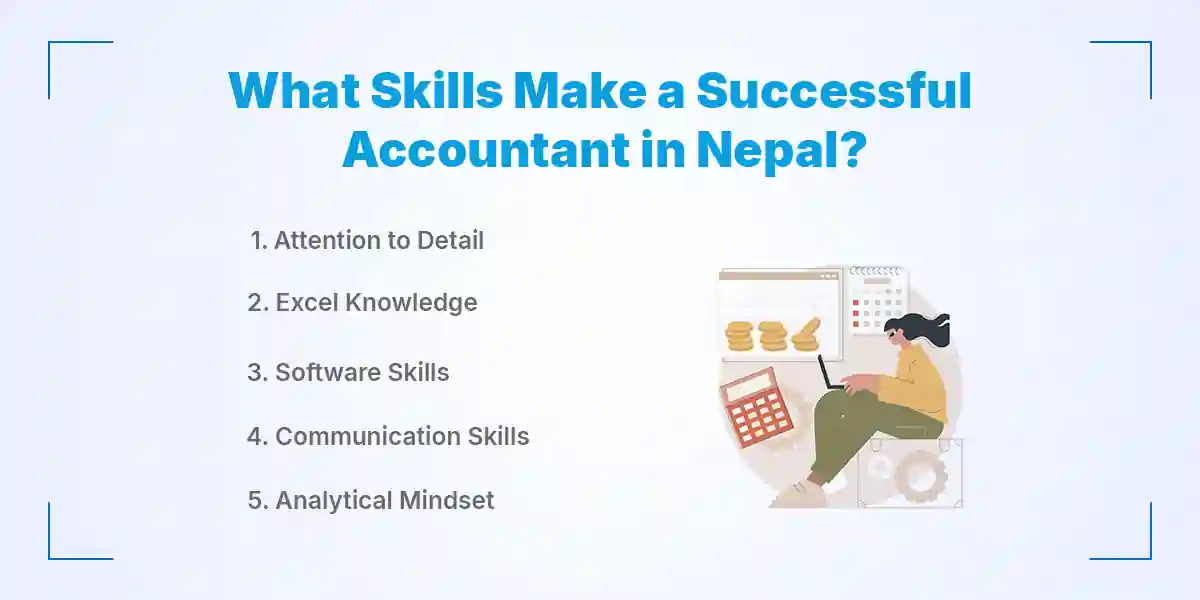
1. Attention to Detail
Accuracy is everything in accounting. Mistakes in ledgers, invoices, or tax filings can lead to compliance issues and financial losses. A careful and detail-oriented approach ensures reliability and builds trust with managers and clients. Attention to detail also helps you spot errors early, saving time and preventing costly mistakes.
2. Excel Knowledge
Advanced Excel skills are essential for creating reports, analyzing trends, preparing dashboards, and managing large datasets. Proficiency in formulas, pivot tables, and financial modeling can save time and improve efficiency. Excel expertise also enables accountants to present data visually, making insights easier for managers to understand.
3. Software Skills
Familiarity with accounting software like Tally, QuickBooks, Sage, or similar tools is highly valued. These platforms help automate tasks, manage accounts efficiently, and handle payroll or inventory without errors. Software skills also make adapting to new systems faster, which is important in modern workplaces.
4. Communication Skills
Accountants need to explain complex financial information in simple terms to management, colleagues, or clients. Clear communication ensures smooth workflows and better collaboration across departments. Strong communication also helps when presenting reports or advising on financial decisions.
5. Analytical Mindset
Strong analytical thinking allows accountants to interpret financial data, identify patterns, and provide insights that support strategic decisions. Problem-solving and critical thinking help in spotting discrepancies or optimizing processes. An analytical mindset also helps you forecast trends and contribute to business growth strategies.
By mastering these skills, you not only become more effective in your day-to-day tasks but also position yourself for faster growth, higher salaries, and leadership opportunities in Nepal’s accounting industry.
Where Can You Work as an Accountant in Nepal?
Accountants in Nepal can work in private companies, banks, audit firms, NGOs/INGOs, corporate houses, manufacturing companies, and startups. These roles involve managing financial records, reporting, and supporting business decisions. Choosing the right sector depends on your career goals, desired salary, and work environment. These are your top options to apply for an accounting job in Nepal:
1. Private Companies
Many small and medium-sized businesses hire accountants to manage day-to-day finances, payroll, and reporting. Roles here often include Accountant, Accounts Executive, or Finance Officer, handling transactions, budgeting, and internal reporting. Working in private companies helps you gain versatile experience across multiple business functions.
2. Audit Firms
Accountants in audit firms focus on verifying financial statements, checking compliance, and assisting clients with tax and regulatory matters. Job titles include Audit Associate, Junior Auditor, or Senior Auditor. These positions provide exposure to multiple industries and are excellent for building technical expertise and analytical skills.
3. Banks and Financial Institutions
Banks and other financial institutions hire accountants for treasury management, risk assessment, compliance, and reporting. Roles like Bank Accountant, Risk Analyst, or Compliance Officer often come with higher salaries and structured career paths. These positions suit those interested in specialized finance functions and financial strategy.
4. NGOs / INGOs
Non-governmental and international organizations require accountants to manage donor funds, project budgets, and grants. Job titles include Project Accountant, Finance Officer, or Grant Accountant. These roles maintain transparency, compliance, and donor reporting. These offer valuable experience if you plan to work in international finance.
5. Corporate Houses & Large Firms
Big companies often employ accountants for internal reporting, financial planning, cost control, and decision support. Positions such as Senior Accountant, Finance Manager, or Chief Accountant allow you to take on leadership responsibilities and strategic planning tasks.
6. Startups & Tech Companies
Startups also need accountants to handle books, cash flow, payroll, and taxation. Working in a startup environment is fast-paced and teaches adaptability, multitasking, and hands-on problem-solving.
7. Manufacturing & Trading Companies
Accountants in manufacturing and trading handle inventory accounting, cost control, and production-related financial reporting. Titles like Cost Accountant or Accounts Executive help develop analytical skills while directly contributing to profitability and operational efficiency.
Tips for Getting Your First Accounting Job in Nepal
The best way to get your first accounting job in Nepal is to combine practical training with active job searching. Gaining practical exposure through internships or training programs helps you apply your knowledge and build confidence. Using job portals, preparing a clean CV, and improving Excel and communication skills increases your chances of landing a role. Consider using the following approaches to succeed in your accounting career in Nepal:
1. Take Practical Training
Practical accounting experience is more valuable than theory alone. Training programs help you understand real-world bookkeeping, payroll, VAT, TDS, and report preparation. Platforms like Kumari Job provide hands-on training designed for Nepali business environments, giving you confidence and a competitive edge when applying.
2. Build a Simple but Clean CV
Your CV should highlight your education, software skills, and practical experience. Keep it concise, easy to read, and tailored to accounting roles. Include any internships, certifications, and software knowledge (Tally, Excel, QuickBooks) to show employers that you are ready to contribute from day one.
3. Apply for Internships
Internships in Nepal are the fastest way to gain experience and get your foot in the door. Even short-term projects allow you to work with real financial data, interact with senior accountants, and understand workplace expectations. These experiences can often lead to full-time job offers.
4. Improve Excel & Communication Skills
Advanced Excel knowledge helps you handle reporting, data analysis, financial modeling, and automation efficiently. Strong communication skills ensure you can explain complex financial insights clearly to managers, clients, or colleagues. Together, these skills make you a more effective, confident, and valued team member, capable of contributing to better decision-making and smoother workflows.
5. Use Job Portals
Thousands of accounting jobs are posted online every month. Using reliable job portals like Kumari Job helps you find verified openings, compare salaries, and apply directly to employers looking for skilled accountants. Build a strong LinkedIn profile, connect with professionals in your industries. Active job searching, combined with your skills, training, and networking significantly increases your chances of landing a role.
Conclusion
Becoming an accountant in Nepal is a rewarding career path with strong growth opportunities, diverse roles, and competitive salaries. Starting with the right academic foundation; right degree, focused training, or professional certificate sets you up for success.
Developing technical skills, mastering accounting software, and honing soft skills like communication and attention to detail are essential to excel in the field. Practical experience and real-world training give you confidence and make you job-ready from day one.
Platforms like Kumari Job offer practical accounting training and access to thousands of verified job opportunities across private companies, banks, NGOs, and corporate firms. They also actively list accounting, finance, CA and ACCA jobs in Nepal from verified companies. Start your accounting career today by gaining practical training and exploring top job opportunities.
Frequently Asked Questions
Submit your comments

Get Our App On



SEO Training for Freshers in Nepal: Skills, Career & Job Opportunities
VIEW DETAILS
SEO Training vs. Self-Learning: Which Is Right for You?
VIEW DETAILS
How to Choose Between Two Job Offers
VIEW DETAILS
Digital Marketing Training Interview Questions and Answers for Freshers
VIEW DETAILS


Loading Comments...