



Choosing the right accounting qualification in Nepal can feel confusing. Many students and professionals struggle to decide between ACCA and CA, unsure which path will open doors to higher-paying jobs, global opportunities, or local recognition. This uncertainty often leads to wasted time, effort, and money.
If you’ve been stuck asking yourself whether to pursue a globally recognized ACCA or a locally respected CA, you’re not alone. Understanding the differences, requirements, and career implications is crucial before committing years of your life.
In this guide, we break down ACCA vs CA in Nepal step by step, covering eligibility, exams, career prospects, costs, and more, so you can make a confident, informed choice and take control of your accounting career.
In this blog
What is ACCA?
The Association of Chartered Certified Accountants (ACCA) is a globally recognized professional accounting qualification, trusted by employers and finance professionals worldwide. ACCA opens doors to international career opportunities, allowing members to work across different countries with credibility and expertise.
The ACCA curriculum is designed to build both technical knowledge and practical skills in accounting, finance, and business management. It is structured in multiple levels:
- Applied Knowledge – Fundamentals of accounting, management, and business principles
- Applied Skills – Broader subjects including taxation, audit, financial management, and law
- Strategic Professional – Advanced technical and professional skills focusing on leadership, strategy, and risk management
The exams are flexible and can be taken in stages, allowing candidates to progress at their own pace. This modular structure ensures a clear learning path, balancing theory with practical application.
Eligibility Criteria and Requirements
To pursue ACCA in Nepal, candidates must meet certain academic and professional prerequisites:
- Academic qualifications: Completion of higher secondary education (10+2) or equivalent with a strong foundation in mathematics or accounting is preferred. Graduates in commerce, finance, or related fields may receive exemptions for some papers.
- Work experience: To become a fully qualified ACCA member, candidates must complete 36 months of relevant practical experience, which can be gained before, during, or after exams. This ensures that members are not only knowledgeable but also capable of applying skills in real-world accounting environments.
ACCA’s combination of global recognition, structured curriculum, and practical experience requirements makes it a top choice for ambitious pro
What is CA in Nepal?
Chartered Accountancy (CA) is a prestigious professional accounting qualification in Nepal, governed by the Institute of Chartered Accountants of Nepal (ICAN). Recognized locally as the gold standard for accounting and auditing professionals, the CA certification equips candidates with the expertise required to meet Nepal’s regulatory and business standards.
The CA curriculum is rigorous, focusing on both technical knowledge and professional ethics. It is structured into multiple levels:
- Foundation Level – Basics of accounting, business mathematics, economics, and law
- Intermediate Level – Core accounting, taxation, audit, and financial management subjects
- Final Level – Advanced accounting, strategic financial management, audit practice, and professional ethics
Exams are comprehensive, designed to test candidates’ analytical abilities, problem-solving skills, and application of accounting principles in real-world scenarios. This ensures CA professionals are highly competent and prepared for top jobs in finance and accounting within Nepal.
Eligibility and Qualification Requirements
To pursue CA in Nepal, candidates must meet specific academic and professional criteria:
- Academic prerequisites: Completion of higher secondary education (10+2) in commerce or equivalent streams. Graduates from finance, commerce, or related disciplines can also enter the program through lateral entry.
- Training and practical experience: Aspiring CAs must complete a mandatory practical training of 3 to 5 years under a licensed CA firm. This on-the-job training ensures candidates gain hands-on experience in auditing, taxation, financial reporting, and business advisory services.
CA in Nepal provides strong local recognition, practical expertise, and a clear career path in accounting, auditing, and finance, making it the preferred choice for professionals aiming for leadership roles in Nepalese businesses and regulatory organizations.
Key Differences Between ACCA and CA in Nepal
Choosing between ACCA and CA in Nepal requires understanding their fundamental differences in recognition, curriculum, cost, and career opportunities. Both qualifications have their own advantages, so comparing them side by side helps you make an informed decision.
| Aspect | ACCA | CA in Nepal (ICAN) |
|---|---|---|
| Recognition | Globally recognized; allows work in multiple countries | Highly respected locally; primarily recognized within Nepal |
| Governing Body | Association of Chartered Certified Accountants (UK-based) | Institute of Chartered Accountants of Nepal (ICAN) |
| Curriculum Structure | Three levels: Applied Knowledge, Applied Skills, Strategic Professional; flexible exams | Three levels: Foundation, Intermediate, Final; exams are sequential and stricter |
| Exam Difficulty | Moderate to high; flexible scheduling | Highly structured progression with rigorous evaluation |
| Eligibility | 10+2 or equivalent; graduates can get exemptions | 10+2 or equivalent; graduates can enter through lateral entry |
| Practical Experience | Minimum 36 months relevant work experience (can be before/during/after exams) | Mandatory 3–5 years training under a licensed CA firm |
| Cost | Moderate; exam fees and study materials vary | Generally lower than ACCA, but training costs may apply |
| Career Opportunities | Global finance roles, multinational firms, international mobility | Local accounting, auditing, taxation, and leadership roles in Nepalese organizations |
| Salary Potential | Higher internationally, competitive in Nepal too | Competitive in Nepal; limited international mobility |
Why Choose ACCA Over CA in Nepal?
Choose ACCA if you want global recognition and international career opportunities. Many aspiring accountants in Nepal prefer ACCA because it opens doors to multinational companies, global mobility, and flexible study options. With ACCA, you gain skills that are recognized worldwide, making it easier to work abroad or in international finance roles.
1. Global Recognition and Career Mobility
ACCA is recognized in over 180 countries, allowing members to work across continents without additional certification. This global recognition provides access to multinational firms, international banks, and global accounting roles. Unlike CA in Nepal, which is mostly valued locally, ACCA members can pursue careers in countries like the UK, UAE, Singapore, or Australia. For ambitious professionals seeking international exposure, ACCA provides a significant advantage.
2. Flexible Exam and Study Structure
ACCA exams are modular, allowing candidates to progress at their own pace. You can attempt exams in multiple sessions per year, making it easier to balance work and study. The curriculum combines theory with practical application, giving candidates hands-on skills while avoiding strict sequential barriers. This flexibility is ideal for working professionals or students who cannot commit to a rigid schedule.
3. Global Salary and Job Opportunities
The ACCA qualification often leads to higher-paying jobs internationally and competitive salaries in Nepal. Members can work in audit, taxation, finance management, consulting, or corporate finance roles worldwide. Employers value the combination of technical knowledge and global perspective that ACCA brings, which enhances career growth and leadership potential.
Why Choose CA Over ACCA in Nepal?
Choose CA if your goal is strong local recognition and leadership opportunities within Nepal. Many accounting aspirants prefer CA because it is highly respected by Nepalese businesses, regulatory authorities, and professional networks. CA certification equips you with deep expertise in local laws, taxation, and auditing practices, making it ideal for careers rooted in Nepal’s corporate and financial sectors.
1. Strong Local Recognition and Authority
CA is regulated by the Institute of Chartered Accountants of Nepal (ICAN), giving it unparalleled credibility within the country. Employers in Nepal often prefer CAs for senior finance, auditing, and leadership roles. This local authority makes it easier to establish trust with clients, businesses, and government institutions. CA holders are considered experts in Nepalese accounting standards, taxation, and corporate regulations.
2. Comprehensive Practical Training
The CA program requires 3–5 years of practical training under licensed CA firms. This hands-on experience ensures candidates gain in-depth knowledge of auditing, taxation, financial reporting, and advisory services. Unlike ACCA, where experience can be gained flexibly, CA’s structured training creates strong professional discipline and familiarity with Nepal’s business environment.
3. Career Growth and Local Opportunities
CAs in Nepal have access to leadership positions in accounting firms, corporations, and regulatory bodies. They are often appointed as auditors, CFOs, or financial consultants, leveraging their expertise in compliance and financial governance. The strong local network and recognition help CA professionals advance quickly within Nepalese organizations, providing stability and high career value in the local market.
ACCA vs CA in Nepal: Which One is Right for You?
Choosing between ACCA and CA in Nepal depends on your career goals, budget, and preferred work environment. Both qualifications are valuable, but the right choice hinges on whether you want global exposure or strong local recognition. Understanding your priorities will help you invest your time and money wisely.
Factors to Consider
1. Career Goals
- If you aim to work internationally or in multinational companies, ACCA is the better choice.
- If you plan to build a career in Nepal, especially in auditing, taxation, or leadership roles, CA is ideal.
2. Recognition and Credibility
- ACCA offers global recognition across 180+ countries.
- CA provides unmatched credibility within Nepal and the regulatory authority.
3. Exam Structure and Study Flexibility
ACCA allows modular exams and flexible scheduling, suitable for working professionals.
- CA follows a sequential and structured exam path with rigorous training requirements.
4. Cost and Time Investment
- ACCA can be more expensive overall, but offers international mobility.
- CA is more affordable locally, but practical training extends over 3–5 years.
5. Practical Experience:
- ACCA requires 36 months of relevant experience (flexible).
- CA requires 3–5 years of structured training under licensed CA firms.
6. Decision-Making Table
| Factor | ACCA | CA in Nepal |
|---|---|---|
| Career Focus | Global mobility | Local leadership |
| Recognition | International | Local (Nepal) |
| Exam Flexibility | High | Moderate |
| Duration | Flexible | 3–5 years of practical training |
| Cost | Moderate to High | Moderate |
| Job Opportunities | Multinational firms, global finance | Nepalese corporations, auditing, and tax |
CA vs ACCA Salary Scale
Understanding the salary prospects is a key factor when deciding between ACCA and CA in Nepal. Both qualifications offer competitive remuneration, but salaries can vary based on experience, industry, and the type of organization.
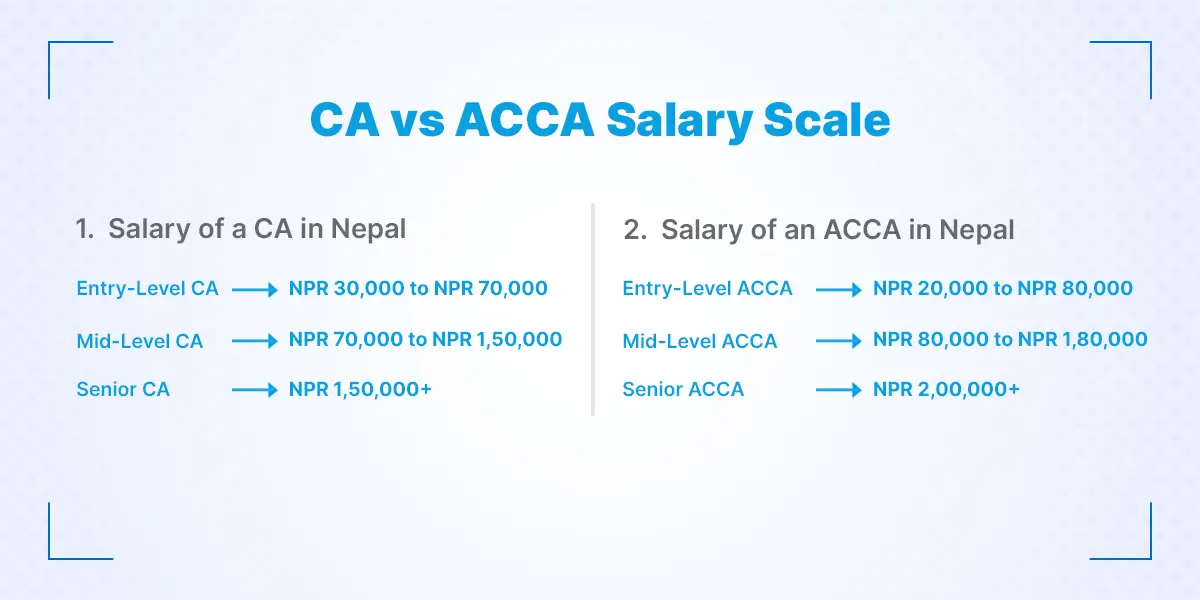
1. Salary of a CA in Nepal
CAs in Nepal are highly respected, particularly in auditing, taxation, and corporate finance roles. CA’s salaries typically increase with experience and seniority:
- Entry-Level CA: NPR 30,000 to NPR 70,000 per month, ideal for fresh graduates completing practical training.
- Mid-Level CA: NPR 70,000 to NPR 1,50,000 per month, generally after 3–5 years of experience in accounting firms or corporations.
- Senior CA: NPR 1,50,000+ per month, for those in leadership roles like CFO, audit manager, or tax consultant.
The CA path provides strong local recognition, making it easier to secure leadership roles within Nepalese organizations, which often results in stable career growth.
2. Salary of an ACCA in Nepal
ACCA salaries in Nepal can be slightly more variable, reflecting their flexibility and international opportunities:
- Entry-Level ACCA: NPR 20,000 to NPR 80,000 per month, depending on the company and prior experience.
- Mid-Level ACCA: NPR 80,000 to NPR 1,80,000 per month, especially in multinational firms or international finance roles.
- Senior ACCA: NPR 2,00,000+ per month, often for positions with global exposure or senior management responsibilities.
ACCA members benefit from broader international opportunities, which can lead to higher salaries abroad, while also offering competitive pay in Nepal, particularly in multinational companies or large finance organizations.
Conclusion
Choosing between ACCA and CA in Nepal ultimately depends on your career goals and professional priorities. If your aim is international mobility, exposure to multinational firms, and globally recognized credentials, ACCA is the ideal choice. It offers flexible exams, worldwide recognition, and the ability to work across borders. On the other hand, if you want strong local credibility, in-depth knowledge of Nepalese accounting standards, and structured practical training, CA provides unmatched authority within Nepal, opening doors to leadership roles in auditing, taxation, and corporate finance.
Both paths are valuable, and pursuing either can lead to rewarding CA ACCA jobs in Nepal. The best choice aligns with whether you prioritize global opportunities (ACCA) or local expertise and recognition (CA), helping you build a successful and sustainable accounting career.
Ready to level up your accounting career? Build in demand skills with advanced accounting training and open doors to higher roles, better salaries, and global opportunities.
Frequently Asked Questions
Submit your comments

Get Our App On



SEO Training for Freshers in Nepal: Skills, Career & Job Opportunities
VIEW DETAILS
SEO Training vs. Self-Learning: Which Is Right for You?
VIEW DETAILS
How to Choose Between Two Job Offers
VIEW DETAILS
Digital Marketing Training Interview Questions and Answers for Freshers
VIEW DETAILS


Loading Comments...