



You finish a full day at work, open your laptop to learn SEO, and land on twenty tabs of advice that contradict each other. One guide says to build links, another says to fix page speed, and a third says content is everything. After an hour you have more questions than answers, and your energy is gone.
Seo training built for working professionals fixes this by putting the right skills in the right order, in a schedule that fits around your job. This article explains what to learn, which tools to practice, how to study without burning out, and how to choose a course in Nepal that gives you real results.
In this blog
What Is SEO Training for Working Professionals?
SEO training for working professionals is a structured learning program that teaches search engine optimization to people who already hold a job. It uses flexible schedules, short lessons, and hands-on tasks so learners can study without leaving work. The goal is to build skills that you can use in your current role and in future roles.
1. How It Differs From General SEO Courses
General SEO courses usually assume you can attend daily classes for several weeks. Training built for working professionals moves lessons to evenings, weekends, or recorded sessions. It also replaces long theory blocks with short tasks that you can finish in under an hour. When you compare two courses, check the class timing first, because a strong syllabus is useless if you cannot attend.
2. Flexible Learning and Real Website Projects
Good programs pair short lessons with assignments on live websites. You might audit a small business site, fix its title tags, and track the change in Google Search Console. These tasks show you how rankings move, which slides alone cannot do. Ask each provider for sample assignments so you can judge how practical the training really is.
3. How SEO Supports Different Roles
SEO knowledge helps people far beyond the marketing team. A content writer learns to match articles to search intent, a developer learns to speed up pages, and a business owner learns to read traffic reports. Even sales and support staff gain from knowing which questions customers type into Google. Pick one task from your current job and apply each new lesson to it within a week.
What SEO Skills Should Working Professionals Learn?
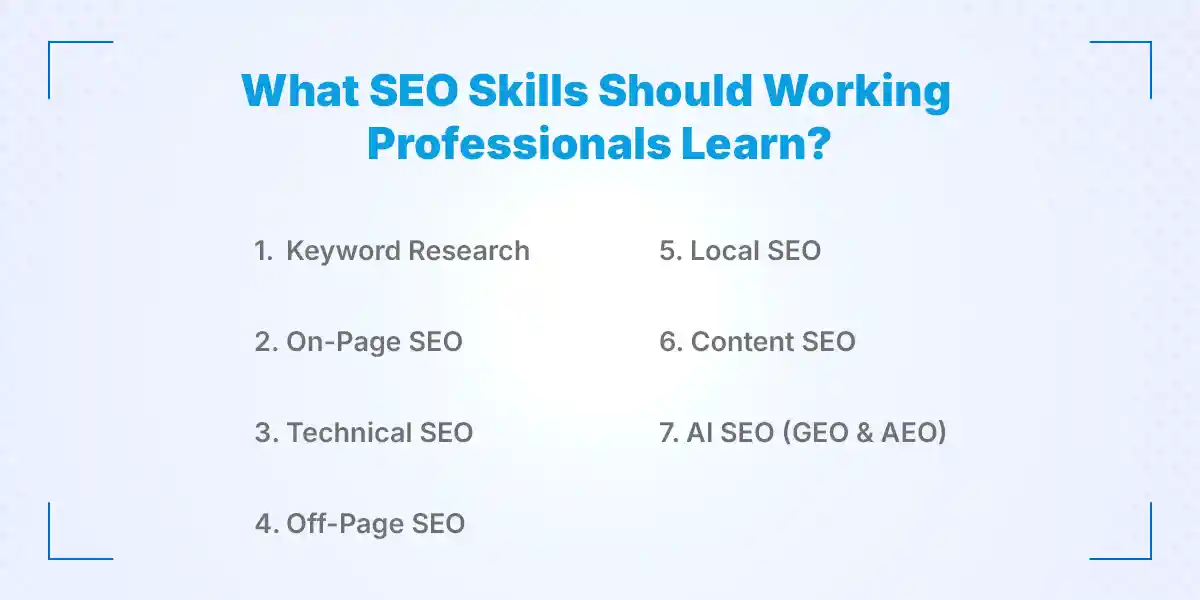
Working professionals should learn seven core SEO skills: keyword research, on-page SEO, technical SEO, off-page SEO, local SEO, content SEO, and AI SEO. Together, these skills cover how people find a business, how search engines read a page, and how AI tools pick sources. Learn them in this order, because each skill builds on the one before it.
1. Keyword Research
Keyword research is the process of finding the exact words people type into search engines. It matters because a page that targets the wrong phrase gets no traffic, no matter how well it is written. Start with Google Keyword Planner, then open the top-ranking pages to see what the searcher wants. Group related phrases together so each page covers one topic well.
2. On-Page SEO
On-page SEO covers everything you control on a single page, such as titles, headings, internal links, and image text. It matters because search engines use these signals to understand what the page is about. Write one clear H1, keep the title under 60 characters, and place the main keyword in the first 100 words. Read the page aloud, and rewrite any sentence that sounds stuffed with keywords.
3. Technical SEO
Technical SEO makes sure search engines can crawl, render, and index your site. A page with a slow load time or a blocked file can lose rankings before anyone reads a word. Run a crawl, fix broken links and redirect chains first, and then compress large images to the WebP format. Test the result in Google PageSpeed Insights, and keep the largest image on each page under 200 KB.
4. Off-Page SEO
Off-page SEO covers signals that come from outside your website, mainly backlinks and brand mentions. It matters because search engines treat links from trusted sites as votes of confidence. Focus on earning links through useful guides, local partnerships, and guest posts on relevant sites. Avoid buying bulk links, since low-quality links can trigger a manual penalty.
5. Local SEO
Local SEO helps a business appear when people search for services near them. It matters in Nepal because many buyers add a city name, such as Kathmandu or Lalitpur, before they call or visit. Claim and complete the Google Business Profile, keep the business name, address, and phone number identical on every listing, and ask happy customers for reviews. Reply to every review within two days to show that the profile is active.
6. Content SEO
Content SEO means writing pages that answer a searcher's question better than the pages already ranking. It matters because search engines and AI tools reward answers that are clear, complete, and trustworthy. Open each section with a direct answer, then add detail, examples, and a short list that readers can scan. Update old posts every six months with fresh facts, and change the date only when the content really changes.
7. AI SEO (GEO and AEO)
AI SEO, which includes Generative Engine Optimization (GEO) and Answer Engine Optimization (AEO), prepares your content to appear in AI-generated answers. It matters because tools such as Google AI Overviews and ChatGPT quote sources that state facts clearly and in a consistent structure. Use short definitions, question-style headings, and FAQ blocks marked up with FAQ schema in JSON-LD. Ask AI tools your target questions, and note which sources they cite so you can study what those pages do well.
Why Should Working Professionals Learn SEO?
Working professionals should learn SEO because it adds a high-demand skill to their career without forcing them to leave their job. Almost every business wants more organic traffic, so the skill applies across many industries. You can start small, keep your salary, and build proof of your ability over time.
- Stronger digital marketing base: SEO connects content, ads, social media, and analytics.
- Career advancement: Managers notice people who can show traffic and lead growth.
- Traffic knowledge: You learn exactly how businesses attract visitors without paid ads.
- Better online presence: You can improve how your employer or your own brand appears in search.
- Freelance and remote options: Clients around the world hire SEO specialists for project work.
- Industry relevance: Search keeps changing, and current SEO skills keep you competitive.
- No career break: You learn alongside your job instead of pausing it.
How Can Working Professionals Learn SEO Alongside a Full-Time Job?
Working professionals can learn SEO alongside a full-time job by choosing flexible online or weekend classes and studying 30 to 60 minutes each day. They should practice on a real website and apply each lesson to their current work. Tracking progress in a simple portfolio keeps motivation high and proves skill to employers.
1. Build a Realistic Weekly Schedule
A schedule works only when it fits the energy you have after work. Block five sessions of 30 to 60 minutes on your calendar, and treat them like meetings. Put theory on weekdays and longer practice tasks on Saturday morning. Cancel a session only if you reschedule it within the same week.
2. Practice on Real Websites
Theory fades quickly unless you test it on a live site. Pick a small website, such as a friend's shop or your own blog, and run keyword research, fix titles, and track clicks in Google Search Console. Real data shows what works, and it gives you results you can describe in interviews. Keep a short log of each change and check its effect after four weeks.
3. Track Progress and Build a Portfolio
A portfolio turns your learning into proof that employers can check. Save before-and-after screenshots, audit reports, and keyword sheets in one shared folder or on a simple web page. Add one small project every month so your portfolio keeps growing while you work. Link your best project in your resume and on LinkedIn.
Which SEO Tools Should Working Professionals Learn?
Working professionals should learn seven SEO tools: Google Search Console, Google Analytics 4, Google Keyword Planner, Ahrefs, SEMrush, Screaming Frog, and Google PageSpeed Insights. Start with the free Google tools, because they show real data from your own site. Add paid tools after you understand the basics, since most employers expect familiarity with at least one.
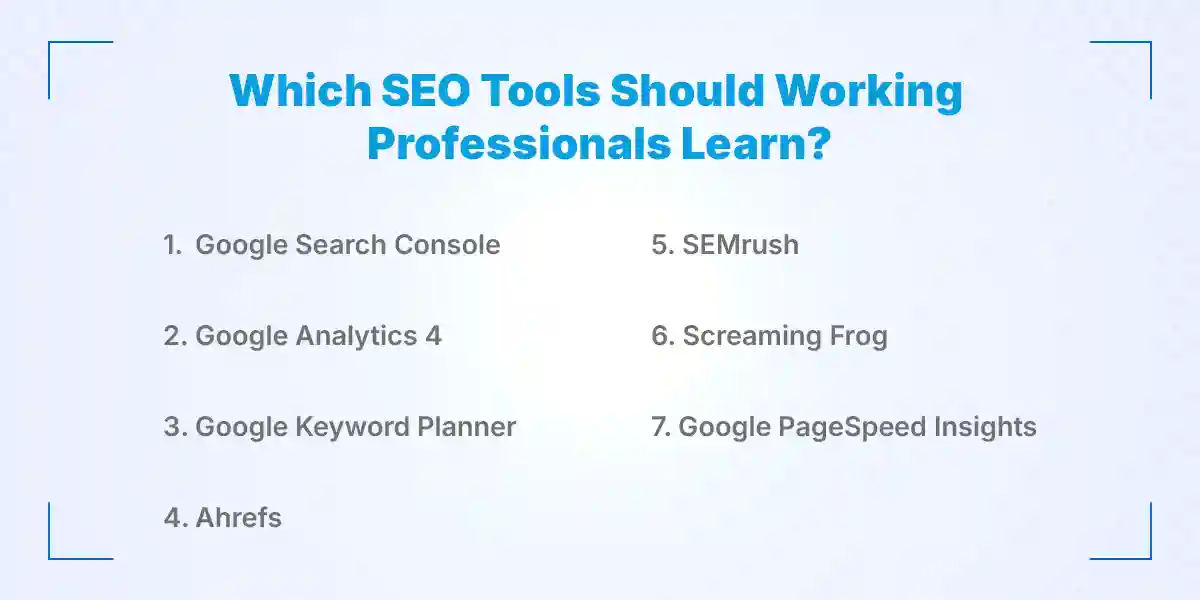
| SEO Tool | What It Does | Cost |
|---|---|---|
| Google Search Console | Shows search queries, clicks, impressions, and indexing problems. | Free |
| Google Analytics 4 | Tracks website traffic and how visitors behave on your site. | Free |
| Google Keyword Planner | Helps research keywords and estimate search volume. | Free with a Google Ads account |
| Ahrefs | Analyzes backlinks, keywords, and competitor websites. | Paid |
| SEMrush | Researches keywords, competitors, and website health. | Paid |
| Screaming Frog | Crawls websites to find broken links, redirects, and SEO tag errors. | Free up to 500 URLs, then paid |
| Google PageSpeed Insights | Checks page performance and suggests improvements for loading speed. | Free |
What Are the Benefits of SEO Training for Working Professionals?
The main benefits of SEO training for working professionals are career growth, better job options, higher salary potential, career switching, freelance income, business growth, and stronger confidence. Each benefit grows from the same base, which is the ability to bring organic traffic to a website. The size of the benefit depends on how much you practice, not only on how many classes you attend.
- Career growth: Add skills that support a promotion or a wider role.
- Better job opportunities: Qualify for SEO and digital marketing positions.
- Salary potential: Move toward higher-paying digital marketing roles as your skills and results grow.
- Career switching: Transition into SEO or digital marketing from another field.
- Freelancing opportunities: Offer SEO services to businesses and clients on the side.
- Business growth: Apply SEO strategies to improve your company's website visibility.
- Professional confidence: Make decisions based on SEO data and analytics, not guesses.
How to Choose the Best SEO Training Course for Working Professionals?
To choose the best SEO training course, check for flexible class schedules, a full syllabus covering on-page, off-page, technical, and local SEO, and practical website projects. Confirm that trainers have real experience and that the course includes Google Search Console and GA4. Compare fees, duration, reviews, and career support before you enroll.
- Flexible schedule: Look for evening, weekend, or recorded options that match your work hours.
- Complete syllabus: Read every module and confirm that it includes AI SEO.
- Practical projects: Ask whether you will optimize a live website, not only a demo page.
- Tool access: Check that Search Console and GA4 are part of the lessons.
- Trainer quality: Ask about the trainer's experience and request a demo class.
- Career support: Ask about portfolio reviews, interview help, and job guidance.
- Cost and outcomes: Compare fees, duration, and what you will be able to do at the end.
- Learner reviews: Read feedback from past students, and look for specific results.
If you are still deciding between a class and studying alone, read this comparison of SEO Training vs Self-Learning.
Common Challenges Working Professionals Face While Learning SEO
Most challenges come down to time, complexity, and consistency, and each one has a simple fix.
- Balancing learning with full-time work: Use fixed daily sessions of 30 to 60 minutes instead of waiting for free time.
- Finding time for practical assignments: Reserve one weekend block each week for hands-on tasks.
- Understanding technical SEO: Learn one topic at a time, such as crawling first and schema later.
- Keeping up with Google algorithm updates: Follow one trusted source, and review updates once a month.
- Applying theory to real websites: Work on a live site from week one, even a tiny one.
- Staying consistent during busy weeks: Shrink the session to 15 minutes instead of skipping it.
Structured training helps here because it sets the order, the deadlines, and the feedback for you.
Is SEO Training Worth It for Working Professionals in Nepal?
Yes, SEO training is worth it for working professionals in Nepal when it includes practical website projects and fits around a job schedule. Agencies, IT companies, startups, and retail and education businesses all compete for attention on Google, so they need people who can bring in organic traffic. A good course also lets you keep your salary while you build a skill that employers and clients can verify.
- Growing digital demand: Nepali businesses increasingly rely on online visibility to reach customers.
- Career paths: SEO skills open roles in agencies, IT companies, startups, and in-house marketing teams.
- Support for current roles: Marketing and content professionals can add SEO to what they already do.
- Freelance and remote work: You can serve local clients or work remotely for businesses abroad.
- Practical experience: Choose training that gives you live projects, because employers ask for results.
- Learning while employed: Evening and weekend formats let you study without leaving your job.
If you are newer to the field, start with our guide to SEO Training for Freshers in Nepal. If you already work in marketing or content, KumariJob SEO Training in Nepal offers a practical way to add these skills, so explore the course and see whether the schedule fits yours.
What Can You Learn from SEO Training in Kathmandu?
SEO training in Kathmandu helps learners develop practical skills to improve website visibility, organic traffic and search engine rankings. From keyword research and content optimization to technical SEO, link building, and local SEO, learners understand how to optimize websites effectively. At KumariJob, the training also covers Google Search Console, Google Analytics 4 (GA4), AI SEO, AEO and GEO, along with live website projects and practical SEO exercises.
Conclusion
The biggest barrier for working professionals is not talent or time. It is starting with theory and never touching a real website. A learner who optimizes one small site for 30 minutes a day will pass a learner who watches ten hours of videos and never publishes a change.
Pick one live website this week, run a keyword search, fix one title tag, and record the result. That single habit builds the portfolio, the confidence, and the evidence that employers and clients look for. If you want a structured path with trainers and real projects, explore KumariJob SEO Training in Nepal and start building your SEO skills alongside your job.
Frequently Asked Questions
Submit your comments

Get Our App On



How to Become an Office Secretary in Nepal: Skills, Salary, and Requirements
VIEW DETAILS
SEO Training for Small Business Owners: A Beginner's Guide
VIEW DETAILS
Pastry Chef and Bakery Jobs in Nepal: Skills, Salary and How to Apply
VIEW DETAILS
Auditor vs Accountant in Nepal: Duties, Differences, and Career Opportunities
VIEW DETAILS


Loading Comments...