



Accounting courses support learners who want stable careers in finance, tax work, audit support, and banking services. Nepal’s job market values individuals who track income, record expenses, review statements, and maintain compliance. These skills stay relevant because every company needs accurate reports and reliable financial control.
Many students choose accounting training because numbers follow clear rules, progress feels measurable, and career paths remain steady. Courses also help beginners understand accounting jobs, business transactions, and tax duties. This mix of clarity and practical use attracts college students, job seekers, and working professionals.
This guide explains course fees in Nepal for 2026, showing price ranges across short courses, diploma programs, professional qualifications, and exam-prep classes. It highlights course types, expected duration, and what learners receive from each option so you can compare costs with confidence.
In this blog
What is an Accounting Course?
Accounting course is a structured program that teaches learners how to record transactions, prepare statements, manage tax duties, and support financial decisions within a business. These programs introduce clear processes for tracking money flow, reviewing documents, and producing reliable reports that managers, auditors, and government offices depend on.
Learners study financial reporting methods that show profit, loss, and cash movement. Training covers tax rules for VAT, income tax, and compliance tasks that every Nepali firm must follow. Courses also explain Tally functions for ledgers, vouchers, billing, and inventory, along with Excel tools used for formulas, summaries, and monthly analysis. Many programs include basic audit steps, helping learners review entries, check accuracy, and identify errors before those errors create larger issues.
Accounting remains a safe career path in Nepal because almost every industry needs people who maintain clean financial records. Banks, audit firms, cooperatives, private companies, NGOs, and government offices recruit individuals who understand structured financial systems. That steady demand gives learners long-term stability, room for advancement, and the ability to shift across sectors without losing opportunities.
How Much Are Accounting Course Fees in Nepal?
Accounting course fees in Nepal usually fall between NPR 15,000 and NPR 50,000. Price shifts based on course depth, training length, and institute standards. Advanced job-oriented programs sit around NPR 20,000 to NPR 35,000, and those programs suit learners who want practical skills for finance, audit, and tax work.
Higher fees often reflect longer sessions, stronger instructor support, hands-on software practice, and structured guidance for workplace responsibilities. Shorter programs cost less because they focus on summaries rather than full practical coverage.
Kumari Job provides an accounting course at NPR 12,000, which gives strong value for money. Learners receive practical Tally work, Excel training, tax compliance guidance, and examples drawn from Nepali business workflows, making the program useful for beginners who want clear, job-focused learning.
Types of Accounting Courses in Nepal
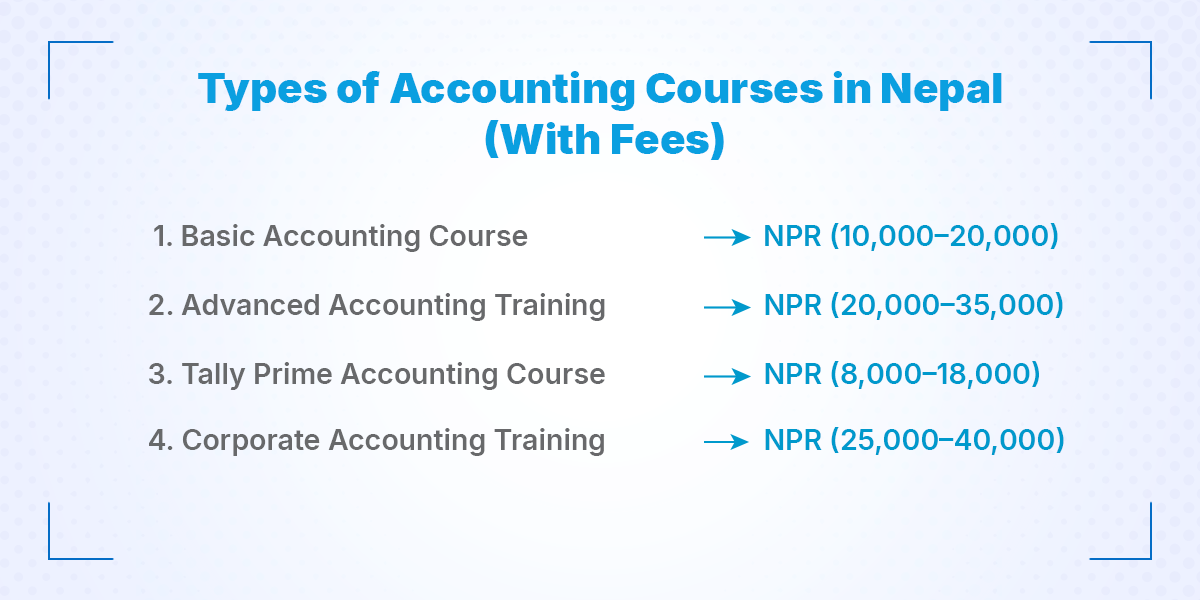
Nepal offers several accounting courses that match different skill levels, career goals, and learning needs. Each category carries a specific fee range shaped by depth of training, software practice, and overall duration. These programs help beginners start from zero while giving working professionals advanced tools for finance-focused roles.
1. Basic Accounting Course
Basic accounting courses usually cost NPR 10,000 to NPR 20,000 and suit beginners who want a simple introduction to financial statements, cash flow tracking, and bookkeeping rules. Students learn entries, ledgers, and reporting formats that companies use for everyday transactions. This foundation helps learners build confidence for junior finance roles or prepare for advanced programs. Many learners also choose a job oriented accounting course to gain practical skills that improve hiring chances.
2. Advanced Accounting Training
Advanced accounting programs generally cost NPR 20,000 to NPR 35,000 and support learners who want job-ready skills for office responsibilities. Training includes Excel reporting, VAT work, income tax procedures, payroll management, and basic auditing steps. Many institutes add hands-on Tally and spreadsheet practice to show how real offices manage monthly data. Kumari Job Advanced Accounting Training belongs in this category and stays fully practical.
3. Tally Prime Accounting Course
Tally Prime courses cost NPR 8,000 to NPR 18,000 and suit learners who want fast software skills for billing, ledgers, vouchers, inventory updates, and tax summaries. This option focuses on direct application, making it ideal for individuals who prefer practical learning over long theory-based sessions.
4. Corporate Accounting Training
Corporate accounting programs cost NPR 25,000 to NPR 40,000 and target professionals managing budgets, statements, taxation, compliance, and financial analysis in larger firms. Sessions include advanced Excel, structured reporting, and real-case studies that help learners improve accuracy and decision-making inside corporate environments.
Factors That Affect Accounting Course Fees
Accounting course prices shift because each program carries a different depth, training style, and support level. Longer courses, advanced modules, and practical sessions usually cost more because learners receive extended guidance, software practice, and detailed instruction. Shorter programs are cheaper since they focus on summaries rather than full workflow training. Delivery mode also changes fees because online classes reduce overhead while physical sessions require classroom space and in-person support.
Trainer experience influences pricing as well. Instructors with strong industry backgrounds add more value through real examples, accurate methods, and structured explanations. Programs that include Tally practice, Excel work, taxation assignments, and actual business cases charge slightly higher fees because those sessions demand preparation, software access, and guided demonstrations.
• Longer duration increases cost due to extended practice and detailed lessons.
• Higher-level programs remain more expensive because those programs cover tax duties, payroll, and audits.
• Online classes cost less since institutes avoid hall expenses.
• Physical classes cost more because learners receive direct interaction.
• Trainers with years of field experience raise course value and price.
• Practical sessions increase fees due to software use and real-case work.
• Theory-focused classes stay cheaper because those classes need fewer resources.
Best Institutes Offering Accounting Courses in Nepal
Several institutes across Kathmandu, Lalitpur, and Bhaktapur offer accounting courses that cover financial reporting, taxation, Excel, and Tally. These centres attract learners who want structured classes, steady support, and practical training that prepares them for real office tasks. Many provide flexible class schedules so students, job seekers, and working individuals can study without affecting their daily routines.
Online learning platforms give learners an alternative option with recorded lessons, live sessions, and downloadable resources. These platforms suit individuals who want flexible timing or lower fees. Learners who follow the lessons consistently can gain strong fundamentals even without attending physical classes.
Kumari Job stands out among Nepali institutes because of its value-focused teaching style. Sessions include full Tally practice, Excel reporting, VAT and income tax work, payroll activities, and real business examples. Their method focuses on practical learning instead of memorising theory, which helps learners understand how offices handle monthly data. Many students choose Kumari Job because the training remains affordable, clear, and job-oriented, increasing confidence for placement.
A good institute maintains organized modules, provides hands-on software practice, and assigns trainers with real industry experience. Strong support, clear explanations, and practical sessions help learners complete tasks accurately when they start working.
Who Should Take an Accounting Course?
Accounting courses support a wide group of learners because every sector depends on clean financial records, tax compliance, and structured reporting. These programs help beginners understand basic entries while giving advanced learners the tools needed for office tasks. Students gain clarity for future studies, job seekers strengthen skills for accounting, professionals upgrade workplace performance, and entrepreneurs improve business control.
Individuals planning a career switch also benefit because accounting provides stable roles, predictable growth, and clear processes. The following sections explain how each group benefits from accounting training.
1. Students
Students use accounting courses to build a strong foundation before choosing higher studies in BBS, BBA, CA, or ACCA. Training helps them understand ledgers, entries, and cash flow, and gives them an idea about how to become an accountant in Nepal. Early exposure also improves analytical thinking and boosts confidence for future internship opportunities.
2. Job Seekers
Job seekers gain practical skills that match office requirements. Training covers everyday responsibilities like billing, reporting, tax filing, and Excel work. These abilities increase employability for junior finance roles in firms, cooperatives, banks, and audit offices.
3. Working Professionals
Working professionals take accounting courses to handle monthly statements, tax tasks, and reporting duties with greater accuracy. Improved software skills and updated tax knowledge help them complete assignments faster and reduce errors at work.
4. Entrepreneurs
Entrepreneurs join accounting courses to manage expenses, track revenue, monitor stock, and understand tax responsibilities within their own ventures. This knowledge reduces dependency on others and improves decision-making that supports business growth.
5. People Switching Careers
Individuals planning a career shift pick accounting because the field offers steady demand across many industries. Clear processes, practical tasks, and predictable growth help career switchers move into finance roles without confusion.
Career Opportunities After Accounting Training
Accounting training opens steady roles across firms, banks, cooperatives, NGOs, and audit offices. Learners gain software skills, tax knowledge, and reporting clarity, allowing them to handle daily financial tasks without confusion.
Each role supports different parts of business operations, giving learners multiple paths to grow and specialize. These opportunities remain stable because every organization depends on accurate numbers and clean records.
1. Accountant
Accountants manage daily financial activity, including vouchers, ledgers, billing, and monthly statements. They prepare reports that help management understand cash flow and overall performance. Their work ensures records stay accurate, up to date, and ready for audits. Strong accounting training helps new accountants complete tasks confidently from the first week.
2. Finance Assistant
Finance assistants support data entry, document checks, and basic financial summaries. They help senior staff maintain a smooth office workflow by organizing files and preparing simple reports. Many firms hire finance assistants as entry-level staff who later grow into accountant roles. Training improves speed, accuracy, and familiarity with common office tools.
3. Tax Officer
Tax officers handle VAT returns, income tax filings, and compliance checks for businesses. They review purchase and sales records, calculate tax amounts, and ensure entries follow Nepali tax rules. Their role holds great value because mistakes can create penalties for firms. Accounting training gives learners a clear understanding of tax steps and reporting cycles.
4. Payroll Assistant
Payroll assistants calculate monthly salaries, allowances, deductions, and attendance-based payments. They update staff records, maintain sheets, and ensure timely salary processing. Their work keeps employees paid correctly and reduces payroll errors. Accounting training strengthens Excel skills and improves comfort with payroll systems.
5. Auditor Support Staff
Support staff in audit teams handle file reviews, cross-check entries, and verify supporting documents during internal or external audits. They help auditors gather evidence, organize reports, and prepare review notes. This role builds strong analytical habits and often leads to senior audit positions over time.
6. Accounting Freelancer
Freelancers offer bookkeeping, billing, tax filing, and monthly reporting services to small businesses that need part-time support. They manage multiple clients, control their schedules, and build income through flexible work. Accounting training gives freelancers the skills needed to produce clean records and dependable reports for each client.
Conclusion
Accounting course fees in Nepal range from NPR 8,000 to NPR 50,000, depending on course level, duration, and training style. Basic programs stay at the lower end, while advanced and corporate courses fall into higher ranges due to deeper content and practical work. These options allow learners to pick training that fits their goals and budget.
Accounting remains a strong career choice because every organisation depends on clear records, accurate tax work, and steady financial reporting. Demand stays consistent across firms, banks, cooperatives, NGOs, and audit offices, giving learners long-term stability and room to grow.
Selecting the right institute matters because strong trainers, clear structure, and hands-on sessions shape real performance at work. Quality training improves confidence, accuracy, and job readiness.
If you want more internship opportunities, check out Kumari Job, where hundreds of verified openings get listed every day. Explore these options to find roles that match your goals and skill level.
Frequently Asked Questions
Submit your comments

Get Our App On



Auditor vs Accountant in Nepal: Duties, Differences, and Career Opportunities
VIEW DETAILS
Best Part-Time Jobs During Dashain in Nepal
VIEW DETAILS
Education Counselor Interview Questions and Answers in Nepal
VIEW DETAILS
Finance Jobs vs. Accounting Jobs in Nepal: Duties, Differences, and Career Opportunities
VIEW DETAILS


Loading Comments...