


Securing a government job in Nepal is a dream for thousands, but the confusion around eligibility, application steps, and Lok Sewa notices often turns that dream into frustration. Many aspirants miss the Kharidar Vacancy simply because they do not understand the process clearly or apply incorrectly, despite having the right qualifications and preparation.
If you are tired of searching scattered information, unclear deadlines, and complex instructions, you are not alone. The Kharidar post remains one of the most competitive yet achievable government positions, especially for candidates seeking job security and long-term growth.
In this guide, we will explain everything, from eligibility and documents to the exact application steps. You will learn how to apply for the Kharidar vacancy in Nepal confidently, correctly, and on time.
In this blog
Who is a Kharidar in Nepal?
A Kharidar is an entry level non gazetted officer in the civil service system of Nepal. It is a key government post that supports day to day administrative and clerical work across ministries, departments, and local offices. Kharidar positions fall under the Nepal Government Service and are recruited through the Public Service Commission (Lok Sewa Aayog).
A Kharidar works at the operational level of government offices and ensures smooth execution of public services. This role is often considered the first step for candidates aiming to build a long term career in Nepal’s civil service.
Key responsibilities of a Kharidar include:
Handling official files, records, and government documents
Assisting senior officers in administrative tasks
Preparing letters, reports, and notices
Supporting public service delivery at local and central offices
Managing data entry, filing systems, and office coordination
Position and service details:
Post level: Non Gazetted Second Class
Recruiting authority: Public Service Commission of Nepal
Work locations: Ministries, departments, district offices, and local bodies
Career scope: Promotion to Nayab Subba and higher posts through exams and experience
Why Kharidar is an important post:
Acts as the backbone of daily government administration
Offers stable government employment with salary, allowances, and pension benefits
Provides clear career progression within the civil service structure
For many aspirants, the Kharidar post is a respected and secure government job in Nepal, offering both professional growth and long term service to the public.
Eligibility Criteria for Kharidar Vacancy
To successfully apply for a Kharidar Vacancy, you must meet specific eligibility requirements set by the Public Service Commission (Lok Sewa Aayog) of Nepal. These rules ensure that only qualified candidates enter the competitive process while also providing inclusive opportunities for underrepresented groups.
1. Minimum Age Requirements
- You must be 18 years old by the application deadline to qualify.
- The upper age limit is generally 35 years, giving most young adults the chance to compete.
- Age relaxation up to 40 years is provided for female candidates and persons with disabilities.
- Permanent civil servants often face no age limit when applying through internal or promotional examinations.
2. Educational Qualifications
The educational criteria depend on the service group or field you apply for within the Kharidar Vacancy:
- General Administration and Law/Justice groups: Passed SLC/SEE or equivalent from a recognized institution.
- Accounts and related administrative functions: Passed SLC/SEE with Mathematics, Accounting, or a related elective.
- For candidates studying under the grading system, a minimum GPA of 2.0 at the SEE/SLC level is typically accepted as meeting the requirement.
3. Internal Promotion and Service Experience
If you are a current government employee, additional eligibility paths open up:
- Employees in Non-Gazetted Third Class or uncategorized posts can compete through internal competitive exams.
- A minimum service period (for example, three years in relevant posts) is often required.
- Special relaxations in the service period apply to women, Dalit, indigenous groups, Madhesi communities, persons with disabilities, and those from backward areas.
4 Other Key Conditions
- You must not be disqualified under Nepali civil service laws.
- All qualifications must be verified and documented before or during the application process.
These eligibility benchmarks ensure fair competition and reflect both merit and inclusive policy goals in the Kharidar Vacancy process.
How to Apply for a Kharidar Vacancy in Nepal?
To apply for a Kharidar Vacancy in Nepal, you must use the official Lok Sewa Aayog online portal, complete your registration or login, correctly fill the application form, optionally select inclusive category options, pay the required fee, and submit your application before the deadline. This process ensures your candidacy is accepted and moves you into the competitive exam stages.
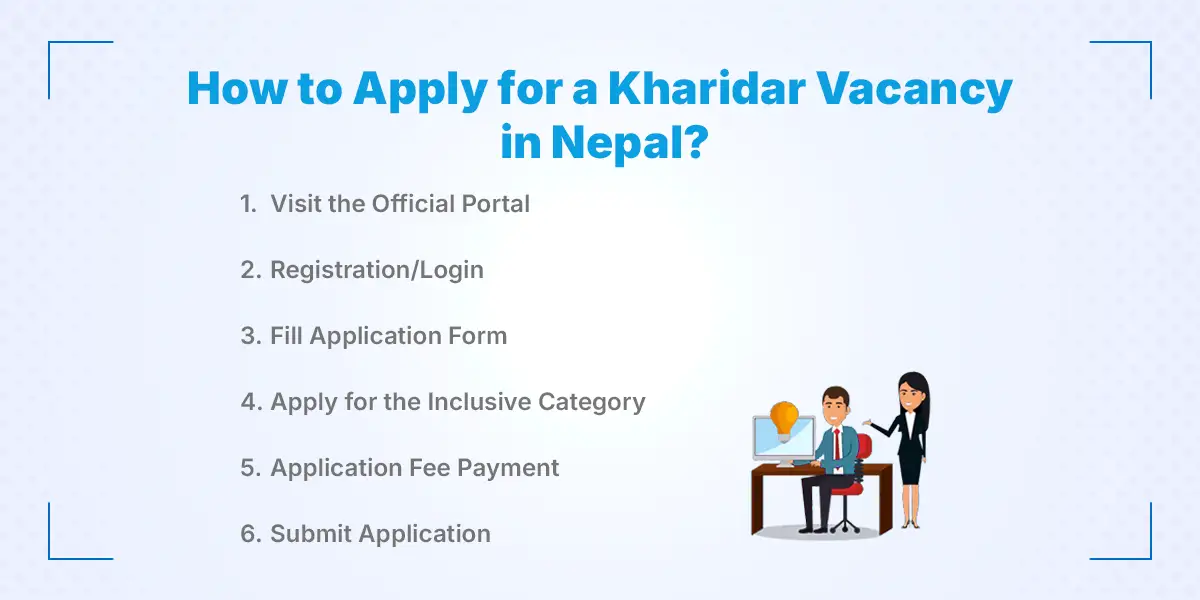
1. Visit the Official Portal
Start by going to the Public Service Commission’s online application system at the official website (e.g., psconline.psc.gov.np). This portal is where all Kharidar Vacancy applications are submitted electronically. Ensure you are using the government’s authentic link and that the site is secure before entering your details.
2. Registration/Login
If you are a new user, create an account by registering with your personal information and a valid email. After registration, you will receive login credentials. If you already have an account, simply log in. This login will take you to your dashboard, where you can begin the application. Always use accurate personal data, since mismatches can lead to application rejection.
3. Fill Application Form
Once logged in, find the vacancy for the Kharidar position and fill out the electronic form. Enter your educational details, contact information, preferred exam centers, and other required data carefully. Upload scanned copies of required documents, such as your citizenship certificate and academic certificates, as per the specified file formats.
4. Apply for the Inclusive Category
If you are eligible under inclusive groups (like women, persons with disabilities, or ethnic/indigenous categories), select the inclusive category during the form filling. Make sure you have supporting documents for that category ready in the required format before uploading. Eligibility and documentation impact your placement in the inclusive quota.
5. Application Fee Payment
After completing the form, you must pay the application fee. The standard fee is typically NPR 500 for each vacancy advertisement, and additional charges may apply for extra group selections. You can pay online through the portal or by using the bank voucher method, where you print a voucher and pay the fee at a designated bank.
6. Submit Application
Once you have filled out the form and paid the fee, review all entries for accuracy and then submit the application. After submission, you will receive a confirmation on the portal or via email. Keep this confirmation safe as proof of your application submission. Ensure you complete this before the application deadline to avoid late penalties or rejection.
Required Documents for Kharidar Vacancy Application
When applying for a Loksewa Vacancy in Nepal, preparing and uploading the right documents is crucial to avoid rejection of your application. Lok Sewa Aayog requires scanned copies of these documents in specific formats during the online submission process, and you must also carry originals for verification if you qualify for the next stages of the selection process.
Here are the key documents you need for the Kharidar Vacancy application:
- Educational Qualification Certificates: You must upload certified copies of your academic certificates showing your minimum qualification, such as SLC/SEE or equivalent. This proves you meet the required educational standards for the Kharidar Vacancy.
- Citizenship Certificate: Scan and upload the front side of your Nepali citizenship certificate in the format specified (often JPEG for the citizenship image). This is essential to confirm your nationality and eligibility.
- Training and Experience Certificates: Suppose the advertisement requires or benefits from training or relevant experience. Upload certificates showing your training or work history. This can be especially helpful if experience adds weight to your application.
- Inclusive Group Proof (If Applicable): Candidates applying under inclusive categories (such as Indigenous/Janajati, Madhesi, Dalit, persons with disabilities, backward areas) must upload official documents proving their eligibility for that group. These may include certificates from local authorities, government publications, disability ID cards, or other recognized verifications.
- Equivalence Certificate (For Foreign or Grading System Degrees): If your qualification is from a foreign institution or under a grading system, you might need an equivalence determination certificate from the relevant Nepali authority to prove your education level meets the vacancy’s requirements.
Kharidar Vacancy Exam Pattern and Syllabus
When preparing for the Kharidar Vacancy in Nepal, knowing the exam pattern and syllabus is key to doing well and managing your study time wisely. The Public Service Commission (Lok Sewa Aayog) updates the syllabus and structure from time to time, but the most recent patterns include multiple stages with clear subject areas. Understanding how many papers there are, what topics are covered, and how marks are assigned helps candidates focus their preparation in the right direction. Here’s a simple and clear breakdown.
1. Written Exam Structure
The Kharidar written exam usually has multiple parts or papers. The first stage is a preliminary written test, which is qualifying in nature and has a set number of marks. After passing this, you move on to the main written exams, which often include separate papers like Office Management and Job Knowledge-related topics. Each paper tests different skills such as general knowledge, administrative basics, and practical office concepts. Passing each paper with the required marks is essential to moving forward in the selection process.
2. First Paper (Preliminary)
The first paper often acts like a screening test. It can be about general awareness, basic administrative concepts, current affairs, and simple reasoning questions. You need to score a minimum number of marks to qualify for the next phase. Even if this paper’s marks are not added to the final total, clearing it is compulsory. This helps shortlist candidates for the main papers.
3. Second Paper (Office Management)
The second paper usually focuses on office and administrative management topics. This includes basic office procedures, file handling, record keeping, office communication, and simple management concepts. Questions are designed to understand whether candidates can handle everyday office tasks and procedures effectively.
4. Third Paper (Job Knowledge)
The third paper tests specific job-related knowledge aligned with the Kharidar role. It may include questions on Nepal’s civil service system, administrative laws, revenue procedures, or general office duties. This paper checks how well you understand the technical aspects of the post.
After written exams, there may also be computer skill tests and interviews as part of the final selection process.
Selection Process for Kharidar Vacancy
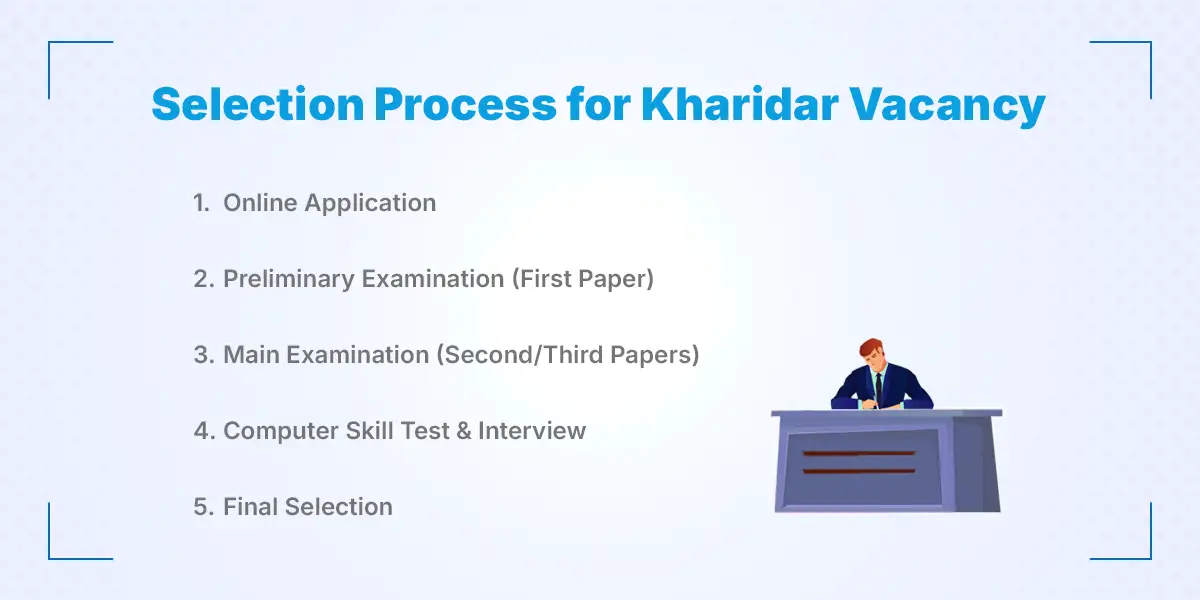
The selection process for the Kharidar Vacancy is designed to choose candidates fairly through clear and step-by-step stages. Each stage checks a different skill, starting from basic knowledge to practical ability. If you understand this process early, you can prepare in the right way without confusion. Below is a simple explanation of each stage so you know exactly what to expect.
1. Online Application
The selection process starts with the online application through the Lok Sewa Aayog portal. Candidates must fill in personal, academic, and category details carefully. Required documents are uploaded in the given format. After filling out the form, the application fee must be paid. Only candidates who submit the form correctly are allowed to sit for the exam.
2. Preliminary Examination (First Paper)
The preliminary exam is the first written test. It checks basic knowledge like general awareness, simple reasoning, and office-related topics. This exam works as a filtering stage. You must score the minimum required marks to pass. If you fail here, you cannot move to the next stage.
3. Main Examination (Second and Third Papers)
Candidates who pass the first paper appear in the main examination. This usually includes the second and third papers. These papers focus on office management and job-related knowledge. The marks from these exams are very important for the final selection. Strong preparation is needed to score well.
4. Computer Skill Test & Interview
After clearing written exams, candidates may face a computer skills test. This checks basic computer use needed for office work. Then comes the interview, where communication skills and confidence are tested. Interview marks also count in the final result.
5. Final Selection
The final selection is done based on total marks from all required stages. A merit list is published by Lok Sewa Aayog. Candidates with higher marks are selected first. Selected candidates receive appointment letters for the Kharidar post.
Kharidar Salary, Grade, and Benefits in Nepal
The Kharidar Vacancy is an entry-level civil service job with a stable salary and several long-term perks. Salaries are set by the Nepal Government and adjusted through annual budgets, with pay increasing over time based on grade increments and promotions. Benefits include allowances for living costs, transport, and festivals, making the total income higher than just the basic pay. Understanding these pay components helps aspirants see the real value of a Kharidar role beyond the base number.
1. Salary and Grade Structure
When you join as a Kharidar, you usually start at Grade 7 with a basic monthly salary of around NPR 32,902. Each year you stay in service and gain experience, your grade rises (for example, to Grade 6, 5, and so on), and your basic pay increases accordingly. Higher grades mean more responsibility and better pay. For grade 1, the salary of Kharidar is NRS 43,932. This gradual climb makes long-term career growth financially rewarding for loyal civil servants.
2. Total Pay With Allowances
In addition to basic pay, Kharidars receive several monthly or periodic allowances. These can include a cost-of-living allowance (Mahangi Bhatta), which helps manage rising expenses, and a transport allowance to cover commuting costs. A festival allowance or Dashain bonus is also provided, usually equal to about one month’s basic pay. With allowances added, the total monthly pay can be significantly higher than the basic salary alone.
3. Other Benefits
Kharidars enjoy additional government benefits like health and accident insurance, a provident fund contribution that boosts long term savings, and sometimes housing support depending on the posting. After many years of service, these benefits help with financial security. Over time, promotions to higher posts like Nayab Subba mean even better pay and allowances.
Overall, working as a Kharidar offers steady income, periodic pay increases, and job-related benefits that support both daily needs and future security.
Why Choose Kharidar Vacancy as a Government Career?
Choosing a Kharidar Vacancy as a government career is a smart decision as it offers job security, stability, respect, and long-term growth. For many job seekers in Nepal, private jobs often come with pressure, low security, and unclear future paths. The Kharidar post offers a balanced work life with fixed working hours and a steady income. It is also one of the most practical entry points into Nepal’s civil service for fresh candidates.
One major reason to choose Kharidar Vacancy is job security. Once selected, the risk of sudden job loss is very low compared to private sector jobs. You also get regular salary, grade increase, and government-backed benefits that continue throughout your service life.
Key reasons to choose Kharidar Vacancy:
- Stable monthly salary with yearly grade increment
- Permanent government job with pension and provident fund
- Work-life balance with fixed office hours and public holidays
- Social respect and recognition in society
- Clear promotion path to posts like Nayab Subba and higher levels
- Nation service opportunity through public administration
Another strong benefit is career growth. Starting as a Kharidar allows you to appear in internal exams and promotions over time. With experience and preparation, you can move into higher administrative roles without leaving government service.
Overall, the Kharidar Vacancy is ideal for candidates who value security, growth, and a respected career. It may start at an entry level, but it opens doors to a stable future and long-term success in Nepal’s government sector.
Conclusion
Applying for a Kharidar vacancy in Nepal becomes much easier when you clearly understand the process, eligibility, exams, and selection steps. This post answers the real question most aspirants have: how to apply correctly without missing requirements or deadlines. With proper preparation, the right documents, and a clear exam plan, the Kharidar post is not just achievable but realistic for dedicated candidates. It offers stable government jobs and a career with steady income, growth opportunities, and long-term security.
Instead of feeling overwhelmed by notices and rules, candidates who follow a structured approach can apply with confidence. If you are serious about building a secure career, the Kharidar Vacancy can be your first strong step into Nepal’s civil service system.
Want to stay career ready and never miss important job updates? Get started with Kumari Job to explore verified job opportunities and practical trainings that help you build a stronger career.
Frequently Asked Questions
Submit your comments

Get Our App On



SEO Training for Freshers in Nepal: Skills, Career & Job Opportunities
VIEW DETAILS
SEO Training vs. Self-Learning: Which Is Right for You?
VIEW DETAILS
How to Choose Between Two Job Offers
VIEW DETAILS
Digital Marketing Training Interview Questions and Answers for Freshers
VIEW DETAILS


Loading Comments...