



Working as a government employee in Nepal is a dream for many, and the Kharidar position is often the first big step toward that goal. If you’ve ever wondered what makes this role so attractive, it’s not just the stability. It’s the pay, benefits, and career growth opportunities. In 2026, the salary of a Kharidar in Nepal shows both the structured pay grade of the government and the valuable role these workers play in the public sector. From competitive monthly pay to high-performing allowances and a clear path towards promotion, the work offers long-term security.
Whether you are preparing for the Lok Sewa Aayog exam or simply interested in working for the government, this blog will give you a complete breakdown of Kharidar salary in Nepal, how they get paid, and what sort of benefits are included.
In this blog
Overview of the Kharidar Position in Nepal
A Kharidar is a government servant of the non-gazetted second class. They are engaged in office records, preparation of papers, and various day-to-day administrative tasks. They may write letters, keep files, or answer questions from the public. They are usually the first contact point for visitors in most offices. They also keep official documents safely and send information to superior authorities. At times, they are also sent to the field for work. Briefly, they make sure the office runs smoothly day-to-day.
Kharidars are an important part of the government machinery. They make the records systematic, thereby helping the quicker decision-making process of the senior officials. They work through many letters, reports, and papers. Since they often come in direct contact with people, they create the initial impression of the office. Even though their work remains mostly behind the scenes, they keep the entire system running. Without them, most of the government services would come to a standstill.
To become a Kharidar, you should have a minimum SLC/SEE education. You should also meet the age limit as set by the government. The recruitment is done through Lok Sewa Aayog examinations. You submit the form first. After that, you take a written test, and at times, an interview or a practical exam as well. Many candidates apply, so it's intense competition. Passing the exam results in a safe career in the government.
Kharidar Salary in Nepal - 2026 Pay Scale
The starting basic salary of a Kharidar in Nepal as of 2026 is NPR 32,902. This is the monthly salary before any allowance or bonus is added. For most new Kharidars, this is the salary they earn every month as basic salary. Over time and with yearly increments and promotions, this salary increases. The government also updates pay scales from time to time, which can give rise to salary increases for all government workers.
1. Current Monthly Basic Pay for Kharidar
A Kharidar’s pay is set according to their grade and level of experience. Most new Kharidars start in Grade 7 or equivalent, earning about NPR 32,902 basic salary monthly. This amount is guaranteed and does not include extra payments like allowances. Every year, Kharidars receive small increments that increase their basic salary. These increments reward their continued service and experience. These small differences over the course of several years translate to a significant amount of difference in take-home pay.
2. Grade-Wise Kharidar Salary Structure
Most new Kharidars start at Grade 7 with a basic salary of about NPR 32,902 per month. As they gain experience and get promoted, they move up to higher grades. Each grade comes with a higher basic salary than the one below it. These figures do not include allowances like dearness allowance, transport, or festival bonuses. With allowances, total monthly pay can be significantly higher.
Here is a brief overview of kharidar from grade-wise:
| Grade | Approx. Basic Monthly Salary (NPR) |
|---|---|
| Grade 7 | 32,902 |
| Grade 6 | 34,622 |
| Grade 5 | 36,386 |
| Grade 4 | 38,197 |
| Grade 3 | 40,057 |
| Grade 2 | 41,968 |
| Grade 1 | 43,932 |
3. Pay Differences for Entry-Level and Experienced Kharidar
Freshly recruited Kharidars receive the starting basic salary. But with experience and after some years of service, their salary is raised. Promotions to the higher grades help them earn greater rises in salary. Senior Kharidars who have 10 or more years of experience are able to receive a significantly higher salary in comparison to newly appointed ones. Besides basic salary, senior officials also enjoy higher allowances and benefits. This makes government service a viable option for long-term career growth.
4. Total Salary with Allowances
In addition to the basic salary, Kharidars also receive various allowances. These may vary from dearness allowance, transport allowance, festival allowances like Dashain, to other benefits. When you add these allowances to the basic salary, the total monthly salary of a Kharidar is around NPR 49,589. Such additional payments are to cover day-to-day expenses and increase the overall salary package.
Allowances and Benefits for Kharidar Employees
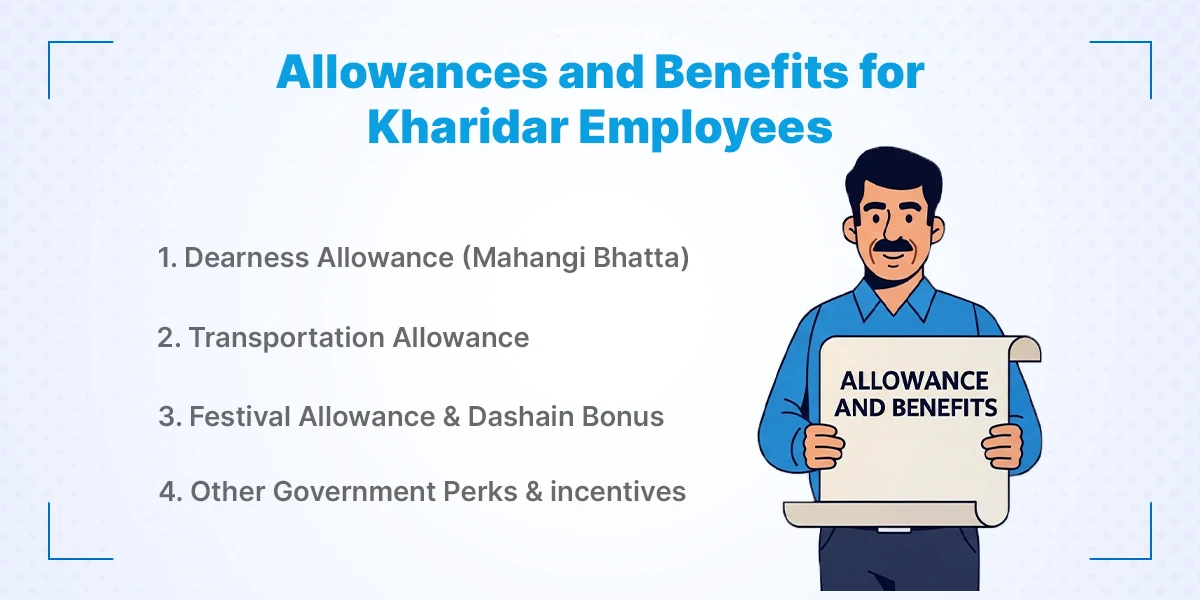
Apart from the basic pay, Kharidars are given other payments in the form of allowances. They help with day-to-day expenses like traveling and living costs. Allowances are a major part of the total salary and make government jobs more attractive. Kharidars in Nepal even receive special festival bonuses during festivals like Dashain. Apart from cash, the government provides other benefits like medical benefits and a pension. Let us discuss these allowances and benefits one by one so that you have a good understanding of how much a Kharidar gets over and above the basic pay.
1. Dearness Allowance (Mahangi Bhatta)
The government has increased the monthly dearness allowance for all civil servants to NPR 5,000, effective mid-July 2025. The allowance is provided to help the employees manage the high cost of living. It's a fixed rate over the basic pay and not performance- or grade-based.
2. Transportation Allowance
Kharidar personnel receive a transport allowance for travel. The exact amount varies are based on the place of posting and the grade of the employee. Those posted in remote or rural centers may receive additional allowances to compensate for the higher travel expenses.
3. Festival Allowance & Dashain Bonus
The government officials are given a festival allowance, commonly referred to as the Dashain bonus. It is a mandatory payment of one month's basic salary. The employees who have worked for less than one year are given an amount according to the months worked. For example, if an employee has worked 6 months, they are given half of the annual allowance.
4. Other Government Perks & Incentives
Besides the above allowances, Kharidar staff are blessed with some other benefits:
- Housing Allowance: The staff are provided with a specified percentage of their basic salary as housing allowance, which varies based on their grade and posting.
- Medical Benefits: Civil servants and their families are eligible for medical reimbursements or subsidized treatment at government-approved facilities.
- Pension and Gratuity: The workers, upon retirement, receive a pension and gratuity, which is calculated based on their final salary and years of service. However, the pension system was removed in the year 2082/83.
- Annual Clothing Allowance: The workers receive an annual clothing allowance of NPR 10,000.
Additional Income Opportunities for Kharidar
Apart from the minimum salary of Nepal and standard allowances, Nepalese Kharidars earn much more cash from other benefits. These increase their net income and pay them for extra work. Some of the most frequent ones include overtime pay, field allowance, and seminar or training allowance. Let's discuss each one briefly.
1. Overtime Pay
There may be situations when Kharidars have to work beyond their regular office timings. In this situation, they are given extra pay that is called overtime. This is when you get more money per extra hour worked. Overtime is not available in all departments, but most of them provide overtime during busy seasons or on projects. The government controls how much overtime is paid per hour. It can help you make more money if there is some work buildup. Overtime is a great way to increase your monthly pay without changing your base salary.
2. Field Allowances
Kharidars can be sent to work outside of the normal office, for example, traveling to remote places or government project sites. They are paid a field allowance when they do so. It provides funds for traveling, eating, and other expenses while working away from the home office. It is different according to distance and fieldwork duration. Field allowances are important because it may be difficult and costly to work in the field. It is a helpful allowance besides the minimum salary.
3. Training & Seminar Allowances
Government officials, e.g., Kharidars, also undertake training courses or seminars periodically to upgrade their skills. When this is done, an allowance is provided to cover traveling, food, and other costs. The allowance encourages learning and reimbursement of expenses made during training. It also motivates workers to gain new knowledge and work effectively. The rate varies with the location of the training and duration. Training allowances are an excellent way of earning some money while upgrading your skills.
Kharidar Salary in Nepal vs. Other Government Posts
Understanding the salary structure across various government positions in Nepal helps in career planning and setting expectations. While the Kharidar role is an entry-level position, it offers a clear path for advancement through promotions. The following table provides a comparative overview of the basic monthly salaries for Kharidar and other government roles:
Government Position Salary Comparison
| Position | Grade | Basic Monthly Salary (NPR) | Total Monthly Salary with Allowances (Approx.) |
|---|---|---|---|
| Kharidar | 10 | 32,902 | 48,872 |
| Nayab Subba | 10 | 34,730 | 51,310 |
| Section Officer | 6 | 45,103 | 59,121 |
| Undersecretary | 6 | 52,279 | 67,737 |
| Joint Secretary | 5 | 60,950 | 76,110 |
| Secretary | 2 | 72,082 | 81,888 |
| Chief Secretary | 2 | 77,211 | 87,359 |
Career Growth and Promotions for Kharidar
Starting as a Kharidar is the start of a government career. Many people choose this career because it provides the chance to gain advancement and earn higher pay over time. The typical career move is Kharidar to Nayab Subba, and then to Section Officer. Each level of promotion comes with extra duties and an increased salary.
As you are promoted, your basic pay increases. For example, a Kharidar gets a basic pay of NPR 33,000. Then, after being a Nayab Subba, it is increased to approximately NPR 35,000 or even higher. And then, as a Section Officer, even the basic pay increases from as low as approximately NPR 45,000. Apart from the basic pay, the allowance even increases with each promotion, and therefore, your net pay also gets better quite a bit.
To be promoted, you have to pass certain tests. The government conducts these tests through the Lok Sewa Aayog (Public Service Commission). The exams examine your knowledge and skills for the next job rank. You are also required to have experience. Generally, you have to work for a few years before you can try to get promoted. For example, after 3 to 5 years of serving as a Kharidar, you are eligible to take the Nayab Subba test.
Therefore, a career as a Kharidar is not just a secure job. It offers scopes to learn, grow, and earn more over time. If you work hard and study well, you can gain higher posts in the government and improve your life over time.
Conclusion
Being a Kharidar is a great platform to start a secure career in the Nepalese government. It is not only a job, it is a career where you get a chance to learn, learn new things, develop skills, and build your future step by step. With hard work and sincerity, there are sure chances to rise to higher ranks with greater responsibility and remuneration. Along the way, you gain a number of benefits that help you in your day-to-day life as well as on festive occasions. Besides that, other aspects like overtime and training allowances add to the job satisfaction. If you're looking to have a long-term career with the government, working as a Kharidar can open many avenues for you. It offers security, consistent promotion, and the possibility to serve the people. Thus, focus on working hard and making the most of every chance that comes along.
Looking for reliable government jobs in Nepal? Explore the latest openings and take the first step toward a secure and rewarding career today!
Frequently Asked Questions
Submit your comments

Get Our App On



SEO Training for Freshers in Nepal: Skills, Career & Job Opportunities
VIEW DETAILS
SEO Training vs. Self-Learning: Which Is Right for You?
VIEW DETAILS
How to Choose Between Two Job Offers
VIEW DETAILS
Digital Marketing Training Interview Questions and Answers for Freshers
VIEW DETAILS


Loading Comments...