


If you've searched for "Sokiya Sachiv salary in Nepal," you've probably landed on outdated or vague answers. That's because this isn't a static government job with a fixed pay slip published somewhere; it's a politically appointed role that was actually abolished in September 2025 and reinstated in July 2026, and it's currently the subject of a Supreme Court case over how it's paid.
This guide walks through what the role actually is, how its pay works, what benefits come with it, who's eligible, and why the job's status has been so unstable over the past year, all grounded in the governing law and recent reporting, not guesswork.
In this blog
What Is a Sokiya Sachiv (Personal Secretary) in Nepal's Federal Parliament?
Sokiya Sachiv more accurately transliterated as Swakiya Sachiv (स्वकीय सचिव) literally means "personal secretary." In Nepal's Federal Parliament, it refers to a personal aide appointed to serve a Member of Parliament (MP) or a parliamentary officeholder, such as the Speaker, Deputy Speaker, the Chair or Vice-Chair of the National Assembly, or the chairs of parliamentary committees.
Unlike Nepal's permanent civil service positions, which are filled through open, competitive exams administered by the Public Service Commission (Lok Sewa Aayog), a Sokiya Sachiv is chosen directly by the officeholder they'll work for. The position exists to give that officeholder day-to-day administrative support, and it's formalized through the Federal Parliament Secretariat rather than through any independent recruitment process.
Because appointment is discretionary rather than merit-tested, a Sokiya Sachiv's job security, pay, and even legitimacy have been more politically contested than almost any other paid government-adjacent role in Nepal, which is exactly what's driven so much news coverage of the position over the last year.
Sokiya Sachiv Salary in Nepal
Here's the part most articles get wrong: there is no single, universal "Sokiya Sachiv salary." Pay is set as parity with existing Nepal government civil-service officer grades, not as its own independent pay scale, and the level of parity depends on whose secretary you are.
What the law says. The role's remuneration and benefits are governed by the Federal Parliament Officeholders and Members' Remuneration and Facilities Act, 2073 (2016), specifically Schedule 2 of that Act. Under Section 25 of the Act, the Government of Nepal has authority to amend that schedule at any time through a notice published in the Nepal Gazette, which is exactly the mechanism used both to cut the facility in 2025 and restore it in 2026. In practical terms, this means the "official" pay figure for a Sokiya Sachiv isn't fixed in one place; it's whatever the currently gazetted version of Schedule 2 says.
Grade parity, not a flat number. Reporting on the role shows the pay isn't uniform across all Sokiya Sachiv appointments:
- The chairs of Parliament's 14 thematic committees are entitled to a Sokiya Sachiv at Under Secretary (उपसचिव) level pay and benefits.
- Some senior officeholders' secretaries have received even higher parity; for example, reporting on the National Assembly Chair's personal secretary described Joint Secretary (सहसचिव)-level service and facilities, including a government vehicle and driver.
- More broadly, Sokiya Sachiv appointees are typically treated on par with Nepal government Gazetted Officer (अधिकृत)-level staff, whose combined monthly salary and allowances currently sit in the rough range of Rs 60,000, though this is a general civil-service benchmark, not a confirmed Sokiya Sachiv-specific figure, and it moves with each government pay revision.
Why you should treat any specific rupee number with caution. Because the schedule is amended by gazette notice rather than published as a stable public pay chart, any number you see quoted online (including in this guide) should be treated as a snapshot tied to a date, not a permanent figure. For the current authoritative number, check the latest Nepal Gazette notice amending Schedule 2 of the 2073 Act, or contact the Federal Parliament Secretariat directly.
Recent timeline that changed everything:
- 5 Asoj 2082 (around mid-September 2025): The interim government led by Sushila Karki abolished the Sokiya Sachiv facility for MPs entirely, through a Cabinet decision amending Schedule 2. The stated reasoning was cutting unproductive government expenditure and promoting fiscal discipline.
- Mid-Shrawan 2083 (around July 2026): The Cabinet reversed that decision, restoring MPs' ability to appoint a Sokiya Sachiv, following sustained pressure and repeated demands from sitting MPs. The reversal was formalized through a fresh Nepal Gazette notice.
For a role that's supposed to represent a stable line item in the national budget, that's an unusually turbulent two years and it's the single most important context for understanding the "salary" question today.
What Allowances and Other Benefits Does a Sokiya Sachiv Receive?
Beyond base pay parity, reporting points to several additional benefits, though again these vary significantly depending on which officeholder the secretary serves:
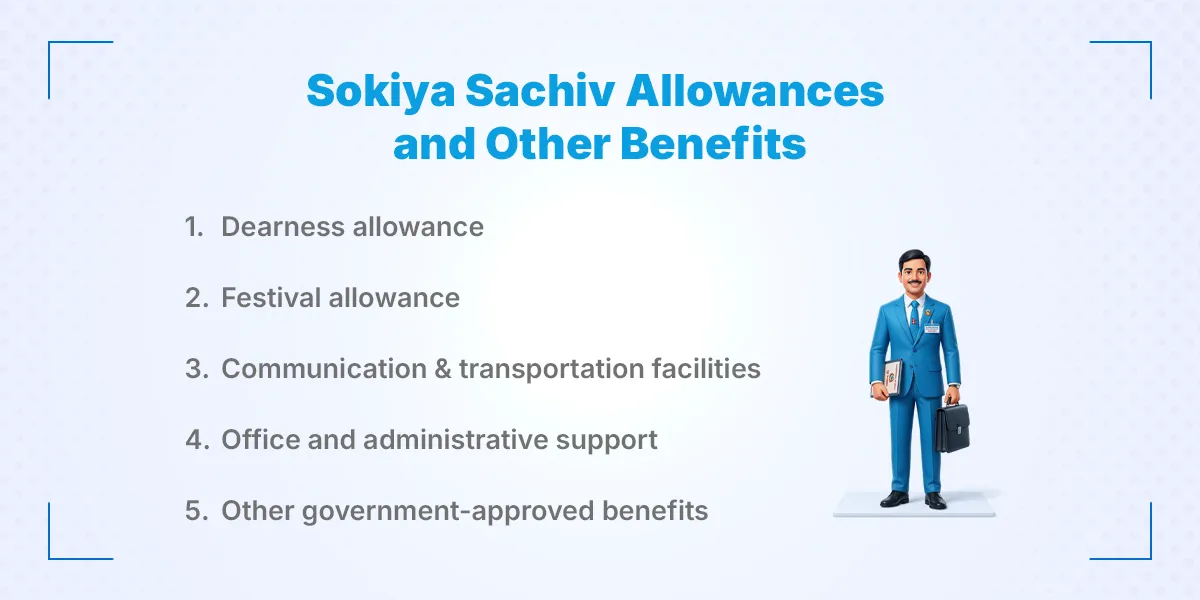
- Dearness allowance and festival allowance (दशैं भत्ता): Since Sokiya Sachiv appointees are treated on par with officer-level civil servants, they're generally covered by the same categories of allowances applied to that pay grade, including dearness allowance and the annual festival allowance.
- Communication and transportation: Some senior appointments come with a government vehicle and an assigned driver this has been documented for at least one National Assembly officeholder's secretary but this is not standard across all Sokiya Sachiv positions.
- Office and administrative support: As a Parliament Secretariat linked position, a Sokiya Sachiv typically has access to office space, equipment, and administrative resources similar to permanent secretariat staff.
- Monthly budget allowance parity: Some Sokiya Sachiv appointees have reportedly received the same one-month budget allowance given to permanent Parliament Secretariat staff.
The key takeaway: benefits scale with the seniority and discretion of the officeholder being served. A committee chair's secretary and the National Assembly Chair's secretary are not receiving the same package, even though both carry the "Sokiya Sachiv" title.
What Does a Sokiya Sachiv Do?
Day-to-day, the role is built around keeping an officeholder's office running smoothly:
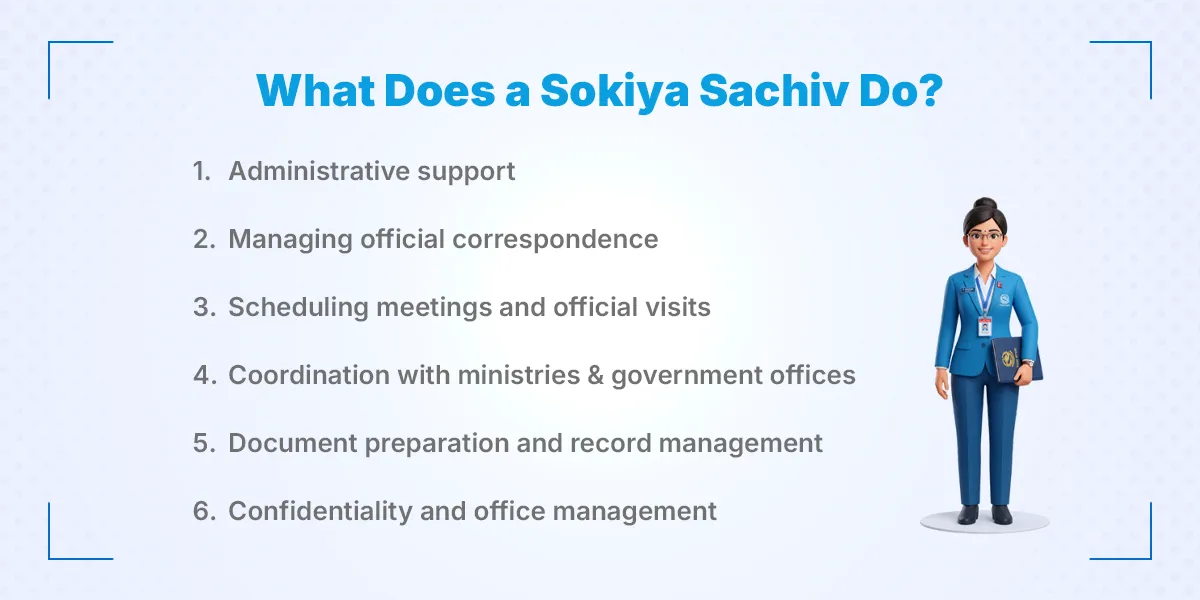
- Administrative support: handling the officeholder's daily workflow and priorities
- Managing official correspondence: letters, requests, and communications on the officeholder's behalf
- Scheduling meetings and official visits: coordinating calendars and appointments
- Coordination with ministries and government offices: acting as a liaison point for the officeholder
- Document preparation and record management: drafting notes, maintaining files, preparing briefings
- Confidentiality and office management: since the role sits close to sensitive political and legislative matters, discretion is central to the job
Eligibility Criteria
This is where the role's biggest controversy lives. In theory, a position paid at officer, Under Secretary, or even Joint Secretary parity should require the educational qualifications Nepal's civil service normally demands at those grades. In practice, that hasn't always held up.
- Educational qualification: Investigative reporting including coverage by Onlinekhabar found that several sitting MPs' Sokiya Sachiv appointees did not hold the qualifications typically required for the officer-level pay grade they were receiving, with some appointees reportedly holding qualifications well below that standard. This mismatch is central to a pending Supreme Court case (covered below).
- Required skills: Strong communication, coordination ability, and discretion are consistently cited as practical requirements, even where formal qualification requirements haven't been consistently enforced.
- Experience: There's no standardized experience requirement because appointment is discretionary rather than exam-based, officeholders can select whoever they choose, subject to whatever qualification floor is (or isn't) enforced.
- Age and citizenship: General public-service norms around Nepali citizenship apply; there's no evidence of a Sokiya Sachiv-specific age bracket publicly documented — this should be confirmed against any current Parliament Secretariat circular before being stated as fixed.
How Is a Sokiya Sachiv Appointed?
- Appointment process: The MP or officeholder personally selects their Sokiya Sachiv. There's no open advertisement or competitive exam the choice is formalized through the Federal Parliament Secretariat once the officeholder makes their selection.
- Required documents: Typically includes citizenship documentation and educational certificates, submitted as part of formalizing the appointment with the Secretariat.
- Selection procedure: Entirely discretionary the officeholder chooses; there is no Lok Sewa Aayog exam or independent merit review involved.
- Employment duration: Tied directly to the appointing officeholder's term. When an MP's term ends or they lose their seat, their Sokiya Sachiv's position typically ends as well.
Is Sokiya Sachiv a Permanent Government Job?
No. This is one of the most important things to understand about the role, and it's been proven twice over in the last year alone.
- Contract vs. permanent employment: A Sokiya Sachiv is not a permanent, pensionable civil service position. It's a discretionary appointment tied to the term of the officeholder who selected them.
- Job security: The clearest evidence of how unstable this role is: the entire facility was eliminated by Cabinet decision in September 2025, meaning every sitting Sokiya Sachiv lost their position and pay overnight, not because of individual performance, but because of a single policy decision. It was only restored roughly ten months later.
- Renewal process: There's no automatic renewal. A new officeholder can appoint a new Sokiya Sachiv, and there's no guarantee an existing appointee keeps their role even if the officeholder is re-elected.
- Career implications: Because the role isn't part of the permanent civil service track, time spent as a Sokiya Sachiv doesn't automatically count toward civil service seniority or pension eligibility. Anyone considering the role for long-term career security should understand this clearly going in.
Career Growth and Future Opportunities
Despite the lack of job security, the role isn't a dead end for everyone who takes it:
- Skills gained: Close exposure to how Parliament and ministries operate, hands-on experience with government correspondence and coordination, and a level of political networking that's hard to get elsewhere.
- Career progression: Some former Sokiya Sachiv appointees go on to sit the Lok Sewa Aayog exams and enter the permanent civil service, using their parliamentary experience as practical (though not formal) preparation.
- Transition to other roles: The administrative and coordination skills built in this role transfer reasonably well to other government-adjacent, NGO, or private-sector administrative and public-relations positions.
Factors That Affect Sokiya Sachiv Salary
- Government-wide salary revisions: Since pay is pegged to civil-service officer-grade scales, annual government pay revisions (like the 15% increase applied to MPs' own salaries in recent years) can indirectly affect Sokiya Sachiv pay parity too.
- Position level: Whether the secretary serves a committee chair, an ordinary MP, or a senior officeholder like the Speaker or National Assembly Chair makes a direct difference to pay and benefits.
- Additional allowances: Vehicle access, driver assignment, and other perks aren't uniform and depend on the specific office.
- Policy changes: As 2025–2026 has shown, the entire facility can be added or removed by a single Cabinet decision making this, by far, the biggest single factor affecting whether the role pays anything at all in a given year.
Sokiya Sachiv vs. Similar Government Positions
Note: Exact current Section Officer and Nayab Subba salary figures change with each government pay revision. For the latest confirmed numbers, check Nepal's official civil service pay scale rather than relying on any figure published before the most recent budget.
Conclusion
The honest answer to "what does a Sokiya Sachiv earn in Nepal" is: it depends on who they work for, and it's set by whatever the currently gazetted version of Schedule 2 says, not a single published number. What is clear is that pay tracks civil-service officer-grade parity (Under Secretary or higher for senior appointments), benefits vary sharply between offices, and the position is explicitly not a permanent, pensionable government job. The last twelve months abolition in September 2025, reinstatement in July 2026, and an ongoing Supreme Court case over qualification standards make that instability impossible to ignore for anyone considering the role or simply trying to understand it.
If you're exploring government career paths in Nepal, it's worth weighing a discretionary, politically dependent role like this against permanent, exam-based civil service positions with clearer long-term security. Explore the latest verified government vacancies, public-sector career guides, and job opportunities through Kumari Job to compare your options before deciding which path fits you best.
Frequently Asked Questions
Submit your comments

Get Our App On



SEO Training for Freshers in Nepal: Skills, Career & Job Opportunities
VIEW DETAILS
SEO Training vs. Self-Learning: Which Is Right for You?
VIEW DETAILS
How to Choose Between Two Job Offers
VIEW DETAILS
Digital Marketing Training Interview Questions and Answers for Freshers
VIEW DETAILS


Loading Comments...