



Finding a good security guard job in Nepal is not easy. Many guards work long hours, get low pay, and are unsure if they are being paid fairly. This confusion creates stress, especially when salaries differ a lot from one company to another. Everyone wants clear information, but most people only hear random numbers.
This is why understanding the real salary range matters. When you know how much companies pay and what benefits they offer, it becomes easier to choose the right job without guesswork. It also helps you avoid low-paying offers.
In this guide, you will get a complete breakdown of security guard salaries in Nepal, company-wise details, day and night rates, and everything you need to make a better decision.
In this blog
What is the Average Security Guard Salary in Nepal?
The average salary of a security guard in Nepal ranges from NPR 25,000 to NPR 70,000 per month. The salary mainly depends on the company, duty hours, and location. In big cities like Kathmandu, the pay is usually higher because living costs are higher. In smaller towns, the salary is on the lower side, but the workload is often lighter.
Here’s a quick breakdown to make it clear:
- Average monthly salary: Most guards earn between NPR 25,000 and NPR 40,000. Experienced guards or those working in banks, offices, and corporate areas can earn up to NPR 70,000.
- Basic salary vs allowance: The basic salary usually covers around 60 percent of total earnings. The remaining amount comes from food allowance, overtime, uniform allowance, and festival bonus. Some agencies add travel allowance too.
Day and night shifts also affect the earnings. Night duty pays more because it comes with a higher risk and longer hours. Many companies add extra NPR 2,000 to NPR 6,000 per month for night shifts.
Salaries also differ because every agency has its own policy. Some companies give better training, uniforms, and insurance. These companies usually pay more because they follow strict standards. For example, bank and hospital guards get higher pay due to higher responsibility and longer duty hours.
Another reason for the gap is location. A guard in Kathmandu or Pokhara earns more than a guard in small districts because clients in big cities pay higher service charges.
In simple words, if you choose the right company, the right duty post, and have basic training, you can earn more than the average range. This is why knowing the current market rate is important before joining any guard job.
What Factors Affect Security Guard Salary in Nepal?
Security guard salary in Nepal is mainly affected by experience, job location, training, company policy, and the risk level of the duty post. Many guards notice that salaries can be very different even for the same type of job. This happens because companies follow their own rules, and every duty post has a different risk level. Once you understand these factors, it becomes much easier to know your real earning potential.
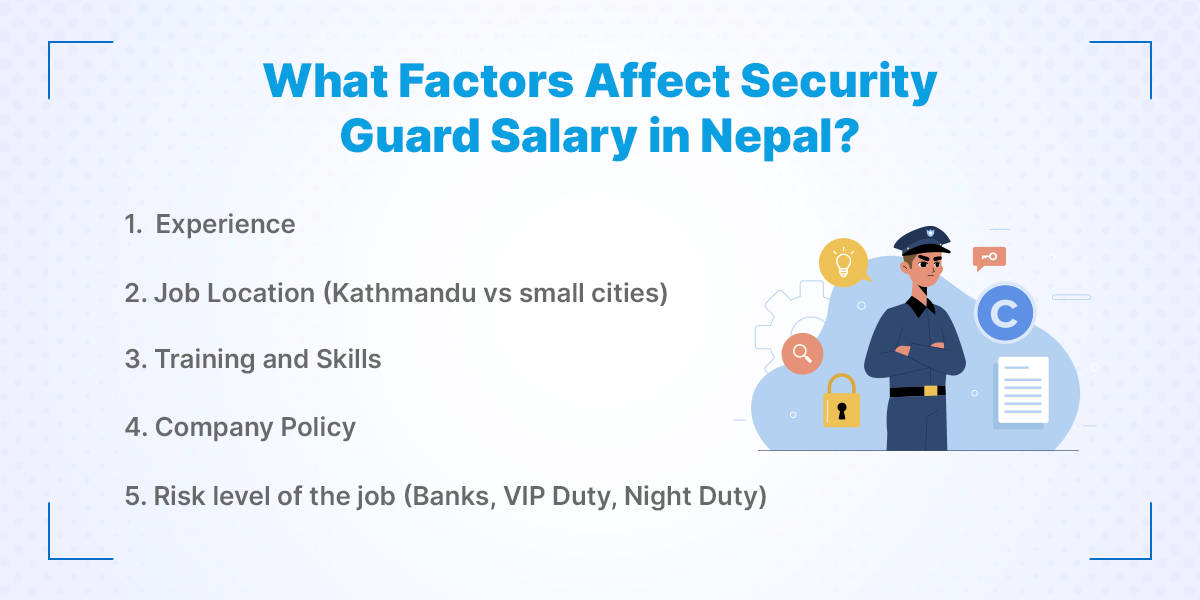
1. Experience
Guards with more experience always earn more. A fresher usually starts with basic pay, while someone with a few years of duty knows discipline, reporting, and emergency handling. Companies trust experienced guards more, so they offer higher salaries and better posts. Experience also shows that the guard can manage daily challenges without constant supervision. With more years, guards may get roles like supervisor or shift-in-charge. These roles come with extra responsibility and better income.
2. Job Location (Kathmandu vs small cities)
Location plays a big role in salary. Guards working in Kathmandu, Pokhara, and major cities earn more because living costs are higher. Companies also charge higher service fees in big cities, so the salary increases with it. In small towns or rural areas, salaries are lower, but duties are often easier and with less pressure. Big cities also have more banks, malls, and corporate offices, which offer better pay. So, where you work decides a big part of your income.
3. Training and Skills
Trained guards always get better pay. Basic training about safety, communication, and emergency steps increases a guard’s value. Some agencies even prefer guards who know fire safety, first aid, and visitor management. These small skills help guards handle problems without panic. Better skills also open doors for high-paying posts, like banks or corporate buildings. Training also builds confidence, which companies notice.
4. Company Policy
Every security company follows a different salary structure. Some provide higher basic pay, while others add more allowance. Companies that follow strict rules, offer insurance, and give proper uniforms usually pay more. They also provide overtime, festival bonus, and leave benefits. Smaller agencies may offer lower pay because they cut costs. So, the company you choose can change your salary a lot.
5. Risk Level of the Job (Banks, VIP Duty, Night Duty)
High-risk posts always pay more. Bank duty needs extra alertness, so the salary is higher than normal office posts. VIP duty also brings more responsibility because guards must stay aware at all times. Night duty usually includes an extra allowance because the risk increases after dark. Some posts, like construction sites or remote areas, also pay more due to safety concerns. The more risk involved, the better the income.
How Much Do Security Guards Earn in Nepal?
The average monthly income of security guards in Nepal mostly falls between NPR 25,000 and NPR 70,000, depending on the company, duty post, and shift type. Most guards earn a fixed basic salary plus extra money from allowances. This makes the total income different for every person. Some earn more because they do night shifts or overtime. Others get extra benefits based on the type of duty they handle.
1. Monthly Income Range
A normal guard earns around NPR 25,000 to NPR 40,000 in most agencies. Bank, office, and hospital guards earn more and can reach up to NPR 70,000 with experience. Freshers start from the lower side, but the salary increases after a few months. Income also changes if the guard works in big cities where companies pay more. So the range can look very different from person to person.
2. Day vs Night Shift
Day duty usually pays the basic rate. It is lighter, less risky, and has more public movement. Night duty pays more because the risk is higher and the duty hours feel longer. Most companies add around NPR 2,000 to NPR 6,000 as night allowance. For some posts, like banks or VIP houses, the night duty rate can be even higher.
3. Bonus, Overtime, Food Allowance
Guards earn extra money through different allowances. Overtime is common, especially in offices and hospitals. Food allowance adds a few thousand rupees, depending on the company. Festival bonus is given once a year, and some companies also provide insurance and uniform support. All these small amounts increase the total monthly income.
How Much Salary Does a Security Guard Get Abroad?
Security guards working abroad in countries like the UAE, Qatar, and Saudi Arabia usually earn between NPR 60,000 and NPR 1,20,000 per month, depending on the company and duty type.
Many Nepali guards are attracted to Gulf countries because of the higher pay and better growth opportunities. For example, a guard earning NPR 30,000 in Nepal could potentially earn double or triple abroad. Big companies often provide extra benefits like free accommodation, meals, and transport, which makes saving money much easier. However, the work environment abroad is stricter. Guards have to follow strict rules, maintain discipline, and handle duties in high-risk areas, especially in banks, malls, or VIP locations.
1. UAE, Qatar, and Saudi Security Salary
In the UAE, a security guard can earn around AED 2,000 to AED 3,500 per month, i.e., NPR 80,000 to NPR 1,40,000 per month, including allowances and overtime. Qatar offers salaries between QAR 1000 to QAR 1300 per month, i.e., NPR 40,000 and NPR 52,000, depending on the company and shift. Saudi Arabia pays slightly higher, ranging from SAR 4000 to SAR 7000 per month, i.e., NPR 80,000 to NPR 2,80,000, especially for night duty or VIP assignments. Night shifts, high-risk posts, and overtime work add an extra allowance. Most companies also provide food and housing, reducing monthly expenses significantly.
2. Training and Requirements
Before going abroad, guards need proper training. Basic security knowledge, fire safety, first aid, and communication skills are usually required. For the UAE, certificates like PSBD or SIRA are often mandatory. Guards also need good physical fitness and basic English to manage instructions and interact with supervisors.
3. Benefits and Risks
Working abroad brings higher income, free food and stay, and potential promotions. But it also comes with long working hours, strict supervision, and limited personal time. Guards may face homesickness and cultural adjustments.
In short, working abroad is financially rewarding, but it demands discipline, readiness for strict rules, and the ability to handle long hours. Knowing these facts helps guards make informed decisions about pursuing opportunities outside Nepal.
How Much is the G4S Security Salary in Nepal?
A G4S security guard in Nepal usually earns around NPR 25,000–40,000 per month, while experienced officers and specialized roles can make up to NPR 70,000. G4S is one of the largest security companies in Nepal. Salary depends on your role, duty hours, and responsibility level.
Allowances and Extras
- Overtime pay is common, especially in offices, banks, and hospitals.
- Night duty usually pays more due to the higher risk.
- Some positions may get small allowances for uniforms or meals.
Day vs Night Shift
Daytime duty generally follows the standard pay. Night shifts add an extra allowance, sometimes a few thousand rupees per month. The exact amount depends on the site and company policy.
Salary by Position
- Guard (Entry-level): NPR 25,000–30,000
- Supervisor / Shift In-Charge: Around NPR 39,000–41,000
- Escort / Security Officer: NPR 67,000–73,000
So, while entry-level guards earn modestly, moving into supervisory or officer roles can nearly triple the income. Over time, night shifts and higher-risk duties increase total monthly earnings.
How Much Is the Garud Security Salary in Nepal?
A Garud Security guard in Nepal usually earns around NPR 25,000–50,000 per month, while corporate or specialized guards can earn more depending on duty type, location, and experience.
Garud Securities is one of the largest and most trusted security companies in Nepal. It operates in all 77 districts and employs more than 5500 security personnel. Every new recruit goes through proper training, which includes basic guard duties, patrolling, emergency handling, communication, and physical fitness. This training ensures that guards are prepared to handle different situations safely and professionally. Guards who perform well during training often get better postings and higher chances of promotions.
The company also has a structured increment system. Guards receive periodic salary increases based on experience, performance, and the type of duty they handle. Longer service and moving into more responsible roles usually result in higher monthly pay. Guards who specialize in corporate or high-risk posts, such as banks, offices, or VIP assignments, are paid more than regular guards because these jobs require extra skills, alertness, and responsibility.
Salary overview:
- Regular guard: Around NPR 20,000–25,000/month
- Corporate or specialized guard: Higher pay depending on responsibility and location
- Night duty: Extra allowance due to higher risk
- Overtime: Paid separately for extra hours worked
- Other benefits: Uniform support, occasional food allowance, and festival bonuses
In addition to salary, working at Garud Security provides stability and opportunities to grow. Experienced guards can move to supervisory roles, get better shifts, and handle corporate or VIP duties, which significantly increases earnings. Overall, Garud Security is considered one of the best companies for guards in Nepal because of its training, structured pay, benefits, and long-term growth opportunities.
Salary Breakdown Based on Job Type
Security guard salaries in Nepal vary a lot depending on the type of job and the responsibilities involved. Some posts require more skills, alertness, and experience, so they pay higher. Others are less risky or routine, so the pay is lower. Knowing the salary range for each job type helps guards choose the right post and plan their career better.

1. Bank Security Guard
Bank guards have one of the more responsible jobs because they handle money and protect customers. The salary usually starts around NPR 25,000 and can go up to NPR 50,000 for experienced guards. Bank duty often includes day and night shifts, and night shifts pay more. Guards need to be alert, follow strict protocols, and manage CCTV and alarm systems. Overtime and festival bonuses can add extra income. Guards with more experience or supervisory roles get higher pay.
2. Office Guard
Office guards earn slightly higher because some offices require corporate-level discipline and skills. Salaries start at NPR 35,000 and can reach NPR 90,000 for senior or specialized posts. They monitor office entrances, check visitors, and sometimes handle security equipment. Some offices also require night duty or shift rotation, which adds extra pay. Experienced guards may supervise others or manage multiple floors. Allowances for food, uniform, or overtime may also be included.
3. Hospital Guard
Hospital guards protect patients, staff, and equipment. The starting pay is around NPR 25,000 and can go up to NPR 50,000 with experience. Hospitals have high foot traffic, so guards need to be alert and polite. Night shifts usually pay more, and overtime is common. They also manage visitor entry, monitor parking areas, and ensure safety protocols. Experienced hospital guards may supervise teams or handle emergency situations.
4. Mall Guard
Mall guards watch over shops, customers, and parking areas. Starting salary is around NPR 20,000, rising to NPR 40,000 for experienced guards. Night shifts or busy seasons usually pay extra. Guards need to handle emergencies like theft or crowd control. Some malls require guards to monitor CCTV systems. Experience and good communication skills often lead to higher pay.
5. VIP / House Guard
VIP or house guards protect individuals, homes, or private properties. Salaries range from NPR 30,000 to NPR 60,000, depending on the risk and experience. Guards need to be highly alert, disciplined, and often work night shifts. They may handle security systems and emergency situations. Personal protection duties require additional skills, which usually increase pay. Experienced VIP guards or supervisors earn even higher salaries.
6. Construction Site Guard
Construction site guards protect materials, equipment, and workers. Starting salary is about NPR 20,000, rising to NPR 35,000 with experience. They need to monitor gates, check the entry of workers, and prevent theft. Night shifts usually pay extra because of the higher risk. Some sites require long shifts or remote locations. Experienced guards may manage multiple sites or supervise other guards.
Additional Benefits Security Guards Receive
Apart from the basic salary, security guards in Nepal often receive several additional benefits that make their job more rewarding. These benefits help cover daily expenses and provide extra support during long working hours. Some allowances are standard across companies, while others depend on the agency and the duty post. Understanding these benefits helps guards choose the right company and plan their finances better.
1. Food Allowance
Many security companies provide a food allowance to help guards cover daily meals. This is especially common for guards working long shifts or night duty. The allowance can be a fixed amount added to the monthly salary or provided as meal vouchers. Guards at corporate offices, banks, or hospitals often receive better food support. Food allowance reduces the personal cost of meals, which is helpful for guards working away from home. Some companies include it automatically, while others provide it based on duty hours or location.
2. Overtime
Overtime is a common benefit in security jobs. Guards who work beyond their normal hours or during holidays receive extra pay. This can significantly increase monthly earnings, especially for guards in busy offices, banks, or hospitals. The overtime rate is usually higher than the normal hourly wage. Night shifts, weekend duties, and emergency situations often qualify for overtime. Some companies require prior approval, while others automatically include extra hours in the monthly pay. Experienced guards who handle more responsibility often get more overtime opportunities.
3. Accommodation
Some security companies provide accommodation for their guards, especially if the post is far from the guard’s home. This is common for large firms or guards working in remote districts. Accommodation can include shared rooms, hostels, or company-provided apartments. Providing housing reduces living expenses and makes it easier for guards to focus on their work. Guards working in banks, malls, or corporate offices may receive better housing arrangements. This benefit is particularly useful for freshers or guards relocating for work.
4. Uniform
Companies usually provide a uniform to maintain professionalism and a proper security appearance. Uniforms include shirts, pants, jackets, shoes, and sometimes caps. Some companies replace worn-out uniforms regularly. Wearing a uniform ensures guards are easily recognized and respected in their post. It also reduces personal spending on work clothing.
5. Insurance
Many companies offer insurance benefits to cover accidents or health issues while on duty. Insurance provides financial protection in case of emergencies. Guards feel more secure knowing they have support during unforeseen events. Larger firms, like G4S or Garud, often provide better coverage compared to small agencies.
6. Festival Bonus
Festival bonuses are extra payments given during major Nepali festivals. This is a small financial reward to help guards celebrate festivals comfortably. The bonus amount varies between companies and may depend on performance or length of service. It is a common benefit in almost all established security agencies.
Common Problems Security Guards Face
Security guards in Nepal face several challenges despite the important work they do. Many guards struggle with low pay, long hours, and limited benefits. Some also miss proper training or opportunities to grow in their careers. Understanding these problems helps new guards make better choices when selecting companies or posts.
1. Low Salary
Many security guards earn just the basic pay, which may not be enough to cover living expenses. Entry-level salaries often start around NPR 20,000–25,000, and only increase slightly without experience or specialized duties. Even with overtime and allowances, some guards find it hard to save money. Banks, corporate offices, or high-risk posts pay more, but these positions are limited. Low salary can also affect motivation and performance. Choosing the right company and post is crucial to improving earnings.
2. Long Duty Hours
Guards often work long shifts, sometimes 8–12 hours a day, with night duties included. This can be tiring, especially for those who work in busy offices, hospitals, or malls. Long hours affect rest, personal time, and overall health. Some guards even work extra hours without proper overtime pay, depending on the company. Night shifts are more stressful due to increased risk and less supervision.
3. No Off-Days
Many guards have limited or no regular off-days, especially in smaller companies or high-demand posts. Continuous work can cause fatigue and reduce alertness on duty. Lack of proper rest can lead to mistakes, which may be risky for security work. Some agencies provide weekly off-days, but it is not standard everywhere.
4. Lack of Training
Not all companies provide adequate training for guards. Some guards start work without learning proper safety, emergency handling, or equipment usage. Lack of training increases stress and makes duties harder. Trained guards can earn more and handle difficult situations effectively. Big companies like Garud or G4S usually provide better training programs.
5. Limited Growth Opportunities
Many guards struggle to move into higher positions or get promotions. Without experience or specialization, most guards remain in entry-level posts. Limited growth opportunities can affect motivation and salary over time. Supervisory or corporate posts are available, but competition is high. Choosing a company that offers clear career paths can help overcome this problem.
How to Become a Security Guard in Nepal?
To become a security guard in Nepal, you need to meet physical requirements, complete proper training, obtain necessary certificates, and choose a reliable security company. Security guarding is an important job that requires alertness, discipline, and responsibility. Many people want to join this field because it offers steady work and the chance to grow in experience. However, not everyone qualifies immediately. There are a few key steps that help you get hired and succeed in this career.
1. Physical Requirements
A security guard should be physically fit. Good stamina, strength, and eyesight are important. Guards often need to stand or patrol for long hours. Basic fitness ensures they can handle emergencies and perform their duties safely. Some companies also have height and weight requirements, especially for corporate or VIP posts.
2. Training Requirements
Training is essential before starting work. Guards learn basic security duties, emergency handling, first aid, and proper reporting. Some companies also teach fire safety and communication skills. Training ensures guards are confident and ready to handle different situations professionally. Completing training can also improve your chances of higher pay and better posts.
3. Certificate & Company Selection
After training, obtaining a certificate is often required by companies. Certificates show that you have completed the necessary training and are qualified for the job. Choosing the right company is also important. Big companies like Garud or G4S offer better pay, structured growth, and proper benefits. Research the company’s reputation and opportunities before applying.
4. Tips to Get Hired
Prepare your documents, certificates, and ID proofs. Present yourself neatly with a clean uniform if required for the interview. Be confident and polite during the selection process. Showing alertness, discipline, and willingness to learn can make a big difference. Networking and references from existing guards may also help you get selected faster.
In short, becoming a security guard in Nepal is straightforward if you meet physical standards, complete proper training, choose a good company, and prepare well for the hiring process. Following these steps increases your chances of getting a stable and rewarding security job.
Conclusion
Security guard salaries in Nepal vary widely depending on the company, duty type, experience, and location, but with the right choices, the job can be rewarding and stable. Entry-level guards usually earn around NPR 20,000–25,000 per month, while specialized or corporate guards, night-shift workers, and those in banks, offices, or VIP posts can earn significantly more. Benefits like food allowance, overtime, accommodation, uniform, insurance, and festival bonuses add to the total income.
Choosing a reputable company like G4S or Garud can provide better pay, proper training, and clear growth opportunities. By understanding the salary ranges, benefits, and job requirements, aspirants can make informed decisions and secure a security guard position that offers fair pay and career growth.
Looking for high-paying jobs? Upgrade your skills, gain experience, and apply for roles that offer better pay, benefits, and growth opportunities today!
Frequently Asked Questions
Submit your comments

Get Our App On



SEO Training for Freshers in Nepal: Skills, Career & Job Opportunities
VIEW DETAILS
SEO Training vs. Self-Learning: Which Is Right for You?
VIEW DETAILS
How to Choose Between Two Job Offers
VIEW DETAILS
Digital Marketing Training Interview Questions and Answers for Freshers
VIEW DETAILS


Loading Comments...