



A library science graduate applies for a "Librarian" post in Kathmandu and gets offered NPR 18,000 a month. A friend with the same degree, working at a university library, earns NPR 45,000. Neither number is wrong but neither one tells the whole story either, and that gap is exactly why so many job seekers in Nepal end up confused about what this profession actually pays.
This guide breaks down librarian salaries in Nepal for 2026 by experience level, workplace type, location, and government pay structure, so readers can benchmark their own offer or plan a realistic career path. It also covers the qualifications and skills that move a librarian from the lower end of the pay scale to the upper end.
In this blog
What Is the Average Librarian Salary in Nepal in 2026?
The average librarian salary in Nepal in 2026 falls between NPR 25,000 and NPR 45,000 per month, or roughly NPR 300,000 to NPR 540,000 annually. This range covers most school, college, and private-sector library roles across the country. Government and university positions can push well past this range once allowances and seniority are factored in.
- Entry-level: NPR 15,000 – 25,000/month
- Mid-level: NPR 25,000 – 40,000/month
- Senior/experienced: NPR 40,000 – 60,000/month
- Head Librarian or Library Manager: NPR 60,000 – 90,000+/month
Pay depends heavily on the type of institution, the librarian's qualifications, and whether the role is government, academic, or private. A library assistant, who typically handles circulation and shelving rather than collection management or cataloguing, earns noticeably less than a qualified librarian in the same building.
Librarian Salary in Nepal Based on Experience
Experience is one of the strongest predictors of librarian pay in Nepal, and the jump between career stages is often larger than in comparable administrative roles.
1. Fresher/Entry-Level Librarian
A fresher librarian in Nepal typically starts between NPR 15,000 and NPR 25,000 per month. At this stage, the role usually involves cataloguing, shelving, basic circulation desk duties, and assisting patrons with searches. Most employers hire freshers with a Bachelor's degree in Library and Information Science, sometimes accepting related degrees with short-term training. Salary growth from here depends heavily on how quickly the librarian picks up digital cataloguing tools and automation software.
2. Mid-Level Librarian
A mid-level librarian, generally with three to six years of experience, earns between NPR 25,000 and NPR 40,000 per month. Responsibilities expand to include collection development, budget input, and supervising junior staff or interns. Many professionals at this stage also start managing digital repositories or library management systems independently. This is typically the point where a Master's degree or professional certification starts to noticeably affect salary negotiations.
3. Senior Librarian
Senior librarians, with roughly seven or more years of experience, earn between NPR 40,000 and NPR 60,000 per month depending on the institution. They usually oversee acquisitions, staff training, and cross-department coordination with academic or administrative leadership. Universities and large research institutions pay at the higher end of this bracket because senior librarians manage complex archival and digital collections. Government seniority allowances can push this figure higher still.
4. Head Librarian/Library Manager
A Head Librarian or Library Manager, sitting at the top of the internal career ladder, earns NPR 60,000 to NPR 90,000 or more per month at well-funded institutions. This role combines strategic planning, budget ownership, staff management, and representing the library to external stakeholders or accreditation bodies. Universities, large NGOs, and government libraries offer the strongest compensation at this level. Reaching this tier almost always requires a Master's degree plus a decade or more of progressively senior experience.
Librarian Salary in Nepal by Workplace
Where a librarian works matters as much as how long they have worked.
- School librarian: NPR 12,000 – 22,000/month — often a part-time or combined teaching-librarian role in smaller schools
- College librarian: NPR 20,000 – 35,000/month — more structured cataloguing and reference duties
- University librarian: NPR 30,000 – 60,000/month — includes research support, digital archives, and interlibrary coordination
- Public library: NPR 15,000 – 30,000/month — pay tied to municipal or provincial budgets
- Private library/organization: NPR 20,000 – 40,000/month — varies widely by company size and sector
- Government institutions: NPR 30,000 – 70,000/month — structured by civil service pay scale plus allowances
- NGO/INGO and research organizations: NPR 30,000 – 55,000/month — often the highest-paying non-government option, especially for roles involving data or knowledge management
Government Librarian Salary in Nepal
A government librarian in Nepal earns based on the civil service pay scale rather than a flat market rate. Salaries are structured by "level," similar to other government job categories, and typically range from NPR 30,000 to NPR 70,000 per month once basic pay and allowances are combined. This structure means two librarians with identical degrees can earn different amounts depending purely on their assigned level and years of government service.
- Pay is tied to official government pay grades (Level 5 to Level 9 roughly, depending on post and institution)
- Allowances often include dearness allowance, festival allowance, and sometimes housing or transport support
- Job security and pension benefits are significantly stronger than in most private-sector library roles
- Promotions follow a formal seniority and examination-based system rather than individual salary negotiation
- Compared to private-sector librarians, government employees often earn less in early career but more in total lifetime compensation once benefits are included
Librarian Salary in Nepal by Location
Location affects librarian pay in Nepal largely through cost of living and institutional density.
- Kathmandu: NPR 25,000 – 55,000/month — highest average due to concentration of universities, INGOs, and corporate libraries
- Pokhara: NPR 20,000 – 40,000/month — growing demand from colleges and tourism-related institutions
- Lalitpur: NPR 22,000 – 45,000/month — benefits from proximity to Kathmandu's institutional base
- Other major cities (Biratnagar, Bharatpur, Butwal, Dharan): NPR 15,000 – 30,000/month — lower cost of living but fewer specialized library roles
Librarians in Kathmandu and Lalitpur generally earn more in absolute terms, but the higher cost of living in these cities narrows the real advantage compared to smaller cities with lower expenses.
Factors That Affect Librarian Salary in Nepal
Several variables combine to determine where a librarian lands within these salary ranges.
- Educational qualification: A Master's in Library and Information Science typically commands a higher starting offer than a Bachelor's degree alone
- Work experience: Each additional year of relevant experience generally strengthens negotiating power, especially past the five-year mark
- Professional certifications and training: Short courses in library automation, archiving, or digital repository management can add measurable value
- Type and size of institution: Universities and large NGOs consistently outpay small schools and community libraries
- Job position and responsibilities: Supervisory or budget-holding roles pay more than purely operational ones
- Digital library and technology skills: Familiarity with library management software and digital cataloguing tools is increasingly a salary differentiator
- Location: Kathmandu Valley institutions generally offer the highest nominal salaries
- Government vs. private employment: Government roles trade lower early-career pay for stronger long-term security and benefits
What Qualifications Are Needed to Become a Librarian in Nepal?
To become a librarian in Nepal, candidates generally need at least a Bachelor's degree in Library and Information Science, with a Master's degree required for senior or academic positions. This educational path is fairly standardized across public and private institutions. Beyond the core degree, additional training in digital systems has become close to essential for competitive roles.
- Bachelor's degree in Library and Information Science (minimum requirement for most entry-level roles)
- Master's degree in Library and Information Science (preferred or required for university and senior posts)
- Short-term professional certifications in cataloguing, archiving, or library automation software
- Basic to intermediate computer skills, including familiarity with digital library systems
- Strong organizational and communication skills for patron-facing responsibilities
Skills That Can Increase a Librarian's Salary in Nepal
Certain practical skills consistently separate higher-paid librarians from the rest of the field.
- Library management and administration
- Cataloguing and classification systems
- Digital library and repository management
- Database management
- Information retrieval and reference services
- Research support for academic or corporate teams
- Proficiency with library automation software
- General computer and technology literacy
- Communication and administrative coordination
Librarian Career Growth and Job Opportunities in Nepal
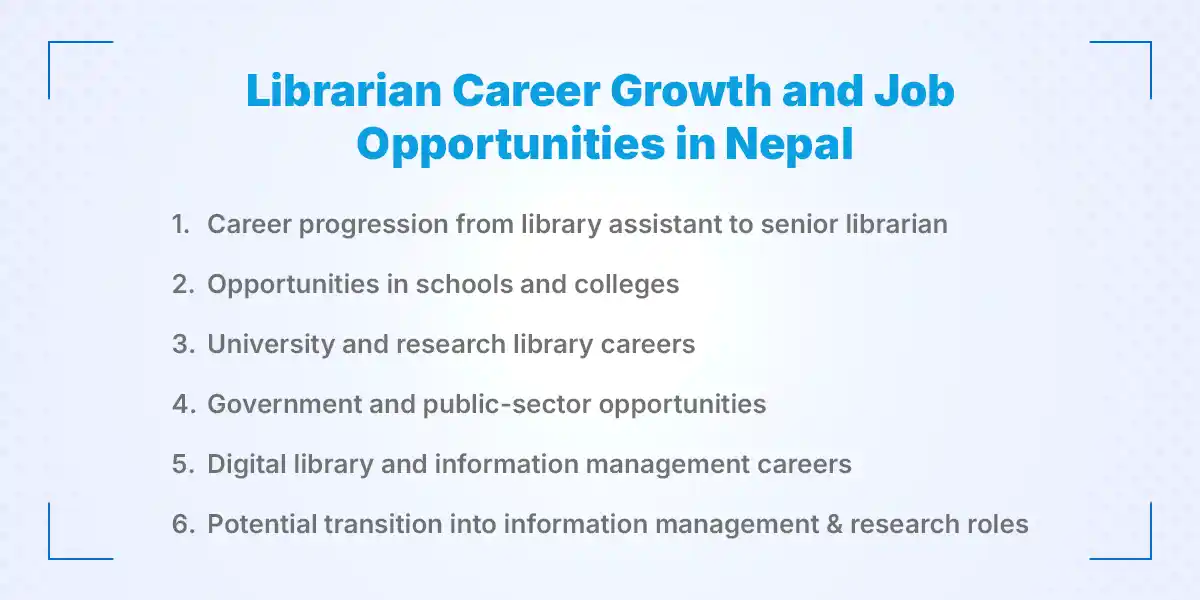
Librarians in Nepal can build a stable career by gaining experience, improving library management skills, and developing digital information technology skills. Career opportunities are available in schools, colleges, universities, government institutions, public libraries, research organizations, and private institutions.
1.Career Progression:
Librarians can advance from Library Assistant to Librarian, Senior Librarian, Head Librarian, or Library Manager with experience and qualifications.
2.Schools and Colleges:
Schools and colleges offer librarian positions for managing books, digital resources, cataloguing, and student information services.
3.University and Research Libraries:
Universities and research institutions provide opportunities in academic libraries, research support, digital resources, and information management.
4.Government and Public Sector:
Government institutions and public libraries offer librarian positions with opportunities for stable employment and career growth.
5.Digital Library Careers:
Learning library automation, digital databases, electronic resources, and information systems can help librarians access new career opportunities.
6.Information Management and Research:
Experienced librarians can transition into information management, documentation, research support, knowledge management, and related information-service roles.
Librarian Jobs in Nepal: Where Can You Find Vacancies?
Librarian vacancies in Nepal appear across a wide range of employer types, and knowing where to look saves significant job-search time.
- Schools and colleges (often posted directly on institutional notice boards or websites)
- Universities and higher education institutions
- Government organizations, through civil service vacancy announcements
- Public libraries under municipal or provincial administration
- NGOs and INGOs, frequently for knowledge management or documentation roles
- Research institutions and think tanks
- Private companies with in-house libraries or resource centers
- Online job portals and career websites, which aggregate listings across all of the above
Checking multiple sources regularly, rather than relying on a single platform, remains the most effective way to catch new openings early.
Conclusion
Librarian salaries in Nepal in 2026 span a wide range, and the biggest driver of where any individual lands isn't luck it's a combination of qualification, workplace type, and digital skill level that compounds over a career. A fresher with only a Bachelor's degree and no automation experience will likely stay near the lower end of the scale, while someone who pairs a Master's degree with strong digital library skills and targets universities or government institutions can realistically double their earning potential within a decade.
The clearest next step for anyone evaluating this career path is to compare current qualifications against the roles paying at the top of these ranges, then close that gap deliberately. Browse current librarian openings across schools, universities, government bodies, and private organizations on KumariJob to see real-time salary expectations and find the right opportunity to start or advance a library career in Nepal
Frequently Asked Questions
Submit your comments

Get Our App On



SEO Training for Freshers in Nepal: Skills, Career & Job Opportunities
VIEW DETAILS
SEO Training vs. Self-Learning: Which Is Right for You?
VIEW DETAILS
How to Choose Between Two Job Offers
VIEW DETAILS
Digital Marketing Training Interview Questions and Answers for Freshers
VIEW DETAILS


Loading Comments...