



Are you wondering how much HR professionals earn in Nepal and whether this career offers good salary growth? Many students and working professionals consider HR for its stability, growth, and long-term career prospects. Understanding salary trends helps you plan your HR career better. It also helps you set realistic expectations before entering the HR field.
In this blog, we will break down the HR salary in Nepal, including entry-level pay, HR manager earnings, and salary ranges across experience levels. You will also learn what factors influence HR salaries and which industries pay the most. Additionally, we’ll share practical tips to increase your HR income through skills and training. This guide is useful for both beginners and experienced HR professionals.
In this blog
Who Is an HR Professional in Nepal? What Do They Do?
An HR professional in Nepal is a person responsible for managing an organization’s workforce, policies, and people-related processes. They act as a bridge between employees and management while ensuring smooth daily HR operations and legal compliance.
In Nepal, HR professionals play a key role in hiring the right talent, maintaining workplace discipline, and supporting organizational growth. Their responsibilities have expanded beyond administration to strategic people management and employee development. This makes HR an important function in both small businesses and large organizations.
What Do HR Professionals Do in Nepal?
- Handle recruitment, screening, and onboarding of employees
- Manage payroll, attendance, and employee records
- Ensure compliance with Nepal’s labor laws and regulations
- Support performance management and employee evaluations
- Address employee relations, grievances, and workplace issues
- Implement HR policies, training, and development programs
- Contribute to organizational culture and long-term growth
What Is the Average HR Salary in Nepal?
The average HR salary in Nepal ranges from around NPR 15,000 to NPR 1,20,000+ per month, depending on experience, role, industry, and organization size. Freshers usually start with lower pay, while experienced HR professionals earn significantly more. Salaries are higher in corporate offices, multinational companies, and growing industries. Skills, certifications, and location also strongly influence HR income and the average salary in Nepal.
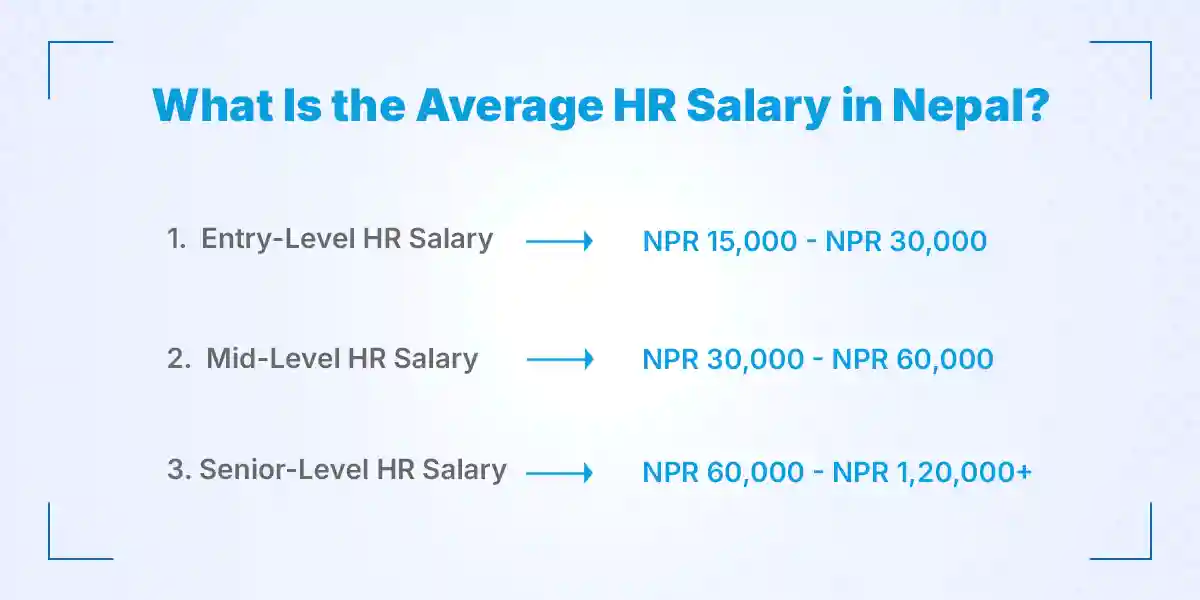
1. Entry-Level HR Salary (NPR 15,000 - NPR 30,000)
Entry-level HR professionals usually include HR assistants, junior HR officers, or trainees. They handle basic tasks like recruitment support, attendance, and documentation. Fresh graduates and trainees often start in this range. Salary increases as practical experience and HR skills improve. Organizations may also provide training and growth opportunities. This level is ideal for building a strong HR foundation and applying for various entry-level jobs.
2. Mid-Level HR Salary (NPR 30,000 - NPR 60,000)
Mid-level HR professionals have a few years of experience and handle core HR functions independently. They manage recruitment, payroll coordination, employee relations, and compliance tasks. Salaries rise due to increased responsibility and performance. Professionals at this level often work as HR officers or executives. Industry and company size affect earnings. Strong communication and labor law knowledge add value when applying for mid-level jobs.
3. Senior-Level HR Salary (NPR 60,000 - NPR 1,20,000+)
Senior-level HR professionals include HR managers, heads of HR, and strategic HR leaders. They oversee HR policies, workforce planning, and organizational development. Experience and leadership skills drive higher salaries. Large companies and multinational organizations pay more. Performance-based incentives may apply. This level offers strong career stability and growth potential.
How Much Does an HR Manager Earn in Nepal?
An HR Manager in Nepal earns in the range of NPR 60,000 to NPR 1,20,000 per month, depending on experience, organization size, and industry. Professionals with strong leadership and labor law knowledge earn on the higher end. Salaries are generally higher in corporate houses and multinational companies. Location and years of experience also play a major role. Performance and responsibilities can further increase pay.
1. HR Manager Salary by Experience Level
HR managers with 3-5 years of experience usually earn at the lower end of the salary range. As experience increases, pay rises steadily with added responsibilities. Managers with over 8–10 years of experience earn higher salaries. Senior HR managers handling strategy and policy earn premium pay. Leadership skills strongly influence salary growth. Long-term experience ensures stability and higher earnings.
2. HR Manager Salary by Organization Type
HR managers in multinational companies earn higher salaries than those in small firms. Corporate offices and large private companies offer better pay packages. NGOs and INGOs also provide competitive salaries with added benefits. Startups and small businesses usually offer lower salaries initially. Organization size and structure affect HR pay levels. Growth-oriented companies reward skilled HR leaders.
Factors That Influence HR Salary in Nepal
HR salary in Nepal is not fixed and varies based on several professional and market-related factors. Education, experience, industry, and location all play important roles. Understanding these factors helps HR professionals plan their career growth and salary expectations better. Knowing these aspects also helps job seekers negotiate better pay.

1. Education and HR Qualifications
Higher education and HR-related qualifications directly impact salary levels. Graduates with management or HR degrees earn better starting salaries. Professional HR training and certifications add value. Employers prefer candidates with updated HR knowledge. Continuous learning improves earning potential. Qualified professionals progress faster in HR careers. Formal education builds a strong HR foundation.
2. Experience and Skill Specialization
Experience is one of the biggest salary drivers in HR. Professionals with hands-on HR exposure earn more. Specialized skills like payroll, labor law, or talent acquisition increase pay. Strong communication and leadership skills matter. Practical experience boosts confidence and value. Skilled HR professionals are in high demand. Experience leads to better role authority.
3. Industry and Company Size
HR salaries differ across industries in Nepal. Corporate offices and multinational companies pay higher salaries. Large organizations offer better pay than small firms. NGOs and INGOs provide competitive packages. Growing industries value strong HR systems. Company size affects role responsibility and salary. Structured companies invest more in HR to maintain robust hr policies.
4. Location and Market Demand
HR salaries are higher in major cities like Kathmandu. Urban areas have more job opportunities and demand. Market competition raises salary levels. Rural areas usually offer lower pay. Demand for HR professionals varies by region. Location influences growth and exposure. City jobs offer better career prospects.
HR Salary in Nepal by Industry
HR salary in Nepal varies widely across industries due to differences in organization size, revenue, and workforce structure. Some industries require advanced HR systems and skilled professionals, which leads to higher pay. Corporate growth and regulatory needs also influence HR salaries. Choosing the right industry can significantly impact long-term income and the effectiveness of an overall hr strategy.
1. Corporate and Business Organizations
HR professionals in corporate and business organizations usually earn NPR 30,000 to NPR 1,00,000+ per month. Large private companies and multinational firms offer higher salaries. Roles often include recruitment, performance management, and policy development. Experience and leadership skills increase pay. Corporate HR jobs offer fast growth. Structured HR systems add value. Performance-based increments are common.
2. Banks and Financial Institutions
HR salaries in banks and financial institutions range from NPR 40,000 to NPR 1,20,000+ per month. These organizations require strict compliance and skilled HR professionals. Experienced HR managers earn premium salaries. Benefits and allowances are often included. Job stability is high. Banking HR roles are competitive. Growth follows structured promotion systems.
3. NGOs and INGOs
HR professionals in NGOs and INGOs earn around NPR 35,000 to NPR 1,10,000 per month, depending on project size and funding. International organizations pay higher salaries. HR roles focus on compliance and reporting. Experience in development sectors is valued. Benefits may include allowances. Contracts often affect pay. Exposure to global HR practices is a plus for those seeking ngo ingo jobs in Nepal.
4. Hospitality, Education, and Service Sectors
HR salaries in hospitality, education, and service sectors range from NPR 25,000 to NPR 70,000 per month. Smaller institutions pay less initially. Hotels and private colleges offer moderate salaries. Experience improves earning potential. HR roles focus on staff management. Growth depends on organization size. Seasonal demand may affect pay levels.
How Can HR Professionals Increase Their Salary in Nepal?
HR professionals in Nepal can increase their salary by improving qualifications, gaining practical experience, and upgrading their skills. Continuous learning and smart career moves play a key role. Choosing the right industry and specialization also boosts income. Long-term planning helps HR professionals reach higher-paying roles.
1. Professional HR Training and Certifications
Professional HR training improves technical knowledge and practical skills. Certified HR professionals earn higher salaries than untrained candidates. Training builds confidence in labor laws and HR systems. Employers prefer certified HR staff. Updated knowledge increases job opportunities. Certification supports faster promotions. It also strengthens professional credibility.
2. Skill Development and HR Specialization
Specialized HR skills lead to better salary growth. Payroll, labor law, and talent acquisition are high-demand areas. Strong communication and leadership skills matter. HR analytics and compliance knowledge add value. Skill-based roles pay more. Specialization improves career stability. In-demand skills attract better offers.
3. Career Growth and Role Advancement
Moving into senior HR roles increases salary significantly. Experience leads to leadership positions. Taking responsibility for strategy and policy improves pay. Promotions raise income steadily. Career planning helps long-term growth. Senior HR roles offer higher benefits. Leadership roles bring financial security.
Which Is the Best HR Training Institute in Nepal?
Kumari Job is the best HR training institute in Nepal because it combines practical, industry-aligned training with experienced HR professionals as trainers. Their courses are designed to closely match real workplace demands and job market needs. Kumari Job helps learners build strong HR skills and confidence from day one. With a proven track record of helping students and professionals succeed, they focus on both knowledge and employability. This makes Kumari Job a preferred choice for anyone serious about a career in human resources.
Factors to Consider When Choosing an HR Training Institute
When choosing an HR training institute in Nepal, look for a practical curriculum that reflects real HR work rather than just theory. Training should cover recruitment, payroll, labor laws, and employee relations with hands-on examples. Industry-aligned training ensures that what you learn matches workplace expectations. Trainers should be experienced HR professionals who have worked in real HR roles and can share practical insights. These trainers help you understand daily HR challenges. A strong support system and feedback from past students are also important. Choosing the right institute sets a solid foundation for your HR career through advanced hr training in Nepal.
Why the Right HR Training Institute Matters?
Choosing the right HR training institute matters because it can directly influence your salary potential and job readiness. Quality training prepares you for interviews and important HR tasks. It also builds confidence in communication, decision-making, and HR tools. A reputable institute like Kumari Job improves your chances of securing better HR roles and higher salaries. It also helps you keep up with changing industry trends and labor regulations. Good training accelerates your growth and opens doors to leadership positions in HR. Ultimately, the right training helps you achieve long-term career success.
Future Scope of HR Careers and Salary Growth in Nepal
The future scope of HR careers in Nepal is strong due to business growth and changing workforce needs. Organizations now focus more on people management and compliance. This increases demand for skilled HR professionals. As demand grows, HR salary levels are also expected to rise steadily, expanding the overall scope of hr in Nepal.
Rising Demand for HR Professionals
The demand for HR professionals in Nepal is increasing across industries. Companies need HR teams to manage hiring and retention. Growing startups and corporations require structured HR systems. Skilled HR professionals add value to business growth. Digital HR practices are gaining importance. This demand supports better salary growth.
Impact of Labor Laws and Corporate Expansion
Changing labor laws require organizations to stay compliant. HR professionals play a key role in legal compliance. Corporate expansion increases workforce size and HR needs. Companies invest more in qualified HR staff. Strong HR management reduces legal risks. This trend improves career stability and pay.
Is a Career in Human Resources Worth It in Nepal?
Yes, a career in Human Resources is worth it in Nepal because it offers steady salary growth along with strong job stability. As organizations grow and labor laws become more structured, the need for skilled HR professionals continues to rise. HR roles exist in almost every industry, which ensures consistent demand and long-term employment security.
HR careers also offer clear long-term leadership opportunities. With experience, HR professionals can move into senior roles such as HR Manager, HR Head, or Chief Human Resources Officer. These positions come with higher salaries, decision-making authority, and strategic involvement in business growth. For professionals who enjoy people management and organizational development, HR is a rewarding and sustainable career path in Nepal.
Conclusion
In conclusion, HR has become one of the most stable and rewarding career paths in Nepal. With growing corporate expansion, strict labor laws, and increased focus on employee management, the demand for skilled HR professionals continues to rise. HR roles offer consistent salary growth, job security, and opportunities across multiple industries, making it a reliable career choice.
For individuals willing to invest in HR training, skill development, and long-term career planning, the HR field provides strong leadership opportunities and professional growth. Whether you are a fresh graduate or a working professional, a career in Human Resources can deliver both financial stability and long-term success in Nepal.
Frequently Asked Questions
Submit your comments

Get Our App On



SEO Training for Freshers in Nepal: Skills, Career & Job Opportunities
VIEW DETAILS
SEO Training vs. Self-Learning: Which Is Right for You?
VIEW DETAILS
How to Choose Between Two Job Offers
VIEW DETAILS
Digital Marketing Training Interview Questions and Answers for Freshers
VIEW DETAILS


Loading Comments...