



Running a business in Nepal is not easy. Many owners struggle with staff issues, unclear rules, late attendance, leave conflicts, and sudden disputes. Most problems start for one reason: there are no clear HR policies. Without written rules, employees feel confused, managers act differently, and small issues slowly turn into big headaches.
That is where proper HR policies help. They bring clarity, fairness, and legal safety to your workplace. Whether you run a startup, SME, or large company, having the right policies matters more than ever in Nepal today.
In this guide, you will learn what HR policies are, why they are important in Nepal, legal requirements, real examples, and simple samples you can use. By the end, you will know how to create clear, legal, and practical HR policies for your organization.
In this blog
What are HR Policies?
HR policies are simple written rules that explain how a company works with its people. They act like a guidebook for the workplace. These policies tell employees what is allowed, what is not allowed, and how things should be done at work. When rules are written clearly, everyone knows where they stand. They are basically the official company rules related to employees, covering areas like hiring, working hours, leave, behavior, salary, safety, and discipline. These rules help both the company and employees work smoothly without confusion.
Purpose of HR Policies in Organizations
The main goal of HR policies is to bring clarity and fairness. When rules are clear, employees feel safe and confident. Managers also find it easier to make decisions because they can follow written guidelines. HR policies help prevent misunderstandings and reduce conflicts at work.
HR policies also protect the company. If a problem or dispute happens, written policies act as proof that the rules were already explained. This is very important in Nepal, where labor law compliance matters.
Discuss HR Policies with a Specialist
Who Do HR Policies Apply To
HR policies are not only for regular staff. They apply to different people connected to the company.
- Full-time and part-time employees
- Managers and supervisors
- Contract and temporary workers
- Interns, if mentioned in the policy
Some policies may apply fully, while others apply only to specific roles. Still, everyone should know the rules that affect their work.
In short, HR policies help a company stay organized, fair, and legally safe while keeping employees informed and confident.
Why are HR Policies Important in Nepal?
HR policies are important in Nepal because they keep companies legally safe, fair to employees, and well organized. They help businesses follow the law, reduce problems, and build a better work culture. Without clear HR policies, even small issues can turn into serious disputes for Nepali organizations.
1. Compliance with the Nepal Labour Act
HR policies help companies follow the Nepal Labour Act properly. The law sets clear rules on working hours, leave, wages, safety, and employee rights. When these rules are written into HR policies, employers avoid mistakes and legal trouble. Employees also understand their rights clearly. This reduces confusion and fear at work. HR policies act as written proof during inspections or disputes. They also protect the company from fines and penalties. In Nepal, legal compliance is not optional; it is necessary.
2. Creating Consistency and Fairness
HR policies make sure everyone is treated the same. Without policies, managers may handle similar issues in different ways. This creates anger and trust issues among employees. Written rules bring fairness to hiring, leave, discipline, and promotions. Employees feel more confident when decisions follow clear rules. Consistency also improves morale and teamwork. Fair treatment helps retain good employees. It builds trust between staff and management.
3. Reducing Disputes and Legal Risks
Many workplace conflicts start due to unclear rules. HR policies clearly explain what is allowed and what is not. This reduces arguments and misunderstandings. If a problem happens, managers can refer to written policies. Employees also know the correct process to follow. This prevents emotional decisions and sudden actions. HR policies protect both sides legally. They reduce the risk of court cases and labor complaints.
4. Supporting Organizational Culture and Growth
HR policies shape how people behave at work. They define values like respect, discipline, and teamwork. Clear policies help new employees adjust faster. As a company grows, policies keep things under control. They support better performance and accountability. Strong policies create a professional work environment. This attracts better talent. In the long run, good HR policies help businesses grow smoothly and sustainably.
Struggling to Manage HR Rules and Policies?
Simplify HR policies, paperwork, and people-related processes with an expert's insight.
HR Policies in Nepal: Legal Framework
HR policies in Nepal are not just company rules. They are closely linked with national labor laws. Every organization, small or large, must follow the legal framework set by the government. Understanding this framework helps employers stay safe, and employees feel protected.
Overview of the Nepal Labour Act
The main law that guides HR policies in Nepal is the Nepal Labour Act. This law explains how employers should manage employees fairly and legally. It covers areas like working hours, wages, leave, safety, termination, and employee rights. The goal of the law is to protect workers and create a balanced work environment. Companies must align their HR policies with this law to avoid penalties. Even startups and small businesses are expected to follow basic rules. Ignoring the law can lead to fines, disputes, or legal action.
Mandatory HR Policies Required by Law
Some HR policies are required by law and must be present in every organization. These policies help ensure employee rights and workplace safety.
- Working hours and overtime rules
- Leave policy, including annual, sick, and public holidays
- Wages, salary payment, and benefits policy
- Health and safety policy
- Disciplinary and termination rules
- Anti harassment and workplace behavior guidelines
These policies should be written clearly and shared with employees.
Employer Responsibilities Under Nepali Regulations
Employers in Nepal have clear duties under labor laws. They must provide fair wages on time. Working hours should follow legal limits. A safe and healthy workplace is mandatory. Employers must respect leave entitlements. They should also handle complaints properly. Keeping records and updating HR policies regularly is important. Following these rules builds trust and avoids legal trouble.
Types of HR Policies in Nepal
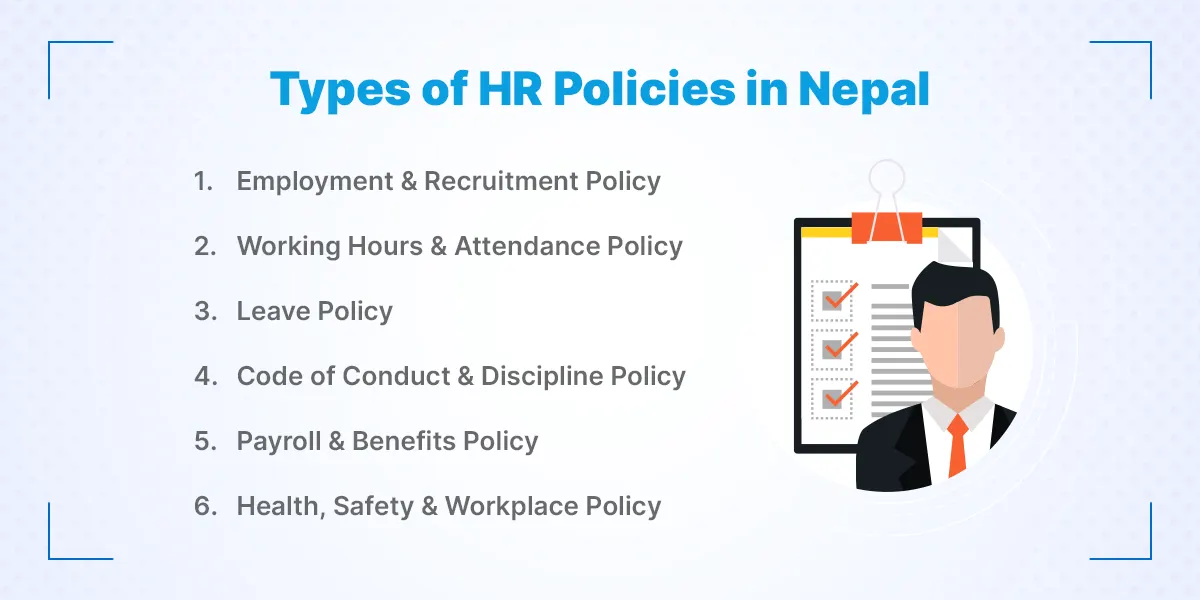
Every company in Nepal needs different types of HR policies to manage employees well. These policies guide hiring, working hours, leave, behavior, salary, and safety. Clear policies help employees know what is expected and reduce confusion. They also help managers make decisions fairly and follow the law.
1. Employment & Recruitment Policy
This policy explains how a company hires new employees. It covers job advertisements, interviews, selection, and joining procedures. It ensures hiring is fair and based on merit. It also defines probation periods and promotion rules. Employees know what to expect when they join. The policy can include rules about internal transfers or referrals. For Nepali companies, following the law in hiring is important. This policy helps avoid favoritism or unfair treatment.
2. Working Hours & Attendance Policy
This policy defines the official working hours for employees. It explains start and end times, breaks, and overtime rules. Attendance rules, late arrivals, and reporting procedures are included. Employees understand how to record their work hours. Managers can track attendance fairly. The policy ensures compliance with the Nepal Labour Act. It helps prevent misunderstandings about work expectations.
3. Leave Policy
The leave policy explains all types of leave employees can take. This includes annual leave, sick leave, maternity/paternity leave, and public holidays. Rules about how to request leave and the approval process are clear. Employees know how much leave they are entitled to. Managers can handle leave requests fairly. This reduces conflicts and absenteeism. It also ensures the company follows Nepal Labour Act rules.
4. Code of Conduct & Discipline Policy
This policy sets rules for employee behavior at work. It explains what is acceptable and what is not. It covers dress code, communication, harassment, and workplace ethics. Disciplinary actions for violations are also mentioned. Employees know the consequences of breaking rules. It promotes respect and harmony in the workplace. The policy protects both employees and the company.
5. Payroll & Benefits Policy
This policy explains how salaries, bonuses, and benefits are managed. It covers payment dates, deductions, and allowances. Employees understand what they will earn and when. It also includes insurance, provident fund, or other perks. Clear policies prevent salary disputes. It ensures compliance with Nepali labor law. It builds trust between employees and management.
6. Health, Safety & Workplace Policy
This policy focuses on keeping employees safe at work. It covers emergency procedures, safe equipment use, and hygiene rules. It also addresses accident reporting and health benefits. Employees know how to stay safe and what to do in emergencies. Managers ensure the workplace meets safety standards. Following this policy reduces accidents and legal issues. It creates a positive and secure work environment.
Examples of HR Policies Used by Companies in Nepal
Here are the highlights of common HR policies used by companies in Nepal. These policies help maintain workplace discipline, ensure fairness, and protect employee rights. Understanding them can help both employers and employees create a productive and positive work environment.
1. Leave policy
This policy explains the types of leave available to employees and how to request them. It ensures fair and consistent leave management for everyone in the organization. All employees are expected to follow the leave procedures to maintain operational efficiency.
[Company Letterhead]
[Company Name]
[Company Address]
Phone: [Contact Number]
Email: [Official Email]
Effective Date: [DD/MM/YYYY]
Version: 1.0
Approved by: [Authorized Person]
HR POLICY DOCUMENT - LEAVE POLICY
Purpose
To explain employee leave entitlements and how to request leave.
Scope
Applies to all full-time, part-time, and contract employees.
Policy Statement
- Employees are eligible for [number] annual leaves per year.
- Sick leave, maternity/paternity leave, and public holidays as per law.
- Leave must be requested at least [number] days in advance, except emergencies.
Responsibilities
- Employees submit leave requests in writing.
- Managers approve/reject requests within [number] days.
Procedure
- Fill out leave form.
- Manager reviews and approves.
- HR records leave in payroll and attendance system.
Review Date: Annually or when labor laws change.
Employee Acknowledgment
I have read and understood this HR Policy and agree to follow it.
Name: ___________________
Signature: _______________
Date: ___________________
[Authorized Person’s Name]
[Designation]
[Company Name]
Signature and Official Stamp
2. Attendance & Punctuality Policy
This policy emphasizes the importance of regular attendance and punctuality at work. It helps maintain discipline and ensures smooth workflow across all departments. Employees are encouraged to adhere to their schedules and report any unavoidable absences promptly.
[Company Letterhead]
[Company Name]
[Company Address]
Phone: [Contact Number]
Email: [Official Email]
Effective Date: [DD/MM/YYYY]
Version: 1.0
Approved by: [Authorized Person]
HR POLICY DOCUMENT - ATTENDANCE & PUNCTUALITY
Purpose
To ensure employees maintain regular attendance and arrive on time for work.
Scope
Applies to all employees in every department.
Policy Statement
- Employees must adhere to scheduled work hours.
- Frequent lateness or absenteeism may result in disciplinary action.
- Attendance records must be maintained accurately by HR.
Responsibilities
- Employees record their attendance daily.
- Managers monitor attendance and report issues to HR.
Procedure
- Employee logs attendance using [system/tool].
- Manager reviews weekly/monthly attendance.
- HR handles follow-up and disciplinary actions if needed.
Review Date: Annually or as needed.
Employee Acknowledgment
I have read and understood this HR Policy and agree to follow it.
Name: ___________________
Signature: _______________
Date: ___________________
[Authorized Person’s Name]
[Designation]
[Company Name]
Signature and Official Stamp
3. Anti-harassment Policy
This policy promotes a safe and respectful workplace for all employees. It clearly defines harassment and outlines procedures for reporting and addressing incidents. Everyone in the organization is expected to act professionally and support a harassment-free environment.
[Company Letterhead]
[Company Name]
[Company Address]
Phone: [Contact Number]
Email: [Official Email]
Effective Date: [DD/MM/YYYY]
Version: 1.0
Approved by: [Authorized Person]
HR POLICY DOCUMENT - ANTI-HARASSMENT
Purpose
To provide a safe, respectful, and harassment-free work environment for all employees.
Scope
Applies to all employees, contractors, and visitors of the company.
Policy Statement
- Harassment of any kind, verbal, physical, or online, is strictly prohibited.
- Complaints will be taken seriously and investigated promptly and confidentially.
- Retaliation against employees who report harassment is forbidden.
Responsibilities
- Employees report any harassment incidents to HR or management.
- Managers and HR ensure complaints are handled fairly and promptly.
Procedure
- Employee submits a harassment complaint to HR.
- HR investigates and documents the case.
- Management takes appropriate action to resolve the issue.
Review Date: Annually or as required by law.
Employee Acknowledgment
I have read and understood this HR Policy and agree to follow it.
Name: ___________________
Signature: _______________
Date: ___________________
[Authorized Person’s Name]
[Designation]
[Company Name]
Signature and Official Stamp
4. Performance Management Policy
This policy outlines how employee performance is monitored, evaluated, and improved. It aims to encourage professional growth, recognize achievements, and address performance issues constructively. Employees and managers are expected to actively participate in the performance management process.
[Company Letterhead]
[Company Name]
[Company Address]
Phone: [Contact Number]
Email: [Official Email]
Effective Date: [DD/MM/YYYY]
Version: 1.0
Approved by: [Authorized Person]
HR POLICY DOCUMENT - PERFORMANCE MANAGEMENT
Purpose
To assess and enhance employee performance, ensuring growth and alignment with company goals.
Scope
All employees across departments and roles.
Policy Statement
- Employees will receive regular performance evaluations.
- Feedback is provided to support development and improvement.
- High performance may result in rewards; poor performance triggers support plans.
Responsibilities
- Employees participate actively in performance discussions.
- Managers conduct evaluations fairly and document results.
- HR monitors consistency and compliance.
Procedure
- Set performance goals at the start of the review period.
- Conduct periodic evaluations and provide feedback.
- Document results and take necessary actions.
Review Date: Annually or as required.
Employee Acknowledgment
I have read and understood this HR Policy and agree to follow it.
Name: ___________________
Signature: _______________
Date: ___________________
[Authorized Person’s Name]
[Designation]
[Company Name]
Signature and Official Stamp
5. Employee Conduct Policy
This policy defines the standards of behavior expected from all employees. It promotes ethical, professional, and responsible conduct in the workplace. Adherence to this policy helps create a positive, safe, and productive work environment.
[Company Letterhead]
[Company Name]
[Company Address]
Phone: [Contact Number]
Email: [Official Email]
Effective Date: [DD/MM/YYYY]
Version: 1.0
Approved by: [Authorized Person]
HR POLICY DOCUMENT - EMPLOYEE CONDUCT
Purpose
To define acceptable behavior and standards for all employees in the workplace.
Scope
Applies to all employees, contractors, and temporary staff.
Policy Statement
- Employees must act ethically, responsibly, and professionally at all times.
- No discrimination, harassment, or misconduct is tolerated.
- Company property and resources must be used responsibly.
Responsibilities
- Employees follow company rules and ethical standards.
- Managers enforce conduct policies consistently.
- HR addresses violations and maintains records.
Procedure
- Employee receives conduct guidelines.
- Manager monitors compliance and addresses issues.
- HR investigates violations and applies corrective actions.
Review Date: Annually or as required.
Employee Acknowledgment
I have read and understood this HR Policy and agree to follow it.
Name: ___________________
Signature: _______________
Date: ___________________
[Authorized Person’s Name]
[Designation]
[Company Name]
Signature and Official Stamp
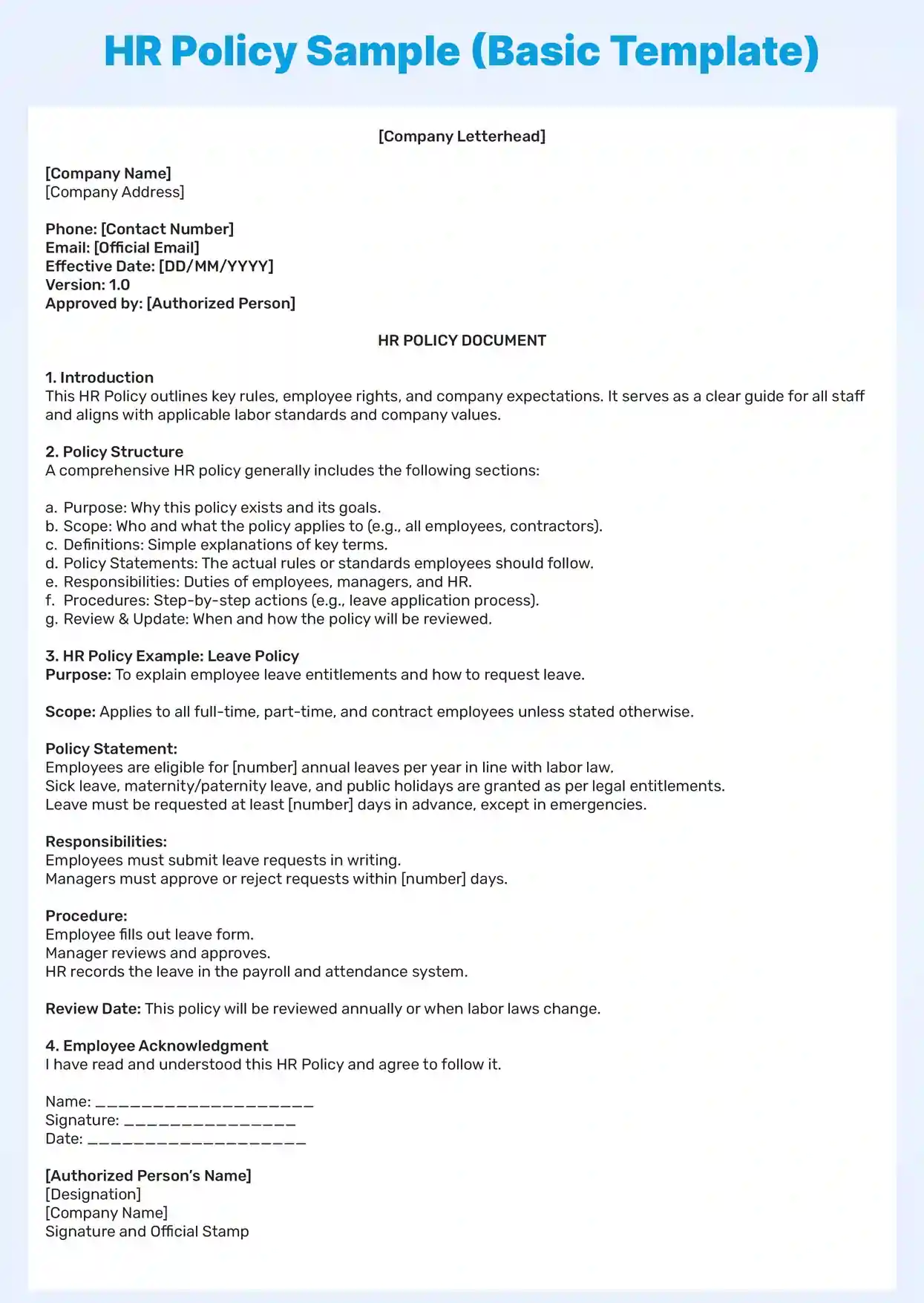
HR Policy Sample (Basic Template)
This HR Policy provides a clear guide on company rules, employee rights, and workplace expectations. It helps ensure consistency, fairness, and compliance with labor laws. All employees are expected to understand and follow the policies outlined in this document.
How to Create HR Policies in Nepal
To create HR policies in Nepal, write clear rules, comply with the law, and ensure employees understand them. Good policies help employees know what to do, reduce confusion, and protect the company from problems. By following the right steps, any business can make HR policies that actually work.
- Identify Key Areas: Start by listing all areas that need rules, like hiring, attendance, leave, behavior, pay, and safety. Decide which areas are most important for your company. This gives a clear focus for your policies.
- Check Legal Requirements: Look at the Nepal Labour Act and other regulations. Make sure your policies meet the minimum legal requirements. This prevents fines, disputes, and legal issues.
- Write Clear and Simple Rules: Write policies in simple words that everyone can understand. Avoid long, confusing sentences. Explain what is expected from employees and what the company promises in return.
- Customize for Your Company: Adjust policies based on your company’s size and industry. A small office may need simpler rules than a large factory. Make policies practical so employees can easily follow them.
- Review and Approve: Share the draft policies with managers and legal advisors. Make changes based on their suggestions. This ensures policies are accurate, fair, and enforceable.
- Share and Get Acknowledgment: Give employees a copy and explain the rules clearly. Ask them to sign an acknowledgment form. This confirms they understand the policies and agree to follow them.
Common Mistakes Companies Make with HR Policies
Many companies in Nepal make avoidable mistakes when creating HR policies. These mistakes can cause confusion, legal problems, and unhappy employees. Some business owners think writing policies is just a formality, but poorly made policies create more problems than they solve. Understanding common errors helps companies build better and practical HR policies.
1. Copy-Paste Policies
Some companies simply copy policies from other organizations or online templates. These may not fit the company’s culture, size, or industry. Rules copied blindly can confuse employees and create conflicts. Policies must reflect the way your company actually works. Customizing them for local context and employee needs makes them more effective.
2. Ignoring Legal Compliance
Ignoring Nepal’s labor laws is a serious mistake. Policies that do not follow the law can lead to fines, disputes, or lawsuits. Rules about wages, leave, working hours, and safety must follow the Nepal Labour Act. Companies should always check legal requirements before finalizing policies. Legal compliance protects both the company and its employees.
3. Not Updating Policies Regularly
Workplaces change over time, and policies need to keep up. Companies that don’t update policies may have outdated rules on leave, attendance, or safety. This can cause confusion and disagreements. Regular updates ensure policies stay relevant, legal, and effective. Employees will trust policies more when they are current.
4. Poor Communication with Employees
Even the best policies fail if employees don’t understand them. Some companies make rules but never explain them properly. Employees may ignore policies or follow them incorrectly. Clear communication through meetings, emails, or manuals is necessary. Always make sure employees read and acknowledge the rules.
How Often Should HR Policies Be Updated?
HR policies are not something you create once and forget. Businesses in Nepal change over time, laws are updated, and employees’ needs evolve. Regularly reviewing and updating HR policies keeps them relevant, legal, and effective. Without updates, even well-written policies can cause confusion or legal problems.
There are a few key reasons why HR policies need regular updates:
- Legal Changes: Nepal Labour Act and other regulations are updated from time to time. Policies must reflect these changes to stay compliant. For example, updates in leave rules, minimum wage, or safety regulations should be included immediately.
- Business Growth: As a company grows, its HR needs change. Startups may have simple policies, but larger companies need detailed rules. Updating policies ensures they fit the current size and structure of the business.
- Employee Feedback: Employees often face challenges that policies do not address. Feedback can help identify gaps or unclear rules. Updating policies based on real experiences improves understanding and compliance.
- Industry Best Practices: HR practices evolve with time and industry trends. Following modern best practices helps attract and retain talent. Policies should be updated to reflect efficient processes, technology, and workplace standards.
A good practice is to review HR policies at least once a year. Some companies also review policies whenever there is a major legal change, organizational restructure, or after gathering significant employee feedback. Documenting these updates and communicating them clearly ensures employees always know the current rules.
In short, regular updates make HR policies effective, fair, and legally safe, while supporting business growth and employee satisfaction in Nepal.
Conclusion
Having clear HR policies in Nepal is no longer optional; it is essential for every business. Proper policies make sure your company follows the law, treats employees fairly, and avoids unnecessary disputes. They guide managers and staff on what is expected, creating a smooth and organized workplace. HR policies also support business growth by setting clear rules that everyone can follow, from small startups to large organizations.
By writing simple, practical, and legal policies, companies can protect themselves and their employees. If you want your workplace to run without confusion and build a strong, trustworthy culture, implementing structured HR policies is the key to success in Nepal.
Want to learn how to create and implement effective HR policies? Enroll in practical HR training in Nepal and gain hands-on knowledge of HR documentation, compliance, and policy development for real workplaces.
Frequently Asked Questions
Submit your comments

Get Our App On



SEO Training for Freshers in Nepal: Skills, Career & Job Opportunities
VIEW DETAILS
SEO Training vs. Self-Learning: Which Is Right for You?
VIEW DETAILS
How to Choose Between Two Job Offers
VIEW DETAILS
Digital Marketing Training Interview Questions and Answers for Freshers
VIEW DETAILS


Loading Comments...