



You spend months learning Excel, SQL, Python, and maybe even Power BI. You build projects, apply for jobs, and still one big question keeps bothering you: how much will you actually earn as a data analyst in Nepal? Some people claim the pay is excellent. Others say it is just average. Fresh graduates feel uncertain, and even working professionals hesitate before switching careers because the salary figures online are inconsistent and unclear.
Next, there is an increasing demand for data analysts in banks, IT companies, startups, and even NGOs around Nepal. However, practical earning potential is based on abilities, experience, and industry.
In this blog, you will get a clear breakdown of the data analyst salaries in Nepal, the factors that influence this, and the way in which you can improve your salary gradually.
In this blog
Who is a Data Analyst and what do they do?
A data analyst is someone who works with numbers to help a business understand what is really going on. Every company in Nepal, whether it is a bank, an IT firm, an e-commerce company, or even an NGO, collects data every day. Sales figures, customer details, website traffic, expenses, and performance reports all create data. A data analyst studies this information and finds useful insights from it.
The job is not just about sitting in front of a computer and making charts. It is about asking questions like: Why are sales dropping? Which product is performing better? Where are we losing customers? Then the analyst looks at the data to find clear answers.
In Nepal, this role is becoming more important as businesses slowly shift toward data-based decision-making. Companies want facts before making big decisions, and that is where a data analyst becomes valuable.
What does a data analyst usually do?
- Extract company system data, spreadsheet, and database data.
- Clean the data by correcting the errors or deleting the duplicates.
- Analyze data with spreadsheets such as Excel, SQL, Power BI, or Python.
- Make basic reports and dashboards for managers.
- Detect patterns, trends, and areas of problems.
- Make recommendations on improvements.
In simple terms, a data analyst is someone who helps businesses make more informed decisions based on data rather than guesswork.
What is the Average Data Analyst Salary in Nepal?
The average salary of a data analyst in Nepal ranges from NPR 50,000 to NPR 80,000 per month. New hires with approximately 1-2 years of data analyst experience are generally paid about NPR 50,000; experienced professionals earn about NPR 80,000. Remuneration will depend on the company, industry, and the individual's competence. Banks, information technology companies, and e-commerce organisations are likely to pay higher than small enterprises or non-governmental organisations.
In Nepal, most data analysts begin by working in entry-level positions, which expose them to actual projects. The higher the level of their experience and familiarity with different tools, such as SQL, Excel, Power BI, or Python, the better their salary will be. Certifications and practical knowledge can also increase earnings. In addition, analysts working in Kathmandu or for international companies often earn more than those in smaller cities. The range of NPR 50,000 to NPR 80,000 gives a realistic picture of what to expect when starting a career in data analytics in Nepal.
Data Analyst Salary by Experience Level
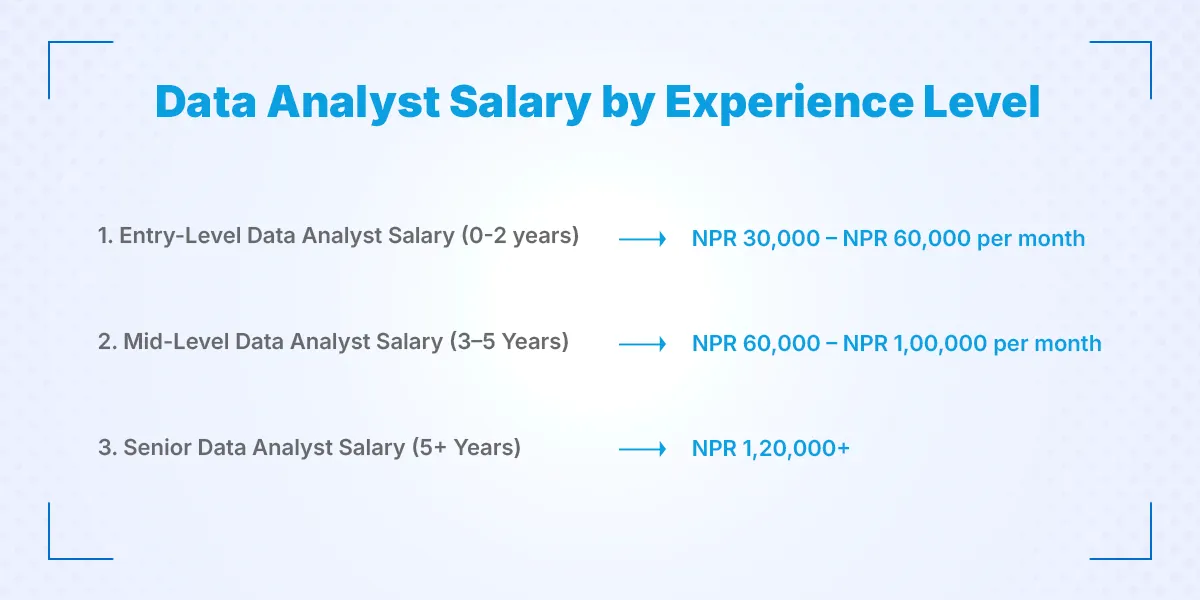
The salary of a data analyst in Nepal depends a lot on experience. The more years you work, the higher your pay usually is. Skills, tools, and the type of company also affect the salary. Here is a simple breakdown based on experience levels.
1. Entry-Level Data Analyst
Entry-level data analysts are usually fresh graduates or people who just started working. Their monthly salary in Nepal ranges from NPR 30,000 to NPR 60,000. Most of them start by learning how to collect and organize data. They also do straightforward reports and charts. Excel and simple SQL are some of the most common tools used at this stage. It is oriented to experience and knowing how businesses utilize the data. Their salary gradually increases with the improvement of their skills.
2. Mid-Level Data Analyst
Mid-level data analysts are more experienced and are able to deal with larger projects. Their salary is between NPR 60,000 and NPR 1,00,000 per month. They use some more complex software such as Power BI, Python, or Tableau. They also develop dashboards and reports that aid in decision making to the managers. At this stage, they may lead small teams or guide juniors. Companies value them for both their technical skills and experience. This is the stage where career growth becomes noticeable.
3. Senior Data Analyst
Senior data analysts are professionals who deal with valuable business information. They have a minimum salary of NPR 1,20,000 and may increase with the company. They manage big projects and provide insights that affect business strategy. They guide junior and mid-level analysts in their work. The senior analysts usually collaborate with the management to strategize the future objectives. Proficiency in various tools and expertise in the industry are much desired. At this point, their involvement is more of decision-making and not merely analysis of data.
Factors That Affect a Data Analyst's Salary in Nepal
A data analyst’s salary in Nepal is not fixed. Many things decide how much you can earn. Experience, skills, and the type of company you work for all matter. Here are the main factors that affect a data analyst’s pay.
1. Experience Level
Experience is the most important factor for salary. Fresh graduates earn less compared to people who have worked for a few years. The more projects you complete and the more problems you solve, the higher your pay. Companies value people who can handle work independently. Even small achievements at work can increase your salary over time. Experience also helps you negotiate better pay.
2. Technical Skills and Proficiency
The tools and skills you know affect your salary a lot. Knowledge of Excel, SQL, Python, Power BI, or Tableau can increase pay. Companies pay more for people who can work efficiently and deliver accurate results. The more tools and techniques you can use, the more valuable you are. Learning new skills can also open chances for promotions. Strong technical skills make it easier to get higher-paying jobs.
3. Industry and Company Type
Various industries do not pay equally. Banks and IT companies tend to pay higher small businesses. Big budgets for data teams are usually present in large companies. Included are other benefits that startups might pay less for but often have. Certain companies are also willing to pay more to obtain certain expertise in their industry. The difference can be in selecting the right industry to increase earnings.
4. Location and Work Mode
The place of work influences the salary. There is a tendency for jobs in Kathmandu or big cities to be higher compared to those in small towns. Big city companies also possess more developed projects. Remote work could enable one to earn in a foreign currency, which can be better than local wages. Geography may also have an impact on such benefits as transport or meal allowances.
5. Education and Certifications
Your education matters, but so do certifications. A degree in IT, business, or statistics helps you start. Data analytics or business intelligence certifications will increase salary. They demonstrate that you are practically qualified for the job. Certified analysts are more appreciated in the companies, particularly in mid or senior jobs. Better pay is usually the result of higher education and training.
6. Benefits and Extra Earnings
Salary is not just the basic pay. Some companies provide bonuses, incentives, or health benefits. Freelancers or remote workers may earn extra income through projects. Perks like allowances, paid leave, or insurance also add value. These benefits can make a job more attractive even if the base salary is lower. Always consider the full package, not just the monthly pay.
How to Increase Your Data Analyst Salary in Nepal?
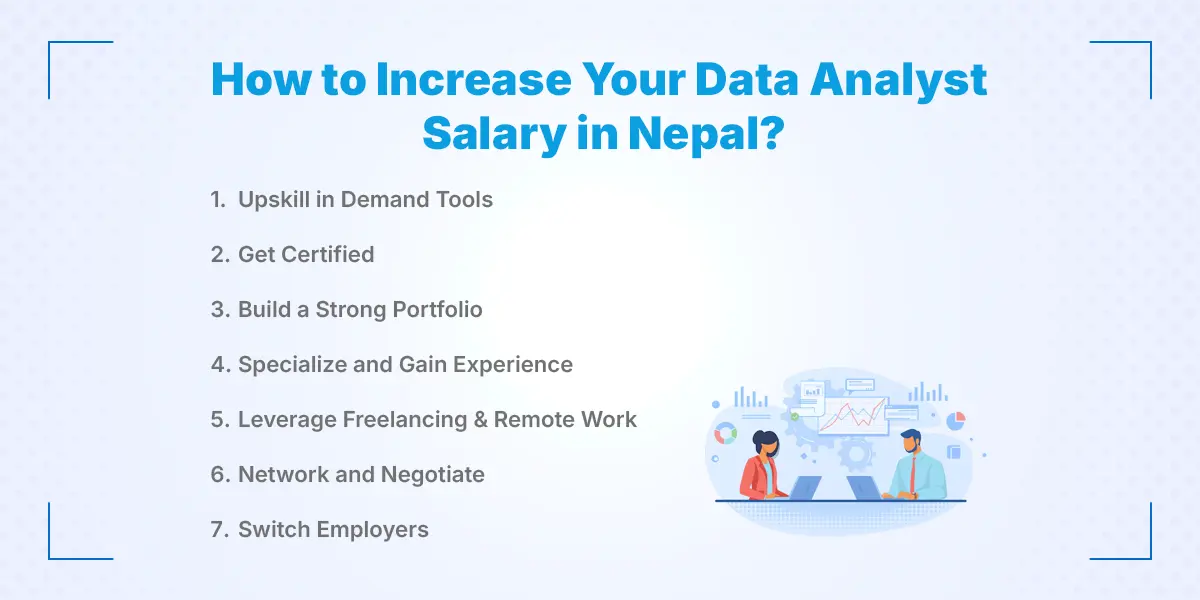
You can increase your salary by improving your skills, gaining experience, and choosing the right opportunities. Learning new tools, certifications, and having a good portfolio can make you more desirable to employers. All these, coupled with freelancing, networking, and smart job changes, can enable you to earn significantly more in the long run.
1. Upskill in Demand Tools
One of the quickest methods of earning more is learning the appropriate tools. Tools such as Excel, SQL, Python, Tableau, and Power BI are very common in Nepal. Organizations will pay more to individuals who are capable of dealing with complex information effectively. The more adept you are with these tools, the quicker the problem solution. You also prepare yourself with upskilling to take on larger projects. One tool is sufficient to begin with and learn the rest gradually. It is necessary to train to feel confident. Skilled and flexible employees attract the attention of employers.
2. Get Certified
Certifications indicate that you are familiar with your work. Courses such as Google Data Analytics, Microsoft, and Tableau certificates are accepted in Nepal. Pay and responsibility are usually given to certified analysts with greater responsibility. It also assists you in making a difference when seeking new employment. There are even companies that offer a pay increase once you have got a certification. A few certificates are not that important, but the corresponding ones count.
3. Build a Strong Portfolio
A portfolio is evidence of work and skills. Add projects that you have undertaken in studies, an internship, or in practice. Report on the shows, dashboards, or insights that you have created. A good portfolio will make employers believe that you can manage actual work. It may also be applied in freelance or distance projects. Keep it informed of new projects. A nice portfolio would give you better opportunities of landing better-paying jobs.
4. Specialize and Gain Experience
Specialization can assist you earn better. Consider such spheres as business analytics, finance, or e-commerce analytics. The greater the projects you do in your niche, the more value you will be bringing. Senior positions and better salaries are frequently suggested to experts. Continued learning in the job and accepted responsibility for difficult tasks. As time goes by, your experience will be transferred into your pay.
5. Leverage Freelancing & Remote Work
Freelancing or telecommuting can bring additional revenue. Nepal is also employed by many firms overseas to complete short-term projects as analysts. It is usually more than the native wages. Freelancing contributes to experience and portfolio, too. Begin with small projects and start increasing to bigger projects. This would make it a regular stream of additional revenue. Working at home will allow you to make dollars or other foreign currency.
6. Network and Negotiate
Being connected with the right people is beneficial to your career. Participate in local gatherings, webinars, or LinkedIn communities around the topic of data analytics. Networking may create a possibility of a better-paying job. Always be prepared to speak about your skills and accomplishments. The negotiation of salary at joining, or in the case of a change of job, is significant. Negotiation is common, and employers can pay more. Feeling confident and ready is an advantage.
7. Switch Employers
At times, it is quickest to leave one company and join another that offers good pay. Firms can pay high salaries to attract competent analysts. Know the latest trends in research salary and compare offers before switching. In Nepal, it is common to change jobs after having some experience under one's belt. Ensure that the new position is in line with your skills and development goals. A great salary increase may be achieved by combining a job change and skills improvement.
Skills and Qualifications Required to Become a Data Analyst
The skill set to be a data analyst consists of technical IT skills and soft skills. You must understand how to handle data, process, and communicate insights effectively. Meanwhile, communication, problem-solving, and experience are also essential. The following is a breakdown of the major skills and qualifications required.
1. Essential Technical Skills
A data analyst is an expert who deals with technical skills. These are tools and knowledge that you apply to gather data, process, and analyze it. These skills are easy to master, and when it comes to complex problems that require accurate results, it becomes simpler to find the solution.
- Programming Languages: Programming is necessary to work with data and analyze it. Common languages include Python, R, and SQL. They assist in the automation of the work, processing big data, and the development of predictive models.
- Mathematics & Statistics: The data analysis relies on mathematics and statistics. Probability, regression, and testing of hypotheses are also concepts that can be used in the interpretation of trends and patterns. It is not easy to analyze data with a good understanding of it.
- Machine Learning & AI: Machine learning and AI enable data analysts to forecast future trends. Model-building and algorithm skills are used in such activities as recommendation systems and forecasting. Simple knowledge can go a long way in decision-making among businesses.
- Data Visualization: Interpreting the data enables other people to know what you have learned. Charts and dashboards can be created more easily with tools such as Tableau, Power BI, or Matplotlib. Visualization is a good conversion of complex data into understandable insights.
- Data Manipulation & Big Data: Data is usually in a disordered form. Cleaning, merging, and processing of large datasets are important skills. Experience with big data applications such as Hadoop or Spark is also desirable.
- Cloud Computing: Cloud platforms such as AWS, Google cloud or Azure are useful in storing and analysing data effectively. They enable the manipulation of huge data volumes without costly hardware. Cloud expertise will enable a data analyst to be more diverse and sought after.
2. Soft Skills and Experience
Soft skills are also relevant since data analysts have to collaborate with other employees and relay data to non-technical individuals. Your work is made meaningful by problem-solving, communication, and domain knowledge. Real project experience is also credible.
- Communication: It is very important to explain data in a clear way. You should be able to provide knowledge to managers and other team members who might not be tech-savvy. Effective communication makes your efforts deliver actual business decisions.
- Problem-Solving: Data analysts use data to solve business problems. Patterns and solutions require critical thinking and creativity. Analysis is more effective because it is able to break down complex problems.
- Domain Knowledge: The knowledge of the industry that you are in enhances your analysis. Domain knowledge aids in the interpretation of data, whether it is in the field of finance, healthcare, or e-commerce. This renders your observations more viable and practical.
- Experience: The experience in real projects is more important than the theory. Skills and confidence are developed during internships, freelance assignments, or practice. Employers value candidates who have proven they can handle actual data challenges.
Career Path and Future Scope of Data Analysts in Nepal
The opportunities for data analysts in Nepal are increasing due to the rising number of companies utilizing data to make decisions. The IT jobs in Nepal are growing, and data analysis is one of the most in-demand jobs. Being a data analyst may lead to better jobs and niche professions. Growth can take place in various directions with the availability of the right skills, experience, and exposure.
Some key career paths and future opportunities include:
- Transition to Data Scientist: Data analysts can become data scientists by acquiring advanced skills in analytics, predictive modeling, and machine learning. Data scientists develop solutions to complicated issues and give strategic advice. This change is most often accompanied by a salary increase and increased accountability.
- Business Intelligence Analyst Roles: BI analysts concentrate on the development of dashboards, reports, and insights that can be used by decision-makers. They monitor the performance within departments and assist businesses in planning more strategically. BI analysts are frequently employed by banks, IT companies, and startup.
- Machine Learning and AI Career Growth: AI and machine learning-knowledgeable analysts can transition to automation, forecasting, and designing intelligent systems. These are the roles that are currently being established in Nepal, giving an early mover an edge. Acquiring these skills can enhance career opportunities to a great extent.
Freelancing and Remote Opportunities: There are a lot of short-term projects by international clients or remote employment by international companies. With freelancing opportunities, it is possible to make more, gain various experiences, and create a powerful portfolio. The fusion of local experience with projects that are remote projects is a growing trend in order to increase revenue.
Conclusion
The profession of a data analyst in Nepal has a high income and stable progress for those who are talented and devoted to working. The success hinges on the development of technical skills and experience on the job, and never-ending learning of new tools and techniques. Opportunities can be further increased by selecting the appropriate industry, building a solid portfolio, and considering freelancing or remote employment.
The high demand for competent analysts will persist as more companies embrace the use of data in decision-making. To any person who possesses sufficient time to cultivate technical and soft skills, a data analyst job in Nepal offers not only a good remuneration package but also consistent career growth and professional development.
Frequently Asked Questions
Submit your comments

Get Our App On



SEO Training for Freshers in Nepal: Skills, Career & Job Opportunities
VIEW DETAILS
SEO Training vs. Self-Learning: Which Is Right for You?
VIEW DETAILS
How to Choose Between Two Job Offers
VIEW DETAILS
Digital Marketing Training Interview Questions and Answers for Freshers
VIEW DETAILS


Loading Comments...