



Have you ever wondered how much an ACCA earns in Nepal in 2026? If you’re thinking about starting this career, or you’re just curious, knowing the actual salary of ACCA professionals actually helps. Many students and job seekers want to know if ACCA is really worth it.
The good news? ACCA professionals in Nepal are earning well, and the demand is rising year by year. Whether you’re just starting after +2 or already in the finance field, ACCA can open many doors for you.
In this blog, we’ll break down the ACCA salary in Nepal at different levels, from freshers to senior experts. You’ll also learn what affects your pay, how it compares to CA, and what to expect in the job market in 2026. Let's make it simple and clear.
In this blog
What is the Average ACCA Salary in Nepal in 2026?
In 2026, the average ACCA salary in Nepal ranges between NPR 20,000 and NPR 100,000+ per month, depending on your experience. ACCA professionals are now getting better pay and more opportunities compared to past years. If you're planning to become an ACCA, it's helpful to know how your salary might grow over time. Let’s break it down into three stages: entry-level, mid-level, and senior-level.
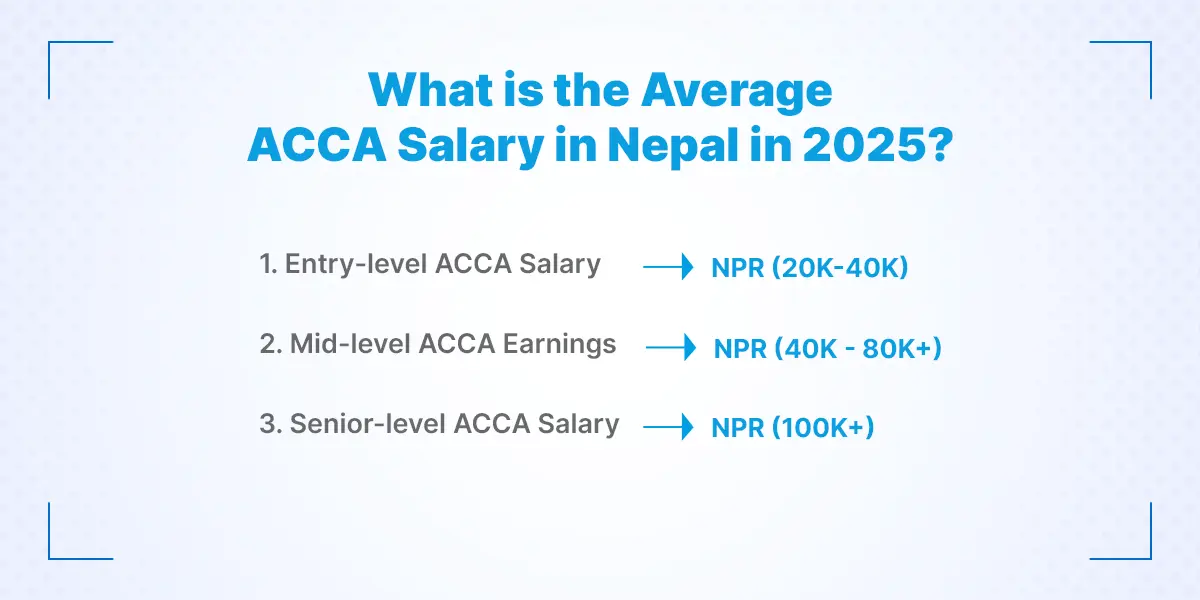
1. Entry-level ACCA Salary (NPR 20,000 – NPR 40,000)
When you begin your ACCA career in Nepal, you can earn between NPR 20,000 and NPR 40,000 a month. This is common for new graduates or those who have just finished their ACCA exams but lack work experience. Most entry-level jobs are in audit firms, as junior accountants, or as finance assistants. Employers look for good communication skills, basic accounting knowledge, and a willingness to learn.
You may not earn much at first, but it is a starting point. Many ACCA trainees begin at big firms to gain experience. These firms might pay less, but the experience is valuable. If you do well and show commitment, you may get a salary increase within one or two years. Some employers also pay for training or give small bonuses for good performance. So, while the starting salary is low, there is a lot of potential for growth.
Download Kumari Job App – Find & Apply for Jobs Instantly
2. Mid-level ACCA Earnings (NPR 40,000 – NPR 80,000+)
After 2 to 4 years of work, your salary can rise to about NPR 40,000 to NPR 80,000 or more a month. At this stage, you are no longer a beginner. You may have finished most or all of your ACCA exams and gained real experience in finance and audits. Mid-level ACCAs often work as finance officers, audit seniors, assistant managers, or internal auditors. Employers give you more responsibilities, like preparing financial reports and leading audits, so you earn more.
If you work for larger companies, banks, or international firms, your salary can be higher. You may also get performance bonuses and benefits like health insurance or training support. Your soft skills, like communication and leadership, are important now. If you keep improving, you can get promoted quickly. This is the phase where your hard work starts to show in your paycheck.
3. Senior-level ACCA Salary (NPR 100,000+)
Senior ACCA professionals in Nepal can earn NPR 100,000 or more each month. This usually happens after over 5 years of experience, a full ACCA qualification, and possibly a management role. At this level, you make financial decisions, manage teams, and advise the company on important issues. You might work as a finance manager, audit manager, CFO, or even start your own firm. Big companies and international organizations seek experienced ACCAs.
If you are skilled, you can earn well above average, especially in Kathmandu or other business centers. Your income may include bonuses, stock options, or revenue shares. Some ACCAs also work part-time as consultants or teachers to earn extra money. This level offers job satisfaction, financial security, and a strong professional reputation. The journey may be long, but reaching this point is rewarding.
Related Blog: How Much Do Accountants Earn in Nepal in 2026?
Government vs Private Sector ACCA Salary in Nepal (Table)
In Nepal, ACCA professionals can work in both private and government sectors. But the salary, work style, and benefits are quite different. Let’s break it down in the simplest way.
1. Opportunities in Public Service and Regulatory Bodies
In the government sector, ACCAs mostly work in regulatory bodies, state-owned enterprises, or audit departments. These roles are not as common as in the private sector, but they do exist. Some government jobs or departments may also hire ACCAs on a contract basis.
The pay in government jobs is usually fixed and based on salary scales, not on skills or experience alone. However, government jobs offer job security, pensions, paid holidays, and other long-term benefits. Growth may be slower, and promotions happen based on rules and time, not just performance.
It’s a good choice if you prefer a stable and secure job, even if the starting pay is lower than in the private sector.
2. Private Corporate Firms and Startups
In the private sector, there are many more opportunities for ACCAs. You can work in banks, audit firms, NGOs, insurance companies, multinational companies (MNCs), or even startups. These jobs often pay more and are open to freshers as well as experienced professionals.
Salary depends on your skills, performance, and company size. Bigger companies usually pay more, while startups might offer faster promotions or bonuses. You can also earn extra income from bonuses, overtime, or consulting work.
Private sector jobs are ideal if you want faster growth, flexible roles, and higher earning potential over time.
Salary and Benefit Comparison
In the government sector, salaries are usually lower at the start but come with long-term benefits.
In the private sector, salaries can be much higher, especially with experience, but may have less job security.
Benefits like bonuses, training, and insurance are more common in corporate jobs.
Government vs Private Sector ACCA Jobs
| Aspect | Government Sector | Private Sector |
|---|---|---|
| Salary Range | NPR 25,000 – NPR 50,000/month | NPR 30,000 – NPR 100,000+/month |
| Job Security | Very high | Moderate to high |
| Growth Rate | Slow and fixed | Fast and performance-based |
| Work Flexibility | Less flexible | More flexible |
| Bonuses/Incentives | Rare | Common in many companies |
| Best For | Stability and benefits | Career growth and higher earnings |
Factors Affecting ACCA Salary in Nepal
Not all ACCA professionals in Nepal earn the same. Your pay is highly affected by some major factors like experience, qualification level, industry size, location, type of employer, and more. Here are the major ones.
1. Experience and Qualification Level
The more experienced you are, the more you are paid. The lowest salary is given to freshers, while individuals with 3–5+ years get very good pay. Suppose you have cleared all the ACCA papers and gained the membership, which also raises your pay. Some companies even offer better positions or faster promotions if you’re a full member. Your work skills matter too. If you’ve handled big projects or led teams, your value goes up. Employers often pay more to people who’ve proven they can take responsibility.
2. Industry and Company Size
Different industries pay differently. For example, banks and INGOs will pay more than small local enterprises. If you are in a high-growth sector like IT, telecom, or financial services, you will have better salaries than in other sectors. The size of the company also matters. Big companies will pay you more and offer more benefits. Small firms will pay you less but provide you with more learning experiences. So, where you are working actually affects your salary as an ACCA in Nepal.
3. Location (Kathmandu vs Other Cities)
Where you are working in Nepal makes a significant contribution to your pay. Most of the well-paying ACCA positions are in Kathmandu. This is due to the fact that large corporations, banks, and foreign offices predominantly exist there. Pay is lower in smaller towns or rural areas. But you get extra benefits such as accommodation or travel allowances. And there could be fewer professional competitors in distant places, which can mean more jobs. But if salary is most important to you, then Kathmandu generally has the most to pay.
4. Type of Employer (Multinational vs Local)
Multinational companies (MNCs) usually pay more than local firms. MNCs have global pay practices, provide bonuses, and provide more structured growth. Local companies can pay less, especially small or family-owned businesses. Local companies may also promote you quickly if you are good. MNCs can be competitive, but the benefits are typically higher. If you want foreign exposure and higher pay, a career with an MNC is perfect.
Qualifications Required to Become ACCA in Nepal
If you wish to be an ACCA in Nepal, there are some basic qualifications you need to have. It is not just about passing exams. You must have the proper background, ability, and formal registration as well. Let us work through each requirement one step at a time.
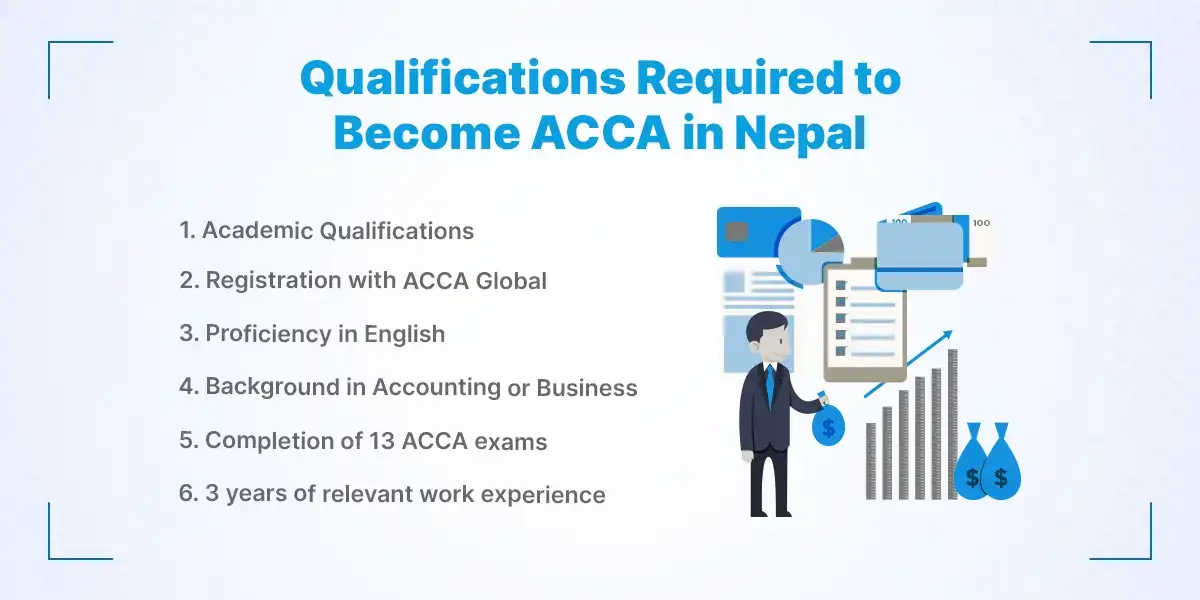
1. Academic Qualifications
The minimum requirement for starting ACCA would be to have completed +2 (Higher Secondary) or any equivalent level. That means, SEE alone will not suffice; at least 12 years of education should be completed. Candidates from any stream, be it Management or Science, are eligible. ACCA also takes on students who did A-levels or other foreign courses. So, it is open to many types of students.
2. Registration with ACCA Global
Before you start your ACCA journey, you have to be registered with ACCA Global, the parent body in the UK. This is done online. You will have to supply academic documents, identification, and a small registration fee. Once approved, verify that you have been issued a student ID and an online ACCA portal to utilize. This is where you reserve exams, track progress, and study notes. You cannot officially sit for ACCA exams without registering. So this is really a critical step to advance your journey.
3. English proficiency
Since ACCA exams and study guides are in English, you must be accustomed to reading, writing, and understanding English. You do not need to be perfect, but you must be able to understand the material easily. Good English allows you to understand accounting terms, write exam answers, and interact in the workplace. Poor English will make it hard for you to take the course. Therefore, some students take foundation English or IELTS beforehand. Fluency also helps in job interviews and presentations in the future.
4. Accounting or Business Background
It is not mandatory, but it will be helpful if you have studied accounting, business, or finance. If you studied accounts or economics at school or college, then the topics will be understood by you better. You have already studied concepts like debit-credit, financial statements, and business laws. Non-business students can also try ACCA, but they might need more time in the beginning. It is simpler to learn more quickly and be more confident if you have a business background. If you are still a student and looking ahead, choosing accounting modules is a worthwhile decision.
Explore Advanced Accounting Training in Nepal !
5. Passing 13 ACCA Exams
To attain the full ACCA membership status, you will need to pass 13 exams. These are divided into three levels: Applied Knowledge, Applied Skills, and Strategic Professional. You can sit for four exams annually, and most students pass in 3-5 years. Each exam is on a separate topic like accounting, taxation, audit, or finance management. There is some exemption for certain students based on previous degrees. But the others must do most of these 13 papers as well. The good news? You don't have to do them all at once.
6. 3 Years of Relevant Work Experience
In addition to passing tests, you also have to have 3 years of on-the-job work experience. This can be undertaken before, during, or after you take your tests. The job can be work in accounting, audit, finance, or other related sectors. You do not have to work full-time. Part-time jobs, training positions, or internships will do too if they meet ACCA's requirements. This experience allows you to apply what you've learned. Upon completion, you will report it online via your ACCA account. You will only then be a member of ACCA officially.
Conclusion
The ACCA profession in Nepal is growing quickly in 2026. Salaries are better, and job opportunities are increasing in both private and public jobs. New graduates can earn between NPR 20,000 and NPR 40,000 per month, while those with experience can make over NPR 100,000. Private companies offer faster growth and higher pay, while government jobs provide more stability.
With the right skills and hard work, ACCA can change your life. It’s not just about numbers; it’s about having a respected and flexible career. ACCA professionals in Nepal can work in banks or join international companies, giving them many options. If you want a future in finance or accounting, this could be a great choice. It may take time, but the benefits are worth it.
Looking for more job opportunities? Kumari Job helps you find the right career path easily and quickly.
Frequently Asked Questions
Submit your comments

Get Our App On



SEO Training for Freshers in Nepal: Skills, Career & Job Opportunities
VIEW DETAILS
SEO Training vs. Self-Learning: Which Is Right for You?
VIEW DETAILS
How to Choose Between Two Job Offers
VIEW DETAILS
Digital Marketing Training Interview Questions and Answers for Freshers
VIEW DETAILS


Loading Comments...