

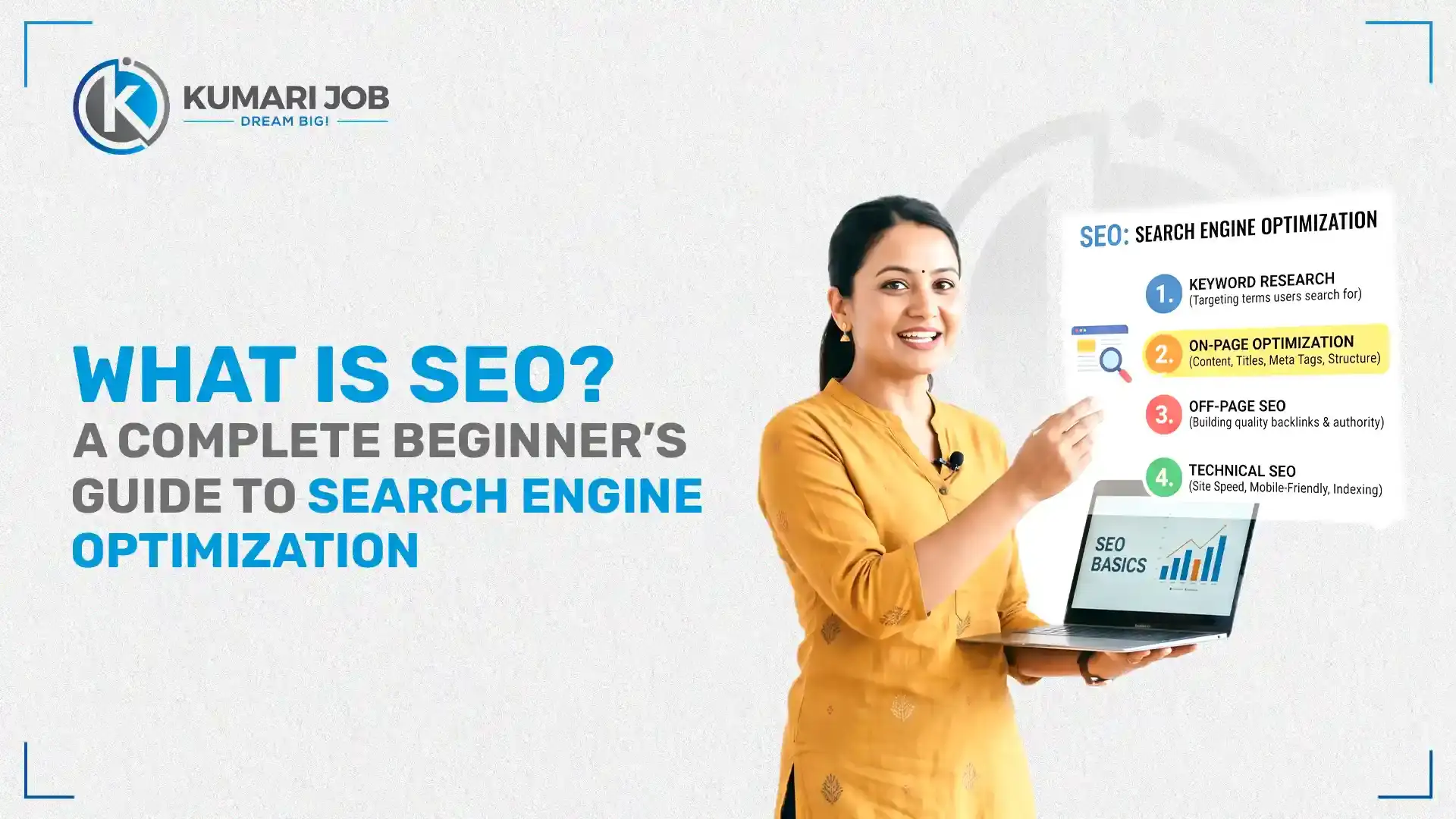

Every day, millions of people use Google to search for products, services, and information. If your website does not appear on the first page of search results, potential customers may never find your business. This is where SEO (Search Engine Optimization) becomes important. SEO helps improve your website’s visibility in search engines and brings more organic traffic without paying for ads.
Whether you are a student, business owner, marketer, or beginner, understanding SEO can help you grow your online presence. In this guide, you will learn what SEO is, why it matters, how search engines work, the different types of SEO, and the key strategies used to improve website rankings and attract qualified visitors.
In this blog
What is SEO?
SEO (Search Engine Optimization) is the process of improving a website’s visibility in search engine results to attract more organic traffic. It involves optimizing content, technical elements, and website authority so search engines can better understand and rank web pages for relevant searches. SEO helps websites appear higher in search results, making it easier for users to find information, products, or services.
The main goal of SEO is to increase organic (non-paid) traffic by improving a website’s relevance, quality, and user experience. Unlike paid search, which relies on advertising, SEO focuses on earning traffic naturally through better rankings. Search engines such as Google crawl, index, and rank web pages to deliver the most relevant results to users, making SEO an essential strategy for long-term online growth.
Why is SEO Important for Businesses and Websites?
SEO is important because it increases online visibility, attracts targeted visitors, improves credibility, and generates sustainable long-term growth. Businesses that invest in SEO can consistently reach potential customers at different stages of the buying journey without relying entirely on paid advertising.
Benefits of SEO
- Increases website visibility
- Drives targeted traffic
- Builds trust and credibility
- Improves user experience
- Generates long-term marketing ROI
- Supports business growth
- Enhances brand awareness
- Creates sustainable lead generation
How Do Search Engines Work?
Search engines work through three core processes: crawling, indexing, and ranking. These processes help search engines discover content, store information, and determine which pages should appear for specific searches.
1. Crawling
Search engines use automated bots to discover web pages across the internet. These bots follow links from one page to another and identify new or updated content. Proper internal linking helps search engines discover important pages more efficiently. A well-structured website improves crawling performance and coverage.
2. Indexing
After discovering a page, search engines analyze and store its content in massive databases called indexes. The indexing process evaluates text, images, metadata, and page structure. Pages with poor quality or technical issues may not be indexed correctly. Indexed pages become eligible to appear in search results.
3. Ranking
Ranking is the process of determining which pages appear first for a search query. Search engines evaluate hundreds of signals related to relevance, authority, quality, and user experience. The most useful and trustworthy pages typically earn higher rankings. Search intent plays a major role in determining visibility.
What Are the Main Types of SEO?
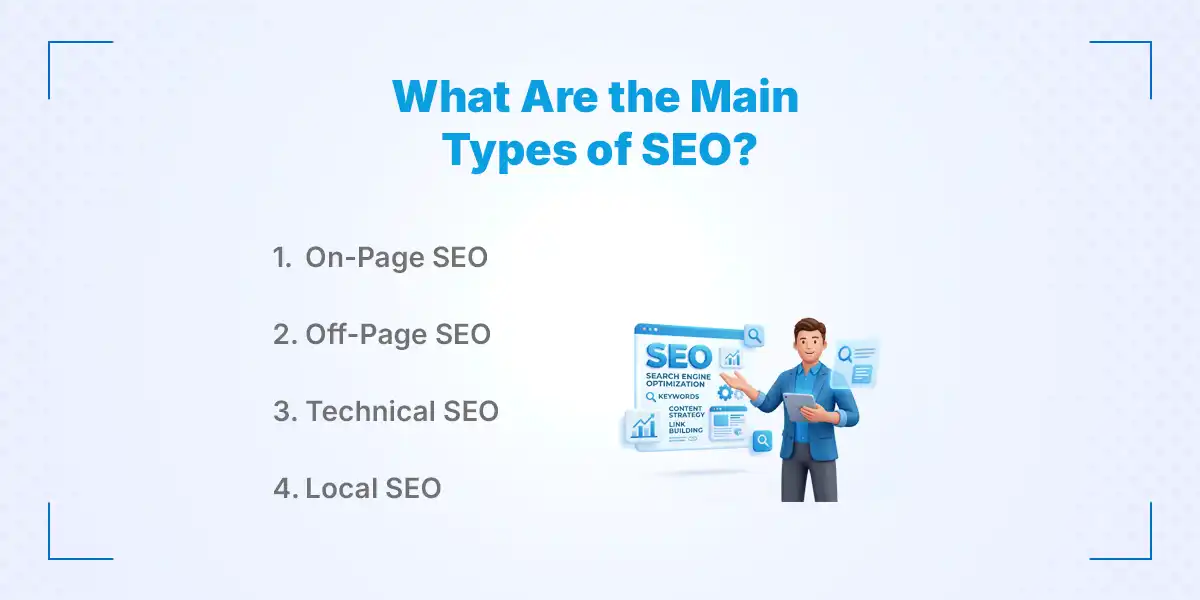
The main types of SEO are On-Page SEO, Off-Page SEO, Technical SEO, and Local SEO. These four categories work together to improve a website’s visibility in search engines, increase organic traffic, and help pages rank higher for relevant search queries.
1. On-Page SEO
On-page SEO focuses on optimizing content and page elements that users and search engines can directly access. This includes keyword placement, content quality, headings, and metadata. Strong on-page optimization helps search engines understand page relevance. It also improves the user experience and content accessibility.
2. Off-Page SEO
Off-page SEO focuses on activities that build a website's authority outside its own domain. Backlinks from trusted websites remain one of the strongest ranking signals. Brand mentions and digital PR efforts can also strengthen online credibility. Effective off-page SEO helps improve trust and search visibility.
3. Technical SEO
Technical SEO ensures that search engines can efficiently crawl, index, and understand a website. Key areas include website speed, mobile usability, structured data, and XML sitemaps. Technical improvements often enhance both rankings and user experience. A technically sound website provides a stronger foundation for SEO success.
4. Local SEO
Local SEO helps businesses appear in location-based searches and map results. Optimizing a Google Business Profile improves visibility for nearby customers. Local citations help validate business information across the web. Local SEO is especially valuable for service providers and physical businesses.
How Does SEO Work?
SEO works by improving content quality, technical performance, website authority, and user experience so search engines can rank pages more effectively. Successful SEO requires a combination of research, optimization, and ongoing performance analysis.
SEO Process
- Conduct keyword research to identify relevant search opportunities.
- Create high-quality content that addresses user intent.
- Optimize titles, headings, metadata, and internal links.
- Improve technical performance and website usability.
- Build quality backlinks from authoritative websites.
- Enhance user experience across devices.
- Monitor rankings, traffic, and conversion performance.
What Are the Most Important Google Ranking Factors?
Google uses multiple ranking factors to evaluate the relevance and quality of web pages. While algorithms constantly evolve, several factors consistently influence search visibility.
Key Ranking Factors
- High-quality content
- Search intent relevance
- Backlinks from authoritative websites
- Page experience
- Mobile optimization
- Core Web Vitals
- Website authority
- Internal linking structure
- HTTPS security
- User engagement signals
How to Become an SEO Expert in Nepal
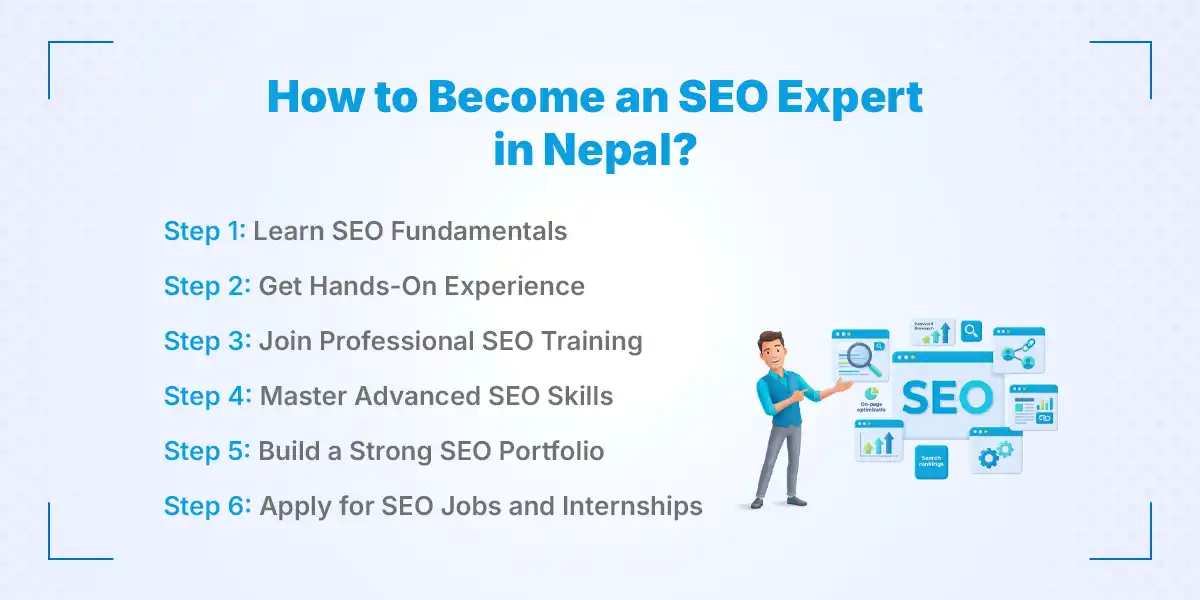
To become an SEO expert in Nepal, you should learn SEO fundamentals, practice on real websites, gain experience with SEO tools, and stay updated with search engine trends. Building practical skills through projects, training, and continuous learning is the key to becoming proficient in SEO.
1. Learn SEO Fundamentals
Understanding SEO fundamentals creates the foundation for long-term success. Start by learning how search engines crawl, index, and rank content. Study keyword research, content optimization, and technical SEO basics. A strong foundation makes advanced concepts easier to understand later.
2. Get Hands-On Experience
Practical experience helps transform theoretical knowledge into real-world skills. Create a website or blog and apply SEO techniques directly. Monitor performance using Google Analytics and Google Search Console. Testing and experimentation accelerate learning significantly.
3. Join Professional SEO Training
Professional SEO training provides structured learning, expert guidance, and practical experience to help you become job-ready faster. It helps learners understand real-world SEO strategies, work on live projects, and build confidence through hands-on practice.
Recommended Training: Kumari Job SEO Advanced Training
Kumari Job SEO Advanced Training is a complete program designed to build strong SEO skills from beginner to advanced level. It covers essential areas like On-Page SEO, Technical SEO, Off-Page SEO, Local SEO, Content Strategy, GA4, Google Search Console (GSC), Google Tag Manager (GTM), and AI-powered SEO techniques.
The training includes practical, real-world projects that help learners apply SEO strategies effectively. It is suitable for beginners, students, marketers, entrepreneurs, and business owners who want to build a strong career in digital marketing and SEO.
4. Master Advanced SEO Skills
Advanced SEO skills help professionals handle complex optimization challenges. Focus on technical audits, Core Web Vitals, schema markup, and content clusters. Learning AEO and AI-driven search optimization provides a competitive advantage. Advanced expertise increases career opportunities and project success rates.
5. Build a Strong SEO Portfolio
A strong portfolio demonstrates practical SEO capabilities and measurable results. Include case studies, ranking improvements, and traffic growth examples. Document challenges, strategies, and outcomes clearly. A professional portfolio strengthens credibility during job applications and client pitches.
6. Apply for SEO Jobs and Internships
Job opportunities in SEO continue to grow as businesses invest more in online visibility and organic growth. Popular career paths include SEO Executive, Junior SEO Specialist, SEO Analyst, Technical SEO Executive, Content Marketing Specialist, Digital Marketing Executive, and SEO Manager. Internship programs provide valuable hands-on experience with real-world SEO projects, while freelancing offers opportunities to work with local and international clients. With the right skills and practical experience, learners can pursue rewarding SEO jobs in Nepal and global remote SEO opportunities.
How Long Does SEO Take to Show Results?
SEO typically takes between three and six months to show measurable improvements, although competitive industries may require longer timelines. Results depend on website authority, competition levels, content quality, technical health, and the consistency of optimization efforts.
Factors That Affect SEO Timelines
- Competition level
- Website authority
- Content quality
- Technical SEO performance
- Backlink profile
- Keyword difficulty
- Consistency of optimization
- Industry competitiveness
The Future of SEO
SEO continues to evolve as search engines become more sophisticated and user expectations change. Businesses that adapt to emerging search technologies will maintain stronger visibility and competitiveness.
Emerging SEO Trends
- AI-powered search
- Answer Engine Optimization (AEO)
- Voice search optimization
- Semantic search
- User experience signals
- Entity-based SEO
- Generative search experiences
- Multimodal search optimization
Conclusion
SEO remains one of the most effective digital marketing strategies for building sustainable online visibility, attracting qualified traffic, and supporting long-term business growth. Organizations that focus on content quality, technical excellence, user experience, and authority building are better positioned to succeed in modern search environments.
The most important step is to start implementing SEO consistently rather than waiting for perfect conditions. If you want to develop advanced SEO skills, gain hands-on experience, and build a sustainable organic traffic strategy, explore the Advanced SEO Training program offered by Kumarijob.
Frequently Asked Questions
Submit your comments

Get Our App On



SEO Training for Freshers in Nepal: Skills, Career & Job Opportunities
VIEW DETAILS
SEO Training vs. Self-Learning: Which Is Right for You?
VIEW DETAILS
How to Choose Between Two Job Offers
VIEW DETAILS
Digital Marketing Training Interview Questions and Answers for Freshers
VIEW DETAILS


Loading Comments...