


Preparing for a graphic designer interview can be challenging when you are unsure what the interviewer will ask about your creativity, software skills, portfolio, or design process. Many candidates know how to use design tools but struggle to explain their decisions, handle feedback, or connect their work to business goals.
The best approach is to prepare for both technical and behavioral questions and support your answers with real examples from your projects. This guide covers common graphic designer interview questions for freshers and experienced designers, including portfolio, software, design principles, workplace situations, and practical preparation tips.
In this blog
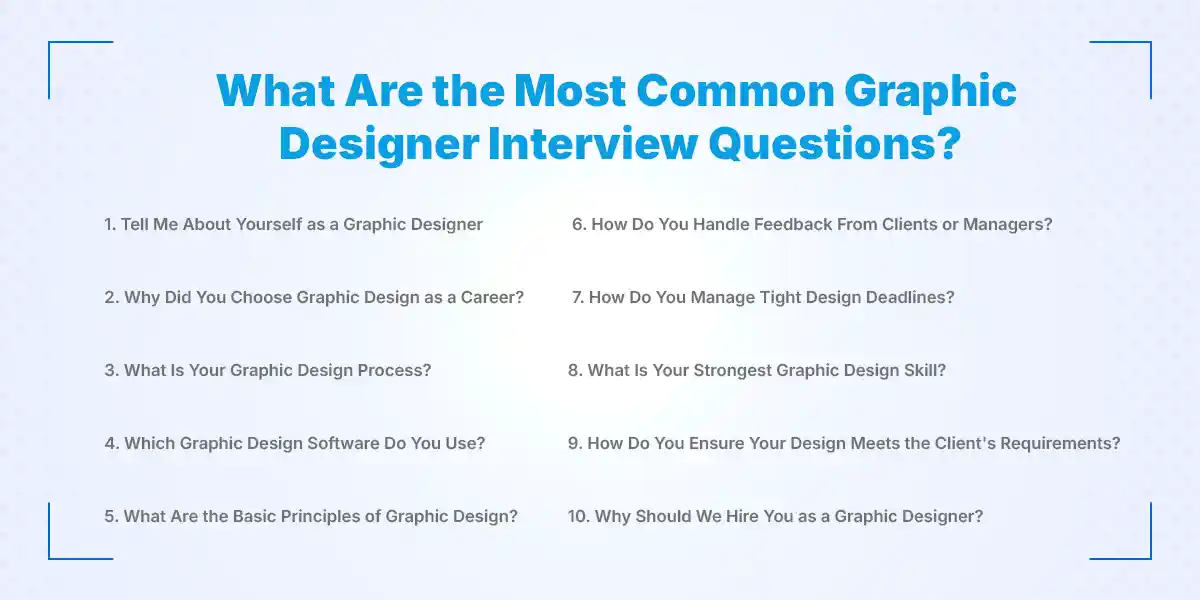
What Are the Most Common Graphic Designer Interview Questions?
The most common graphic designer interview questions assess your design knowledge, creative thinking, software skills, portfolio, communication, and problem-solving ability. Interviewers usually want to understand not only what you can design but also how you approach a brief, explain your decisions, and respond to feedback. Preparing examples from your previous projects can help you give clearer and more confident answers.
1. Tell Me About Yourself as a Graphic Designer
Start by briefly introducing your education, training, experience, and main areas of graphic design. Mention relevant skills such as branding, social media design, typography, illustration, print design, or UI design. Connect your background to the position instead of giving unrelated personal information. A strong answer should show what you can contribute to the company and what type of designer you want to become.
2. Why Did You Choose Graphic Design as a Career?
Explain what attracted you to visual communication and creative problem-solving. You can mention how you enjoy turning ideas, information, or business goals into clear visual content. Avoid giving an answer based only on liking drawing because professional graphic design involves research, communication, strategy, and technical execution. Show that you understand the difference between artistic expression and design for a specific audience or purpose.
3. What Is Your Graphic Design Process?
A strong graphic design job process normally starts with understanding the brief, target audience, objectives, and brand requirements. Next, research the subject, collect references, develop concepts, create initial designs, and review the work against the brief. After receiving feedback, make necessary revisions and prepare the final files in the correct formats and dimensions required for the graphic design job. Explaining this process shows the interviewer that you can work systematically and create designs that meet both client and company requirements rather than relying only on personal preference.
4. Which Graphic Design Software Do You Use?
Mention the software you actually know and explain what you use each tool for. Common tools include Adobe Photoshop for image editing, Adobe Illustrator for vector graphics, Adobe InDesign for layouts, Figma for interface design, and Canva for quick visual content. Do not claim advanced knowledge of software that you have only used occasionally. Instead, describe your strongest tools and provide examples of projects created with them.
5. What Are the Basic Principles of Graphic Design?
The basic principles of graphic design include balance, contrast, alignment, proximity, repetition, hierarchy, and emphasis. These principles help designers organize information and create visual relationships that are easy for audiences to understand. For example, visual hierarchy can guide viewers toward the most important headline or call to action. During an interview, give a simple example of how you have applied one or more principles in an actual project.
6. How Do You Handle Feedback From Clients or Managers?
Treat constructive feedback as part of the design process rather than as a personal criticism. First, understand exactly what needs to change and ask questions if the feedback is unclear or conflicts with the original brief. Then evaluate the requested changes against the target audience, brand guidelines, and project objectives. This approach demonstrates professionalism, flexibility, communication skills, and a willingness to improve the final design.
7. How Do You Manage Tight Design Deadlines?
Begin by understanding the deadline, project priority, required deliverables, and approval process. Break the project into smaller tasks such as research, concept development, design, revisions, and final delivery. Communicate early if you identify a realistic problem that could affect the deadline instead of waiting until the last moment. Good time management allows you to maintain design quality while completing work within the required timeframe.
8. What Is Your Strongest Graphic Design Skill?
Choose a skill that genuinely represents your strongest area rather than listing every design skill you know. You could focus on branding, logo design, social media graphics, typography, illustration, UI design, or visual communication. Support your answer with a specific portfolio example that demonstrates how you used that skill to solve a design problem. This makes your answer more credible and gives the interviewer something concrete to discuss.
9. How Do You Ensure Your Design Meets the Client's Requirements?
Start by reviewing the design brief and identifying the purpose, audience, message, dimensions, brand guidelines, and required deliverables. Before finalizing the design, compare the work against those requirements instead of judging it only by whether it looks attractive. Ask for clarification when the brief contains conflicting or incomplete information. A final checklist for spelling, dimensions, colors, typography, file formats, and brand consistency can prevent avoidable mistakes.
10. Why Should We Hire You as a Graphic Designer?
Explain how your combination of design skills, technical knowledge, creativity, communication, and reliability matches the position. Mention the type of work you can handle and connect those abilities to the company's requirements. Use one or two portfolio examples to demonstrate that you can turn requirements into practical visual solutions. Keep the answer specific and confident instead of simply saying that you are hardworking or creative.
Graphic Designer Interview Questions for Freshers
Graphic designer interview questions for freshers usually focus on basic design knowledge, software skills, portfolio projects, creativity, and how you approach new design tasks.
- Tell me about your graphic design education or training.
- What design projects have you worked on?
- Which graphic design tools are you familiar with?
- How do you create a design from scratch?
- How do you build a graphic design portfolio?
- How do you handle a design task you have never worked on before?
- What type of graphic design interests you most?
- How do you stay updated with graphic design trends?
Graphic Designer Interview Questions for Experienced Designers
Experienced graphic designers are commonly asked about project management, client communication, brand consistency, design performance, teamwork, revisions, and leadership skills.
- How do you manage multiple design projects?
- How do you handle difficult clients?
- How do you maintain brand consistency?
- How do you measure the effectiveness of your designs?
- What is the most challenging design project you have completed?
- How do you manage revisions?
- How do you collaborate with marketing and content teams?
- How do you mentor junior graphic designers?
Technical Graphic Designer Interview Questions
Technical questions test whether you understand the fundamentals behind professional graphic design rather than simply knowing how to operate software.
- What is the difference between RGB and CMYK?
- What are vector graphics?
- What are raster graphics?
- What is DPI and why does it matter?
- What is typography?
- What is color theory?
- What is visual hierarchy?
- What is the difference between PNG, JPG, SVG, and PDF?
- What is the difference between Photoshop and Illustrator?
- What is responsive design?
A good strategy is to learn the practical application of each concept instead of memorizing definitions. For example, you should understand why a designer may choose CMYK for certain print workflows and RGB for screen-based content, or why vector graphics are useful for logos that need to scale to different sizes.
Graphic Design Portfolio Interview Questions
Your portfolio is often one of the strongest pieces of evidence you can provide during a graphic design interview. Select projects that demonstrate different skills while keeping the presentation focused on your strongest work.
- Which project in your portfolio are you most proud of?
- What was your role in your favorite design project?
- How did you solve a design problem in one of your projects?
- How do you explain your design decisions?
- Which portfolio project best represents your skills?
- How do you present your portfolio during an interview?
When presenting a project, explain the brief, problem, process, design decision, and outcome. Do not simply show the final image and say that you created it; interviewers often learn more from understanding how you reached the final solution.
Behavioral Graphic Designer Interview Questions
Behavioral questions help employers understand how you respond to real workplace situations. Use specific examples and explain what happened, what action you took, and what you learned from the experience.
- Tell me about a time you received negative feedback on a design.
- Describe a difficult design project you completed.
- Tell me about a time you worked under pressure.
- Describe a situation where you disagreed with a client.
- Tell me about a time you made a design mistake and how you fixed it.
- How do you work as part of a creative team?
For experience-based answers, the STAR method can make your response easier to follow: explain the Situation, Task, Action, and Result. Keep the example relevant to the position and focus more on your actions and learning than on blaming another person or department.
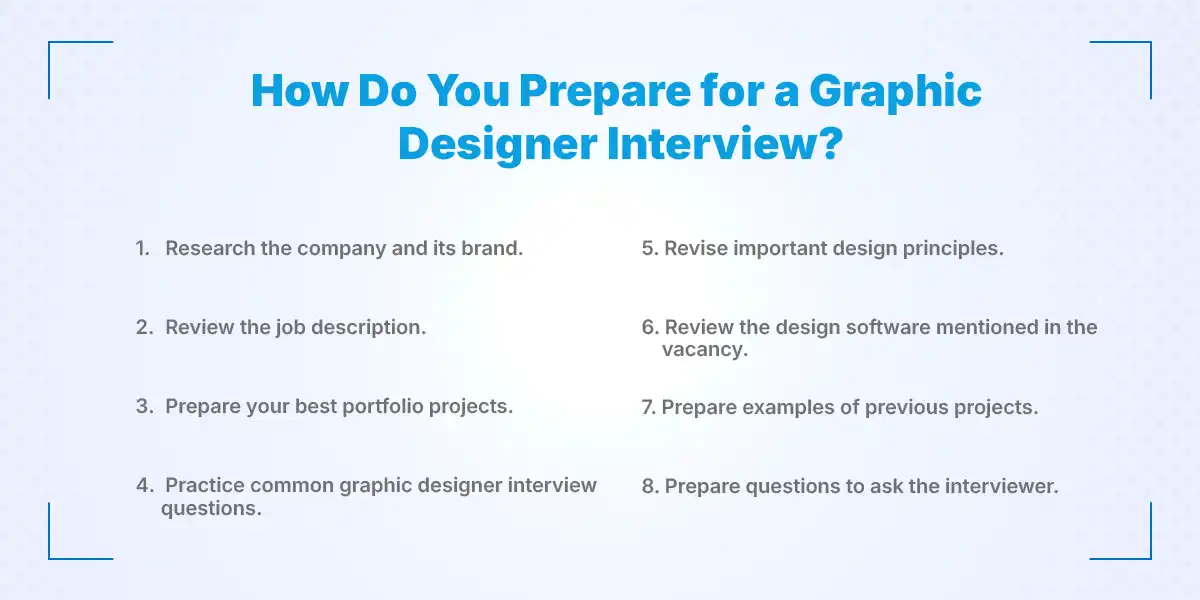
How Do You Prepare for a Graphic Designer Interview?
You can prepare for a graphic designer interview by researching the company, reviewing the job requirements, preparing your portfolio, and practicing common interview questions. Focus on understanding the employer's expectations and preparing clear examples that demonstrate your creativity, technical skills, and problem-solving ability.
1. Research the Company and Its Brand
Learn about the company's products, services, target audience, visual style, and recent marketing campaigns. This helps you understand the type of design work you may handle.
2. Review the Job Description
Identify the required design skills, software, experience, and responsibilities mentioned in the vacancy. Prepare examples that show how your skills match the requirements.
3. Prepare Your Best Portfolio Projects
Select relevant projects that demonstrate your strongest graphic design skills. Be ready to explain your design process, decisions, challenges, and final results.
4. Practice Common Graphic Designer Interview Questions
Practice questions about your experience, design process, software skills, portfolio, teamwork, and handling feedback. Keep your answers clear and support them with practical examples.
5. Revise Important Design Principles
Review typography, color theory, visual hierarchy, balance, contrast, alignment, and composition. Understanding these fundamentals can help you answer technical graphic design interview questions confidently.
6. Review the Design Software Mentioned in the Vacancy
Refresh your knowledge of tools such as Photoshop, Illustrator, InDesign, Figma, or Canva if they are relevant to the position. Focus especially on the features you may use in the actual graphic design job.
7. Prepare Examples of Previous Projects
Keep examples ready for questions about deadlines, client feedback, difficult projects, design mistakes, and teamwork. Use specific situations to show how you solved problems and improved your work.
8. Prepare Questions to Ask the Interviewer
Prepare relevant questions about the design team, projects, workflow, tools, expectations, and career growth. Asking thoughtful questions shows that you are interested in the graphic designer position and the company.
Skills Employers Look for in a Graphic Designer
Employers generally look for a combination of creative, technical, communication, and workplace skills. Software knowledge alone is rarely enough because professional designers must understand requirements and communicate visual ideas effectively.
- Creativity and originality: Develop fresh visual concepts that suit the project.
- Adobe Creative Suite skills: Work efficiently with relevant professional design software.
- Typography and color theory: Create readable and visually consistent designs.
- Branding and visual identity: Maintain a consistent appearance across different materials.
- Communication skills: Explain design decisions clearly to clients and team members.
- Time management: Complete projects according to agreed deadlines.
- Problem-solving: Find practical design solutions when requirements or constraints change.
- Attention to detail: Identify errors in typography, spacing, alignment, colors, and file preparation.
- Portfolio presentation: Demonstrate skills through relevant and well-explained projects.
- Ability to accept feedback: Use constructive feedback to improve the final result.
Questions to Ask the Interviewer
An interview should not be treated as a one-way conversation because you also need to understand whether the role fits your career goals and working style. Prepare two or three questions that help you learn about the design team, responsibilities, workflow, and expectations.
- What type of design projects would I work on?
- What design tools does the team use?
- Who would I work with most closely?
- How does the company handle design feedback?
- What would success look like in this role?
- Are there opportunities for professional growth?
Avoid asking questions that the job description or company website already answers clearly. Instead, use the interview to learn about the actual workflow, team structure, expectations, and challenges associated with the position.
Conclusion
A strong graphic designer interview is not simply about proving that you can use Photoshop, Illustrator, Figma, or another design tool. The stronger candidate can explain why they made a design decision, understand the target audience, respond professionally to feedback, manage deadlines, and demonstrate these abilities through a relevant portfolio. Your goal should be to enter the interview with a clear understanding of the role and several real examples that prove your skills.
If you are looking for graphic design vacancies and other career opportunities in Nepal, Kumari Job can help you explore relevant job opportunities and take the next step in your career.
Frequently Asked Questions
Submit your comments

Get Our App On


SEO Training for Freshers in Nepal: Skills, Career & Job Opportunities
VIEW DETAILS
SEO Training vs. Self-Learning: Which Is Right for You?
VIEW DETAILS
How to Choose Between Two Job Offers
VIEW DETAILS
Digital Marketing Training Interview Questions and Answers for Freshers
VIEW DETAILS


Loading Comments...