

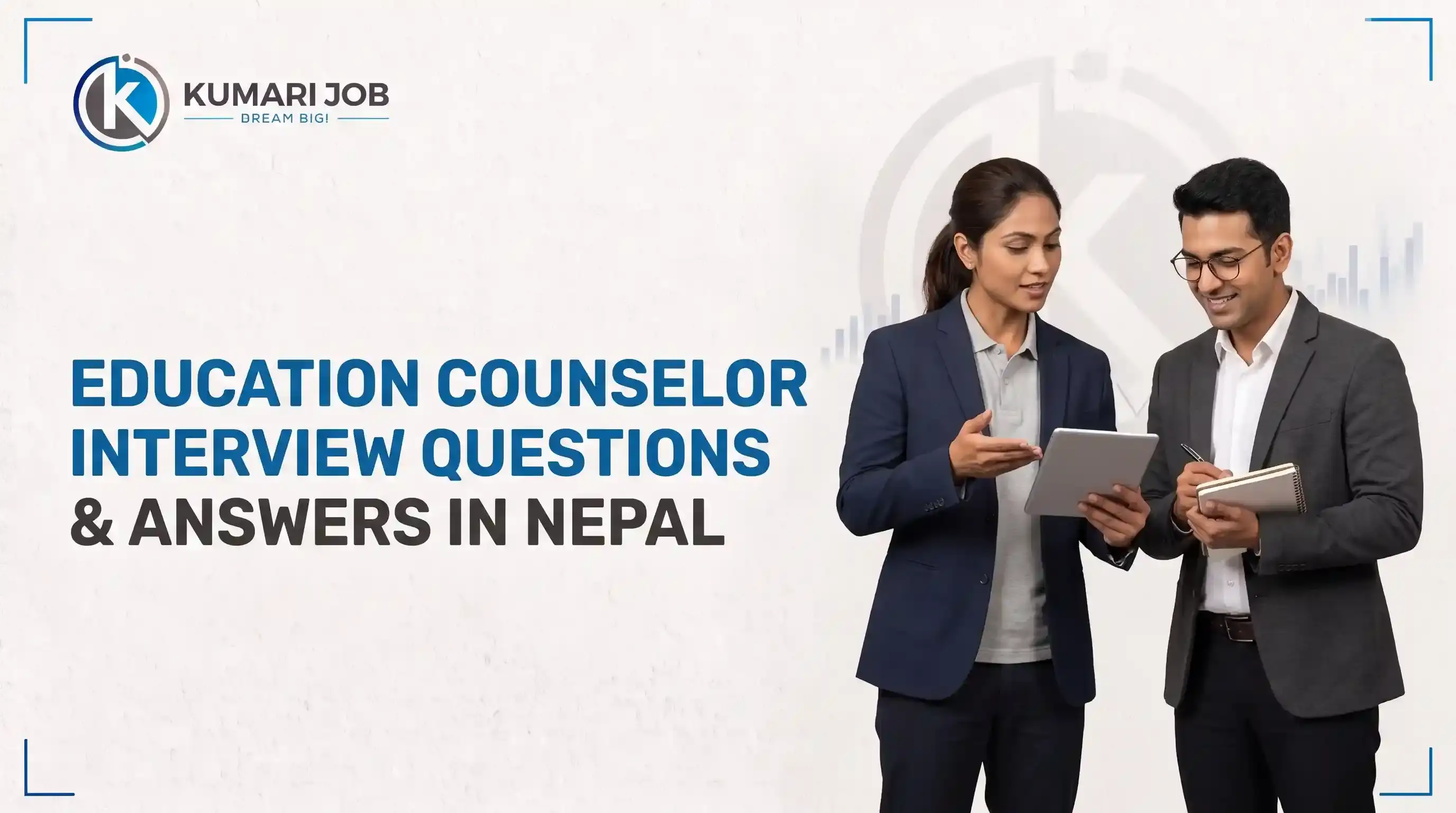

Education counseling is a popular career option in Nepal’s study abroad sector. Consultancies hire education counselors to guide students through course selection, university admissions, scholarships, and visa preparation, making these roles relevant to graduates interested in education and student advising.
During an interview, employers assess your communication skills, understanding of admission procedures, honesty, and ability to manage student inquiries and documentation. This guide covers education counselor interview questions and answers in Nepal, with practical sample answers, preparation tips, essential skills, and career opportunities to help you prepare confidently.
In this blog
What Are the Most Common Education Counselor Interview Questions?
The most common education counselor interview questions ask you to introduce yourself, explain why you chose counseling, show you know the consultancy, and prove why you are the right hire. Consultancies in Nepal ask these because they reveal how clearly you speak and how well you prepared. Keep every answer under one minute.
1. Tell me about yourself.
Use a three-part answer covering your present, your past, and your goal. For example, say, “I recently completed my BBS, I helped students with admission inquiries at a language institute, and I want to grow into a study abroad counseling role.” Practise it aloud, and do not simply recite your CV.
2. Why do you want to become an education counselor?
Give a real reason, not “I like helping people.” You might say you wish someone had guided you honestly when you chose your own course. Connect it to a small experience, like guiding juniors at college. Avoid saying “I need any job,” because it signals low commitment.
3. What do you know about our consultancy?
This shows whether you did your homework. Read the website and social pages before the interview, and mention one service, one destination, and one thing you noticed, such as a scholarship webinar. Only mention what you have verified, and end with a question like “Which destination desk will this role support?”
4. Why should we hire you?
Match two or three strengths from the job description to one proof point each. A fresher might say, “I communicate clearly with parents, I keep documents organized, and I managed registration records for a three-day college event.” Close with a promise to give honest advice and follow the consultancy’s process.
5. What are your strengths?
Choose strengths that matter in counseling, such as listening, honesty, organization, and persistence. Give each one a short example and explain how it helps the student. Keep it to three strengths so the answer stays sharp and perfectly aligns with the skills for your resume.
How Can Freshers Answer Education Counselor Interview Questions?
Freshers can answer by using college projects, part-time work, and volunteering as proof of counseling ability. Many consultancies hire for attitude and train new counselors on destination rules, which is a great way to get experience without a job initially. Give short examples and show that you are ready to learn.
1. How do you answer without counseling experience?
Be honest, then move to transferable skills. Talk about guiding juniors, working at a help desk, or tutoring. Say something like, “I have not worked as a counselor yet, but I helped 20 classmates complete their college applications.” Finish by showing eagerness to learn the destinations and admission process.
2. What would you do if you did not know a student’s question?
Admit it, then show how you find the answer. Explain that you would check the official university or immigration website, ask a senior colleague, and return to the student with a confirmed answer. Never guess, because a wrong answer about admission or visa rules can seriously harm a student.
3. What skills make you suitable for counseling?
Pick the three that best match the job post, such as communication, listening, and attention to detail, and back each with one short story. Mention that you can explain a process clearly in both Nepali and English, which helps students and parents equally.
What Counseling, Study Abroad, and Visa Questions Are Asked?
Interviewers ask about course selection, admission documents, and visas to assess your ability to guide students responsibly. Since requirements vary by country and change over time, emphasize checking official sources and never guaranteeing an outcome.
1. How Would You Help a Student Choose the Right Course and University?
Ask about the student's academic background, interests, career goals, budget, and preferred destination before suggesting suitable options. Explain the entry requirements, costs, and course benefits clearly so the student can make an informed decision without pressure.
2. How Would You Counsel a Student With Low Grades?
Review the student's overall profile, including academic records, test scores, and relevant experience, to identify realistic options. Discuss alternatives such as foundation or pathway programs where available, without promising admission.
3. How Would You Handle a Student Who Is Unsure About Studying Abroad?
Listen to the student's concerns about costs, family, or future plans before discussing possible options. Explain the benefits, challenges, and alternatives, including studying in Nepal, without pressuring the student to proceed.
4. What Factors Should Students Consider When Choosing a Study Destination?
Consider tuition fees, living costs, course availability, English test requirements, scholarships, student work rules, and visa requirements. Compare suitable destinations based on the student's budget, academic background, and future goals.
5. What Documents Are Generally Required for University Admission?
Common documents include academic transcripts, a passport, English test results where required, a statement of purpose, recommendation letters, and proof of finances where applicable. Explain that requirements vary by institution and country, so you would verify the official checklist for each student.
6. How Would You Explain the Student Visa Process?
Outline the main steps, including receiving an offer, preparing documents, submitting the visa application, and completing any required biometrics or interviews. Check the official immigration website for current requirements and explain that visa approval cannot be guaranteed.
How Do You Answer Scenario-Based and Difficult Questions?
You answer these by staying calm, putting honesty first, and showing a clear step-by-step response. Interviewers use them to see how you behave when pressure, money, or expectations are involved. Use the STAR method, which means Situation, Task, Action, and Result, to keep your answer tight.
1. Can you guarantee my visa?
Say no, kindly and clearly. Visa decisions are made by immigration authorities, so no counselor can honestly guarantee an outcome. Then explain what you can do: prepare a complete and accurate application, advise on documents, and support the student throughout. Interviewers listen for this answer more than any other.
2. How would you handle a student whose visa was rejected?
Stay calm and supportive, then review the refusal reason with the student. Depending on the case, the options might include reapplying with stronger documents, applying to another institution or country, or choosing a different plan. Be clear about what can and cannot be changed, and never blame the student or promise an easy fix.
3. What would you do if a student asked you to provide false information?
Refuse politely. Explain that false documents can lead to rejection, bans, or cancelled admission and could harm the student and the consultancy. Offer to help build an honest application and inform your supervisor if needed. Do not hesitate or say “it depends.”
4. How would you handle an upset student or parent?
Listen without interrupting, acknowledge the concern, and avoid becoming defensive. Clarify the facts, explain what can be done, and set a clear time for the next update. If the issue is beyond your authority, involve your supervisor quickly and keep the family informed.
5. How would you manage multiple applications and deadlines?
Keep a tracker for every student with deadlines, documents received, documents missing, and next steps. Prioritize by deadline and give students earlier internal deadlines so there is a buffer. Leave clear notes so a colleague can take over a file without confusion.
How Can You Prepare for an Education Counselor Interview in Nepal?
Prepare by researching the consultancy, learning the basics of popular destinations, rehearsing your answers, and presenting yourself professionally. Start at least three days before the interview and ask a friend to run a mock interview. You should also check whether the roles are listed on the best job portal in Nepal.
Research the consultancy: Read its website, social pages, services, and partner institutions, and note one thing you admire.
Learn the destinations: Study the official education and immigration pages for the countries it handles, including intakes, English tests, and visa steps.
Practice your answers: Answer aloud and record yourself to check your pace and clarity.
Prepare real examples: Choose situations from internships, jobs, or projects and use the STAR method.
Prepare your documents: Carry printed copies of your CV, ID, and certificates, and keep your introduction under one minute.
Dress professionally and arrive early: Wear neat formal clothes, reach the venue 15 minutes early, and silence your phone, whether you are applying for remote or in-office jobs in Nepal.
Also prepare questions for the interviewer, such as how new counselors are trained and how targets and incentives work.
What Mistakes Should You Avoid in an Education Counselor Interview?
The mistakes to avoid are overpromising, weak knowledge of destinations, dishonesty, negative talk about past employers, and poor preparation. Each tells the interviewer you may harm students or the consultancy’s reputation, which can quickly ruin your chances of getting hired for roles listed on reputable job portals.
Promising visas or admissions: No counselor can guarantee an outcome, and saying so is a serious red flag.
Showing weak knowledge of destinations: Learn the fundamentals before the interview.
Lying about experience: Employers check references, and a lie can cost you the offer or the job later.
Speaking negatively about past employers or competitors: Describe what you learned instead.
Giving unclear or very long answers: Use short sentences and one example per answer.
Conclusion
Education counselor interviews reward honesty, preparation, and clear communication rather than big promises. Show that you can listen to students, verify information, and guide families with realistic advice. Use examples from college, part-time work, or volunteering to demonstrate your skills.
Prepare five personal examples linked to relevant skills and practice explaining each in under a minute. Then explore current education counselors and admission vacancies on Kumari Job, choose suitable roles, and tailor your CV to highlight the strengths and experience you can discuss confidently during the interview. Ready to guide students on their study abroad journey? Explore the latest study visa counselor jobs in Nepal today and take the next step in your career.
Frequently Asked Questions
Submit your comments

Get Our App On


Best Part-Time Jobs During Dashain in Nepal
VIEW DETAILS
Finance Jobs vs. Accounting Jobs in Nepal: Duties, Differences, and Career Opportunities
VIEW DETAILS
Can You Get a Hotel Job Without a Hotel Management Degree in Nepal?
VIEW DETAILS
Sales Job Interview Questions and Answers in Nepal
VIEW DETAILS


Loading Comments...