



You sit in a waiting room in Kathmandu with your CV in hand, and the interviewer opens with Sell me this pen. Your mind goes blank, your palms sweat, and the answer you practised last night disappears. Many candidates know the product and understand the job, yet they lose the offer in the first five minutes because they never rehearsed how to speak about themselves.
Sales interviews follow clear patterns, and you can prepare for every one of them. This guide covers the most common sales interview questions in Nepal, with sample answers for freshers and experienced candidates, plus practical advice on targets, objections, preparation, and mistakes to avoid.
In this blog
What Are the Most Common Sales Interview Questions?
The most common sales interview questions ask you to introduce yourself, explain why you chose sales, show your value, name your strengths, and prove you know the company. Interviewers in Nepal ask these because they quickly reveal how clearly you speak and how well you prepared. Plan a short, honest answer to each one and keep every answer under one minute.
1. Tell me about yourself.
This question tests how well you can pitch the most important product in the room, which is you. Use a simple three-part answer covering your present, your past, and your goal. For example, say I recently completed my BBA, I led a sales campaign for my college fest, and I want to grow into a field sales role." Practise it aloud until it sounds natural and finishes within sixty seconds.
2. Why do you want to work in sales?
Interviewers want proof that you chose sales on purpose and did not land there by accident. Name a real reason, such as enjoying conversations, wanting income linked to effort, or liking the challenge of targets. Connect that reason to a small past experience, like selling at a family shop or running a campaign at college. Avoid saying "I need any job," because it signals low commitment.
3. Why should we hire you?
This question asks you to match your skills to the employer's needs. Pick two or three strengths from the job description and attach one proof point to each. A fresher might say, "I communicate clearly, I learn fast, and I raised funds for a college event by pitching to local businesses. Close with a promise to follow the company's process and work toward its targets.
4. What are your strengths?
Choose strengths that matter in sales, such as listening, persistence, honesty, and product learning. Give each strength one short example so the interviewer can believe it. Explain how each strength helps customers and the team, not just you. Keep the answer to three strengths so it stays sharp and easy to remember.
5. What do you know about our company?
This question shows whether you did your homework. Read the company website, product list, social media pages, and recent news before the interview. Mention one product, one customer group, and one reason you like the brand. End with a question, such as "Which market area will this role cover?" to show real interest.
How Can Freshers Answer Sales Interview Questions?
Freshers can answer sales interview questions by using school projects, part-time work, and personal skills as proof of sales ability. Interviewers hire for attitude and learning speed when experience is missing. Give short examples, speak with confidence, and show that you will work hard in the field.
1. How do you answer without sales experience?
Be honest about your lack of experience and then move to transferable skills. Talk about persuading classmates, managing a stall, tutoring, or helping at a family business. Say something like, "I have not worked in sales yet, but I convinced 30 students to join our club event." Finish by showing eagerness to learn the product and the sales process.
2. How would you convince a customer to buy a product?
Start by asking questions to learn what the customer needs. Then link one feature of the product to that need and explain the benefit in simple words. Support it with a proof point, such as a demo, a warranty, or a customer review. Ask for the sale politely at the end instead of waiting for the customer to decide alone.
3. How do you handle rejection?
Rejection is normal in sales, and interviewers want to see a calm, practical response. Explain that you treat a "no" as feedback on the pitch and never as a judgment on you. Mention that you review what happened, adjust your approach, and move to the next customer. Share a small example, like a failed pitch at college that taught you to ask better questions.
4. What skills make you suitable for sales?
The skills that matter most are communication, listening, persistence, time management, and basic number skills. Pick the three that best match the job post. Back each skill with one short story so your answer sounds real. Mention language ability too, since speaking Nepali, English, and a local language such as Maithili or Newari can help you serve more customers.
What Questions Are Asked About Sales Skills?
Interviewers ask about communication, complaint handling, negotiation, and closing to test the core skills a salesperson uses every day. These are usually situation-based questions, so a clear example works better than a general statement. Use the STAR method, which means Situation, Task, Action, and Result, to keep your answer tight.
1. How do you communicate with customers?
Good communication starts with listening, not talking. Explain that you ask open questions, repeat the customer's need in your own words, and then recommend a product. Mention that you adjust your tone and language, such as switching between Nepali and English, to suit the customer. Add that you confirm the details in writing, through a message or invoice, to avoid confusion later.
2. How do you handle customer complaints?
A strong answer follows four steps: listen, apologise, fix, and follow up. Let the customer finish speaking without interruption, and then repeat the problem to show you understood. Offer a clear solution or a firm timeline, and keep your promise. Check back after the fix, since this follow-up often turns an angry customer into a loyal one.
3. How do you negotiate with customers?
Negotiation works best when both sides feel they won something. Explain that you know your price limit and discount rules before the conversation starts. Trade value instead of cutting price, for example by offering free delivery, a longer warranty, or a bundle. Say that you never promise what the company cannot deliver.
4. How do you close a sale?
Closing means asking for a clear decision after you answer the customer's doubts. Describe how you watch for buying signals, such as questions about price, delivery, or payment options. Then use a simple closing line like, "Shall I prepare the order for you today?" Mention that you confirm payment, delivery date, and next steps before you leave.
How Do You Answer Questions About Sales Targets?
You answer sales target questions by showing a clear plan, a calm attitude, and proof that you take ownership of results. Managers in Nepal often set monthly or quarterly targets, so they want someone who plans and reports honestly. Use numbers whenever you have them, even from small projects.
1. How do you achieve sales targets?
Break the monthly target into weekly and daily goals, so progress stays visible. Explain that you rank your leads by how likely they are to buy and spend the most time on the best ones. Mention that you track calls, visits, and conversions in a simple sheet. Add that you review the numbers every week and change your plan when results fall behind.
2. What would you do if you missed a target?
Own the miss first, without blaming the market or the team. Explain that you study the data to find the cause, such as weak leads, poor follow-up, or pricing problems. Tell the interviewer you ask your manager for feedback and set a recovery plan for the next period. Show what you learned with a real example if you have one.
3. How do you handle sales pressure?
Say that pressure is part of the job and that you manage it with planning and routine. Describe habits such as daily to-do lists, early starts, and a focus on actions you control, like calls and visits. Explain that you stay positive by celebrating small wins. Mention that you ask for help early when a deal looks risky.
4. How do you follow up with customers?
Follow-up often decides the sale, because many customers need more than one contact before they decide. Explain that you set a reminder right after each meeting and send a short thank-you message with the key points. Say that you vary the channel, using phone, SMS, WhatsApp, or Viber, based on what the customer prefers. Add that you stop when the customer clearly says no, which keeps the relationship respectful.
What Are the Best Answers to Difficult Sales Interview Questions?
The best answers to difficult sales interview questions stay calm, ask questions first, and focus on the customer's need instead of reciting features. Interviewers use these tricky questions to see how you think under pressure. A short, structured answer beats a long, nervous one every time.
1. Sell me this pen.
Do not start by listing features; start by asking the interviewer how they use pens and what matters to them. Use the answers to link the pen to a need, such as smooth writing for long meeting notes. Explain one clear benefit and then ask for the sale with a line like, "Would you like to buy it today?" The interviewer is judging your process, not the pen.
2. How would you handle a difficult customer?
Stay calm, lower your voice, and let the customer vent before you respond. Acknowledge the frustration with a line such as, "I understand why this is upsetting." Then move quickly to a fix and give a specific time for the next update. If you cannot solve it, involve a senior colleague instead of arguing.
3. How would you convince a hesitant customer?
Hesitation usually hides a doubt about price, trust, or timing, so ask gentle questions to find the real reason. Address that one doubt with proof, such as a demo, a trial, or a customer story. Offer a small next step, like a sample or a short trial, so the decision feels less risky. Never push hard, because pressure makes hesitant customers walk away.
4. How do you handle customer objections?
Treat an objection as a request for more information and not as a refusal. Listen fully, repeat the concern, and then answer it with facts and benefits. When the objection is price, shift the talk to value, such as durability, service, and total cost over time. Check that the customer feels satisfied with your answer before you continue.
How Can You Prepare for a Sales Job Interview in Nepal?
You prepare for a sales job interview in Nepal by researching the company, studying the job description, rehearsing your answers, and presenting yourself professionally. Start at least three days before the interview so you can practise out loud. Ask a friend to run a mock interview and give honest feedback.
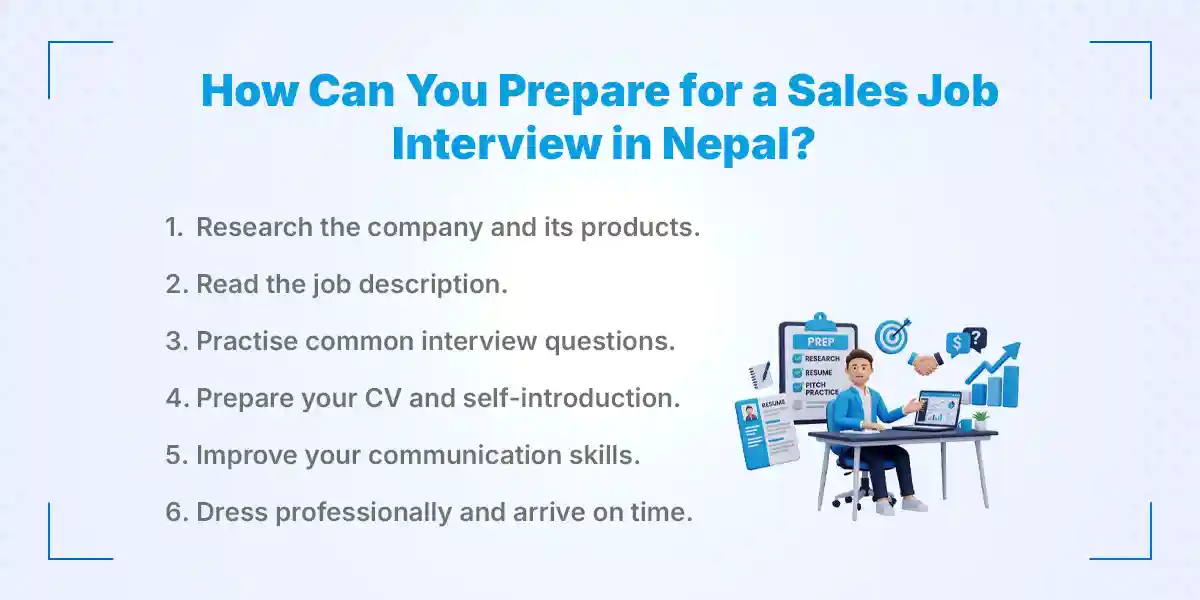
- Research the company and its products: Read the website, product range, and competitors, and note one thing you admire about the brand.
- Read the job description: Highlight each required skill and match it with a personal example.
- Practise common interview questions: Answer them aloud and record yourself to check your pace and clarity.
- Prepare your CV and self-introduction: Carry printed copies of your CV, ID, and certificates, and keep your introduction under one minute.
- Improve your communication skills: Speak clearly, avoid filler words, and use English and Nepali confidently as the role requires.
- Dress professionally and arrive on time: Wear neat formal clothes, reach the venue 15 minutes early, and put your phone on silent.
What Mistakes Should You Avoid in a Sales Interview?
The mistakes to avoid in a sales interview are unclear answers, weak product knowledge, dishonesty, negative talk about past employers, and poor preparation. Each of these tells the interviewer you may struggle with customers. Fix them before the interview, and your answers will sound more confident.
- Giving unclear answers: Rambling hides your point, so use short sentences and one example per answer.
- Showing poor product knowledge: A salesperson who cannot explain the product cannot sell it, so learn the basics first.
- Lying about experience: Managers check references, and a lie can cost you the offer or the job later.
- Speaking negatively about previous employers: It makes you look hard to manage, so describe what you learned instead.
- Failing to prepare for common questions: Candidates who freeze on the first question lose the interviewer's trust early.
Conclusion
The one big takeaway is that sales interviews reward proof, not promises. Every answer you give should show how you listen, solve problems, and finish what you start, even if your proof comes from college, a family shop, or a volunteer project. Pick five stories from your life today, attach each one to a skill, and rehearse them aloud until you can tell each in under a minute.
Once your answers are ready, put them to work. Browse current sales job vacancies on KumariJob, choose roles that match your stories, and apply with a CV that supports what you plan to say.
Frequently Asked Questions
Submit your comments

Get Our App On



Can You Get a Hotel Job Without a Hotel Management Degree in Nepal?
VIEW DETAILS
How to Get a Job in a 5-Star Hotel in Nepal: A Complete Guide
VIEW DETAILS
What Is AI SEO, and How Is It Changing SEO Jobs in Nepal?
VIEW DETAILS
How to Build an SEO Portfolio Without Work Experience
VIEW DETAILS


Loading Comments...