


A teaching candidate can prepare a flawless lesson plan and still freeze the moment a panel asks, "Why should we hire you?" That gap between subject expertise and interview readiness is why so many qualified teachers, both freshers and experienced professionals, lose offers to candidates who simply answered with more structure and confidence.
This guide breaks down the most common teacher interview questions for 2026, covering general questions, fresher-specific questions, classroom management, teaching methodology, behavioral rounds, demo classes, and preparation strategy. Each section includes sample questions and the reasoning behind strong answers, so candidates walk into the interview room with a clear plan instead of guesswork.
In this blog
What Are the Most Common Teacher Interview Questions?
The most common teacher interview questions test three things at once: subject knowledge, classroom judgment, and communication style. Schools rarely ask questions to trip candidates up; they ask them to predict how a candidate will behave in front of thirty students on a difficult Tuesday afternoon. The list below covers the questions that appear across nearly every school interview panel, regardless of subject or grade level.
- Tell me about yourself.
- Why do you want to become a teacher?
- Why do you want to work at our school?
- What are your strengths as a teacher?
- What is your biggest weakness?
- Why should we hire you as a teacher?
- What is your teaching philosophy?
- What makes you a good teacher?
- How do you motivate students?
- Where do you see yourself in five years?
Candidates should treat "Tell me about yourself" as a 90-second professional summary, not a life story. A strong answer moves through qualification, relevant experience, and a specific reason for applying to that school, in that order.
Teacher Interview Questions for Freshers
Fresher teacher interview questions focus on classroom readiness rather than years of service, since new candidates have no track record to point to. Panels ask these questions to gauge how a first-time teacher will think under pressure and how quickly they can apply their training. The goal for a fresher is to show sound judgment, not perfect experience.
- Why did you choose teaching as a career?
- How would you handle your first classroom?
- How would you manage students with different learning abilities?
- How would you prepare a lesson plan?
- How would you make your lessons interesting?
- What would you do if students do not understand your lesson?
- How would you handle classroom discipline as a fresher?
- Why should we hire you without teaching experience?
Freshers should lean on internship experience, student-teaching placements, or even tutoring work as proof points, since interviewers accept practicum experience as a reasonable substitute for full-time classroom years.
School Teacher Interview Questions
School teacher interview questions cover the day-to-day operational side of the job, including lesson planning, discipline, parent communication, and classroom technology. These questions matter because a school is evaluating whether a candidate can run an independent classroom without constant supervision. Interviewers use these questions to separate candidates who understand teaching theory from those who can actually execute it daily.
- How do you plan your lessons?
- How do you maintain classroom discipline?
- How do you evaluate student performance?
- How do you communicate with parents?
- How do you manage a large classroom?
- How do you support slow learners?
- How do you use technology in teaching?
- How do you create an inclusive classroom?
What Are the Most Common Classroom Management Teacher Interview Questions?
- How would you handle a disruptive student?
- What would you do if two students started fighting?
- How would you deal with a student who repeatedly breaks classroom rules?
- How would you handle a student who refuses to participate?
- How do you maintain classroom discipline without being too strict?
- How would you handle bullying in the classroom?
Teaching Methodology Interview Questions
Teaching methodology questions evaluate how a candidate actually delivers content, not just how they manage behavior. Schools ask these questions to confirm that a candidate has more than one instructional tool since relying on a single method fails to meet the needs of different types of learners. The list below covers the methodology questions asked most often across subjects.
- What teaching methods do you prefer?
- How do you make difficult topics easy to understand?
- How do you encourage critical thinking?
- How do you use real-life examples in teaching?
- How do you adapt your teaching style for different learners?
- How do you use digital tools in the classroom?
- How do you measure whether students understand a lesson?
Behavioral Teacher Interview Questions
Behavioral teacher interview questions ask candidates to recall a specific past situation instead of describing a hypothetical one. This matters because past behavior is a stronger predictor of future performance than a theoretical answer, which is why interviewers push for real examples. Candidates should structure every behavioral answer using the situation, task, action, and result format, since panels are trained to listen for that structure.
- Tell me about a challenging student you handled.
- Describe a difficult classroom situation you solved.
- Tell me about a time you received criticism.
- Describe a situation where you worked with another teacher.
- Tell me about a time you changed your teaching approach.
- How would you handle a disagreement with a parent?
Candidates without full-time classroom experience can substitute examples from internships, student teaching, tutoring, or even group projects during teacher training, since the interviewer is really testing reasoning ability, not tenure.
Subject-Specific Teacher Interview Questions
Subject-specific rounds test depth of knowledge within a candidate's teaching area, and the question style shifts depending on the subject and grade level. Panels typically pair a content question with a pedagogy question, asking a candidate both what a concept means and how they would teach it to a specific age group. The most common subject categories include:
- English Teacher Interview Questions
- Mathematics Teacher Interview Questions
- Science Teacher Interview Questions
- Computer Teacher Interview Questions
- Social Studies Teacher Interview Questions
- Primary Teacher Interview Questions
- Secondary Teacher Interview Questions
Candidates preparing for a subject-specific round should review the current national curriculum for their subject and grade band, since outdated syllabus references are one of the fastest ways to lose credibility with a panel.
Teacher Interview Questions About Lesson Planning
Lesson planning questions test whether a candidate can translate a syllabus into a structured, deliverable class session. Interviewers ask these questions because lesson planning is the clearest signal of organizational skill, and disorganized lesson plans usually predict a disorganized classroom. Panels expect candidates to speak in specifics, not general statements about "being prepared."
- What is a lesson plan?
- What should a good lesson plan include?
- How do you set learning objectives?
- How do you choose teaching materials?
- How do you assess learning outcomes?
- How do you modify a lesson when students struggle?
A complete lesson plan answer should reference objectives, materials, instructional steps, an assessment method, and a backup activity for students who finish early or fall behind.
Teacher Interview Questions About Student Assessment
Student assessment questions evaluate how a candidate measures learning, not just how they deliver a lesson. These questions matter because assessment data drives report cards, parent conversations, and school-wide performance tracking, so the school needs confidence in a candidate's grading judgment. The most common assessment questions include:
- How do you assess student performance?
- What is the difference between formative and summative assessment?
- How do you provide constructive feedback?
- How do you help students who perform poorly?
- How do you track student progress?
Strong candidates distinguish formative assessment, which happens during learning through quizzes and class activities, from summative assessment, which happens at the end of a unit through tests and final projects.
What Questions Are Asked in a Teacher Demo Class?
Demo class questions test whether a candidate can actually deliver a lesson in real time, not just describe one in an interview chair. Schools schedule a demo round because interview answers about teaching style can sound convincing without matching classroom reality. The questions below cover what interviewers typically ask before, during, and after a demo lesson.
- How would you introduce your lesson?
- How would you explain the topic to beginners?
- How would you engage students during the class?
- How would you handle questions from students?
- How would you evaluate student understanding?
- What teaching aids would you use?
- How would you conclude your lesson?
Candidates should rehearse the demo lesson with a strict time limit beforehand, since running over time in the actual demo is one of the most common reasons panels mark a candidate down.
How Can You Prepare for Teacher Interview Questions?
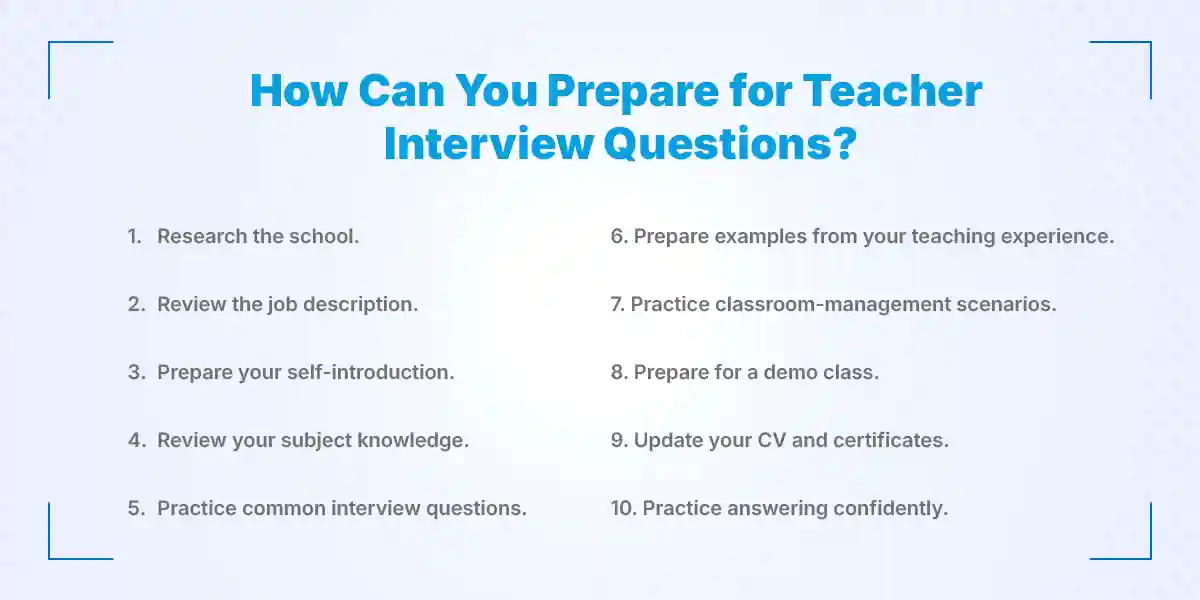
Preparing for a teacher interview requires research, rehearsal, and a demo-ready lesson, not just memorized answers. Interview panels can tell the difference between a candidate who has genuinely prepared for their specific school and one reciting generic responses. The three steps below cover the preparation work that produces the strongest results.
Research the school before the interview.
Candidates should review the school's website, curriculum, mission statement, and recent achievements, since panels frequently ask why do you want to work here" and expect a specific answer. Generic responses about a good reputation" rarely stand out in a competitive applicant pool. A candidate who references the school's specific programs or values signals genuine interest rather than a mass application. This single step often separates shortlisted candidates from the rest.
Practice common interview questions out loud.
Reading through a list of questions is not the same as answering them under time pressure in front of another person. Candidates should rehearse with a friend, mentor, or mirror, focusing on clear, concise answers rather than long, unfocused responses. Recording the practice session and reviewing it afterward helps identify filler words and pacing issues. This rehearsal builds the confidence that panels read as competence.
Prepare a polished, timed demo lesson.
A demo class is often the deciding factor in a teacher interview, so candidates should treat it with the same seriousness as the verbal interview questions. The lesson should include a clear introduction, an engagement activity, and a short assessment check, all within the allotted time. Candidates should also prepare backup materials in case of technical issues, such as a projector failure. A well-rehearsed demo class demonstrates classroom readiness far more convincingly than any spoken answer.
Skills Interviewers Look for in Teachers
Interview panels are not only listening to answers; they are also screening for a specific skill set that predicts classroom success. The most commonly evaluated skills include:
- Communication skills
- Classroom management
- Subject knowledge
- Lesson planning
- Leadership
- Patience
- Creativity
- Problem-solving
- Time management
- Student engagement
- Technology skills
- Adaptability
Candidates should weave two or three of these skills into their answers with specific examples, rather than listing them as abstract traits, since concrete evidence carries far more weight than a self-description.
Teacher Career Opportunities in Nepal
Nepal's education sector offers a wide range of teaching roles across public schools, private institutions, and online platforms. Common career paths include:
- Primary school teacher
- Secondary school teacher
- Higher secondary teacher
- Subject teacher
- English teacher
- Mathematics teacher
- Science teacher
- Computer teacher
- Private school teacher
- Online teacher
- Tutor
- Academic coordinator
Candidates looking for current teaching vacancies across these roles can browse active listings on KumariJob, where schools and educational institutions across Nepal post openings for both fresher and experienced teaching positions.
Conclusion
Teacher interview success comes down to focused preparation, not just confidence. Candidates who research the school, practice common and behavioral teacher interview questions, and prepare a well-timed demo lesson can perform more effectively during the interview. If you are looking for teacher jobs in Nepal, KumariJob is a practical platform to explore current teaching vacancies from schools and educational institutions. You can browse relevant teacher job openings and apply for positions that match your qualifications and experience.
Frequently Asked Questions
Submit your comments

Get Our App On



SEO Training for Freshers in Nepal: Skills, Career & Job Opportunities
VIEW DETAILS
SEO Training vs. Self-Learning: Which Is Right for You?
VIEW DETAILS
How to Choose Between Two Job Offers
VIEW DETAILS
Digital Marketing Training Interview Questions and Answers for Freshers
VIEW DETAILS


Loading Comments...