


Getting ready for your first software engineer interview can feel difficult when you are unsure whether the interviewer will focus on programming basics, coding problems, databases, or your personal projects. Freshers often know the theory from college but struggle to explain concepts clearly, solve problems under pressure, or connect their skills to the role.
The best approach is to prepare across the main areas employers test, including programming fundamentals, data structures, databases, software development, behavioral skills, and project knowledge. This guide covers the most important software engineer interview questions for freshers and practical ways to prepare so you can answer with clarity rather than simply memorizing definitions.
In this blog
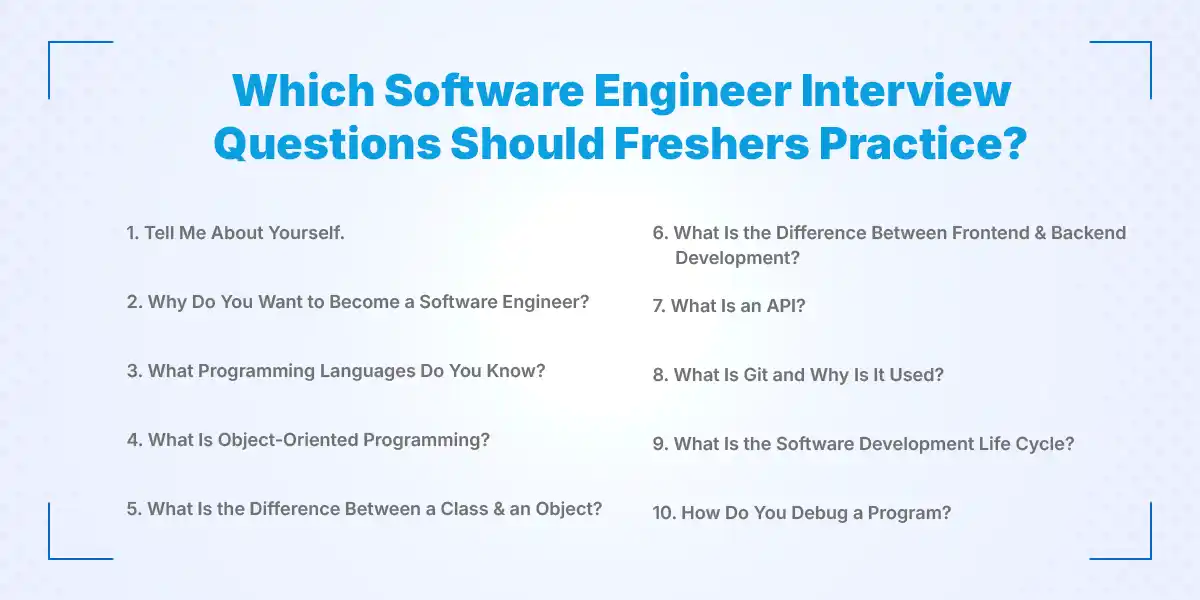
Which Software Engineer Interview Questions Should Freshers Practice?
Freshers should practice software engineer interview questions covering programming fundamentals, object-oriented programming, development tools, APIs, debugging, and software development practices. Interviewers use these questions to check whether candidates understand core concepts and can apply them to practical problems. A strong candidate explains the reasoning behind an answer instead of repeating a definition learned from a textbook.
1. Tell Me About Yourself.
Start with your education, relevant technical skills, projects, and career goal rather than giving unrelated personal information. Mention programming languages, frameworks, academic projects, internships, or personal projects that match the position. Keep your introduction structured and usually within one to two minutes. End by connecting your background to the software engineering position you are applying for.
2. Why Do You Want to Become a Software Engineer?
Explain that you enjoy solving problems, building applications, working with technology, or turning ideas into useful software. Support your answer with a practical example such as a college project or application you developed. Avoid giving a generic response that could apply to any job. Show that you understand software engineering involves continuous learning, testing, teamwork, and problem-solving.
3. What Programming Languages Do You Know?
Mention the languages you can actually use and describe your level of practical experience with each one. For example, you might discuss Java, Python, JavaScript, C++, or C# depending on your background. Be prepared for follow-up questions about syntax, data types, functions, object-oriented programming, and debugging. It is better to demonstrate strong knowledge of two languages than to list many languages you cannot explain.
4. What Is Object-Oriented Programming?
Object-oriented programming is a programming approach that organizes software around objects containing data and behavior. Its major concepts include encapsulation, inheritance, polymorphism, and abstraction. Interviewers often ask this question because OOP concepts appear in many popular programming languages and real-world applications. Prepare a simple example for each concept instead of memorizing only theoretical definitions.
5. What Is the Difference Between a Class and an Object?
A class is a blueprint that defines properties and behaviors, while an object is an instance created from that class. For example, a Car class can define properties such as color and model, while a specific car can exist as an object of that class. Understanding this difference helps you explain basic OOP concepts more confidently. You should also be ready to explain how constructors and methods work with objects.
6. What Is the Difference Between Frontend and Backend Development?
Frontend development focuses on the part of an application users see and interact with, while backend development handles server-side logic, databases, authentication, and application processes. HTML, CSS, and JavaScript are common frontend technologies, while backend development can use languages and frameworks such as Java, Python, PHP, Node.js, or .NET. Freshers should understand how frontend and backend components communicate through APIs. If you have worked on a full-stack project, explain how these parts worked together.
7. What Is an API?
An API is a defined way for different software applications or components to communicate and exchange data. Web applications commonly use APIs to allow a frontend application to request information from a backend server. You should understand common concepts such as HTTP methods, endpoints, request parameters, responses, status codes, and JSON. A simple example from one of your projects can make your answer much stronger.
8. What Is Git and Why Is It Used?
Git is a version control system used to track changes in source code and collaborate on software projects. Developers use Git to create branches, commit changes, merge work, review code, and maintain different versions of a project. Freshers should know basic commands such as clone, pull, add, commit, push, branch, and merge. If you have a GitHub project, be prepared to explain how you used Git during development.
9. What Is the Software Development Life Cycle?
The Software Development Life Cycle is a structured process used to plan, develop, test, deploy, and maintain software. Common stages include requirements gathering, planning, design, development, testing, deployment, and maintenance. Interviewers may ask this to determine whether you understand how professional software projects move from an idea to a working product. Learn how development activities differ between approaches such as Agile and traditional development models.
10. How Do You Debug a Program?
Debugging involves identifying, analyzing, and fixing errors that cause a program to produce incorrect or unexpected results. Start by reproducing the problem, checking error messages and logs, isolating the faulty section, testing a possible fix, and verifying that the change does not introduce another problem. Use debugging tools, breakpoints, logs, and test cases when appropriate. During an interview, explain your reasoning step by step rather than immediately guessing the answer.
Data Structures and Algorithms Interview Questions
Data structures and algorithms help software engineers organize information efficiently and solve programming problems with fewer resources. Freshers should understand arrays, linked lists, stacks, queues, trees, graphs, searching, sorting, recursion, and complexity analysis. You do not need to memorize hundreds of problems, but you should practice applying these concepts to unfamiliar problems.
1. What Is a Data Structure?
A data structure is a method of organizing and storing data so that programs can access and modify it efficiently. Common examples include arrays, linked lists, stacks, queues, trees, hash tables, and graphs. Each structure has different strengths depending on how the application needs to store and retrieve information. When answering, explain both the definition and a practical use case.
2. What Is the Difference Between an Array and a Linked List?
An array stores elements in a structured sequence, while a linked list stores elements as connected nodes. Arrays generally provide efficient direct access by index, whereas linked lists can make certain insertions and deletions easier when the relevant node is already located. The choice depends on how the application accesses and modifies data. Interviewers may also ask about memory allocation, traversal, and time complexity.
3. What Is a Stack and Where Is It Used?
A stack is a data structure that follows the Last In, First Out principle. Common applications include function call management, undo operations, expression evaluation, and browser history mechanisms. Typical stack operations include push, pop, and peek. Be prepared to explain these operations with a simple example.
4. What Is a Queue?
A queue is a data structure that generally follows the First In, First Out principle. Elements enter from one end and leave from the other, making queues useful for task scheduling, request processing, and waiting-line systems. Common operations include enqueue and dequeue. You should also understand variations such as circular queues and priority queues.
5. What Is Big O Notation?
Big O notation describes how an algorithm's resource requirements grow as the input size increases. Common complexities include O(1), O(log n), O(n), O(n log n), and O(n²). Interviewers use complexity questions to evaluate whether candidates can think about algorithm efficiency rather than only whether their code produces the correct output. Practice calculating the time and space complexity of simple loops, searches, sorting methods, and recursive functions.
SQL and Database Interview Questions for Freshers
Database knowledge is important because many software applications need to store, retrieve, update, and organize information. Freshers should understand relational databases, SQL queries, keys, normalization, joins, indexes, and basic database design.
Key areas to prepare include:
- Database fundamentals: Tables, rows, columns, records, and relationships.
- SQL vs. NoSQL: Understand the basic differences and when each approach may be useful.
- Primary key and foreign key: Know how they identify records and establish relationships.
- Normalization: Understand how normalization reduces unnecessary data duplication.
- SQL joins: Prepare INNER JOIN, LEFT JOIN, RIGHT JOIN, and their practical uses.
- Indexes: Understand how indexes can improve query performance and their trade-offs.
- Basic SQL queries: Practice SELECT, WHERE, GROUP BY, ORDER BY, INSERT, UPDATE, and DELETE.
- DELETE vs. DROP vs. TRUNCATE: Know how each command affects database data and structure.
Software Engineering Behavioral Interview Questions
Behavioral questions help employers understand how you communicate, solve problems, work with others, and respond to challenges. Freshers can use academic projects, internships, freelance work, volunteer activities, or personal projects when they lack professional experience.
Common questions include:
- Why should we hire you?
- What are your strengths and weaknesses?
- Tell me about your academic or personal project.
- How do you handle deadlines?
- How do you handle programming errors?
- How do you work in a team?
- Where do you see yourself in five years?
For experience-based questions, structure your response around the situation, task, action, and result. This approach keeps your answer focused and gives the interviewer evidence of how you behave rather than only what you claim about yourself.
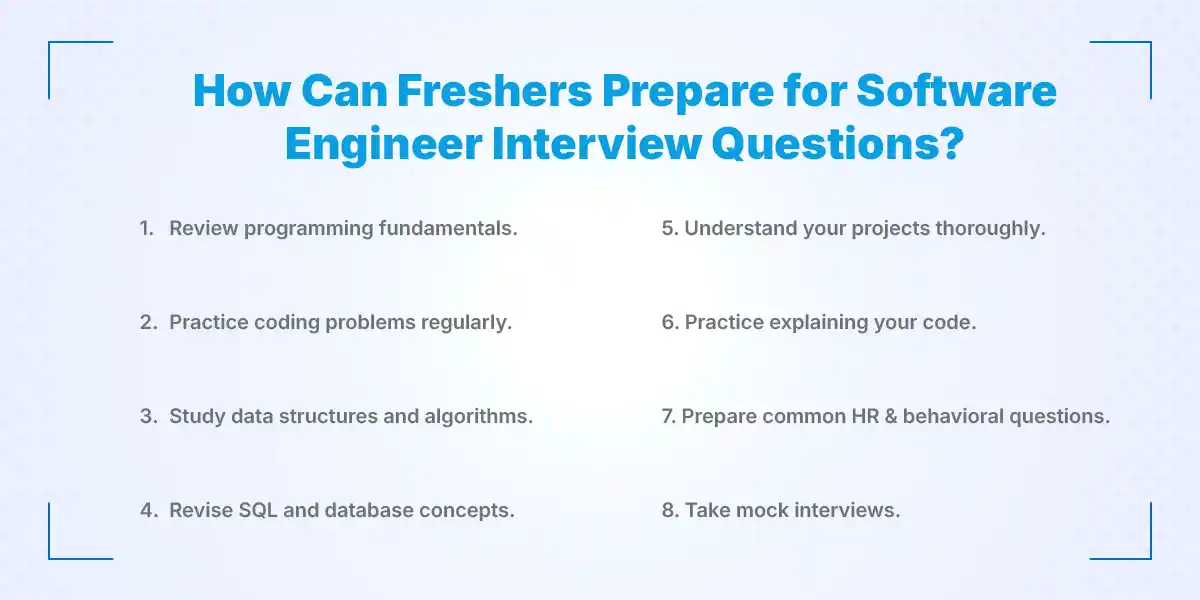
How Can Freshers Prepare for Software Engineer Interview Questions?
Freshers can prepare for software engineer interview questions by reviewing core programming concepts, practicing coding problems, understanding their projects, and preparing for technical and behavioral interview rounds. Consistent practice helps candidates improve their problem-solving skills, explain their approach clearly, and feel more confident during the interview.
1. Review Programming Fundamentals
Revise variables, data types, loops, functions, conditional statements, exception handling, and object-oriented programming. Focus on understanding how each concept works rather than memorizing definitions. Practice writing small programs to strengthen your understanding. Be ready to explain programming concepts with simple examples during the interview.
2. Practice Coding Problems Regularly
Solve coding problems involving arrays, strings, numbers, searching, sorting, and basic algorithms. Start with simple problems and gradually move toward more complex challenges. Explain your approach before writing the code. Check your solution for errors, edge cases, and time complexity.
3. Study Data Structures and Algorithms
Learn important data structures such as arrays, linked lists, stacks, queues, trees, graphs, and hash tables. Understand when and why each structure is used in software development. Practice common algorithms for searching, sorting, and recursion. Also learn basic Big O notation to explain the efficiency of your solutions.
4. Revise SQL and Database Concepts
Practice SQL commands such as SELECT, INSERT, UPDATE, DELETE, WHERE, GROUP BY, ORDER BY, and JOIN. Understand primary keys, foreign keys, normalization, indexes, and relationships between tables. Write practical queries using sample databases. Be prepared to explain the difference between SQL and NoSQL databases.
5. Understand Your Projects Thoroughly
Review every project mentioned on your resume before the interview. Be able to explain the project's purpose, technologies used, your specific contribution, challenges, and how you solved them. Interviewers may ask why you selected a particular technology or approach. Prepare clear examples of problems you faced and the results you achieved.
6. Practice Explaining Your Code
Practice explaining what your code does and why you selected a particular approach. Describe your logic step by step before discussing the implementation. Mention possible edge cases and explain how you would test the solution. Clear communication can demonstrate your problem-solving ability even when your first solution is not perfect.
7. Prepare Common HR and Behavioral Questions
Prepare answers for questions such as “Tell me about yourself,” “Why should we hire you?” and “What are your strengths and weaknesses?” Use examples from your college projects, internships, teamwork, or personal experiences. Keep your answers honest, specific, and relevant to the software engineering role. Practice speaking naturally instead of memorizing complete answers word for word.
8. Take Mock Interviews
Mock interviews help you practice answering technical and behavioral questions under realistic conditions. Ask a friend, mentor, teacher, or experienced developer to conduct a practice interview. After each session, identify areas where you struggled with technical knowledge, communication, or time management. Repeat the process until you can answer common questions confidently and explain your reasoning clearly.
Skills Freshers Should Prepare Before a Software Engineer Interview
A software engineering fresher should prepare a balanced set of technical and professional skills rather than focusing only on programming syntax.
- Programming fundamentals: Variables, functions, control structures, data types, and error handling.
- Data structures and algorithms: Arrays, linked lists, stacks, queues, trees, graphs, sorting, searching, and complexity.
- Object-oriented programming: Classes, objects, inheritance, encapsulation, polymorphism, and abstraction.
- SQL and databases: Queries, relationships, joins, normalization, and indexes.
- Git and GitHub: Version control, branching, commits, pull requests, and collaboration.
- APIs: HTTP methods, endpoints, status codes, authentication, and JSON.
- Debugging and testing: Error identification, test cases, logs, debugging tools, and basic software testing.
- Problem-solving: Breaking large problems into smaller, manageable steps.
- Communication and teamwork: Explaining technical decisions clearly and collaborating with developers and other teams.
- Company research: Study the company's products, technology requirements, job description, and expectations before the interview.
Where to Find Software Engineer Jobs in Nepal
You can find software engineer jobs in Nepal through online job portals like KumariJob, company career pages, and professional networks. Search for roles such as Software Engineer, Junior Software Developer, Backend Developer, Frontend Developer, or Full-Stack Developer, and check each vacancy’s skills, experience, and education requirements before applying.
Conclusion
The biggest advantage a fresher can bring to a software engineering interview is not knowing every possible answer; it is being able to understand a problem, explain a logical approach, and demonstrate a willingness to learn. Build your preparation around programming fundamentals, coding practice, databases, projects, communication, and the specific requirements mentioned in each vacancy.
Once your technical foundation is strong, put that preparation into practice by applying for relevant opportunities and treating every interview as a chance to improve. KumariJob can help you explore software engineering vacancies and other career opportunities in Nepal while you continue building the skills employers are looking for.
Frequently Asked Questions
Submit your comments

Get Our App On



SEO Training for Freshers in Nepal: Skills, Career & Job Opportunities
VIEW DETAILS
SEO Training vs. Self-Learning: Which Is Right for You?
VIEW DETAILS
How to Choose Between Two Job Offers
VIEW DETAILS
Digital Marketing Training Interview Questions and Answers for Freshers
VIEW DETAILS


Loading Comments...