



Explore MR (Medical Representative) jobs in Nepal. Learn eligibility, challenges, scope, salary, and application guide for a successful MR career in Nepal.
Medical Representative (MR) jobs in Nepal are growing as the healthcare and pharmaceutical industries expand. Being an MR is a respected and rewarding career that offers exposure to the healthcare field, professional growth, and the chance to make a real impact on people’s lives. MRs promote medicines, explain their benefits to doctors and pharmacies, and make sure products reach the right places.
These jobs are ideal for people who want to work in healthcare while using communication and sales skills. It also involves understanding medical products, giving correct information, and building strong relationships with healthcare professionals. Professionalism, clear communication, and careful planning are key to success.
For anyone planning a career as an MR, learning about the role, skills, and challenges can help you prepare well and achieve long-term growth.
In this blog
What is an MR Job?
A Medical Representative, or MR, is a professional who promotes medicines and healthcare products to doctors, pharmacists, and hospitals. They act as the link between pharmaceutical companies and healthcare providers. The main goal of an MR is to make sure that the right products reach the right professionals while providing accurate information about their use and benefits. This role is essential in the healthcare industry because it helps companies grow while ensuring that medical products are used safely and effectively.
Unlike general sales jobs, MR jobs require specific knowledge about medicines, treatments, and healthcare regulations. They are not just about selling products; they involve educating healthcare professionals, building trust, and maintaining long-term relationships.
MRs also gather feedback from the market, which helps companies improve their products and strategies. In this way, the role of an MR combines sales skills, product knowledge, and professional communication to create value for both companies and the healthcare sector.
Role and Objective of a Medical Representative
A medical representative’s role is to promote pharmaceutical products to doctors, pharmacists, and healthcare providers while providing accurate information. Their objective is to build strong professional relationships, meet sales targets, and support business growth. Understanding these responsibilities helps you see why the right skills and training are essential, which we will explore in detail next:
1. Promoting Pharmaceutical Products to Healthcare Professionals
A key role of a medical representative is to promote medicines and healthcare products to doctors, pharmacists, and hospitals. This involves explaining the benefits, uses, and safety of products in a clear and professional way. MRs need to highlight why their products are better than others in the market while staying truthful and ethical. By doing this, they help healthcare providers make informed decisions. Effective promotion not only increases product reach but also builds the company’s reputation in the healthcare community.
2. Building and Maintaining Relations with Doctors and Pharmacies
Another important objective of an MR is to develop strong, long-term relationships with healthcare professionals. This involves understanding the needs of doctors and pharmacists, listening to their feedback, and responding to questions or concerns. MRs are responsible for maintaining trust and open communication to ensure that healthcare providers feel supported and valued. Strong relationships make it easier to share product information, gather feedback, and create loyalty toward the company’s brand.
3. Meeting Sales Targets and Market Coverage Goals
MRs are also responsible for achieving sales targets and ensuring that their assigned goal is properly covered. This means planning daily visits, prioritizing potential clients, and monitoring sales performance. Meeting these targets is important for both the company’s growth and the MR’s career progress. MRs need to balance quantity with quality, ensuring that interactions with healthcare professionals are meaningful.
4. Collecting Market Feedback and Competitor Insights
Medical representatives play a critical role in gathering information from the field. They collect feedback about how products are performing, what challenges doctors or pharmacies face, and what competitors are offering. This information is then shared with the company to improve products, marketing strategies, and sales approaches. MRs act as the eyes and ears of the company in the market. Their insights help the business adapt quickly and stay competitive in a changing healthcare environment.
5. Empower Brand Loyalty & Business Growth
Finally, MRs help build loyalty toward the company’s products and brand. By educating healthcare professionals, providing reliable support, and responding to concerns, they create a positive image for the company. This trust translates into repeated prescriptions, higher product adoption, and stronger business growth. In this way, the MR’s role goes beyond selling. Medical Representatives are the ambassadors who represent the company’s values and ensure long-term success in the market.
What are the Qualities of a Medical Representative?
The essential qualities of a successful medical representative include strong communication, product knowledge, professionalism, and the ability to build relationships. These qualities help them effectively promote products, meet sales targets, and gain the trust of healthcare professionals. Understanding these key traits is important for both employers and aspiring MRs, and we will discuss them in detail next.
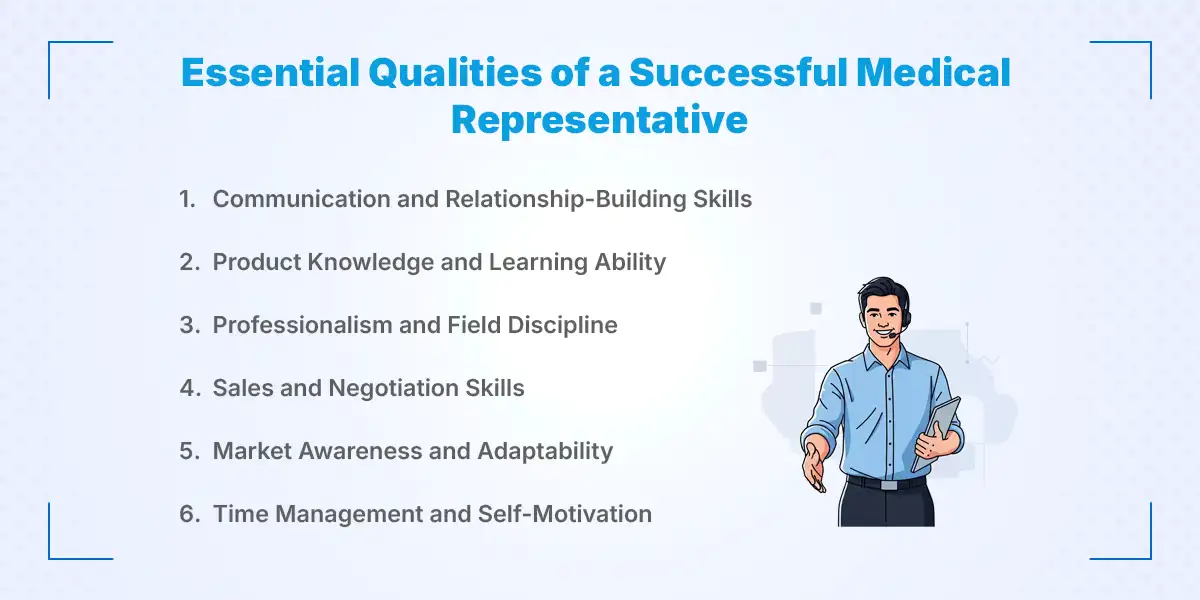
1. Communication and Relationship-Building Skills
A medical representative must be able to communicate clearly and confidently with doctors, pharmacists, and other healthcare professionals. This involves explaining product benefits, answering questions, and addressing concerns in a professional way.
Building strong relationships is just as important as communication because trust helps healthcare providers rely on the MR for accurate information. Effective communication and relationship skills also make it easier to influence decisions and improve product adoption.
2. Product Knowledge and Learning Ability
An MR needs to entirely understand the product they are promoting. This includes knowing how medicines work, their uses, side effects, and the advantages over competitors. A successful MR is always learning about new products, updates, and healthcare trends. Continuous learning helps them provide accurate advice and respond to questions confidently. Employers also value MRs who can quickly understand complex information and share it clearly with healthcare professionals.
3. Professionalism and Field Discipline
Professionalism sets top-performing MRs apart. They must follow ethical guidelines, respect client time, and represent the company with integrity. Field discipline is equally important, as MRs often work independently and need to plan their daily visits effectively. Being punctual, organized, and consistent helps build credibility with healthcare providers. Professional behavior also ensures long-term success and a positive reputation for both the MR and the company.
4. Sales and Negotiation Skills
While MRs are not typical salespeople, they need strong sales and negotiation abilities. This means presenting products persuasively without being pushy, addressing objections calmly, and convincing healthcare providers to try new products. Negotiation skills are also useful when discussing order quantities or promotional activities. A good MR balances business goals with professional relationships to achieve mutually beneficial outcomes.
5. Market Awareness and Adaptability
A successful MR keeps track of the market, competitors, and industry trends. They understand which products are in demand, what competitors are offering, and how healthcare needs change over time. Adaptability allows them to adjust their approach depending on the client, region, or situation. MRs who are flexible can respond quickly to new challenges and opportunities. This awareness and adaptability make them valuable assets to any company.
5. Time Management and Self-Motivation
Medical representatives often work in the field with minimal supervision, so managing time effectively is essential. They need to plan visits, prioritize clients, and ensure all areas of their territory are covered. Self-motivation drives MRs to meet targets, follow up consistently, and maintain high performance. Good time management and motivation together ensure that they are productive every day. Employers look for candidates who can work independently while achieving results consistently.
Eligibility Criteria for the MR Job in Nepal
The eligibility criteria for MR jobs in Nepal include having a relevant bachelor’s degree, usually in science, pharmacy, or life sciences. Candidates are also expected to have basic knowledge of medical products, strong communication skills. Knowing these requirements helps both employers and job seekers understand what it takes to succeed.
1. Educational Qualifications Required for MR Jobs
Most medical representative positions in Nepal require at least a bachelor’s degree in a science-related field such as pharmacy, biology, chemistry, or life sciences. Some companies also consider candidates with business or management degrees if they have a strong interest in healthcare. Basic knowledge of medical terminology and pharmaceutical products is highly valued. Meeting these educational requirements ensures that the MR can understand products, communicate effectively with healthcare professionals, and provide accurate information.
2. Experience Requirements for Entry-Level and Experienced MRs
For freshers, many pharmaceutical companies offer training-based MR jobs to help them gain practical field experience. These positions often focus on learning product knowledge, sales techniques, and client interaction skills. Experienced candidates are usually expected to have prior MR or sales experience, strong networks with doctors and pharmacies, and proven ability to meet sales targets. Employers prefer candidates who can quickly adapt to their territory, understand market dynamics, and contribute to business growth from day one.
How to Land Medical Representative Jobs in Nepal?
To land medical representative jobs in Nepal, candidates should meet the required educational qualifications, develop essential skills, and apply to relevant pharmaceutical or healthcare companies. Gaining product knowledge, preparing a strong CV, and performing well in interviews increase the chances of selection. Next, we will guide you step by step on how to prepare and succeed in securing an MR job in Nepal.
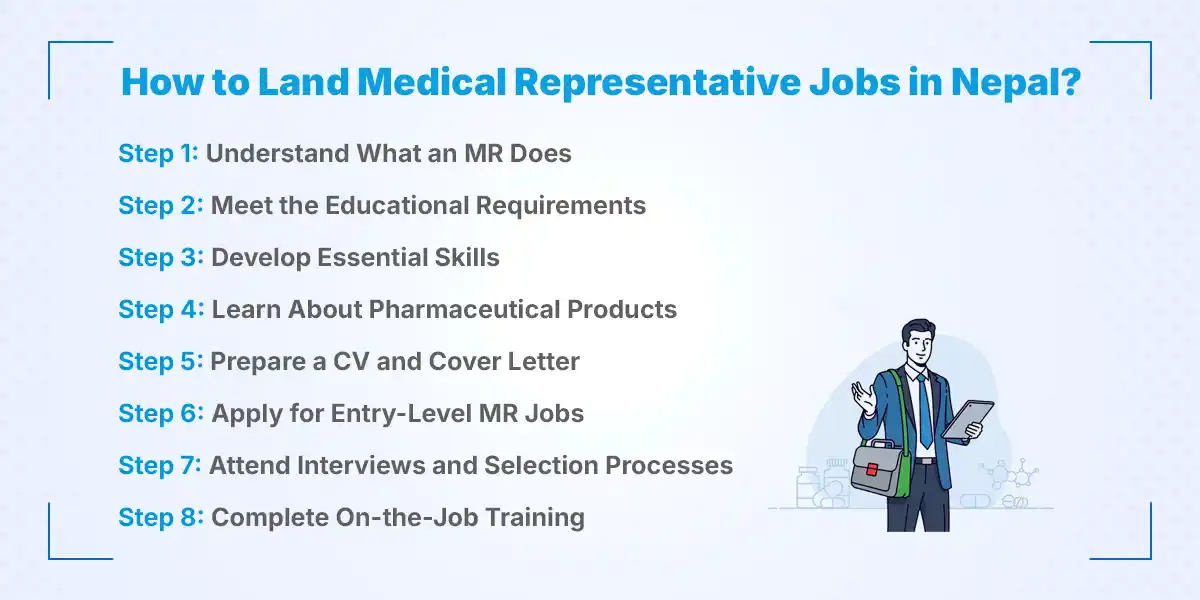
Step 1: Understand What a Medical Representative Does
Before applying for MR jobs, it is important to understand the role and responsibilities of a medical representative. This includes promoting medicines to doctors and pharmacies, providing accurate product information, and maintaining professional relationships. Knowing the expectations of the role helps candidates assess whether they are suited for fieldwork, client interactions, and sales targets. It also prepares applicants to answer questions confidently during interviews and improves their overall readiness for the job.
Step 2: Meet the Educational Requirements
Educational qualifications are the first step in becoming an MR. Most companies require a bachelor’s degree in science, pharmacy, or life sciences, while some may accept management graduates with healthcare interests. Meeting these criteria makes your application eligible for most MR vacancies in Nepal. It also shows employers that you have the foundational knowledge to understand medical products and their applications.
Step 3: Develop Essential Skills & Qualities
Beyond education, developing skills like communication, relationship building, and sales is essential. These skills help you explain products clearly, handle objections, and build trust with healthcare professionals. Employers also value candidates who can manage time effectively and work independently in the field. Developing these abilities before applying increases your chances of performing well in interviews and on the job.
Step 4: Learn About Pharmaceutical Products
Having basic knowledge of medicines, treatments, and healthcare trends is important for any aspiring MR. This includes understanding how products work, their uses, and side effects, as well as keeping an eye on competitor products. This knowledge helps you provide accurate information to doctors and pharmacists. It also gives you confidence during interviews and in the field when discussing products with healthcare professionals.
Step 5: Prepare a CV and Cover Letter
A well-prepared CV and job application letter for an MR job are critical for standing out. Highlight your education, relevant skills, and any internships or training related to healthcare. Curate your application to reflect your understanding of MR responsibilities and your ability to meet sales and relationship-building targets. Clear, professional applications make it easier for employers to see your potential and invite you for interviews.
Step 6: Apply for Entry-Level MR Jobs
Once your CV and application are ready, start applying to entry-level MR positions. Look for opportunities in pharmaceutical companies, medical distributors, and healthcare suppliers. Applying to multiple relevant positions increases your chances of getting noticed. Keep track of applications and follow up professionally to demonstrate interest and commitment.
Step 7: Attend Interviews and Selection Processes
Medical representative interviews usually test your knowledge, communication skills, and sales aptitude. Be ready to answer questions about your understanding of medical products, role responsibilities, and how you would approach doctors or pharmacies. Employers may also assess your problem-solving and relationship-building skills. Preparing thoroughly and presenting yourself confidently improve your chances of selection.
Step 8: Complete On-the-Job or Employer-Supported Training
After selection, most companies provide on-the-job or formal training programs. Training helps you understand product details, sales strategies, and client handling techniques. It also familiarizes you with company policies, territory management, and reporting procedures. Completing training effectively ensures that you start your MR career confidently and perform well in the field.
Medical Representative Jobs in Nepal: Current Market Overview
Medical representative jobs in Nepal are available across pharmaceutical companies, hospitals, clinics, and healthcare product distributors, offering opportunities in both urban and regional areas. Salaries vary based on experience, location, and company, with entry-level MRs earning around NPR 25,000–30,000 and experienced MRs earning more with performance incentives.
1. Industries Hiring Medical Representatives in Nepal
Medical representatives are in demand across various sectors of Nepal’s healthcare industry. Pharmaceutical companies are the largest employers, requiring MRs to promote medicines and medical devices. Hospitals, clinics, and medical distributors also hire MRs to ensure products reach healthcare professionals efficiently.
Additionally, companies producing healthcare supplements, vaccines, and diagnostic products often recruit skilled MRs. Working in these industries allows MRs to gain exposure to different products, client types, and market practices, which helps build a strong career foundation.
2. Urban vs Regional Demand for MR Roles
Urban areas like Kathmandu, Pokhara, and Biratnagar generally have higher demand for medical representatives due to the concentration of hospitals, clinics, and pharmaceutical companies. These cities offer more competitive salaries and better training opportunities.
However, regional and semi-urban areas also present opportunities, especially for companies looking to expand market coverage. MRs working in regional areas may need to travel more, but they gain broader field experience and stronger relationships with local healthcare providers.
3. What Is the Salary of a Medical Representative in Nepal?
The salary of a medical representative in Nepal varies depending on experience, company, and location. Entry-level MRs can expect to earn around NPR 25,000–30,000 per month, while experienced MRs with strong track records may earn NPR 50,000–80,000 or more. Some companies offer performance-based incentives or commissions on sales, which can significantly boost earnings.
Urban positions usually provide higher pay compared to regional roles due to the cost of living and market concentration. Understanding salary expectations helps candidates prepare better and allows employers to set competitive compensation to attract skilled MRs.
Key Challenges in Building a Career as an MR in Nepal
Key challenges in building a career as a medical representative (MR) in Nepal include limited industry knowledge, high competition, and difficulty meeting sales targets. Many candidates also struggle with communication skills, fieldwork demands, and adapting to travel and territory pressure.
1. Lack of Industry Knowledge and Product Understanding
A big challenge for new medical representatives is not knowing enough about the healthcare industry or the products they promote. Without understanding medicines, their uses, and benefits, it is hard to explain them clearly to doctors and pharmacists. This can lead to missed opportunities and lower credibility. Learning continuously and taking training seriously can help overcome this.
2. High Competition for Medical Representative Jobs in Nepal
MR jobs are very competitive because they offer good career growth in healthcare. Many fresh graduates and experienced salespeople apply for the same positions. This makes it important to have a strong education, relevant skills, and a well-prepared CV. Candidates who know products well and can build good relationships with clients stand out.
3. Difficulty Meeting Sales Targets and Performance Expectations
Meeting sales targets is an important part of an MR’s job, and it can be tough for newcomers. Performance expectations are high, and MRs need to work consistently and plan well. Some struggle to manage client visits, product promotion, and reporting all at the same time. Employers expect results while maintaining trust with clients. Good training, guidance, and planning help new MRs handle these responsibilities successfully.
4. Weak Communication and Professional Presentation Skills
Clear communication is essential to explain products and build trust with healthcare professionals. Candidates who cannot present well may not be able to present product benefits effectively. This can affect relationships and reduce sales. Developing confident and professional communication is key to success. Practicing, receiving feedback, and role-playing during training can make a big difference.
5. Adjusting to Field Work, Travel, and Territory Pressure
MR jobs often require a lot of travel and long hours, which can be tiring. Managing several clients in one area needs good planning and time management. New candidates may find it hard to adapt at first. Balancing travel, client visits, and reporting is important for consistent performance. Learning to plan routes, prioritize visits, and stay motivated helps MRs succeed in the field.
Conclusion
A career as a medical representative in Nepal offers great opportunities for growth, learning, and exposure in the healthcare and pharmaceutical industry. To succeed, candidates need the right mix of education, skills, and practical knowledge about medical products and the market. Developing strong communication, relationship-building, and time-management skills can help you stand out and perform confidently in the field.
Understanding the role, responsibilities, and challenges of an MR is important before stepping into this career. Continuous learning, on-the-job training, and preparing well for interviews can make the journey smoother. By focusing on building the right skills and gaining practical experience, aspiring medical representatives can achieve long-term success and make a meaningful impact in their careers.
Frequently Asked Questions
Submit your comments

Get Our App On



SEO Training for Freshers in Nepal: Skills, Career & Job Opportunities
VIEW DETAILS
SEO Training vs. Self-Learning: Which Is Right for You?
VIEW DETAILS
How to Choose Between Two Job Offers
VIEW DETAILS
Digital Marketing Training Interview Questions and Answers for Freshers
VIEW DETAILS


Loading Comments...