


A candidate clears the technical round with confidence, walks into the HR interview relaxed, and then freezes at a simple question like "Tell me about yourself." The technical round tested knowledge, but the HR round tests something harder to prepare for: communication, attitude, and whether the candidate fits the team. Most job seekers lose offers here, not because they lack skills, but because they walk in without a plan for these questions.
This guide covers the HR interview questions every job seeker should prepare for, from the most common ones to the tricky and behavioral questions that trip candidates up. By the end, you will know what recruiters are really asking, how to structure strong answers, and how to walk into the HR round with an actual plan instead of guesswork.
In this blog
What Is an HR Interview?
An HR interview is a conversation where a recruiter evaluates a candidate's personality, communication, and fit for the company, separate from their technical skills. It usually happens after the technical or skills-based rounds, once the company already knows the candidate can do the job. The HR round instead answers a different question: will this person work well with the team and stay motivated in the role?
Key qualities HR recruiters typically evaluate include:
- Communication skills
- Confidence and body language
- Professional attitude
- Teamwork and collaboration
- Problem-solving approach
- Adaptability to change
- Career goals and direction
- Cultural fit with the company
What HR Interview Questions Should Every Job Seeker Prepare For?
Every job seeker should prepare for a core set of ten HR questions that appear in almost every interview, regardless of industry or experience level. These questions test consistent things: self-awareness, motivation, and communication, even when the wording changes slightly between companies. The sections below break down what each question is really asking and how to answer it well.
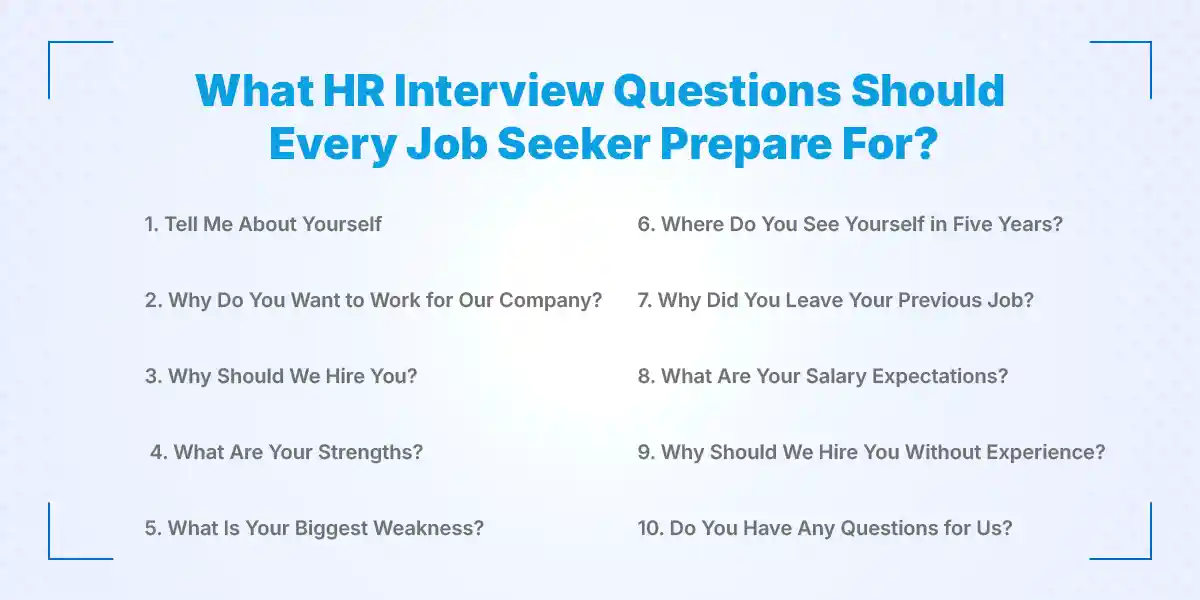
1. Tell Me About Yourself
This question is not an invitation to recite your resume; the interviewer wants a short, structured pitch that connects your background to the role. A strong answer follows a simple pattern: present role or education, one or two relevant achievements, then why you're interested in this position. Keep it under two minutes and avoid listing every job you've ever had. Skip personal details like family background or hobbies unless the interviewer asks directly.
2. Why Do You Want to Work for Our Company?
This question checks whether you researched the company or just applied to every listing you found. A good answer references something specific a product, a value, a recent project and connects it to your own skills or goals. Generic answers like "I want to grow my career" signal low interest and rarely land well. Spend fifteen minutes on the company's website and recent news before any interview to have real material to reference.
3. Why Should We Hire You?
This question wants you to make the business case for yourself in under a minute. Pick two or three skills directly relevant to the job description and explain how they solve a problem the company likely has. Avoid vague claims like "I'm a hard worker" without backing them with a specific example or result. The goal is to sound like a solution, not just an applicant.
4. What Are Your Strengths?
Recruiters ask this to see if your self-assessment matches what the job actually needs. Choose strengths that are directly relevant to the role instead of generic traits like "friendly" or "punctual." Back each strength with a short, real example: a project, a result, a specific situation. Two well-supported strengths beat five vague ones every time.
5. What Is Your Biggest Weakness?
This question tests honesty and self-awareness more than the weakness itself. Pick something genuine but manageable, not a core skill required for the job,b and explain the concrete steps you're taking to improve it. Avoid the cliché "I'm a perfectionist" answer, since most recruiters have heard it too many times to take it seriously. A weakness paired with visible progress reads as maturity, not a red flag.
6. Where Do You See Yourself in Five Years?
This question checks whether your goals align with what the company can actually offer. Give a realistic answer tied to skill growth and increasing responsibility, not a specific job title that may not exist at the company. Avoid answers that sound like you'll leave the moment something better appears. Connecting your growth to the company's own trajectory shows you've thought about the fit, not just the paycheck.
7. Why Did You Leave Your Previous Job?
This is one of the easiest questions to damage yourself on if you're not careful. Keep the answer factual and forward-looking: a search for growth, a new challenge, a shift in career direction,n and never criticize a previous manager or company by name. Even a truthful complaint can make a recruiter worry you'll speak about their company the same way later. Frame the departure around what you're moving toward, not what you're escaping.
8. What Are Your Salary Expectations?
This question requires homework before the interview, not an on-the-spot guess. Research the market rate for the role, your experience level, and the specific city or industry before walking in. Give a reasonable range rather than a single fixed number, and be ready to explain what factors skills, certifications, experience justify the higher end. Avoid answering "whatever you offer," since it removes your negotiating position entirely.
9. Why Should We Hire You Without Experience?
This question is common for freshers and career changers, and it is answerable with the right framing. Highlight relevant coursework, personal projects, internships, or freelance work that demonstrate the skills the job needs. Focus on transferable skills: communication, problem-solving, and time management that apply regardless of formal work history. Willingness to learn quickly, backed by an example of self-teaching something, carries real weight here.
10. Do You Have Any Questions for Us?
This is not a formality; it's a chance to show genuine interest and gather information that helps you decide if the job is right for you. Prepare two or three thoughtful questions in advance about the role, the team structure, or growth expectations. Avoid asking only about salary or vacation days at this stage, since it can signal misplaced priorities. Saying "no questions" is one of the most common mistakes candidates make in this round.
Common HR Interview Questions for Freshers
- Tell me about yourself
- Why did you choose your field?
- Why do you want this job?
- What are your career goals?
- What are your strengths and weaknesses?
- Do you have any internship or project experience?
- How do you handle pressure?
- Are you comfortable working in a team?
- Why should we hire you as a fresher?
- What salary do you expect?
HR Interview Questions for Experienced Candidates
- Why are you looking for a job change?
- What did you learn from your previous role?
- What was your biggest professional achievement?
- How do you handle workplace conflicts?
- How do you manage deadlines?
- What leadership experience do you have?
- What are your long-term career goals?
- Why do you want to join our organization?
Behavioral HR Interview Questions
Behavioral questions ask you to describe a real past situation, because past behavior is one of the strongest predictors recruiters have for future performance. These questions almost always start with "tell me about a time" or "describe a situation," and they reward candidates who prepare specific stories in advance. The strongest answers use the STAR method Situation, Task, Action, Result to keep the story structured and focused on outcome.
- Tell me about a time you faced a difficult situation at work
- Describe a conflict you had with a colleague and how you handled it
- Tell me about a time you made a mistake
- Give an example of when you worked under pressure
- Describe a situation where you demonstrated leadership
- Tell me about a time you failed and what you learned
Situational HR Interview Questions
Situational questions present a hypothetical scenario instead of asking about the past, testing how you'd reason through a problem you haven't necessarily faced yet. There's no single correct answer here recruiters are watching how you think, not just what you'd do. Structuring your response around a clear decision-making process, rather than a rehearsed script, tends to land better than a perfect-sounding answer.
- What would you do if you disagreed with your manager?
- What would you do if you had multiple urgent deadlines?
- How would you handle an unhappy customer?
- What would you do if a team member was not contributing?
- How would you respond to constructive criticism?
- What would you do if you made a serious mistake?
Tricky HR Interview Questions and How to Answer Them
Tricky questions are designed to catch unprepared candidates off guard, often by phrasing a normal question in an uncomfortable way. The trap is usually not the question itself but the instinct to either over-explain or get defensive. Staying calm, brief, and specific defuses most of these questions regardless of how they're worded.
- Why should we not hire you?
- What motivates you?
- What demotivates you?
- Are you willing to relocate?
- Are you comfortable working overtime when required?
- What would your previous manager say about you?
- What makes you different from other candidates?
- What are your expected salary and benefits?
How Can You Prepare for an HR Interview?
Preparing for an HR interview means researching the company, rehearsing your answers, and practicing delivery, not memorizing a script word for word. Recruiters can tell when an answer sounds robotic versus genuinely thought through, and rehearsed-but-natural answers perform far better than either extreme. Building practical HR knowledge alongside interview preparation can also give candidates greater confidence. Kumari Job’s Professional HR Training helps aspiring HR professionals develop practical, industry-relevant skills and better prepare for real-world HR roles. The checklist below covers the preparation steps that matter most.
- Research the company and job description thoroughly
- Review your resume and be ready to discuss every line on it
- Prepare answers to the ten common questions above
- Practice your self-introduction until it flows naturally
- Prepare 2–3 STAR-method examples for behavioral questions
- Research the expected salary range for the role and location
- Prepare 2–3 thoughtful questions for the interviewer
- Do at least one mock interview, ideally with feedback
- Work on communication clarity and body language
- Dress appropriately and arrive with documents ready
HR Interview Questions vs Technical Interview Questions
| HR Interview | Technical Interview |
|---|---|
| Focuses on personality and attitude | Focuses on technical knowledge |
| Communication skills | Technical skills |
| Career goals | Problem-solving ability |
| Cultural fit | Role-specific expertise |
| Teamwork and adaptability | Practical, hands-on knowledge |
What Should You Do After an HR Interview?
What you do after an HR interview can influence the final decision almost as much as the interview itself. A short, professional follow-up message shows continued interest without being pushy, and reflecting on tough questions helps you improve for the next round or the next opportunity. The steps below cover the most useful post-interview habits.
- Send a professional follow-up message within 24 hours, when appropriate
- Reflect on which questions were hardest to answer and why
- Note specific areas that need improvement before your next interview
- Continue preparing for possible technical or managerial rounds
- Follow up professionally if you haven't heard back within the stated timeline
Conclusion
HR interview questions are predictable enough to prepare for, but they still reward candidates who practice real answers instead of memorizing generic scripts. The candidates who consistently get offers are not the ones with perfect answers they're the ones who sound clear, honest, and specific under a bit of pressure, because they rehearsed enough to stay calm.
If you're actively preparing for interviews or looking for your next role, Kumarijob lists current job openings and connects candidates directly with hiring companies browse active listings on Kumarijob and start applying with an interview strategy that's actually ready.
Frequently Asked Questions
Submit your comments

Get Our App On


SEO Training for Freshers in Nepal: Skills, Career & Job Opportunities
VIEW DETAILS
SEO Training vs. Self-Learning: Which Is Right for You?
VIEW DETAILS
How to Choose Between Two Job Offers
VIEW DETAILS
Digital Marketing Training Interview Questions and Answers for Freshers
VIEW DETAILS


Loading Comments...