


Nepal's IT sector added over 1,000 new tech jobs in 2024, and full stack developers remain among the most sought-after hires. Companies, from startups in Kathmandu to international remote employers are actively searching for developers who can build complete web applications from front-end interfaces to back-end systems.
This guide covers the specific skills Nepali employers want, salary expectations at each experience level, where to find IT Job openings, and how to prepare for technical interviews to become a full stack developer in Nepal.
In this blog
What is a Full Stack Developer?
A full stack developer is a software professional who works on both the front-end and back-end of web applications. The front-end refers to everything users see and interact with. This may include the buttons, forms, navigation menus, and designs you usually see. The back-end covers the invisible parts: servers processing requests, databases storing information, and APIs connecting different services.
As a full stack developer, one person can manage an entire project from start to finish, which reduces communication gaps between separate front-end and back-end teams. Startups especially value this versatility because smaller teams handle more responsibilities.
Essential Skills Nepali Employers Look for in Full Stack Developers
Nepali employers look for essential full stack developer skills like JavaScript proficiency, experience with frameworks (React, Node.js), database management, API integration, version control (Git), and problem-solving ability. These in-demand IT skills ensure developers can handle both frontend and backend tasks efficiently while adapting to different project needs. Let’s explore these in-demand skills in detail.
1. Front-end Development Skills
HTML, CSS, and JavaScript form the foundation of every web interface. HTML structures content, CSS styles it, and JavaScript adds interactivity. Beyond the basics, employers typically want experience with modern frameworks like React or Angular. Becoming a react developer prepares you for the majority of full stack listings across Nepali job portals.
2. Back-end Development Skills
Back-end development involves languages like Node.js, Python, PHP, or Java. Node.js has become especially popular because it uses JavaScript. This means developers can work on both front-end and back-end using the same language. Python developers using Django or Flask frameworks appear frequently in data-focused companies.
3. Database management
Every application stores data somewhere. Relational databases like MySQL and PostgreSQL organize information in structured tables. NoSQL databases like MongoDB offer flexibility for unstructured data. Knowing how to design database schemas and write efficient queries separates competent developers from exceptional ones.
4. Version control and Git
Git is a version control system that tracks changes to code over time. GitHub hosts repositories online, enabling team collaboration. Nearly every Nepali IT company uses Git daily, so showing up to an interview without Git knowledge raises immediate concerns.
5. API development and REST
APIs (Application Programming Interfaces) allow different software systems to communicate. When you log into an app using your Google account, an API handles that authentication. RESTful APIs follow specific conventions for how front-end applications request data from back-end servers.
6. Soft Skill Valued by Nepali IT Companies
Technical abilities alone won't secure offers. Employers also evaluate soft skills like communication, problem-solving, English proficiency (especially for client-facing roles), and teamwork. Software development is rarely a solo activity.
Most in-Demand Technology Stacks for Full Stack Jobs in Nepal
A technology stack refers to the combination of programming languages, frameworks, and tools used to build an application. The most in-demand full stack technology stacks in Nepal include the MERN stack, MEAN stack, LAMP stack, and Django + React combinations.
Employers often hire for specific stacks, so specializing increases your chances of matching job requirements. Let’s take a closer look at how each stack is used in real projects.
1. MERN Stack
MERN stands for MongoDB, Express.js, React, and Node.js. This JavaScript-based stack dominates Nepal's startup ecosystem. MERN developers receive the highest number of interview calls among full stack candidates based on job listing frequency.
2. MEAN Stack
MEAN replaces React with Angular: MongoDB, Express.js, Angular, Node.js. The back-end remains identical to MERN, so transitioning between the two requires learning only a different front-end framework.
3. LAMP Stack
LAMP uses Linux, Apache, MySQL, and PHP. While considered older technology, LAMP powers many government projects and established businesses. Developers comfortable with LAMP find steady work maintaining existing systems.
4. Python Full Stack
Combining Django or Flask with front-end frameworks creates a Python-based full stack. Data-driven companies and organizations building machine learning features often prefer this approach.
| Stack | Front-End | Back-End | Database | Best For |
|---|---|---|---|---|
| MERN | React | Node.js, Express | MongoDB | Startups, modern web apps |
| MEAN | Angular | Node.js, Express | MongoDB | Enterprise applications |
| LAMP | HTML/CSS/JS | PHP, Apache | MySQL | Legacy systems, WordPress |
| Python | React/Vue | Django/Flask | PostgreSQL | Data-heavy applications |
Where to Find Full Stack Developer Jobs in Nepal?
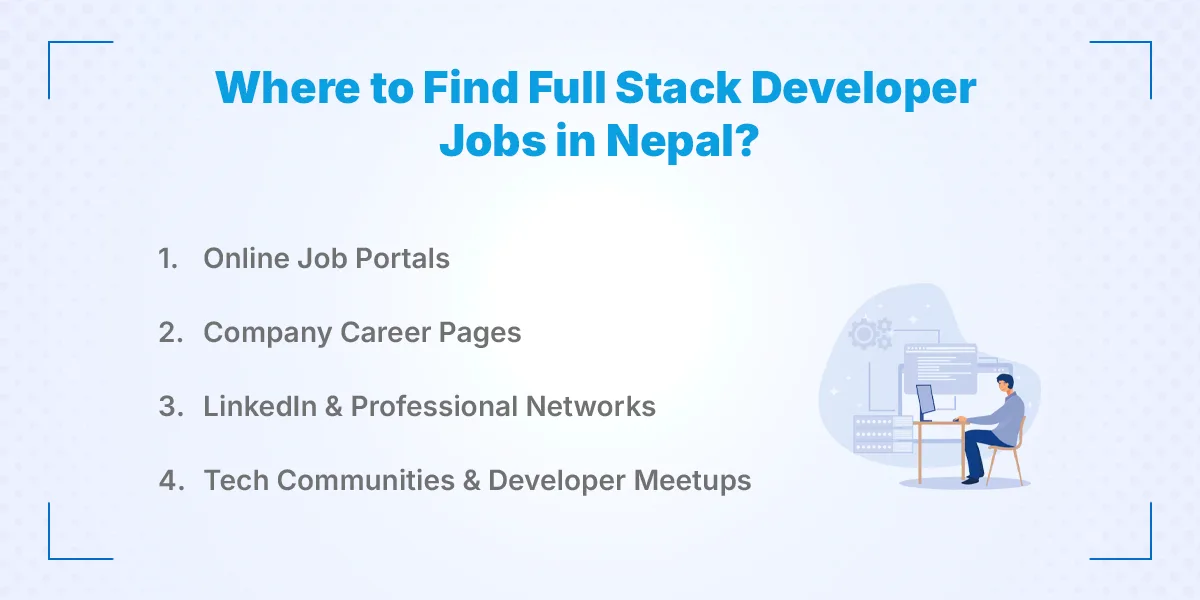
You can find full stack developer jobs in Nepal through job portals like Kumari Job, LinkedIn, company career pages, recruitment agencies, and tech communities. Using multiple channels increases your chances of discovering both advertised and hidden opportunities in the market. Here are the most effective platforms and methods to explore.
1. Online Job Portals
Reputed job portals like Kumari Job lists full stack developer vacancies from companies across Nepal, often updated daily. The platform allows filtering by location, experience level, and salary range to quickly narrow relevant roles. Application deadlines appear on each listing, so some positions expire within days, making timely applications important.
2. Company Career Pages
Top IT companies like Cedargate, Fusemachines, and Leapfrog post openings directly on their websites. Checking career pages weekly helps catch positions before they appear on aggregator sites. This also gives insight into company culture, tech stacks, and hiring priorities.
3. LinkedIn and Professional Networks
Optimizing a LinkedIn profile with relevant keywords helps recruiters find candidates more easily. Many Nepali tech recruiters actively search for developers rather than waiting for applications. Engaging with posts, sharing projects, and networking increases visibility and credibility.
4. Tech Communities and Developer Meetups
Kathmandu hosts regular developer meetups, hackathons, and tech talks that connect professionals in the industry. Networking at events often leads to referrals, and referred candidates typically receive faster responses than cold applicants. These communities also help developers stay updated with trends and learn from peers.
Top Companies Hiring Full Stack Developers in Nepal
Top companies hiring full stack developers in Nepal include IT service firms like Leapfrog Technology and Deerwalk, fintech leaders like Khalti, banks such as NIC Asia Bank, and e-commerce platforms like Daraz. These organizations consistently hire developers to build, scale, and maintain modern digital platforms across industries. Here’s a closer look at where opportunities are most concentrated.
1. IT Services and Software Companies
Companies like Leapfrog Technology, Fusemachines, Cotiviti Nepal, and Deerwalk represent Nepal’s largest software employers. They work on international projects, offering exposure to global development standards, agile workflows, and modern tech stacks. These companies often provide structured career growth, mentorship, and opportunities to work with distributed teams.
2. Fintech Startups
Fintech leaders like Khalti, eSewa, and Fonepay are driving Nepal’s digital payment ecosystem. As transaction volumes and user bases grow, these companies continuously expand their engineering teams. Developers here work on secure systems, real-time processing, and scalable financial applications.
3. Banks and Financial Institutions
Banks such as NIC Asia Bank, Global IME Bank, and Sanima Bank are increasingly building in-house tech teams rather than outsourcing development. This shift creates steady demand for full stack developers to modernize banking systems and digital services. Roles in the banking sector often include added benefits like insurance, bonuses, and retirement plans.
4. E-commerce and Digital Businesses
Platforms like Daraz, Sastodeal, and Foodmandu regularly hire developers to maintain and enhance their platforms. These roles involve handling high-traffic systems, optimizing performance, and integrating payment gateways. Working in e-commerce also exposes developers to fast-paced product development and user-focused innovation.
How to Build a Full Stack Developer Portfolio in 2026?
To build a strong full stack developer portfolio in 2026, focus on showcasing real-world projects, full stack capabilities, live demos, and clear project explanations that prove your practical skills. Employers prioritize candidates who can demonstrate what they’ve built, how they built it, and the impact of their work. Here’s how to create a portfolio that stands out.
1. Include Real-World Projects
Include projects that reflect real use cases, not just basic tutorials. Cloning applications like Twitter or Trello shows understanding of complex features, but building tools like a budget tracker, local event finder, or freelance project demonstrates problem-solving ability. Projects tied to real users or needs make your portfolio more credible and impactful.
2. Showcase Both Front-End and Back-End Work
Each project should clearly demonstrate full stack capability by combining a polished user interface with functional server-side logic. A visually appealing front end without backend functionality, or a powerful API without a usable interface—only shows partial expertise. Highlighting how both layers interact strengthens your profile.
3. Add Live Demos and GitHub Links
Employers want to interact with working applications, not just view screenshots. Hosting projects using platforms like Vercel, Netlify, or Railway makes demos easily accessible. Including GitHub repository links also allows recruiters to review code structure, version control practices, and overall quality.
4. Write Clear Project Descriptions
For each project, explain the problem it solves, technologies used, and your specific contributions, especially in team settings. Briefly describing challenges faced and how you solved them adds depth and shows critical thinking. Clear, concise descriptions help employers quickly understand your capabilities and decision-making process.
How to Write a Resume for Full Stack Developer Jobs in Nepal?
To write an effective full stack developer resume in Nepal, focus on clear structure, relevant technical skills, quantified achievements, and ATS-friendly formatting that quickly communicates your value. Since employers often scan resumes in under 30 seconds, clarity and relevance are key to getting shortlisted. Here’s how to optimize your resume.
1. Lead with Technical Skills
Place a dedicated skills section near the top listing your core technologies. Group them logically into front-end (e.g., React, HTML, CSS), back-end (Node.js, Django), databases (MySQL, MongoDB), and DevOps/tools. This makes it easy for recruiters to instantly assess your technical fit. Mention your certification properly if you’ve taken any related training programs in Nepal.
2. Quantify Achievements
Replace generic statements with measurable results to make your impact clear. For example, “Developed e-commerce platform handling 500+ daily transactions” or “Reduced page load time by 40% through optimization.” Numbers grab attention and validate your contributions.
3. Tailor the Resume for Each Application
Customize your resume based on the job description to improve relevance. If a role emphasizes React and Node.js, highlight those skills prominently in both your skills and experience sections. This also helps your resume pass Applicant Tracking System filters used by many companies.
4. Keep It Concise and ATS-Friendly
Use clean formatting with standard fonts like Arial or Calibri, and avoid graphics or complex tables that ATS tools may misread. Keep your resume within one to two pages, focusing only on relevant experience and skills that align with the role.
Remote Full Stack Developer Jobs in Nepal
Remote work has transformed opportunities for Nepali developers. International companies now hire talent regardless of location, often paying significantly higher than local market rates.
Platforms like Upwork, Fiverr, and Himalayas actively connect Nepali developers with global employers. Kumari Job also lists remote positions from companies specifically seeking Nepal-based talent.
Remote work requires additional capabilities beyond coding:
- Self-discipline: Managing your own schedule without office structure
- Asynchronous communication: Working effectively across time zones
- Reliable infrastructure: Stable internet and backup power solutions
Benefits include higher salaries, flexible schedules, and exposure to international development practices. On the other hand, isolation and difficulty separating work from personal life affect some remote workers negatively. Regardless, it is always worth your time to explore remote IT jobs.
Full Stack Developer Salary in Nepal by Experience Level
Full stack developer salary in Nepal typically range from NPR 20,000 to NPR 200,000+ per month depending on experience, skills, and company type. Compensation varies based on factors like technology stack, project complexity, and whether the role is local or remote. Here’s a breakdown of salary expectations by experience level in Kathmandu and similar markets.
1. Entry-Level and Fresher Developer Salary
Fresh graduates or candidates with less than one year of experience typically earn NPR 20,000–30,000 monthly. Internships and trainee roles may start lower but provide valuable hands-on experience and industry exposure. Building strong foundational skills during this stage can quickly accelerate salary growth.
2. Junior Developer Salary in Nepal
With one to two years of experience, salaries rise to NPR 35,000–50,000 monthly. Developers who demonstrate proficiency in a specific stack and contribute to live projects often move up faster. Practical experience and problem-solving ability play a key role at this stage.
3. Mid-Level Developer Salary
Developers with three to five years of experience typically earn NPR 50,000–100,000 monthly. At this level, employers expect independent work, ownership of features, and sometimes mentoring junior developers. Strong architecture understanding and performance optimization skills become important.
4. Senior Developer Salary
Senior developers with five or more years of experience earn NPR 100,000–200,000+ monthly. These roles often involve system design, code reviews, and leading development teams. Senior professionals may also influence technical decisions and contribute to long-term product strategy.
| Experience Level | Monthly Salary Range (NPR) | Key Factors |
|---|---|---|
| Fresher (0-1 year) | 20,000–40,000 | Portfolio quality, internship experience |
| Junior (1-2 years) | 40,000–70,000 | Stack specialization, project contributions |
| Mid-level (3-5 years) | 70,000–120,000 | Leadership ability, complex project experience |
| Senior (5+ years) | 120,000–200,000+ | Architecture skills, team management |
Tip: Remote positions with international companies often pay two to three times local rates. A mid-level developer might earn $1,500–2,500 monthly working remotely for a US or European company.
How to Prepare for Full Stack Developer Interviews in Nepal?
To prepare for full stack developer interviews in Nepal, focus on mastering core technical concepts, practicing coding problems, understanding system design, and researching the company beforehand. Most Nepali IT companies follow multiple rounds including HR screening, technical interviews, and final discussions. Here’s how to approach each step effectively.
1. Review Common Technical Questions
Expect questions on JavaScript fundamentals, React component lifecycle, Node.js event loop, database design, and REST API principles. Interviewers often assess how clearly you explain concepts, not just whether you know them. Strong fundamentals and clear communication make a big difference.
2. Practice Coding Challenges
Use platforms like HackerRank, LeetCode, and Codewars to practice interview-style problems. Many companies conduct live coding rounds where your approach, logic, and problem-solving process are evaluated. Consistent practice improves both speed and confidence.
3. Prepare for System Design Questions
Mid-level and senior candidates are often asked system design questions like designing a URL shortener or real-time chat application. These test your ability to think about scalability, architecture, database selection, and trade-offs. Structuring your answers clearly is just as important as the solution itself.
4. Research the Company Before the Interview
Before the interview, review the company’s products, services, and tech stack. Understanding what they build helps you align your answers with their needs. Asking thoughtful questions about their projects shows preparation and genuine interest.
Conclusion
The path to landing a full stack developer role combines technical skill-building, strategic job searching, and interview preparation. Start by mastering one technology stack thoroughly rather than spreading thin across many. Build projects demonstrating real problem-solving ability, then present them through a polished portfolio and targeted resume.
Nepal's IT sector continues expanding, with new companies launching and established firms growing their teams. Demand for developers who can handle both front-end and back-end work remains strong across Kathmandu, Pokhara, and remote international opportunities.
Frequently Asked Questions
Submit your comments

Get Our App On



SEO Training for Freshers in Nepal: Skills, Career & Job Opportunities
VIEW DETAILS
SEO Training vs. Self-Learning: Which Is Right for You?
VIEW DETAILS
How to Choose Between Two Job Offers
VIEW DETAILS
Digital Marketing Training Interview Questions and Answers for Freshers
VIEW DETAILS


Loading Comments...