



Nepal’s tech industry is experiencing an unprecedented boom, and the growing demand for Flutter developers is at the forefront of this digital revolution. As startups, fintech platforms like eSewa, Thepaceinfosys and F1Soft, and SaaS companies aggressively expand their digital footprints, the need for seamless, high-performance mobile applications has skyrocketed. Businesses are shifting toward mobile-first strategies to capture a wider audience, creating a massive vacuum for skilled developers who can bring these digital visions to life.
Why is Flutter becoming such a popular career choice among IT students and developers in Nepal? The answer lies in its efficiency.
Google's UI toolkit allows developers to write code once in Dart and deploy it natively on both Android and iOS. This significantly reduces development time and operational costs, making it a favorite among tech companies. If you are looking to build a lucrative career in tech, in this guide, we will break down everything you need to know about Flutter jobs, salaries, required skills, and the best places to find vacancies in Nepal.
In this blog
What Is a Flutter Developer Job?
A Flutter developer job involves creating multi-platform mobile applications for iOS and Android using Google's open-source UI framework, Flutter. By utilizing a single codebase, developers save time and resources while delivering native-like performance. This role requires building intuitive mobile app UIs, integrating REST APIs, and seamlessly connecting the application with robust backend systems to ensure a smooth user experience.
Why Flutter Jobs Are Growing in Nepal
Flutter jobs are rapidly growing in Nepal because startups and established enterprises alike are shifting toward cost-effective, mobile-first business models. Nepal's IT and software industry is actively expanding, creating a massive local demand for developers who can efficiently build cross-platform apps. Furthermore, the global shift toward remote work has brought numerous lucrative outsourcing projects from international clients directly to Nepali developers.
Scope of Flutter Jobs in Nepal
The scope of Flutter development in Nepal is incredibly broad, offering lucrative paths in local software companies, dynamic startups, and tech-driven sectors. There is a soaring demand for mobile app developers, particularly in the booming fintech domains and emerging e-commerce platforms. Additionally, local developers have excellent opportunities to take on high-paying freelance and remote work for international client projects right from Nepal.
What Skills Are Required for Flutter Jobs?
To secure a top Flutter development role, you need a mix of core programming knowledge and framework-specific expertise.
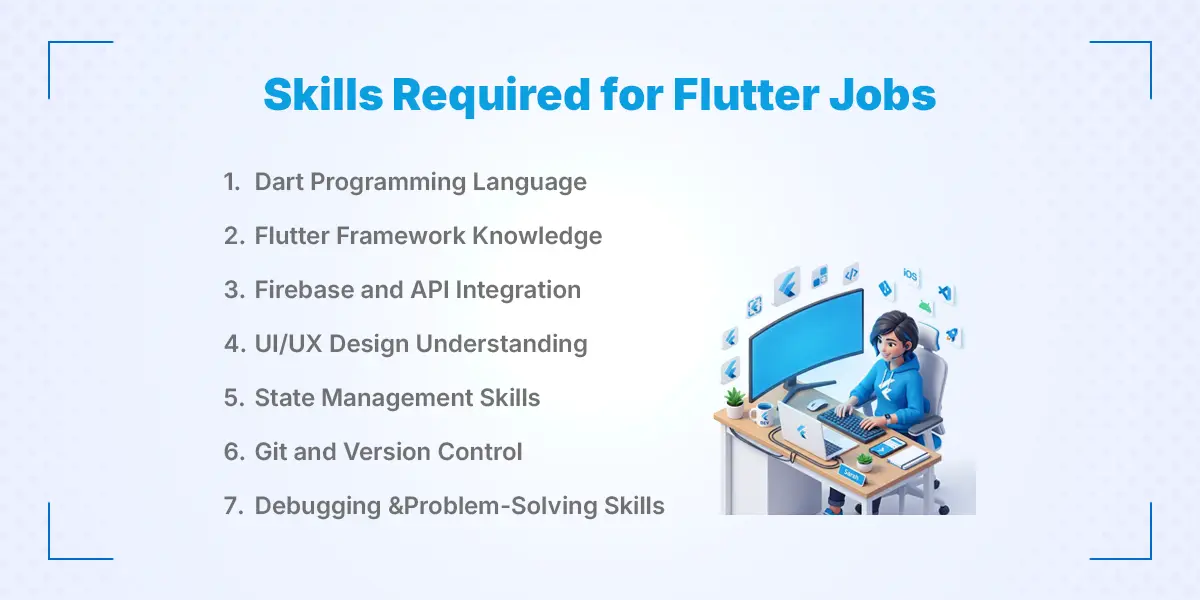
1. Dart Programming Language
Dart is the foundational programming language used to write Flutter applications. You must understand its object-oriented concepts, asynchronous programming features, and null safety. Mastery of Dart allows you to write clean, efficient, and highly performant code. Employers look for developers who can natively understand Dart rather than just relying on basic Flutter widgets.
2. Flutter Framework Knowledge
Understanding the core mechanics of the Flutter framework is non-negotiable for developers. You need to be proficient with the widget tree, stateful and stateless widgets, and the application lifecycle. Knowing how to structure an application and use Flutter's rich set of pre-built UI components is critical. This knowledge directly translates to how quickly and effectively you can build cross-platform apps.
3. Firebase and API Integration
Most modern mobile applications require dynamic data and cloud connectivity to function properly. You must know how to integrate Firebase for authentication, real-time databases, and push notifications. Additionally, connecting your Flutter app to RESTful APIs to fetch and send backend data is an absolute requirement. This skill bridges the gap between the frontend user interface and the server logic.
4. UI/UX Design Understanding
A great Flutter developer doesn't just code; they also understand how to create visually appealing and user-friendly interfaces. You need a solid grasp of mobile UI/UX design principles and responsive layouts that look good on various screen sizes. Translating Figma or Adobe XD wireframes into pixel-perfect Flutter screens is a daily operational task. Excellent design intuition easily separates a good developer from a great one.
5. State Management Skills
As applications grow in complexity, managing the state of the app becomes both challenging and crucial. You must be comfortable with popular state management solutions like Provider, Bloc, Riverpod, or GetX. Knowing when and how to implement these architectures ensures your app runs smoothly without unnecessary memory overhead. This is often a key topic in technical job interviews.
6. Git and Version Control
Version control is the backbone of collaborative software development in any IT company. You need to be proficient in using Git to track changes, create branches, and merge code efficiently. Understanding how to manage merge conflicts and use platforms like GitHub, GitLab, or Bitbucket is essential. Without robust Git skills, working seamlessly in a professional development team is virtually impossible.
7. Debugging and Problem-Solving Skills
Writing code is only half the job; finding and fixing errors is where true expertise shines. You need strong debugging skills using tools like Flutter DevTools to track down UI glitches and memory leaks. Excellent problem-solving and analytical thinking abilities are required to optimize app performance and load times. Employers highly value developers who can independently troubleshoot complex logic issues.
Educational Qualification for Flutter Jobs
While a specific degree is not always a strict barrier in the IT sector, having an academic background in BIT, BCA, CSIT, or Computer Engineering provides a massive advantage when applying for Flutter jobs in Nepal. Formal education builds your foundational understanding of software engineering, algorithms, and computer science principles. However, the tech industry heavily values self-learning, online courses, and continuous upskilling. Ultimately, your certifications, coding bootcamps, and the tangible value of your portfolio projects and active GitHub profile will speak louder than a degree alone during the hiring process.
Flutter Developer Salary in Nepal
The salary of a Flutter developer in Nepal is highly competitive and depends largely on experience, skill level, and the hiring company.
1. Entry-Level Flutter Developer Salary
For fresh graduates and junior developers with 0 to 2 years of experience, the starting salary typically ranges between NPR 25,000 to NPR 45,000 per month. At this stage, companies focus on your foundational knowledge, eagerness to learn, and basic portfolio. Many start as interns or junior developers before proving their value and securing full-time salaries. As you gain practical skills and handle more features, your salary will naturally increase.
2. Mid-Level Flutter Developer Salary
With 2 to 5 years of hands-on experience, mid-level Flutter developers can expect to earn between NPR 50,000 and NPR 90,000 per month. Mid-level developers are expected to handle bigger projects, write clean code, and occasionally guide junior team members. Pay at this tier is often influenced by your proficiency in state management and API integration. Working in top local fintech companies usually places you at the higher end of this range.
3. Senior Flutter Developer Salary
Senior Flutter developers with over 5 years of experience command salaries ranging from NPR 100,000 to NPR 160,000+ per month. These professionals do more than just code; they lead development teams, architect scalable applications, and make critical technical decisions. Expertise in advanced cloud integrations, CI/CD, and application optimization significantly boosts their market value. Because their work directly impacts business growth, senior developers receive top-tier compensation.
4. Freelance and Remote Earnings
Freelance and remote work offer the highest earning potential, often bypassing local salary caps entirely. Experienced Nepali developers working remotely for international clients can earn anywhere from NPR 150,000 to well over NPR 300,000 per month. Payment is usually project-based or calculated hourly in USD, requiring strong discipline and self-management. Building a stellar reputation on platforms like Upwork or Toptal can lead to a consistently high international income.
Technologies Flutter Developers Should Learn
To remain competitive and versatile in the job market, a Flutter developer must understand the surrounding ecosystem of tools.
1. Firebase
Firebase is Google's comprehensive cloud platform that integrates seamlessly with Flutter applications. You must learn how to implement Firebase Authentication, Cloud Firestore, and Cloud Messaging for push notifications. It is the go-to backend solution for many modern startups and MVP projects. Knowing Firebase significantly speeds up your overall app development process.
2. REST APIs
Almost every enterprise application relies on external data fetched over the internet. You need to understand how to consume REST APIs using HTTP requests in Dart. This includes handling JSON parsing, data serialization, and managing network errors gracefully. API mastery is critical for connecting your frontend UI to diverse backend services.
3. Clean architecture
Writing code that works is different from writing code that scales efficiently. You should learn Clean Architecture principles to separate your UI, domain, and data layers effectively. This makes your codebase much easier to test, maintain, and expand over time. Companies hiring for mid to senior roles always look for a deep understanding of structural patterns.
4. Database management
While Flutter is primarily a frontend framework, you will frequently deal with local and cloud databases. You need to be familiar with local storage solutions like SQLite, Hive, or Shared Preferences for offline app functionality. Understanding basic NoSQL and SQL database concepts is crucial for managing application data securely. This ensures your app remains functional even when internet connectivity drops.
5. App publishing process
Building the app is only step one; getting it into the hands of users is the ultimate goal. You must learn the step-by-step process of publishing apps to both the Google Play Store and the Apple App Store. This involves managing app signing, configuring bundle IDs, and understanding strict store guidelines to prevent rejections. Familiarity with CI/CD tools like Fastlane can automate and simplify this deployment pipeline.
6. Basic backend development concepts
Though you are a mobile developer, understanding backend logic makes you a massive asset to any team. Familiarizing yourself with basic backend concepts using Node.js, Python, or PHP helps you collaborate better with backend engineers. It allows you to troubleshoot API connection issues from both sides of the network. This knowledge often paves the way to becoming a highly sought-after full-stack mobile developer.
How to Become a Flutter Developer in Nepal in 2026?
Becoming a successful Flutter developer in Nepal requires a structured approach of continuous learning and hands-on practice. By following these steps, you can transition from a beginner to a hired professional.
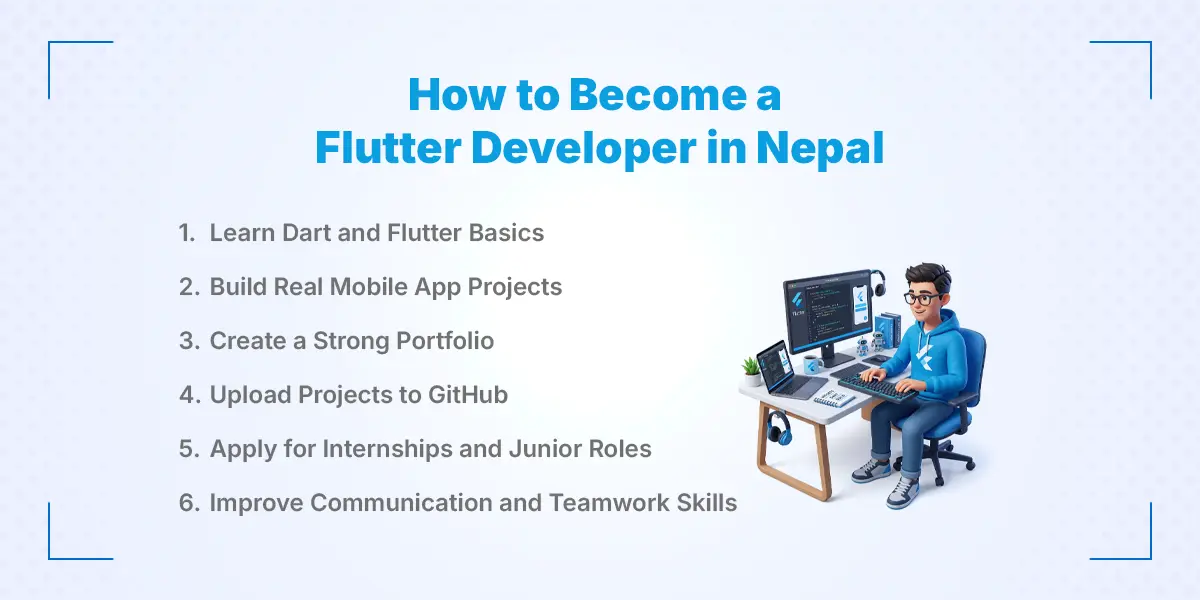
1. Learn Dart and Flutter Basics
Start your journey by mastering Dart, the core programming language behind Flutter. Once comfortable with Dart, move on to understanding Flutter's widget-based architecture and layout systems. Utilize free resources like YouTube, official documentation, or affordable courses on Udemy. Solidifying these basics is critical before attempting complex application logic.
2. Build Real Mobile App Projects
Theory alone won't get you hired; you must put your knowledge into practice. Start building real-world applications such as to-do lists, weather apps, or simple e-commerce clones. Encountering and solving bugs during development is the fastest way to learn. Real projects prove to employers that you can build functional software from scratch.
3. Create a Strong Portfolio
Your portfolio is your digital resume and the strongest tool in your job hunt. Showcase your best 3 to 4 Flutter applications, highlighting the specific problems you solved and the technologies you used. Ensure your apps have clean, intuitive UIs and are free of major bugs. A well-presented portfolio easily separates you from candidates who only list their skills on paper.
4. Upload Projects to GitHub
Tech companies in Nepal always want to see your code quality before scheduling an interview. Upload all your projects to GitHub, ensuring you write clean code and include proper README files explaining the app. Use Git to demonstrate that you understand version control and iterative development. An active GitHub profile acts as undeniable proof of your coding consistency.
5. Apply for Internships and Junior Roles
Once your portfolio is ready, start applying aggressively to local tech companies. Look for internships or junior developer roles on local job portals to gain a foothold in the industry. Don't be discouraged by rejections; use interviews as a learning experience to identify your knowledge gaps. Practical company experience will rapidly accelerate your professional growth.
6. Improve Communication and Teamwork Skills
Software development is rarely a solo endeavor in the corporate world. You need excellent communication skills to collaborate effectively with designers, QA testers, and project managers. Being able to explain technical constraints to non-technical team members is highly valued. Great teamwork skills often determine whether you pass the final cultural fit interview.
Best Places to Find Flutter Jobs in Nepal
Finding the right Flutter job requires looking in the right places and networking effectively. There are numerous avenues to explore when hunting for your next tech role.
1. Online job portals
Local job portals are the most direct way to find active tech vacancies. Platforms like Kumari Job regularly list openings for developers of all experience levels. Set up job alerts for "Flutter" or "Mobile App Developer" to apply as soon as a listing goes live. Ensure your profile on these portals is updated with your latest skills and resume.
2. LinkedIn and tech communities
LinkedIn is a goldmine for tech recruitment in Nepal. Optimize your profile, connect with HR managers at local IT companies, and showcase your portfolio projects in your feed. Joining local tech communities and Flutter Nepal Facebook groups can also alert you to unadvertised openings. Often, a direct message to a recruiter on LinkedIn yields better results than a standard application.
3. IT company career pages
Many top tech companies prefer to hire directly through their own websites. Make a list of top IT firms in Nepal, such as F1Soft, Thepaceinfosys, and eSewa, and frequently check their dedicated career pages. Sometimes, companies accept speculative applications even if there isn't an active listing. Submitting your resume directly shows genuine interest in their specific organization.
4. Freelancing websites
If you prefer remote work or want to earn extra income, freelancing platforms are excellent options. Websites like Upwork, Fiverr, and Toptal allow you to bid on international Flutter projects. While competitive initially, completing a few small jobs builds your rating and opens doors to long-term contracts. This is the best route for earning in USD from Nepal.
5. Networking events and hackathons
Attending local IT events, college tech fests, and hackathons is a fantastic way to network. These events allow you to meet senior developers, startup founders, and potential employers face-to-face. Showcasing your skills in a hackathon can sometimes result in an immediate job or internship offer. Personal connections built at these events often lead to strong career referrals.
Flutter Internship Opportunities in Nepal
Internship opportunities for students and fresh graduates are abundant in Nepal's tech hubs like Kathmandu, Lalitpur, and Pokhara. Many IT companies, especially rapidly growing startups and outsourcing firms, actively seek interns to mold into full-time developers. These internships usually last from three to six months, offering a modest stipend while providing an environment where you can learn industry-standard coding practices, version control, and agile methodologies.
The transition from an internship to a full-time role is highly common in the Nepali IT sector. Companies view internships as an extended interview; if you prove your worth by gaining practical app development experience, fixing bugs, and communicating well, you are highly likely to be offered a junior developer position. Gaining this hands-on, real-world experience is far more valuable than classroom theory and is the crucial first step to a long-term Flutter career.
Challenges in Flutter Careers
While the Flutter ecosystem is rewarding, developers face specific hurdles as they navigate their careers. Understanding these challenges will help you prepare and stay ahead.
1. Competitive junior-level market
Because Flutter is relatively easy to learn, the entry-level market is highly saturated with fresh graduates. To stand out, a basic to-do app won't suffice; you need a unique, complex portfolio. Securing that first junior role requires persistence, networking, and demonstrating a deeper understanding of the framework than your peers. Employers actively filter out candidates who only rely on copy-pasted tutorial code.
2. Need for continuous learning
The tech landscape, and Flutter in particular, evolves at a breakneck pace. Google frequently updates the framework, introducing new features, deprecating old widgets, and changing best practices. A developer must dedicate personal time to continuous learning just to keep their skills relevant and avoid becoming obsolete in the job market. Falling behind on modern architectural patterns can severely limit your career progression.
3. Managing app performance and scalability
Building a simple app is easy, but maintaining performance as the app scales is incredibly difficult. Developers struggle with memory leaks, sluggish animations, and inefficient state management when user bases grow. Mastering performance optimization and clean architecture is a steep learning curve that separates juniors from senior engineers. Proving you can handle these complexities is vital during technical interviews.
4. Keeping up with new technologies and frameworks
A Flutter developer cannot exist in a vacuum; they must understand the broader tech ecosystem. New tools, CI/CD pipelines, backend as a service (BaaS) platforms, and state management libraries emerge constantly. Balancing your daily coding tasks with the necessity of learning these new peripheral technologies can be mentally exhausting. However, adapting to these new technologies is what ensures long-term job security and high salaries.
Future Scope of Flutter Jobs in Nepal
The future scope of Flutter jobs in Nepal is exceptionally bright and secure. The increasing startup ecosystem in Nepal heavily relies on Flutter to quickly launch cross-platform MVPs to market without hiring separate iOS and Android teams. As more traditional businesses shift to mobile-first platforms for e-commerce and services, the rising demand for cross-platform app developers will only accelerate. Furthermore, the exponential growth of remote international opportunities means Nepali developers can continue to live locally while scaling their careers and salaries globally.
Conclusion
Flutter development offers some of the most dynamic and financially strong career opportunities in Nepal’s rapidly growing IT industry. From booming fintech companies in Kathmandu to remote international contracts, the demand for developers who can efficiently bridge the gap between iOS and Android is at an all-time high. To succeed in this competitive space, continuously refining your practical skills, mastering state management, and building a robust project portfolio are absolutely essential.
Freelancing and remote work are currently opening global opportunities, allowing Nepali developers to earn international wages while contributing to the local tech community. If you are searching for the latest Flutter developer jobs, internships, and IT vacancies in Nepal, explore opportunities on Kumari Job to kickstart your mobile app development journey today.
Frequently Asked Questions
Submit your comments

Get Our App On



SEO Training for Freshers in Nepal: Skills, Career & Job Opportunities
VIEW DETAILS
SEO Training vs. Self-Learning: Which Is Right for You?
VIEW DETAILS
How to Choose Between Two Job Offers
VIEW DETAILS
Digital Marketing Training Interview Questions and Answers for Freshers
VIEW DETAILS


Loading Comments...