



A fresh graduate scrolling through job listings often hits the same wall: most entry-level postings ask for two years of experience before they will even consider an application. BPO jobs solve that exact problem, since they are one of the few sectors in Nepal that hires purely on communication skill and trainability rather than a long work history.
This guide covers what BPO jobs actually involve, where to find them in Nepal, the qualifications and skills employers expect, realistic salary ranges, the full application process, and the career path from entry-level agent to operations manager. The primary keyword driving this guide is simple: how to find BPO jobs in Nepal, and every section below answers a piece of that question.
In this blog
What Are BPO Jobs?
BPO stands for Business Process Outsourcing, and it refers to companies that handle specific business tasks, such as customer support or data processing, on behalf of other organizations. These companies operate as service providers, taking on the operational work that a client business does not want to manage in-house. Because a single BPO company can serve multiple clients across different industries, the range of roles inside one office is often wider than candidates expect.
Common types of BPO work include:
- Customer service
- Call center operations
- Technical support
- Telemarketing
- Data entry and processing
- Back-office operations
- Email and chat support
- International customer support
How to Find BPO Jobs in Nepal?
Candidates can find BPO jobs in Nepal by searching online job portals like kumarijob , checking company career pages directly, and following recruitment agencies that specialize in call center and customer support hiring. Nepal's BPO sector has grown alongside demand from international clients, which means new vacancies open regularly across both local and outsourcing-focused companies. The steps below cover the full search-to-offer process in order.
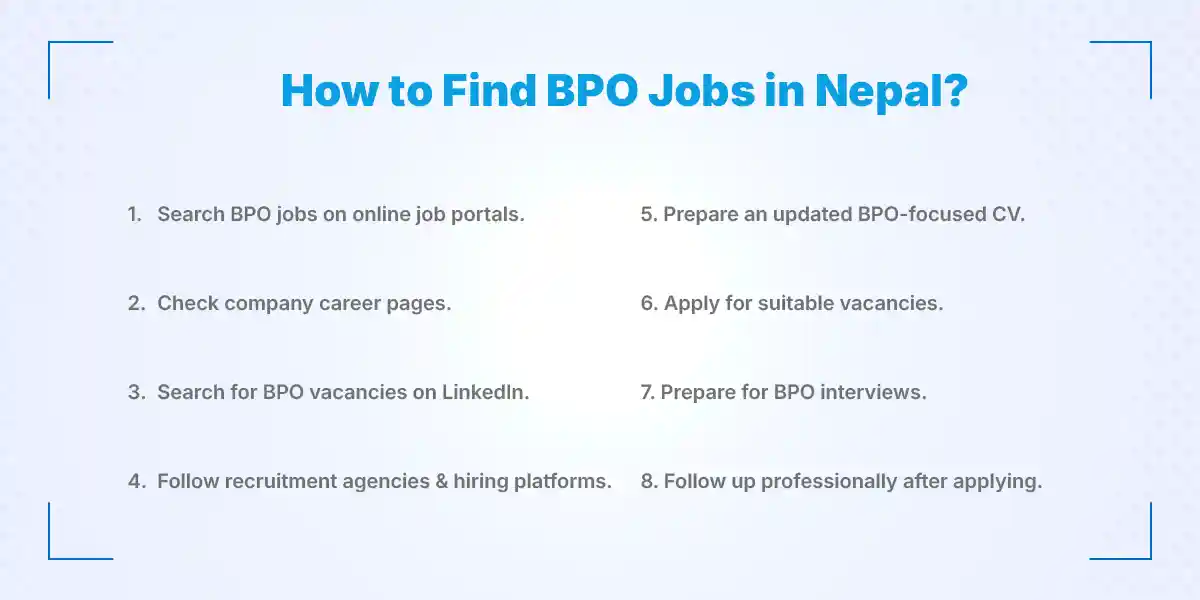
- Search BPO jobs on online job portals.
- Check company career pages.
- Search for BPO vacancies on LinkedIn.
- Follow recruitment agencies and hiring platforms.
- Prepare an updated BPO-focused CV.
- Apply for suitable vacancies.
- Prepare for BPO interviews.
- Follow up professionally after applying.
Candidates can find current openings, along with resources on building a professional CV and fresher-friendly listings, through job portals such as KumariJob.
Where Can You Find BPO Jobs in Nepal?
BPO vacancies in Nepal appear across a mix of digital and in-person channels, so candidates who rely on only one source often miss openings. Job portals remain the fastest way to compare multiple companies at once, while direct company career pages sometimes list roles before they appear anywhere else. Combining several channels increases both the number of opportunities found and the speed of getting an application in front of a hiring manager.
- Online job portals
- Company career websites
- Recruitment agencies
- Social media job groups
- Employee referrals
- Networking events
- Local career fairs
What Qualifications Do You Need for BPO Jobs in Nepal?
Qualification requirements for BPO jobs in Nepal vary by employer and specific role, but most entry-level positions accept candidates with a high school or bachelor's-level education. Employers generally weigh communication ability and trainability more heavily than a specific degree, which is part of why the sector remains accessible to freshers. The requirements below cover what most BPO job listings ask for.
- Minimum educational qualification
- English communication skills
- Basic computer knowledge
- Customer service skills
- Typing and data-entry skills
- Problem-solving ability
- Willingness to work in shifts
- Good interpersonal skills
Some companies also hire for back-office assistant roles, which typically require stronger data accuracy and documentation skills over verbal customer interaction.
What Skills Are Required for BPO Jobs in Nepal?
BPO employers look for a combination of technical and soft skills, since the job blends direct customer interaction with computer-based task completion. Communication sits at the top of that list because nearly every BPO role, from voice support to chat support, depends on clear and professional interaction. The skills below appear across almost every BPO job description in Nepal.
- Communication skills
- English language proficiency
- Active listening
- Customer service skills
- Basic computer skills
- Typing skills
- Problem-solving
- Time management
- Teamwork
- Adaptability
- Conflict resolution
- Multitasking
How Much Is the Salary for BPO Jobs in Nepal?
BPO salaries in Nepal vary based on experience, job role, company, skills, shift timing, and performance incentives.
| BPO Job Role | Typical Monthly Salary in Nepal |
|---|---|
| Entry-Level BPO Job | NPR 15,000–25,000 |
| Customer Service Representative | NPR 18,000–30,000 |
| Call Center Executive | NPR 18,000–30,000 |
| Technical Support Executive | NPR 25,000–40,000 |
| Experienced BPO Professional | NPR 30,000–50,000+ |
| Night-Shift BPO Job | NPR 20,000–40,000+ |
| Performance-Based Incentives | Additional NPR 2,000–15,000+ |
How to Apply for BPO Jobs in Nepal?
To apply for BPO jobs in Nepal, search for suitable vacancies, check the eligibility requirements, prepare a targeted CV, submit your application, and complete the interview and assessment process. Most BPO employers evaluate communication skills, computer knowledge, customer-handling ability, and willingness to work required shifts. Following the steps below can help you complete the application process more effectively.
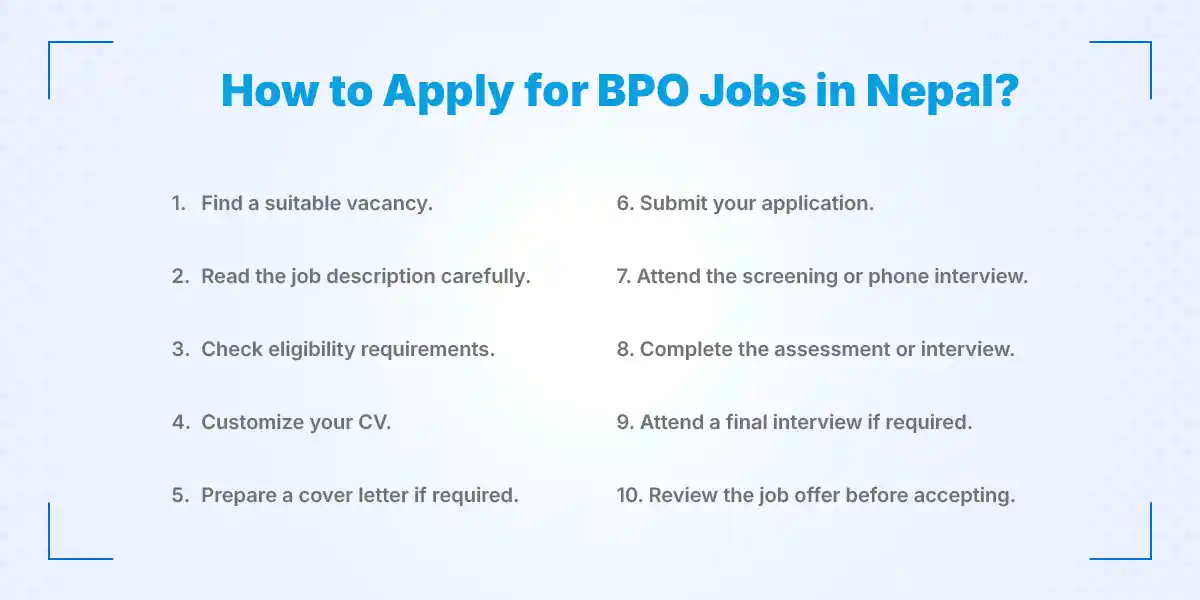
1. Find a Suitable BPO Vacancy
Search for BPO vacancies on job portals, company career pages, LinkedIn, and recruitment platforms. Use keywords such as BPO jobs, call center jobs, customer service jobs, and non-voice BPO jobs. Focus on vacancies that match your education, skills, experience, and preferred location.
2. Read the Job Description
Read the job description carefully before applying to understand what the employer expects. Check the responsibilities, required qualifications, working hours, salary, location, and required skills. This helps you determine whether the position is suitable for you.
3. Check Eligibility Requirements
Review the education, experience, communication, computer, and language requirements listed in the vacancy. Many entry-level BPO positions accept freshers, while specialized roles may require previous experience or technical skills. Apply when you meet the essential requirements rather than relying only on the job title.
4. Customize Your CV
Prepare a clear CV that highlights skills relevant to the BPO position. Emphasize communication, customer service, English proficiency, computer knowledge, typing, problem-solving, and relevant experience. Keep your CV concise and tailor it to the specific vacancy whenever possible.
5. Prepare a Cover Letter
Prepare a short cover letter if the employer requests one or if it can strengthen your application. Explain why you are interested in the position and highlight two or three skills that match the job requirements. Keep the letter professional, relevant, and easy to read.
6. Submit Your Application
Submit your application through the job portal, company website, email, or application method specified in the vacancy. Double-check your CV, contact information, and other required documents before submitting. Keep a record of the positions you apply for so you can follow up when appropriate.
7. Attend the Screening Interview
If your application is shortlisted, you may receive a phone or initial interview from the recruiter. The recruiter may assess your communication skills, availability, salary expectations, and willingness to work specific shifts. Speak clearly and professionally while providing honest answers.
8. Complete the Assessment
Some BPO companies conduct assessments before the final interview. These may include English proficiency, typing speed, computer knowledge, customer-service scenarios, or other role-specific tests. Practice these skills beforehand, particularly if you are applying for a voice or international customer-support position.
9. Attend the Final Interview
The final interview may focus on your communication style, customer-handling ability, problem-solving skills, previous experience, and availability. Prepare answers for common questions such as "Tell me about yourself" and "How would you handle an angry customer?" Researching the company and understanding the role can also help you answer more confidently.
10. Review the Job Offer
Review the complete offer before accepting a BPO position. Check the salary, incentives, benefits, working hours, shift requirements, probation period, location, and other employment terms. Make sure you understand the conditions of employment and clarify any important questions before joining.
Benefits of Working in a BPO Company in Nepal
BPO jobs offer several practical advantages, particularly for freshers entering the workforce for the first time. The most commonly cited benefits include:
- Suitable entry point for freshers
- Professional work environment
- Communication skill development
- Customer service experience
- Training opportunities
- Career advancement
- Exposure to international clients
- Teamwork and professional networking
- Potential performance incentives
Challenges of BPO Jobs in Nepal
BPO work also comes with real challenges that candidates should weigh honestly before accepting an offer. The most common challenges reported by BPO employees include:
- Night and rotating shifts
- High customer interaction
- Performance targets
- Work pressure
- Repetitive tasks in some positions
- Difficult customer interactions
- Maintaining work-life balance
Career Growth Opportunities in the BPO Industry
BPO professionals can progress from entry-level positions to specialized, supervisory, management, and business development roles:
- Customer Service: Handle customer queries, complaints, support requests, and day-to-day customer interactions.
- Technical Support: Develop technical, software, troubleshooting, and communication skills to provide specialized customer support.
- Quality Assurance: Monitor calls, evaluate employee performance, identify service issues, and maintain quality standards.
- Training: Train new employees in communication, customer service, company processes, and job-specific skills.
- Team Management: Progress to a team leader or supervisor role and manage team performance, targets, schedules, and employee support.
- Operations Management: Manage business processes, productivity, staffing, performance, and overall BPO operations.
- Business Development: Move into roles focused on client relationships, sales, account management, and acquiring new business opportunities.
Conclusion
Finding a BPO job in Nepal is less about credentials and more about preparation, since most employers are hiring for communication skill, trainability, and a professional attitude rather than a long work history. Candidates who search across multiple channels, tailor their CV to the role, and prepare seriously for the screening call consistently move through the hiring process faster than those who apply passively.
For candidates ready to start that search, KumariJob lists current BPO, customer support, and call center vacancies across companies in Nepal, offering a practical next step for turning this preparation into an actual job offer.
Frequently Asked Questions
Submit your comments

Get Our App On



SEO Training for Freshers in Nepal: Skills, Career & Job Opportunities
VIEW DETAILS
SEO Training vs. Self-Learning: Which Is Right for You?
VIEW DETAILS
How to Choose Between Two Job Offers
VIEW DETAILS
Digital Marketing Training Interview Questions and Answers for Freshers
VIEW DETAILS


Loading Comments...