



You open a job listing for an entry-level SEO role, and it asks for a portfolio and one year of experience. You have neither, and every employer seems to want proof before giving you the chance to earn it. That gap stops many freshers before they send a single application.
A portfolio does not need paying clients. This guide shows you how to build an SEO portfolio from scratch by choosing a practice website, completing real projects, documenting your results, and turning them into case studies. You will also learn where to publish the portfolio and how to use it in job applications.
In this blog
What Is an SEO Portfolio?
An SEO portfolio is a collection of projects that shows how you research keywords, fix website problems, and improve search visibility. Employers use it to judge your skills, your thinking, and your ability to explain your work. A resume lists what you claim to know, while a portfolio proves it with evidence.
Most strong portfolios include these elements:
- SEO projects
- Keyword research
- On-page optimization
- Technical SEO audits
- Content optimization
- Link-building activities
- Results and insights
- Case studies
Can You Build an SEO Portfolio Without Work Experience?
Yes, you can build a strong SEO portfolio without any paid work. Personal sites, practice projects, and permitted audits show the same skills that client work shows. Employers care most about what you did, why you did it, and what you learned.
- Label every project as personal, academic, volunteer, or client-based.
- Never claim fake client experience.
- Never publish fabricated results.
- Explain your reasoning, not only your actions.
What Should You Include in an SEO Portfolio?
A good SEO portfolio includes a short introduction, a list of skills, several real projects, and proof of results. Each item should answer one question for the recruiter: can this person do the work? Keep every section short, clear, and backed by screenshots or data.
- Short professional introduction
- SEO skills
- Keyword research project
- On-page SEO project
- Technical SEO audit
- Content optimization example
- Local SEO project
- Link-building or off-page SEO project
- SEO tools you can use
- Before-and-after examples
- SEO case studies
- Results or measurable improvements
- Lessons learned
- Contact information
How to Build an SEO Portfolio Without Work Experience?
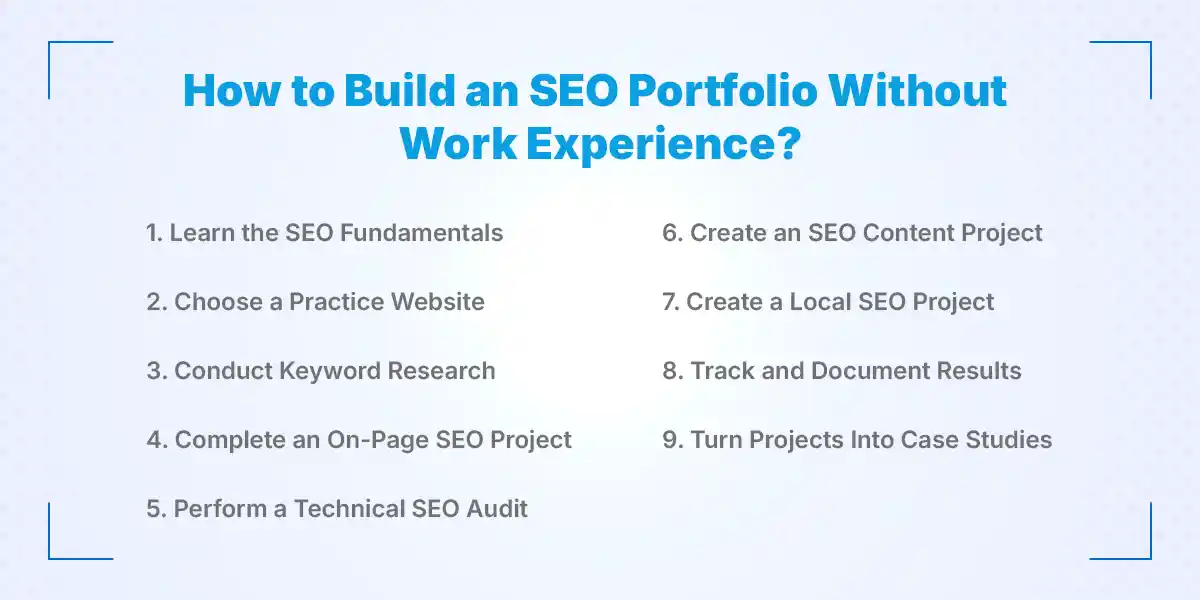
You build an SEO portfolio by learning the basics, running projects on a practice website, and documenting every step as a case study. Each project adds one piece of proof to your portfolio. Follow the nine steps below in order.
1. Learn the SEO Fundamentals
Start with how search engines crawl, index, and rank pages, because every other task depends on it. Search intent matters just as much, since a page that ignores what the searcher wants rarely ranks. Study keyword research, on-page, technical, off-page, and local SEO through free courses from Google and trusted industry blogs. Write short notes on each topic so you can explain it clearly in an interview.
2. Choose a Practice Website
You need a real website to test your ideas, because screenshots from a live site carry more weight than theory. Build a simple blog or personal site on one narrow topic, or get written permission to work on a friend's or a small business's site. Connect Google Search Console and Google Analytics 4 on day one so you capture a starting point. State clearly in your portfolio that the site is a personal or practice project.
3. Conduct Keyword Research
Keyword research shows what people type and why, so it guides every content decision. Pick one primary keyword and several secondary ones, then check the search results to confirm the intent behind each term. Group related terms into clusters and mark long-tail phrases, since small sites win those first. Save your spreadsheet and write down how you chose each keyword.
4. Complete an On-Page SEO Project
On-page work is the fastest way to show visible change. Rewrite title tags and meta descriptions, fix heading structure from H1 to H3, add internal links, and write useful image alt text. Take a screenshot of each page before and after your edits. Add a short note explaining why you made each change.
5. Perform a Technical SEO Audit
A technical audit proves you can find problems that hurt crawling and indexing. Check the robots.txt file, XML sitemap, canonical tags, broken links, mobile usability, and Core Web Vitals with Screaming Frog and PageSpeed Insights. Rank each issue by impact and effort so the reader knows what to fix first. Include your recommended fixes, and show the result for any fix you apply.
6. Create an SEO Content Project
A content project shows you can turn research into a page that satisfies a searcher. Choose one target keyword, study the top-ranking pages, and build an outline that covers what they miss. Write or improve the article, add internal and external links, and set clean headings and metadata. Track impressions and clicks in Search Console for several weeks and record what changes.
7. Create a Local SEO Project
Local SEO projects suit beginners because they need little technical setup. Pick a hypothetical business or one that gives you permission, then research local keywords and review the Google Business Profile. Check that the name, address, and phone number match across directories, and compare the business against three nearby competitors. Finish with a list of local content ideas, such as service pages and neighborhood guides.
8. Track and Document Results
Tracking turns your work into evidence. Record your starting numbers, then monitor impressions, clicks, average position, and organic traffic each week. Note technical fixes with dates so you can connect changes to results. Report what worked and what failed, since honest failures show good judgment.
9. Turn Projects Into Case Studies
A case study tells the story behind your work so a hiring manager can follow your thinking. Cover the objective, background, SEO problem, research, strategy, actions, tools, results, challenges, lessons, and next steps. Keep each case study to one page of clear writing with screenshots. Publish three to five of them rather than one long document.
What SEO Projects Can Beginners Add to Their Portfolio?
Beginners can add keyword research, audits, content work, and local SEO projects that use free or low-cost tools. These projects need no client, only a website and a clear method. Pick the ones that match the jobs you want.
- Keyword research project
- SEO competitor analysis
- On-page SEO audit
- Technical SEO audit
- Blog optimization project
- Content gap analysis
- Internal linking project
- Local SEO audit
- SEO-friendly content creation
- Website speed audit
- Google Search Console analysis
- SEO content strategy
- Keyword clustering project
- Meta title and description optimization
- Small website SEO improvement project
How to Create an SEO Case Study With No Clients?
Use a personal site, practice site, volunteer project, or public website for your audit, and label the project type clearly. Show the problem, your analysis, your actions, and the outcome. If results are not measurable yet, present your recommendations and explain how you would measure success.
Use this format for every case study:
- Project overview
- Goal
- SEO problems
- Keyword research
- SEO strategy
- Implementation
- Results
- Lessons learned
Which SEO Tools Should You Use for Portfolio Projects?
Google Search Console, Google Analytics 4, Screaming Frog, and PageSpeed Insights cover most beginner portfolio needs. Most of these tools have free versions, so cost should not block you. Pair each tool with one problem it helped you solve.
| Tool | Best Use in a Portfolio |
|---|---|
| Google Search Console | Track impressions, clicks, and indexing issues. |
| Google Analytics 4 | Measure organic traffic and user behavior. |
| Google Keyword Planner | Estimate search volume for keyword ideas. |
| Google Trends | Compare seasonal interest and rising topics. |
| Screaming Frog | Crawl a site for broken links and metadata gaps. |
| Ahrefs | Study competitors and backlink profiles. |
| Semrush | Run keyword gap and site audit reports. |
| PageSpeed Insights | Check Core Web Vitals and page speed problems. |
| Google Rich Results Test | Validate structured data for eligible rich results. |
| Google Search | Analyze search intent and competing pages. |
| Bing Webmaster Tools | Review indexing and search performance in Bing. |
How to Show SEO Results When You Have No Client Data?
Show results from your own website or practice project, using screenshots of real data and clear before-and-after comparisons. If a project has not produced results yet, present the completed work and explain the expected impact. Never invent traffic, rankings, backlinks, or conversions, because recruiters spot fake numbers quickly.
- Use screenshots from Search Console and Analytics.
- Compare the same metric before and after your changes.
- Include the date range for every chart.
- Explain what you think caused each change.
Best Practices for Creating a Strong SEO Portfolio
- Keep the portfolio simple and easy to navigate.
- Showcase three to five high-quality projects.
- Explain your decision-making process.
- Use screenshots and data where appropriate.
- Highlight measurable results.
- Be honest about project ownership and experience.
- Update the portfolio as you gain new skills.
- Match portfolio projects to the SEO jobs you want.
- Make the portfolio mobile-friendly.
Where Can You Publish Your SEO Portfolio?
You can publish your SEO portfolio on a personal website, Notion, Google Drive, GitHub, LinkedIn, or Medium. A personal website gives you the most control and doubles as a live SEO project. Any platform works if recruiters can open it with one link.
- Personal website: Best for control, branding, and showing your own rankings.
- Notion: Fast to set up and easy to update.
- Google Drive: Simple for sharing PDFs and spreadsheets.
- GitHub: Useful if you document technical audits or scripts.
- LinkedIn: Reaches recruiters directly through articles and featured links.
- Medium: Works for publishing written case studies.
- Online portfolInclude both technical and content-focused work.
- io platforms: Offer ready-made templates.
How to Use Your SEO Portfolio to Get Your First SEO Job?
You can use your SEO portfolio to show employers your practical SEO skills, even if you do not have professional work experience. Add your portfolio to your resume and LinkedIn profile, highlight relevant SEO projects when applying for jobs, and use your case studies to demonstrate how you solve real SEO problems.
- Add Your SEO Portfolio to Your Resume
Include your portfolio link near your contact information or in the relevant skills section. Make sure the link opens directly to your projects, case studies, and SEO work. - Add Your Portfolio to LinkedIn
Add your SEO portfolio to your LinkedIn profile and Featured section. This allows recruiters to see your practical SEO skills when reviewing your profile. - Mention Relevant Projects in Your Cover Letter
Highlight one or two SEO projects that match the job requirements. For example, mention a keyword research, on-page SEO, technical SEO audit, or content optimization project. - Show Your Case Studies During Interviews
Use your portfolio to explain how you identified an SEO problem, researched the issue, implemented a solution, and measured the results. This helps demonstrate your practical knowledge. - Use Portfolio Projects to Answer SEO Questions
When an interviewer asks a practical SEO question, connect your answer to a project you completed. Explain what you did and why you chose that approach. - Apply for SEO Internships and Entry-Level Jobs
Use your portfolio when applying for SEO internships, SEO fresher jobs, junior SEO roles, and digital marketing positions. A strong portfolio can help demonstrate skills when professional experience is limited. - Customize Your Portfolio for Each SEO Job
Highlight projects that match the specific role. For a technical SEO position, emphasize audits and technical improvements. For a content SEO role, highlight keyword research, content optimization, and internal linking projects. - Keep Updating Your SEO Portfolio
Continue adding new projects, case studies, skills, and measurable results as you gain experience. An updated SEO portfolio shows that you are continuously learning and improving your SEO skills.
SEO Portfolio Checklist for Freshers
A strong SEO portfolio for freshers should clearly show your practical SEO skills, projects, tools, and learning process. Before sharing your portfolio with employers, make sure it includes relevant SEO projects, case studies, results or recommendations, and your professional contact details.
Use this checklist before applying for SEO internships and entry-level SEO jobs:
- Professional Introduction: Briefly explain who you are, your SEO skills, and the type of SEO role you are looking for.
- SEO Skills: List your key skills, such as keyword research, on-page SEO, technical SEO, content optimization, off-page SEO, and local SEO.
- Keyword Research Project: Show how you found keywords, analyzed search intent, and selected target keywords.
- On-Page SEO Project: Include examples of optimizing title tags, meta descriptions, headings, content, images, and internal links.
- Technical SEO Audit: Show your ability to identify issues related to crawling, indexing, redirects, canonical tags, sitemap, and website performance.
- Content Optimization Example: Include a before-and-after example of how you improved content for users and search engines.
- SEO Case Study: Explain the SEO problem, strategy, actions taken, and outcome of a project.
- SEO Tools Used: Mention tools such as Google Search Console, Google Analytics, Google Keyword Planner, Screaming Frog, Semrush, or Ahrefs.
- Screenshots and Data: Use relevant screenshots, reports, or performance data to support your work.
- Results or Recommendations: Show measurable results when available. If you do not have performance data, clearly explain your SEO recommendations and expected outcomes.
- Lessons Learned: Briefly explain what you learned from each project and how you would improve the strategy in the future.
- Resume Link: Add a link to your updated resume so recruiters can easily review your qualifications.
- LinkedIn Profile: Include your LinkedIn profile to provide additional information about your education, skills, and professional background.
- Contact Information: Add a professional email address or other suitable contact method so employers can reach you easily.
Conclusion
Nobody becomes an SEO professional by reading about SEO, and no recruiter hires on intention alone. Pick one website and one project this week, such as a keyword research sheet or a basic technical audit, and finish it. A single completed project with honest data beats a plan for ten projects you never start.
Explore SEO learning resources and entry-level SEO jobs on KumariJob, and turn your first portfolio project into your first job offer.
Frequently Asked Questions
Submit your comments

Get Our App On



Can You Get a Hotel Job Without a Hotel Management Degree in Nepal?
VIEW DETAILS
Sales Job Interview Questions and Answers in Nepal
VIEW DETAILS
How to Get a Job in a 5-Star Hotel in Nepal: A Complete Guide
VIEW DETAILS
What Is AI SEO, and How Is It Changing SEO Jobs in Nepal?
VIEW DETAILS


Loading Comments...