


Should you choose online or offline accounting classes in Nepal? This is the exact question thousands of students and job seekers ask before enrolling in a course. With training centers popping up across Kathmandu and online options expanding daily, making the right pick can feel overwhelming.
You might wonder whether physical classroom practice is worth the daily commute. Or maybe you are curious if an online accounting course in Nepal can actually teach you real-world skills like VAT filing and Tally Prime.
The truth is, there is no single answer for everyone. The best choice depends on your current routine, learning style, and career goals. This comprehensive guide compares both online vs offline options to learn accounting in Nepal to help you make a smart, confident decision.
In this blog
Online vs Offline Accounting Classes in Nepal: Quick Comparison
Online accounting classes offer great flexibility to study from anywhere in Nepal, while offline classes provide hands-on computer lab practice and direct trainer help. Because of this, online options work best if you have a busy schedule, whereas offline classes help complete beginners build practical software skills much faster.
To help you choose the right path easily, here is a quick side-by-side comparison of both learning formats:
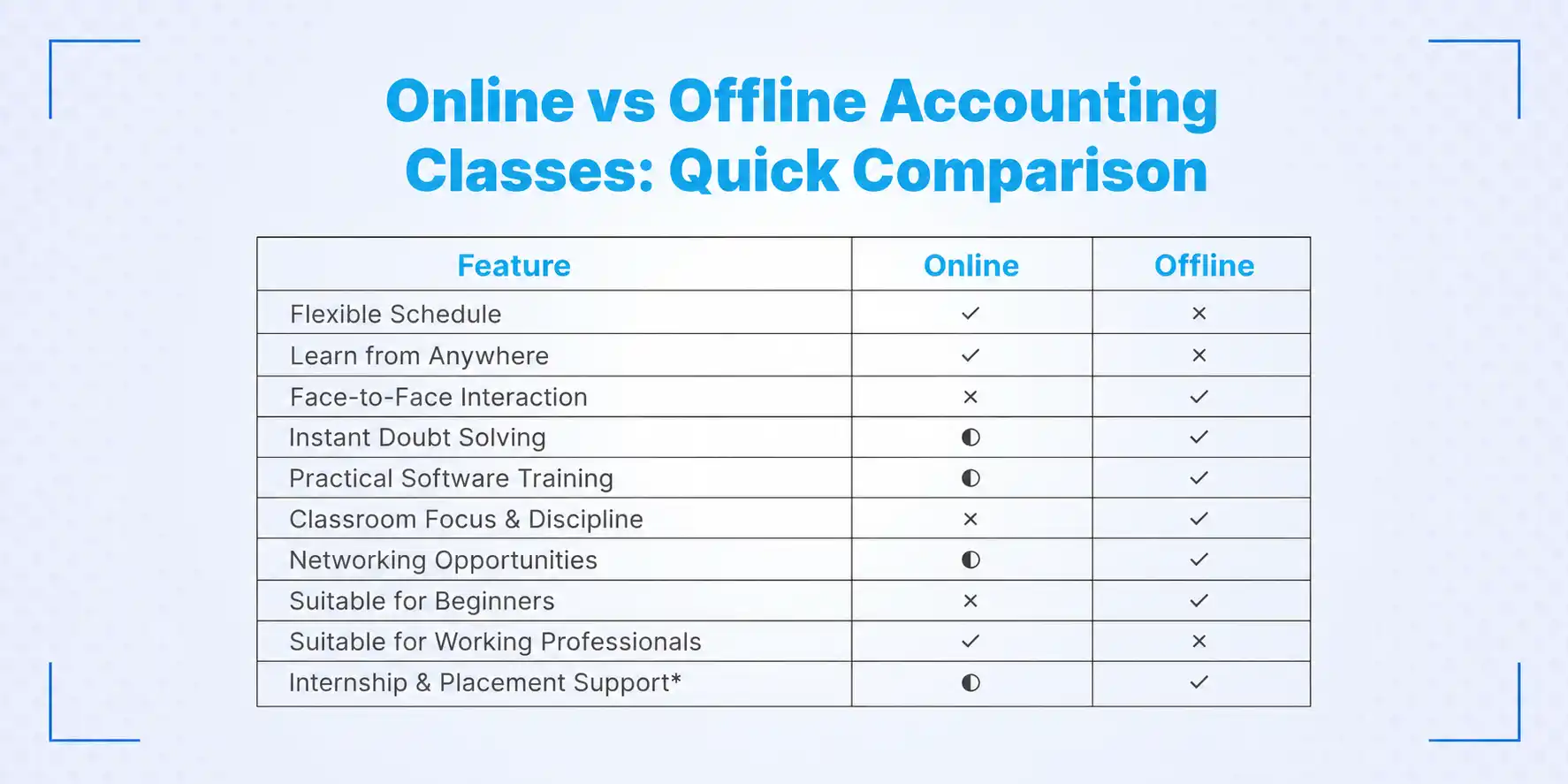
Key Takeaway: Choose online classes if you need flexibility and live far from training centers. Choose offline classes if you need structured guidance, direct computer lab access, and hands-on support.
How Online Accounting Classes Work in Nepal?
Online accounting classes let you attend live sessions, complete practical assignments, and learn accounting software from anywhere. Most institutes combine live classes with recorded lessons and digital study materials, allowing you to learn at your own pace while still receiving trainer support.
1. Advantages of Online Classes
- Learn from Anywhere: Join quality accounting training from any part of Nepal without relocating.
- Flexible Schedule: Study around college, work, or other commitments.
- Lower Overall Cost: Save on travel, accommodation, and daily commuting expenses.
2. Limitations of Online Classes
- Requires Self-Discipline: Staying consistent is entirely your responsibility.
- Less Face-to-Face Interaction: Asking questions and collaborating with classmates can feel less natural.
- Depends on Technology: A reliable internet connection and a suitable computer are essential.
How On-Site Accounting Classes Work in Nepal
Offline accounting classes take place in a physical classroom where students learn directly from an instructor and practice using accounting software in computer labs. The structured environment encourages regular attendance, hands-on learning, and immediate feedback.
1. Advantages of Offline Classes
- Immediate Guidance: Trainers can solve problems and correct mistakes on the spot.
- Better Practical Learning: Software practice and classroom activities are easier to follow.
- More Structured Environment: Fixed schedules help many students stay focused and consistent.
2. Limitations of Physical Classes
- Less Flexibility: You must attend classes at fixed times.
- Travel Time and Costs: Daily commuting adds both time and expense.
- Limited Access: Students outside major cities may have fewer quality institutes nearby.
Online vs Offline Accounting Classes in Nepal: Which Is Better?
Offline accounting classes in Nepal are best for complete beginners who need hands-on lab practice and direct trainer guidance, whereas online classes are ideal for working professionals and out-of-valley students who require flexible schedules. Beginners benefit more from in-person trainer guidance on software like Tally Prime, while working students gain the freedom to upskill without interrupting their jobs.
Below is a complete comparison of both options to help you decide which path best fits your career goals.
1. Learning & Instructor Support
Classroom dynamics and trainer availability directly shape how quickly you understand complex tax rules.
| Criteria | Online | Offline |
|---|---|---|
| Classroom Interaction | Digital chats and Q&A sessions | Direct verbal dialogue with peers |
| Doubt Solving | Scheduled Q&A or chat messages | Instant, face-to-face assistance |
| Feedback Speed | Checked within 24–48 hours digitally | Checked live during lab practice |
| Accountability | Self-driven study habit required | Instructor-led daily discipline |
Offline classes give you immediate feedback, while online classes require you to take initiative in asking questions.
2. Practical Training & Software
Accounting requires hands-on practice with tools like Tally Prime and Advanced MS Excel.
| Criteria | Online | Offline |
|---|---|---|
| Software Setup | Installed on your personal computer | Pre-installed on institute computers |
| Business Vouchers Practice | Worked on using digital PDF samples | Worked on using physical paper bills |
| Exercise Style | Self-paced project files | Guided lab exercises |
| Hands-on Lab Access | Home computer setup needed | Dedicated lab facilities provided |
Offline institutes supply ready computer labs, whereas online students must have a working personal computer at home.
3. Flexibility & Convenience
Managing your study hours alongside daily work or college commitments is critical.
| Criteria | Online | Offline |
|---|---|---|
| Scheduling | Highly flexible time slots | Fixed, rigid daily schedules |
| Commuting | Zero travel time | Daily travel through city traffic |
| Learning Pace | Re-watch recorded videos anytime | Follows the speed of the class |
| Accessibility | Accessible from any district in Nepal | Limited to major city locations |
Online learning fits effortlessly into busy routines, whereas offline courses demand fixed daily travel.
4. Cost & Accessibility
Your total investment includes course fees, travel costs, and potential relocation expenses.
| Criteria | Online | Offline |
|---|---|---|
| Tuition Fees | Generally lower and affordable | Slightly higher due to center overheads |
| Transport Expenses | Zero bus or petrol costs | Daily travel and snack costs |
| Relocation Needs | No need to move to big cities | May require living near the institute |
| Overall Cost Efficiency | High budget savings | Higher total expenditure |
Online training saves a lot of money on travel and hostel fees for students outside Kathmandu.
5. Career Support
Landing your first job often depends on networking and the placement help offered by your training center.
| Criteria | Online | Offline |
|---|---|---|
| Peer Networking | Digital messaging groups | In-person classmate connections |
| Internships | Remote project assignments | Local office internship connections |
| Placement Support | Online job board referrals | Direct local business recommendations |
| Employer Trust | High (if practical skills are proven) | High (due to physical lab proof) |
Offline institutes usually have stronger direct relationships with local hiring managers in Nepal.
Does the Learning Format Affect Your Job Readiness?
Many students assume offline classes automatically lead to better jobs. In reality, employers rarely ask how you learned. They care about what you can do.
If you can confidently use accounting software, prepare financial records, calculate payroll, and understand Nepal's tax system, you're already in a much stronger position—whether you learned online or in a classroom.
1. The Institute Matters More Than the Format
A high-quality online course can be just as effective as an offline one. Likewise, an offline class with outdated teaching and little practical work won't make you job-ready.
When comparing institutes, look beyond whether classes are online or offline.
2. Practical Training Is What Employers Value
A good accounting course should include hands-on practice with:
- Accounting software like Tally Prime and Advanced Excel
- Real business documents and vouchers
- VAT, TDS, and payroll
- Practical assignments and case-based exercises
These are the skills employers expect from entry-level accounting roles in Nepal.
3. Training Support Makes Online Learning More Effective
A good online course shouldn't leave students to learn on their own. The best skill training institutes keep learners engaged through live classes, practical assignments, trainer support, and regular progress checks.
For example, Kumari Job supports online learners with live classes, practical assignments, recorded sessions for revision, and trainer guidance throughout the course. This keeps learning interactive and helps students stay on track.
Bottom Line
Job readiness comes from practical exercises and real-world projects, not from sitting in a physical classroom.
Choose the institute before you choose the format. A practical curriculum, experienced trainers, and consistent guidance will have a much bigger impact on your career than whether you study online or offline.
Many students debate between a CA vs Practical Accounting Job in Nepal, but for most corporate accounting roles, functional software skills win every time.
Features to Look for Before Joining Any Accounting Course
Before joining any accounting course, check if it offers practical training, accounting software, experienced trainers, an updated syllabus, and internship or placement support. These features will help you build real skills and prepare you for accounting jobs, no matter where you study. Use the checklist below to compare different accounting institutes and choose the one that gives you the best overall value.
Use this quick checklist to evaluate any accounting institute in Nepal before paying tuition fees:
- Updated Syllabus: Covers modern Nepalese tax rules, VAT laws, and IRD portal filings.
- Practical Assignments: Uses real sample bills, purchase vouchers, and bank statements.
- Accounting Software: Includes hands-on practice in Tally Prime and Advanced MS Excel.
- Experienced Trainers: Taught by active Chartered Accountants or working finance heads.
- Internship & Placement Support: Connects past students directly with hiring companies.
- Small Batch Sizes: Ensures every student gets personal attention and screen reviews.
Compare institutes using these practical features rather than choosing based on cheap course fees alone.
How to Choose the Right Accounting Class in Nepal?
Choosing the right accounting class in Nepal depends on your career goal, current skill level, learning format, practical training, and the support offered by the institute. Looking at these factors will help you choose a course that matches your needs and prepares you for real accounting jobs. Follow the simple steps below to compare your options and make the right choice.
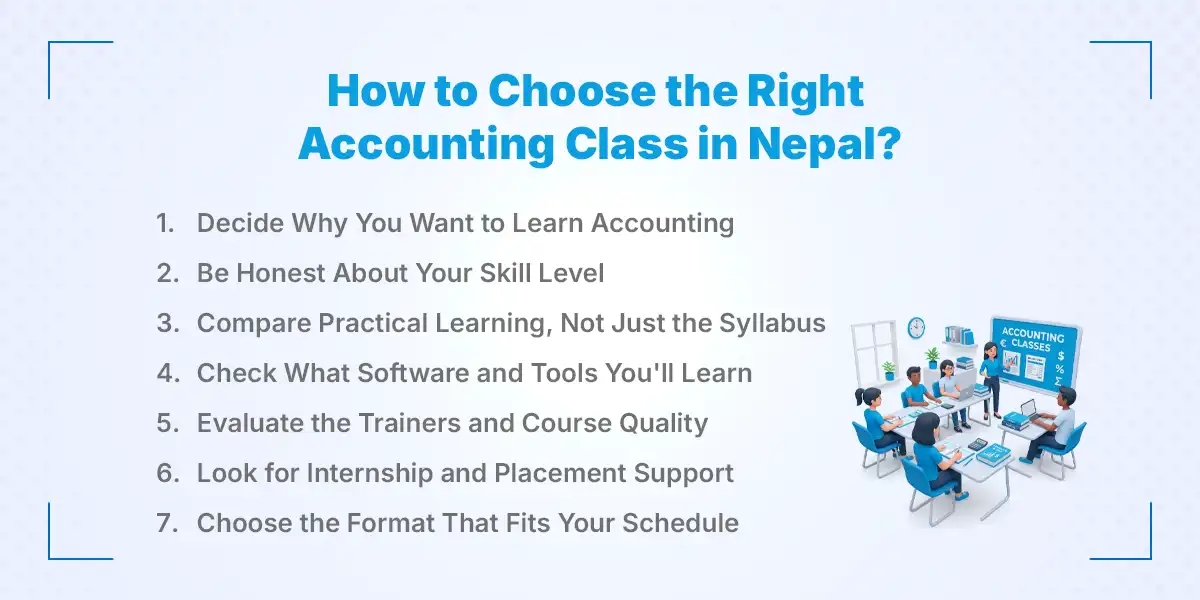
1. Decide Why You Want to Learn Accounting
Start by identifying your goal. Are you looking for your first accounting job, planning to switch careers, or trying to upgrade your current skills? Your answer will help you choose the right course level and learning format.
2. Be Honest About Your Skill Level
Think about what you already know. If you're a complete beginner, a structured course with more guidance may be the better choice. If you already have accounting knowledge, you may be ready for a more advanced program.
3. Compare Practical Learning, Not Just the Syllabus
A long syllabus doesn't always mean better learning. Check whether the course includes practical assignments, case studies, software practice, and real business documents instead of only classroom theory.
4. Check What Software and Tools You'll Learn
Most employers in Nepal expect accountants to use tools like Tally Prime and Advanced Excel. Make sure the course gives you enough hands-on practice with the software used in real workplaces.
5. Evaluate the Trainers and Course Quality
Experienced trainers can make difficult topics much easier to understand. Look for institutes that offer updated content, practical teaching methods, and regular guidance throughout the course.
6. Look for Internship and Placement Support
If you're looking for your first job, choose an institute that helps students with internships, interview preparation, resume building, or job placements. These services can make your transition into the workplace much smoother.
7. Choose the Format That Fits Your Schedule
Finally, choose a learning format you can realistically stick with. Online classes are ideal if you need flexibility, while offline classes are better if you learn best in a structured classroom environment. The right choice is the one you'll complete with confidence.
Online vs Offline Accounting Classes in Nepal: Which is Best for You?
Offline accounting classes in Nepal are best for complete beginners who need hands-on lab practice and direct trainer guidance, whereas online classes are ideal for working professionals and out-of-valley students who require flexible schedules.
Choose Online If...
- You work full-time or attend college during daytime hours.
- You need a flexible schedule for studying.
- You live far away from major business hubs.
- You own a computer and can practice independently.
Choose Offline If...
- You are a complete beginner in practical accounting.
- You focus much better in a structured physical classroom.
- You do not own a personal computer for practice.
- You want direct face-to-face internship and placement support.
Job-Oriented vs Advanced Accounting Training in Nepal: Which Should You Choose?
Choose Job-Oriented Accounting Training if you're starting your accounting career and need practical, job-ready skills. Choose Advanced Accounting Training if you already have accounting knowledge or work experience and want to move into higher-level finance roles.
1. Job-Oriented Accounting Training
Made specifically for +2 graduates, BBS/BBA freshers, and entry-level job seekers, this hands-on program gives you the key skills local companies expect. You will get real practice with daily bills, Tally Prime, basic VAT and TDS rules, and salary sheets so you can start your first accounting job with confidence.
2.Advanced Accounting Training
Built for junior accountants and finance workers who want to step up to senior roles, this Advanced Accounting Training course in Nepal focuses on higher-level company finances. You will learn advanced tax filing, financial reports, corporate compliance rules, and audit preparation to grow your career faster.
Kumari Job’s Job-Oriented vs Advanced Accounting Training
The table below compares Kumari Job's Job-Oriented Accounting Training and Advanced Accounting Training to help you choose the right course.
| Feature | Job-Oriented Accounting Training | Advanced Accounting Training |
|---|---|---|
| Best For | +2 graduates, BBS/BBA students, fresh graduates | Working accountants and finance professionals |
| Experience Required | None | Basic accounting knowledge or work experience |
| Focus | Bookkeeping, Tally Prime, VAT, Payroll | Advanced taxation, NFRS, auditing, financial reporting |
| Goal | Get your first accounting job | Grow your career and earn more |
| Outcome | Junior Accountant, Accounts Assistant | Senior Accountant, Finance Executive, Tax Professional |
Conclusion
Neither format is automatically superior. Online accounting classes offer flexibility and savings, while offline training provides hands-on computer lab practice and direct personal guidance.
Your choice should depend on your daily routine and learning needs. If you require daily discipline and step-by-step help, choose an offline course. If you need to balance a job or live outside major cities, an online course is ideal.
Focus on practical exercises, software exposure, and real-world projects above all else. Finding a practical training program that fits your life will help you launch a successful accounting career in Nepal.
Frequently Asked Questions
Submit your comments

Get Our App On



How to Make a Police Report (Police Clearance Certificate) in Nepal?
VIEW DETAILS
Types of SEO and How They Work: Complete Beginner's Guide
VIEW DETAILS
Government Restricts New Lok Sewa Vacancy Requests 2083/84 — Or Not?
VIEW DETAILS
How to Apply for Tattoo Artist Jobs in Nepal?
VIEW DETAILS


Loading Comments...