



Hiring employees in Nepal without a legal entity can be complex and risky, especially when you are unfamiliar with local labor laws, tax regulations, and compliance requirements. One mistake in contracts, payroll, or statutory contributions can lead to legal penalties, financial loss, and operational delays for foreign companies entering the Nepal market.
In this blog, you will learn what an Employer of Record (EOR) service in Nepal means and how it helps global companies hire legally without registering a local entity. An EOR becomes the official employer on paper and manages payroll, taxes, compliance, and employment contracts while you control the employee’s daily responsibilities. Many international businesses use EOR services to expand into Nepal quickly, reduce administrative burden, and lower legal risk. This guide explains the full process, key benefits, cost structure, and how to choose the best EOR provider in Nepal.
In this blog
What is an EOR Service in Nepal?
An Employer of Record (EOR) service in Nepal is a legal solution that allows foreign companies to hire and manage employees in Nepal without setting up a local entity.
In practice, the EOR becomes the official employer on paper and handles all legal responsibilities, including employment contracts, payroll processing, tax filings, and compliance with Nepal’s labor laws. This means the foreign company can focus on managing employee tasks and performance while the EOR ensures that all local legal and administrative obligations are met.
Unlike direct hiring, where a company must register locally and take full responsibility for labor law compliance, EOR hiring shifts the legal employer responsibilities to the EOR provider. This reduces administrative burden, lowers legal risk, and allows faster market entry for foreign businesses expanding into Nepal.
How EOR Services Work in Nepal
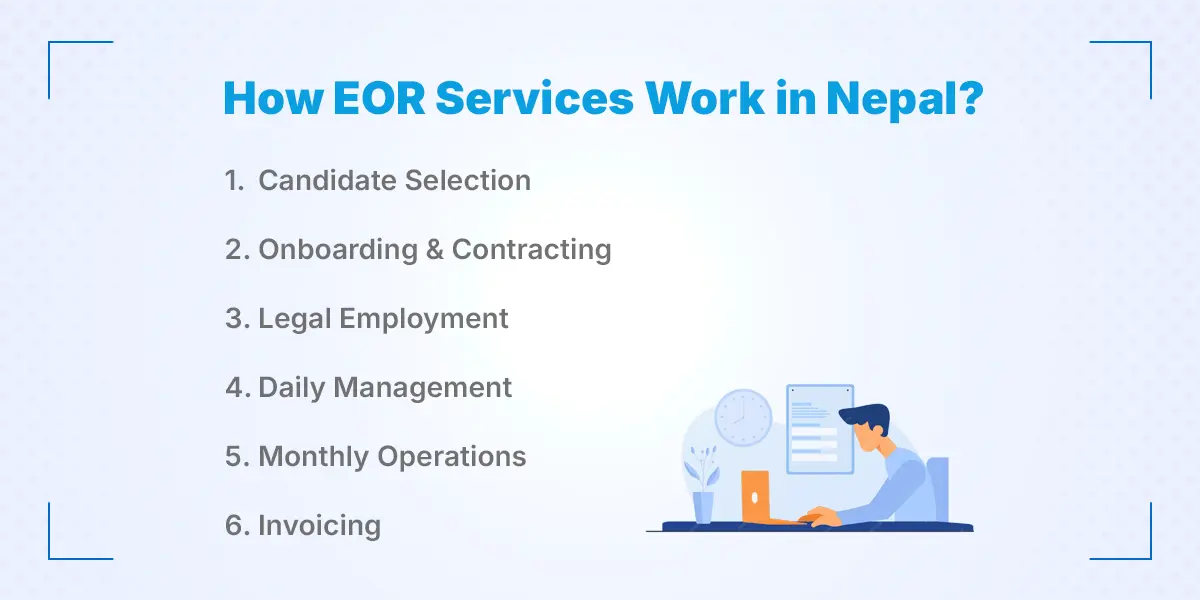
EOR services in Nepal operate by legally employing staff on behalf of foreign companies while handling all compliance, payroll, and administrative tasks. They simplify global hiring by managing every step from recruitment to invoicing, allowing businesses to focus on their core operations. Here’s a step-by-step breakdown of how EOR services work in Nepal:
1. Candidate Selection
The EOR helps identify and screen qualified candidates based on the company’s requirements. They manage job postings, interview scheduling, and initial assessments to ensure a good fit. This process reduces hiring errors and ensures candidates meet both the company’s and Nepal’s legal standards. The foreign company can participate in interviews to select the best talent while the EOR handles administrative tasks.
2. Onboarding & Contracting
Once a candidate is selected, the EOR manages the onboarding process and prepares employment contracts. These contracts comply with Nepal’s labor laws, including minimum wage, benefits, and leave policies. The EOR ensures all necessary documentation is collected and legally valid, protecting both the employee and the foreign company.
3. Legal Employment
The EOR becomes the official employer of record, registering the employee with local authorities and ensuring compliance with labor laws. They handle work permits (if applicable), social security contributions, and other statutory requirements. This protects the foreign company from legal penalties and administrative issues.
4. Daily Management
While the EOR handles legal and administrative obligations, the foreign company manages the employee’s daily work and performance. The EOR ensures that employment terms are adhered to and can provide HR support if any legal or workplace issues arise. This balance allows seamless integration of the employee into the company’s operations.
5. Monthly Operations
The EOR manages monthly payroll, tax deductions, and statutory contributions for all employees. They also generate reports and handle salary disbursements accurately and on time. This reduces administrative workload and ensures employees are paid correctly under Nepal’s legal framework.
6. Invoicing
After managing payroll and operations, the EOR invoices the foreign company for the total cost of employment, which may include salary, taxes, benefits, and service fees. Transparent invoicing allows companies to budget accurately and maintain financial clarity while outsourcing all employment compliance tasks.
Why Companies Use EOR Services in Nepal
Companies use EOR services in Nepal to legally hire employees without setting up a local entity, allowing them to expand quickly while staying fully compliant with local laws. An EOR reduces legal risks, administrative burden, and costs associated with direct company registration, making it an efficient solution for global hiring.
1. Hiring Without Registering a Company in Nepal
EOR services allow foreign businesses to employ staff legally without establishing a Nepalese company. This eliminates the need for local registration, permits, and additional administrative work. Companies can start operations immediately, saving months of setup time while still complying with all labor laws.
2. Faster Market Entry
By using an EOR, businesses can quickly hire and onboard talent in Nepal. This speeds up market entry compared to setting up a local entity, which may take significant time for approvals and legal processes. Faster hiring allows companies to begin operations, projects, or services without delay.
3. Compliance with Local Labor Laws
EOR providers ensure full adherence to Nepal’s labor regulations, including employment contracts, minimum wage, leave policies, and social security contributions. This protects foreign companies from potential legal penalties and fines while maintaining employee trust and satisfaction.
4. Reduced Legal and Administrative Risk
Handling employment laws, tax filings, and payroll manually in a foreign country can be risky. EORs take on legal and administrative responsibilities, reducing the chances of errors or non-compliance. Companies can focus on business growth rather than worrying about legal pitfalls.
5. Cost-Effective Expansion Strategy
Hiring through an EOR is often more affordable than setting up a local entity, especially for small teams or short-term projects. It eliminates registration costs, office setup, and ongoing administrative expenses. Companies can scale operations in Nepal flexibly without long-term financial commitments.
Benefits of Using an EOR in Nepal
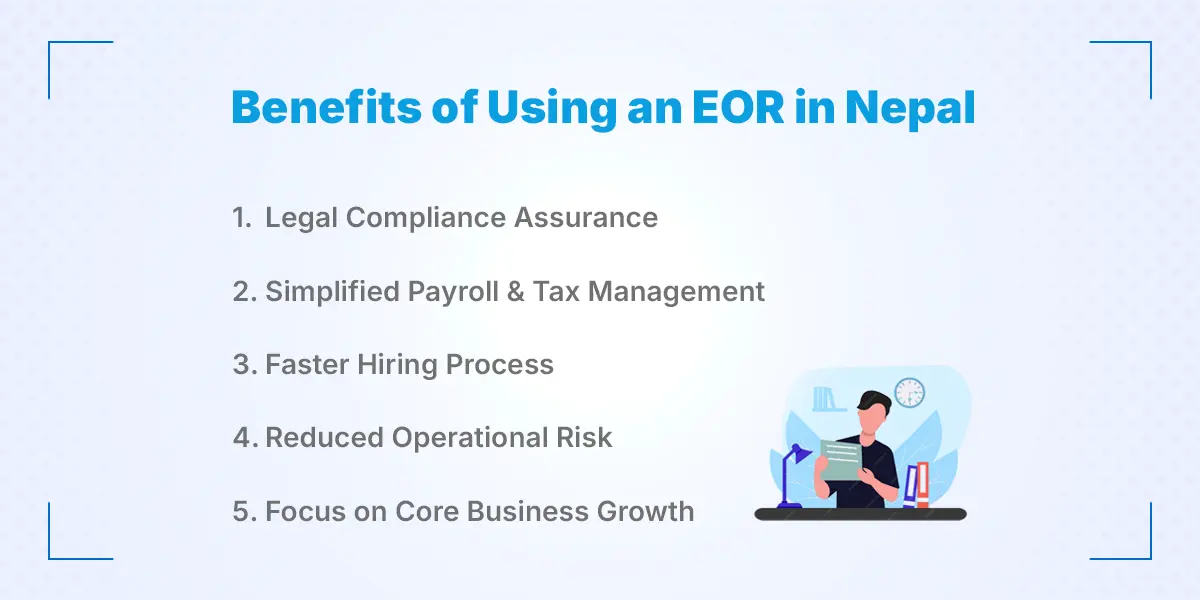
Using an EOR in Nepal provides foreign companies with a legal and efficient way to hire employees while minimizing risk and administrative burden. EOR services handle compliance, HR, and payroll management, allowing businesses to focus on growth and operational efficiency.
1. Legal Compliance Assurance
An EOR ensures that all employment practices follow Nepal’s labor laws, including contracts, minimum wage, social security contributions, and termination regulations. This protects foreign companies from fines, legal disputes, and regulatory issues. Employees are legally protected, creating a compliant and secure working environment.
2. Simplified Payroll & Tax Management
The EOR manages all payroll processing, tax deductions, and statutory contributions on behalf of the company. This reduces errors, ensures timely payments, and keeps employees satisfied. Companies save time and avoid complex tax filings while staying fully compliant with Nepalese regulations.
3. Faster Hiring Process
By outsourcing recruitment and employment to an EOR, businesses can hire qualified employees quickly without delays from legal or administrative procedures. This enables companies to scale teams faster, enter the market promptly, and start projects without waiting for company registration.
4. Reduced Operational Risk
EORs take on the legal employer responsibilities, which minimizes the risk of non-compliance, fines, or lawsuits. Companies can operate confidently in Nepal knowing that all employment-related obligations are managed professionally and accurately.
5. Focus on Core Business Growth
With the EOR handling compliance, payroll, HR, and administrative tasks, foreign companies can concentrate on strategy, sales, and project management. This allows businesses to expand in Nepal efficiently while maintaining operational focus and productivity.
EOR vs Company Registration in Nepal
Using an EOR in Nepal is often more efficient than setting up a local company, especially for foreign businesses seeking quick market entry. While company registration gives full control, it comes with higher costs, more legal responsibilities, and significant administrative work. EOR services provide a faster, compliant, and cost-effective alternative.
| Factor | EOR Service | Company Registration | Why EOR is Better |
|---|---|---|---|
| Cost | Low to moderate monthly fees per employee | High setup costs, office rent, and recurring administrative expenses | EOR avoids initial company setup and reduces ongoing expenses |
| Time Required | Immediate hiring, onboarding in days | Months to complete registration and approvals | EOR allows faster market entry |
| Legal Responsibility | EOR assumes the employer's legal obligations | The company bears all labor law, tax, and compliance responsibilities | EOR reduces legal risk for foreign companies |
| Administrative Burden | Payroll, contracts, and compliance are handled by EOR | The company must manage payroll, HR, taxes, and statutory filings | EOR frees the business from administrative work |
| Best Use Case | Short-term projects, small teams, testing the market | Long-term operations with full control | EOR is flexible and scalable without long-term commitment |
Which is the Best EOR Service Provider in Nepal
The best EOR service provider in Nepal is one that ensures full legal compliance, reliable payroll management, and seamless support for foreign companies. Kumari Job is a trusted, legally certified HR consulting firm that provides comprehensive EOR and outsourcing services in Nepal.
Choosing the right EOR provider requires evaluating several key factors to ensure smooth operations and risk-free hiring in Nepal. Kumari Job combines local labor expertise with transparent pricing and robust HR systems to deliver reliable solutions for international businesses.
1. Criteria to Evaluate an EOR Provider
When selecting an EOR, consider legal compliance, experience, pricing transparency, payroll and HR management systems, and the ability to support foreign companies. A provider should clearly explain services, costs, and responsibilities to avoid hidden fees or legal issues.
2. Experience in Nepal Labor Compliance
A good EOR must have extensive knowledge of Nepal’s labor laws, tax regulations, and social security requirements. Kumari Job has years of experience ensuring that employees are legally employed, payroll is accurate, and all statutory obligations are met, reducing risk for foreign employers.
3. Transparent Pricing Structure
Transparent pricing allows companies to budget accurately without surprises. Kumari Job provides clear, per-employee pricing that covers payroll, benefits, compliance, and service fees, making financial planning straightforward for businesses hiring in Nepal.
4. Payroll and HR Management Capability
Efficient payroll processing and HR management are critical for smooth operations. Kumari Job handles salary disbursements, tax filings, employee benefits, and HR queries, ensuring employees are satisfied while the foreign company focuses on core business tasks.
5. Support for Foreign Companies
A reliable EOR should provide dedicated support to foreign clients, including consultation, onboarding guidance, and legal advice. Kumari Job offers personalized assistance for international businesses, helping them navigate Nepal’s employment landscape confidently.
Cost of EOR Services in Nepal
The cost of EOR services in Nepal is usually based on a per-employee, per month model, which covers salary management, taxes, compliance, and administrative support. This structure makes it easy for foreign companies to budget for local hiring without investing in a full company setup.
Several factors can affect the total cost, including the employee’s role and seniority, required benefits, complexity of compliance, and any additional services like recruitment or onboarding. Compared to setting up a local company, which requires high registration costs, office expenses, and ongoing administrative work, using an EOR is generally more cost-effective and flexible.
EOR services also provide transparency in fees, so businesses can clearly see the breakdown of costs per employee and avoid unexpected expenses. This model is particularly suitable for companies entering the Nepal market for short-term projects, testing the waters, or scaling teams without long-term financial commitment.
Who Should Use EOR Services in Nepal
EOR services in Nepal are best suited for foreign companies, startups, IT firms, NGOs, and businesses with short-term hiring needs who want to hire legally without setting up a local entity.
EOR solutions allow these businesses to onboard employees quickly, stay fully compliant with Nepalese labor laws, and reduce administrative and legal risks. Companies can focus on operations, projects, and growth while the EOR handles payroll, contracts, and HR management.
1. Foreign Companies Hiring Remote Teams
Foreign companies that want to hire remote employees in Nepal can rely on an EOR to manage all legal and payroll responsibilities. This ensures compliance with local laws and allows seamless integration of remote talent into the company’s operations.
2. Startups Testing the Nepal Market
Startups entering Nepal can use EOR services to test the market without the time and cost of company registration. This lets them hire a small team efficiently and scale based on market response.
3. IT and Outsourcing Companies
IT and outsourcing firms often need skilled professionals in Nepal. EORs simplify the hiring process, manage compliance, and allow companies to focus on project delivery and client requirements.
4. NGOs and International Organizations
NGOs and international organizations can hire local staff through an EOR to ensure adherence to employment laws. This reduces legal risk and administrative workload, letting them focus on their mission and programs.
5. Businesses Needing Short-Term Project Hiring
Companies with temporary or project-based staffing needs can use EOR services to hire employees quickly without committing to long-term contracts or setting up a local office. This provides flexibility, cost savings, and fast project execution.
Key Legal Considerations for EOR in Nepal
EOR services in Nepal must comply with the Nepal Labor Act, minimum wage standards, social security contributions, employment contract rules, and employee protection laws to ensure legal and safe employment for foreign companies.
Ensuring these legal requirements are met protects both the employee and the foreign company from fines, penalties, or disputes. EOR providers like Kumari Job handle these obligations, allowing businesses to hire confidently while staying fully compliant with Nepalese labor laws.
1. Nepal Labor Act Compliance
EOR providers must follow the Nepal Labor Act, which governs employee rights, working hours, leave, and workplace safety. Compliance ensures that foreign companies are legally protected and employees receive their entitled benefits.
2. Minimum Wage Standards
All employees hired through an EOR must be paid at least the legally mandated minimum wage in Nepal. The EOR ensures salaries meet or exceed these standards, preventing legal issues and ensuring fair treatment of staff.
3. Social Security Fund Contributions
EORs are responsible for registering employees with the Social Security Fund and making monthly contributions for pensions, health insurance, and other statutory benefits. This guarantees legal compliance and employee protection.
4. Employment Contract Requirements
Employment contracts must comply with local laws, clearly defining job roles, responsibilities, salary, benefits, and termination conditions. EOR providers prepare legally valid contracts to protect both the employee and the foreign company.
5. Termination and Employee Protection Laws
EORs manage employee termination according to Nepalese labor laws, including notice periods, severance pay, and dispute resolution. This reduces legal risks for foreign employers while ensuring employees are treated fairly.
How to Choose the Right EOR Service in Nepal
To choose the right EOR service in Nepal, businesses should evaluate legal expertise, country coverage, pricing transparency, HR and payroll capabilities, and request a consultation or demo before making a decision.
Selecting the right EOR ensures compliance with Nepalese labor laws, smooth payroll and HR management, and reliable support for foreign companies. A careful evaluation helps avoid hidden costs, legal risks, and administrative challenges while providing a seamless hiring experience.
1. Check Legal Expertise
Ensure the EOR provider has in-depth knowledge of Nepal’s labor laws, tax regulations, and compliance requirements. This protects your company from legal penalties and ensures employees are hired legally.
2. Review Country Coverage
If your business operates in multiple countries, check whether the EOR provider can manage employees in all relevant locations. This simplifies global hiring and provides consistent HR practices.
3. Compare Pricing Transparency
Transparent pricing allows you to budget accurately and avoid hidden fees. A good EOR will clearly outline monthly costs per employee, including payroll, benefits, and service fees.
4. Assess HR and Payroll Systems
Evaluate the provider’s HR and payroll platforms for efficiency, reliability, and ease of use. This ensures timely salary disbursement, accurate tax filings, and smooth employee management.
5. Ask for a Consultation or Demo
Request a consultation or demo to understand how the EOR operates, the services included, and how they will support your business. This helps in making an informed decision before signing an agreement.
Conclusion
EOR services are essential for foreign companies looking to hire in Nepal without setting up a local entity. They provide legal compliance, reduce administrative and operational risks, and enable faster market entry. Choosing a compliant and experienced provider ensures smooth payroll management, adherence to labor laws, and reliable support for both the company and employees. Kumari Job, a legally certified HR consulting firm in Nepal, offers trusted EOR and outsourcing solutions to help businesses expand confidently.
If you’re planning to hire in Nepal, consult Kumari Job today to explore reliable EOR services, streamline your hiring process, and ensure full compliance with local laws.
Frequently Asked Questions
Submit your comments

Get Our App On



SEO Training for Freshers in Nepal: Skills, Career & Job Opportunities
VIEW DETAILS
SEO Training vs. Self-Learning: Which Is Right for You?
VIEW DETAILS
How to Choose Between Two Job Offers
VIEW DETAILS
Digital Marketing Training Interview Questions and Answers for Freshers
VIEW DETAILS


Loading Comments...