




Artificial Intelligence is transforming industries faster than ever, and machine learning engineers are at the heart of this revolution. From recommendation systems and chatbots to fraud detection and self-driving technologies, companies worldwide are investing heavily in ML talent. Naturally, many Nepali students, fresh graduates, and tech enthusiasts are asking: what is the salary of a machine learning engineer? More importantly, how does it compare in Nepal versus abroad?
Understanding the machine learning engineer salary landscape is key to planning your career, whether you’re upskilling, switching into AI, or exploring remote opportunities. In this guide, we break down ML engineer salaries in Nepal, the USA, Canada, Dubai, and England, explore the factors that affect pay, and outline how you can start a successful career in this high-demand, fast-growing field in 2026!
In this blog
What Does a Machine Learning Engineer Do?
A machine learning engineer builds systems that allow computers to learn from data and make predictions or decisions without being explicitly programmed. In simple terms, they combine software engineering, data science, and artificial intelligence to create intelligent systems used in applications like recommendation engines, fraud detection, voice assistants, and predictive analytics.
Because this role requires a mix of programming, mathematics, and data expertise, companies across industries, from fintech and e-commerce to healthcare and tech startups, are actively hiring ML engineers.
These are the key responsibilities of an ML Engineer:
1. Building Machine Learning Models
Machine learning engineers design models that help computers find patterns in large datasets. They choose suitable algorithms such as regression models, decision trees, or neural networks depending on the problem. Engineers also test different model structures and parameters to improve prediction accuracy. These models power applications like recommendation systems, fraud detection, and predictive analytics.
2. Training AI Algorithms
After building a model, ML engineers train it using large datasets so the algorithm can learn from examples. During training, the system adjusts its parameters to improve prediction accuracy. Engineers evaluate results using metrics such as accuracy, precision, and recall. They also fine-tune the model to ensure reliable performance over time.
3. Data Preprocessing and Analysis
Raw data often contains errors, missing values, or inconsistent formats. ML engineers clean and organize this data before using it to train machine learning models. They also analyze datasets to identify patterns, trends, and relationships. Proper data preparation improves model accuracy and overall performance.
4. Deploying AI Systems in Real-World Applications
Once a model performs well, it needs to be deployed into real systems. ML engineers integrate models into applications, websites, or cloud platforms so they can process live data. They also monitor performance and optimize systems for speed and scalability. This ensures AI solutions work reliably in real-world environments.
5. Collaborating with Software Engineers and Data Scientists
Machine learning projects usually involve multiple teams working together. ML engineers collaborate with data scientists to improve models and analyze datasets. They also work with software engineers to integrate AI systems into larger applications. This teamwork helps build scalable and practical AI solutions.
What is the Salary of a Machine Learning Engineer in Nepal?
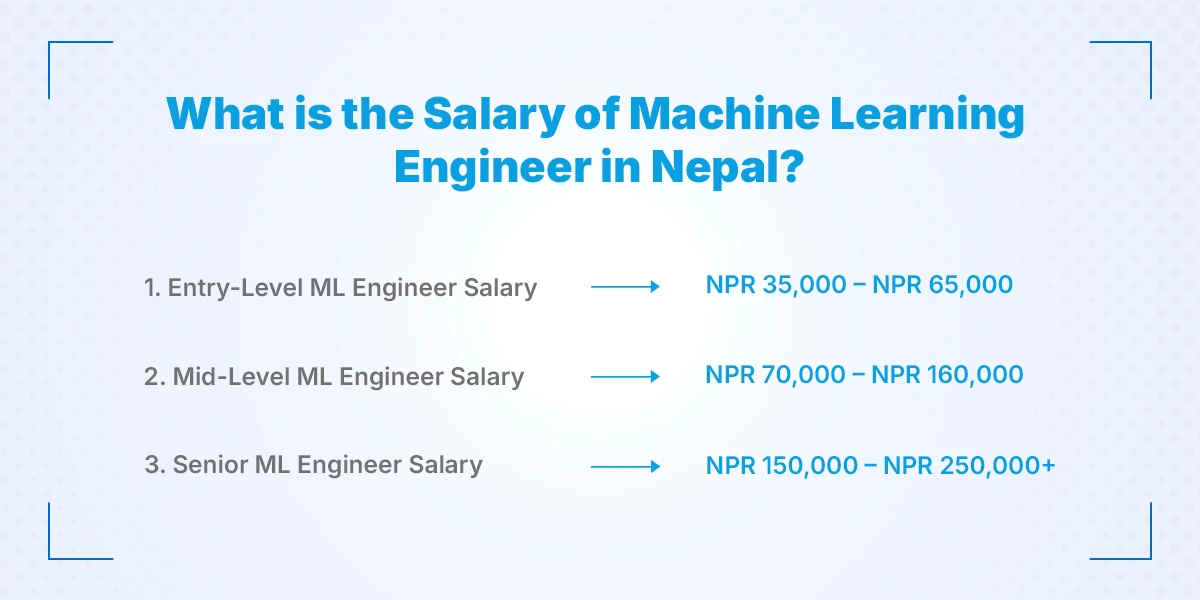
On average, the machine learning engineer salary in Nepal ranges between NPR 70,000 and NPR 160,000 per month. The exact figures largely depend on experience, technical skills, and the type of company you work for. Here is a realistic breakdown of what ML engineers typically earn at different career stages.
1. Entry-Level ML Engineer
Fresh graduates or junior ML engineers typically earn between NPR 35,000 and NPR 65,000 per month. At this stage, companies mainly look for strong fundamentals in Python, statistics, and machine learning concepts. Many entry-level engineers begin their careers at tech startups or software outsourcing companies, gaining hands-on experience with real projects. This period is all about learning, experimenting, and building a solid foundation for future growth.
2. Mid-Level ML Engineer
Professionals with three to five years of experience usually earn NPR 70,000 to NPR 160,000 per month. Mid-level ML engineers are expected to design models, manage data pipelines, and collaborate closely with product or engineering teams. Many move into roles at larger tech companies or international projects. By now, the focus shifts to delivering reliable AI solutions and mentoring junior teammates.
3. Senior ML Engineer
Experienced ML engineers can earn NPR 150,000 to NPR 250,000+ per month, especially when working with international or remote teams. Senior engineers lead complex AI projects and build production-ready systems for real-world use. They often have deep expertise in frameworks like TensorFlow or PyTorch, cloud deployment, and handling large datasets. At this level, professionals also shape AI strategy and guide teams toward scalable solutions.
Nepal’s AI and data science ecosystem is still growing, but demand for machine learning talent is increasing quickly. Many tech startups are experimenting with AI-powered products, creating new opportunities for ML engineers. At the same time, software outsourcing companies are hiring AI talent to work on international projects.
As a result, the salary for machine learning engineers in Nepal has started to rise in recent years, especially for candidates with strong programming and data science skills.
Simultaneously, many Nepali ML engineers are now working remotely for global companies, which often means earning salaries closer to international standards. For skilled professionals, this opens doors to far higher income potential without leaving Nepal.
Machine Learning Engineer Salary Around the World
If you’re curious about how much machine learning engineers earn beyond Nepal, it helps to look at a few major countries. These international figures not only show higher pay scales but also the growing global demand for machine learning expertise. This information is also useful if you’re considering remote or future opportunities abroad. Here’s a snapshot of how salaries stack up in some popular tech hubs:
1. Machine Learning Engineer Salary in USA
The machine learning engineer salary in the USA is among the highest in the world. On average, ML engineers earn around USD 160,000 per year, with many experienced professionals making more depending on location, skills, and company size. Tech hubs like Silicon Valley, Seattle, and New York often offer even higher pay due to cost of living and competition for AI talent. These figures show just how valuable machine learning skills are in a market where data and automation drive business growth.
2. Machine Learning Engineer Salary in Canada
In Canada as well, machine learning engineers enjoy strong earning potential. According to recent data, the average machine learning engineer salary in Canada is roughly CAD 138,000–CAD 147,000 per year, with top tech cities like Toronto and Vancouver offering slightly higher pay. Salaries vary by experience and company, but overall the Canadian market is healthy and steadily growing. Many Canadian companies also hire engineers remotely, adding extra opportunities for Nepalese.
3. Machine Learning Engineer Salary in Dubai
In Dubai, the tech scene is growing, but salaries for machine learning engineers tend to be lower than in North America. The machine learning engineer salary in Dubai averages around AED 5,790 per month (approximately AED 70,000 annually), with some variance depending on experience and employer. Dubai can still be attractive due to tax-free income and a growing AI ecosystem in finance, healthcare, and logistics.
4. Machine Learning Engineer Salary in England
Across the United Kingdom, the machine learning engineer salary in England is competitive, with many junior to senior-level positions offering a good living. Typical salaries range from junior figures around £50,000 to senior roles near £97,500 or more, depending on company and expertise. Cities like London and Cambridge are strong hubs for AI and data science, providing multiple career pathways.
5. Outsourcing and Freelancing Opportunities for Nepali Engineers
Apart from full-time jobs, many Nepali ML engineers work remotely for international companies or as freelancers. Junior engineers usually charge $15–$25 per hour, mid-level professionals $25–$40, and senior experts $40–$60+ per hour, depending on experience and project complexity. Some also join outsourcing contract opportunities, earning $1,100–$2,000+ per month while delivering AI solutions for global clients.
This means talented Nepali professionals can earn competitive international-level income without leaving the country, opening exciting pathways for career growth and remote work.
What Factors Affect the Salary of ML Engineers?
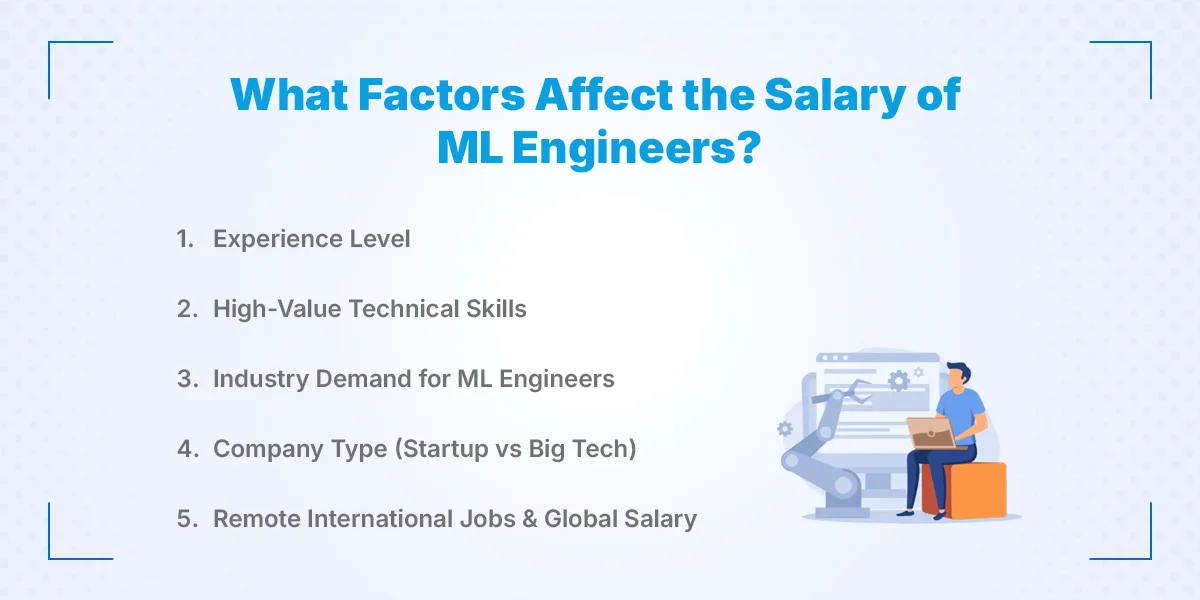
The salary of a machine learning engineer depends on several key factors, including experience, technical skills, industry demand, company type, and opportunities for remote international work. More experienced engineers with advanced skills or those working in high-demand industries usually earn significantly higher pay. Let’s break down each of these factors so you can see exactly how they influence ML engineer salaries, especially for professionals in Nepal.
1. Experience Level
An engineer’s experience is one of the biggest salary drivers. Entry-level ML engineers earn less while mid-level and senior engineers command higher pay due to their proven ability to build, train, and deploy complex AI models. In Nepal, moving from a junior to a senior role can double or even triple monthly earnings, reflecting the value of hands-on expertise.
2. High-Value Technical Skills
Technical skills directly impact how much an ML engineer earns. Knowledge of Python, TensorFlow, PyTorch, cloud deployment, and deep learning frameworks can significantly boost salary potential. Companies are willing to pay more for engineers who can solve challenging AI problems and implement models efficiently.
3. Industry Demand for ML Engineers
The sector you work in also affects pay. Industries like finance, healthcare, and tech startups often pay more because they rely heavily on AI-driven solutions. Higher demand for machine learning skills in these industries pushes salaries upward, especially for specialized roles.
4. Company Type (Startup vs Big Tech)
The type of company you join matters a lot. Startups in Nepal may offer lower base salaries but often provide equity or growth opportunities, while big tech or international companies offer higher salaries and structured benefits. Choosing the right company can therefore balance immediate pay and long-term career growth.
5. Remote International Jobs & Global Salary
Working remotely for international companies can drastically increase earnings. Many Nepali engineers now collaborate with global teams, earning rates closer to Western salaries while living locally. This factor highlights how global opportunities are reshaping salary potential for Nepalese ML engineers.
Who Earns More, AI Engineer or Machine Learning Engineer?
AI engineers and machine learning engineers often work on similar projects, but their focus is slightly different. Machine learning engineers mainly build, train, and deploy models that help computers learn from data. AI engineers take a broader approach, creating full AI systems that can include ML models, robotics, chatbots, and natural language processing tools.
Globally, AI engineers generally earn slightly more, about 10–15% higher than ML engineers. It is because their work covers a wider range of technologies and practical applications. While ML engineers focus on algorithms and model performance, AI engineers integrate AI systems into real-world solutions, which demands a broader technical skill set. Salary ranges typically show:
Here’s a simple comparison table for clarity:
Regardless of these differences, both AI and ML roles are in extremely high demand, with AI engineering seeing slightly faster growth. Machine learning engineers remain very sought after, especially in startups, outsourcing companies, and remote global projects where data-driven decision-making is critical.
For Nepali professionals, this means that focusing on machine learning while gaining exposure to broader AI projects can open doors to the best-paying opportunities, both locally and internationally. It’s a smart way to combine high demand, global opportunities, and competitive salaries.
How to Become a Machine Learning Engineer in Nepal?
To become an ML engineer in Nepal, learn programming, study AI concepts, practice on real projects, get certified, and apply for jobs online. It might seem challenging at first, but breaking it down step by step makes it very achievable. Focus on building a strong foundation, gaining hands-on experience, and connecting with opportunities locally and internationally. Here’s a clear roadmap to guide your journey.
Step 1: Learn Programming and Mathematics
The first step is mastering programming and math, which are the backbone of any machine learning role. Start with languages like Python, R, or Java, which are widely used in AI projects. Simultaneously, brush up on linear algebra, statistics, and calculus, as they help you understand how algorithms work behind the scenes. A solid grasp of these fundamentals will make learning ML concepts much smoother.
Step 2: Study Machine Learning and AI Fundamentals
Once you’re comfortable with programming and math, dive into machine learning and AI fundamentals. Learn about supervised and unsupervised learning, neural networks, deep learning, and data preprocessing. Online courses, tutorials, and free resources can help, but make sure to practice the concepts on real datasets so theory becomes practical.
Step 3: Work on Real Projects and Build a Portfolio
Theory alone isn’t enough. Employers want to see what you can do. Work on real-world projects, such as predicting sales trends, building recommendation engines, or creating image recognition models. Document your work in a portfolio or GitHub profile, showcasing your ability to implement models, clean data, and deliver results. This portfolio will be a key asset when applying for jobs.
Step 4: Take Professional Training or Certification
To boost your credibility, consider professional training or certifications from trusted platforms. These programs often offer structured learning, mentorship, and industry-recognized credentials. In Nepal, some training providers also help you connect with local job portals and recruitment platforms, giving you a head start in landing ML roles.
Step 5: Apply for Machine Learning Engineer Jobs
Finally, start applying for positions that match your skills. Check reputable job portals and recruitment platforms, and company career pages for openings in startups, tech firms, and outsourcing companies. Tailor your resume and portfolio for each application, highlighting hands-on projects, technical skills, and any certifications you’ve earned. With persistence and a strong foundation, you’ll increase your chances of landing your first ML engineer role in Nepal or even remotely for international companies.
Is Machine Learning a Good Career in Nepal?
Yes, machine learning is becoming one of the most promising careers in Nepal. The demand for AI and ML talent is growing fast as companies increasingly rely on data-driven decisions and automation. Many outsourcing tech companies in Nepal hire skilled ML engineers to work on international projects, offering competitive pay and exposure to global standards.
There’s also a growing ecosystem of AI startups in cities like Kathmandu, Pokhara, and Lalitpur, creating exciting opportunities to work on innovative products. On top of that, remote global jobs allow Nepali professionals to earn international salaries without leaving the country.
For those starting out, career support through training programs, certifications, and job platforms can make a big difference. These resources help you gain hands-on experience, build a portfolio, and connect with companies looking for ML talent, making it easier to enter this high-demand, high-growth field.
Conclusion
Machine learning engineering is a high-growth, high-demand career that offers exciting opportunities both in Nepal and globally. From building intelligent models to working on real-world AI systems, the field rewards skill, curiosity, and hands-on experience. Salaries in data science continue to rise as companies seek talented ML professionals.
For Nepalese youth, the path is clear: start with strong programming and math skills, work on real projects, and leverage training programs or certifications to stand out. With dedication, you can move from entry-level roles to senior positions, while even tapping into remote international opportunities that expand your earning potential.
If you’re ready to take the first step, explore structured AI courses, hands-on projects, and search for the latest jobs to begin your ML journey. The global AI wave is here — and it’s waiting for you to ride it.
Frequently Asked Questions
Submit your comments

Get Our App On



Dashain Bonus in Nepal: Festival Allowance Rules, Calculation & Legal Rights (2026 Guide)
VIEW DETAILS
What Skills Do Employers Look for in Freshers in Nepal?
VIEW DETAILS
How to Become a Public Health Officer in Nepal?
VIEW DETAILS.webp)
What Is the Document Controller Salary in Nepal?
VIEW DETAILS


Loading Comments...