



Becoming a CEO in Nepal is a long-term career goal but what does it actually take to reach the top? A business degree or MBA can help, but employers also look for proven leadership, industry knowledge, sound financial judgment, and years of experience managing teams and business results. Recent CEO vacancy notices in Nepal show just how specific these expectations can be.
This guide explains how to become a CEO in Nepal, step by step. Explore the qualifications employers look for, the skills and experience you need to build, career paths that can lead to executive leadership, factors that influence CEO salaries, and where to find senior-level job opportunities. You’ll also learn how real Nepali vacancy requirements can help you plan your career more realistically.
In this blog
What Is a CEO and What Does a CEO Do?
A Chief Executive Officer (CEO) is the highest-ranking executive who leads a company's strategy, operations, and overall performance. The CEO reports to the board of directors and answers for the results of every department. In Nepal, the same title appears in banks, listed companies, startups, and public institutions, so the exact duties vary by organization.
The main responsibilities of a CEO include:
- Setting company goals and business strategy.
- Making the biggest decisions in the organization.
- Managing senior executives and department heads.
- Tracking business performance and financial growth.
- Building trust with investors, employees, and other stakeholders.
- Protecting the long-term health of the business.
People often mix up the CEO with other senior titles. This table shows how they usually differ:
| Role | Main Job | Usual Reporting Line |
|---|---|---|
| CEO | Sets company direction and leads all senior executives. | Board of directors |
| Managing Director (MD) | Often combines a board seat with day-to-day control of the company. | Board or owners |
| General Manager (GM) | Runs a business unit, a branch, or the daily work of a company. | CEO or MD |
| Chief Operating Officer (COO) | Manages daily operations and turns strategy into action. | CEO |
Titles vary from company to company, so always read the job description before you compare roles.
What Qualifications Do You Need to Become a CEO in Nepal?
To become a CEO in Nepal, you usually need a bachelor's degree in business, management, finance, economics, or a related field. Many employers prefer candidates with a master's degree, such as a Master of Business Administration (MBA), along with strong leadership skills and several years of professional experience. However, the exact qualifications depend on the company and industry.
Common educational qualifications for becoming a CEO in Nepal include:
- Bachelor of Business Administration (BBA): Builds knowledge of business management, marketing, finance, and leadership.
- Bachelor of Business Studies (BBS): Provides a foundation in business, accounting, and management.
- Bachelor of Commerce (BCom): Helps develop financial and accounting knowledge.
- Bachelor of Economics: Builds an understanding of markets, business decisions, and economic trends.
- Master of Business Administration (MBA): Develops advanced skills in leadership, strategic planning, and business management.
- Master's degree in Finance, Management, or Economics: Can be useful for executive roles in relevant industries.
Is an MBA Necessary to Become a CEO?
An MBA is not always compulsory to become a CEO. However, it can help you develop business knowledge, leadership abilities, and strategic decision-making skills. Employers may also consider your work experience, professional achievements, and ability to manage teams and business operations.
Are Qualifications Enough to Become a CEO?
No, academic qualifications alone are usually not enough. You also need practical work experience, communication skills, financial knowledge, problem-solving abilities, and leadership experience. Professional certifications and executive training can further improve your skills and career opportunities.
In Nepal, qualification requirements can vary by organization. For example, CEO recruitment in regulated institutions may require a specific academic qualification and substantial managerial experience. Always check the official vacancy notice for the exact eligibility criteria.
How Do You Become a CEO in Nepal?
You become a CEO in Nepal by earning a relevant degree, gaining years of progressive work experience, and proving leadership results in management roles. The path usually moves from entry-level work to team leadership, then to senior management and executive roles. The steps below show what to do at each stage.
1. Complete a Relevant Bachelor's Degree
Start with a degree in business, management, finance, economics, or a related field. This stage gives you basic business knowledge and a first look at how companies earn and spend money. Choose electives that match the sector you want to lead. Join clubs, case competitions, or internships, because they show leadership before your first job.
2. Pursue Higher Education
Consider an MBA or a master's degree in management, finance, or economics. Advanced study builds the strategic thinking that senior leaders use when they decide with limited information. Many executive notices, including the 2026 NEPSE notice, ask for a master's degree or an equivalent qualification. Apply after you gain some work experience, because classroom lessons make more sense when you have real cases to compare.
3. Start With an Entry-Level Position
Begin as a management trainee, business development executive, marketing officer, or financial analyst. These roles teach you how daily operations, customers, and budgets work. Ask for exposure to more than one department in your first years. Treat this stage as training, because every future CEO needs a solid base in how the business runs.
4. Gain Professional Work Experience
Employers treat experience as the main filter in CEO hiring. Take ownership of projects, budgets, and outcomes instead of only finishing tasks. Record your results in numbers, such as revenue growth, cost savings, or customer retention. Stay in each role long enough to show results that an employer can verify.
5. Develop Leadership Skills
Lead small teams and projects as early as you can. Practice clear communication, fair feedback, and calm conflict handling. Ask your manager to give you a team goal, then track how well the team meets it. Study your own mistakes openly, because leaders who learn fast earn trust fast.
6. Move Into Managerial Positions
Aim for roles such as team leader, department manager, operations manager, or senior manager. Each step adds responsibility for people, money, and results. Show measurable performance, because promotion committees compare numbers. The NEPSE notice asks for at least seven years in managerial roles, which shows how much weight boards give to this stage.
7. Build Professional Networks
Connect with mentors, executives, and industry experts through business events, associations, and LinkedIn. Networks bring advice, market knowledge, and sometimes introductions to senior opportunities. Offer help before you ask for it, such as sharing useful research or introducing two contacts. Keep in touch all year, not only when you need a job.
8. Prepare for Executive Leadership
Learn to write strategic plans, and ask senior leaders to review them. The microfinance notice asked for a business plan of about 5,000 words, so practice that skill long before you apply. Build your financial judgment by reading budgets and annual reports. Apply for executive roles only when you meet the notice criteria, and prepare your documents in advance.
What Skills Are Required to Become a Successful CEO?
A successful CEO needs leadership, strategic thinking, financial skill, and clear communication. These skills let one person guide many teams toward one goal. Technical knowledge matters, but boards mostly judge how well a leader decides and communicates under pressure.
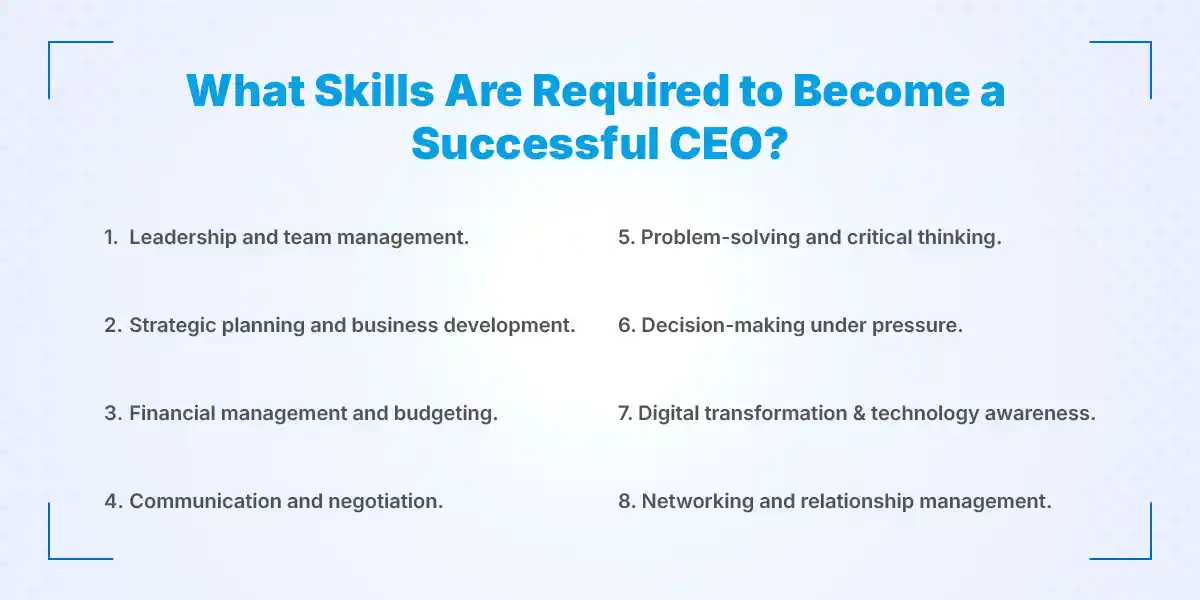
- Leadership and team management: Set direction, build trust, and develop other leaders.
- Strategic planning and business development: Choose where the company will compete and how it will grow.
- Financial management and budgeting: Read financial statements and control costs and risk.
- Communication and negotiation: Explain decisions clearly to staff, investors, and partners.
- Problem-solving and critical thinking: Break large problems into clear choices.
- Decision-making under pressure: Act with limited facts, then adjust as new facts arrive.
- Digital and technology awareness: Understand the tools that change how customers buy and teams work.
- Networking and relationship management: Keep strong ties with regulators, clients, and industry peers.
Which Career Paths Lead to a CEO Position in Nepal?
Finance, marketing, human resources, operations, business development, and entrepreneurship are common career paths to becoming a CEO. Each offers opportunities to develop leadership, business knowledge, and management experience.
- Finance and Accounting: Build experience in accounting, financial management, and business strategy.
- Marketing and Sales: Develop skills in sales growth, marketing strategy, and team leadership.
- Human Resources: Gain experience in people management, recruitment, and organizational development.
- Operations: Learn to manage business operations, resources, and overall performance.
- Business Development: Build expertise in business growth, partnerships, and strategic planning.
- Entrepreneurship: Start and grow your own business while developing overall management and leadership skills.
How Much Experience Do You Need to Become a CEO in Nepal?
No single number applies to every CEO job, but recent Nepali notices asked for 10 to 15 years of work history. Each company sets its own rules, and boards weigh leadership level as much as total years. The table below compares two real notices.
| Employer | Notice Date | Minimum Education | Experience Required |
|---|---|---|---|
| Nepal Stock Exchange (NEPSE) | July 2026 | Master's degree in listed fields, or Chartered Accountancy or equivalent. | At least 15 years in the capital market, financial sector, or management, including at least 7 years in a managerial position. |
| Sana Kisan Bikas Laghubitta | October 2025 | Bachelor's degree in listed fields, including Chartered Accountancy. | At least 10 years at officer level or higher in banks, financial institutions, government bodies, organized institutions, universities, or international organizations. |
1. General Experience vs Leadership Experience
General experience counts the years you have worked, while leadership experience counts the years you have managed people, budgets, and results. Employers value the second type more for CEO jobs, and the NEPSE notice shows this by asking for at least seven managerial years within 15 total years. Move from individual tasks to team ownership as soon as you can. Track the size of each team and budget you managed, so your CV proves your level.
2. How Experience Rules Differ by Sector
Banks and financial institutions publish formal criteria, and some tie them to banking law. The microfinance notice accepted officer-level experience from banks, government bodies, universities, and international organizations, so it welcomed people from several sectors. Public institutions like NEPSE use a recommendation committee formed by the Finance Ministry, which reviews applications and interviews shortlisted candidates. Private companies set their own rules, so read each posting closely and compare it with your record.
3. Why Industry Knowledge and Track Record Matter
Boards want a leader who already understands the market, the rules, and the risks. Competition is strong: for the 2026 NEPSE vacancy, eight people applied and four reached the shortlist for interviews. A clear record of growth, profit, or turnaround work helps you stand out in a field of that size. Pick one industry early and build deep knowledge there before you aim for the top job.
What Is the Average CEO Salary in Nepal?
No official average CEO salary exists in Nepal, because pay depends on company size, sector, and board decisions. Published estimates vary widely, from about NPR 1.5 lakh to NPR 5 lakh per month in general guides, to NPR 10 lakh or more per month at banks and multinational firms. Use these numbers as rough guides, and check each employer's own disclosures when you can.
Four factors shape CEO pay:
- Company size and revenue.
- Industry and business performance.
- The CEO's professional experience.
- The scope of leadership responsibility and the type of organization.
Here is how pay differs by organization type:
- Private companies: Owners or the board set pay. A KumariJob salary guide estimates NPR 1 lakh to NPR 3 lakh per month at small and mid-sized firms, and NPR 4 lakh to NPR 8 lakh at large private firms.
- Banks and financial institutions: Nepal Rastra Bank rules shape the package. A board subcommittee recommends the CEO's fixed salary and allowances, and performance-based pay can reach up to 20 percent of that fixed amount. NMB Bank, for example, reported an annual CEO package of Rs 23.4 million in FY 2021/22, including Rs 8.5 million in allowances and Rs 5 million in bonus.
- NGOs, INGOs, manufacturers, and startups: No reliable public salary data exists for these groups. Boards and founders usually negotiate pay. The Sana Kisan notice, for instance, said pay would follow mutual agreement with the selected candidate.
A CEO package has four parts:
- Basic salary: The fixed monthly amount.
- Allowances: Extra fixed payments for housing, fuel, communication, or festivals.
- Bonuses: Pay linked to company or personal performance.
- Other benefits: Items such as a vehicle, insurance, or retirement contributions.
Where Can You Find CEO Career Opportunities in Nepal?
CEO career opportunities in Nepal are available in banks, private companies, corporate groups, NGOs, and public institutions. Organizations may advertise CEO vacancies through job portals, official websites, newspapers, and executive recruitment agencies. Some companies also promote experienced senior managers to CEO positions.
You can explore CEO career opportunities and senior management vacancies on KumariJob to learn about available roles and their requirements.
- Private companies and corporate groups
- Commercial banks, development banks, and financial institutions
- IT and technology companies
- Manufacturing and industrial organizations
- Tourism and hospitality businesses
- NGOs and INGOs
- Government-owned enterprises and public institutions
- Executive recruitment agencies and professional networks
How Can You Stay Updated on CEO Vacancies in Nepal?
- Check job portals, newspapers, and official company websites regularly.
- Review the required education, professional experience, and eligibility criteria in each vacancy notice.
- Prepare essential documents, such as your CV, experience certificates, and other requested documents.
- Build professional connections with industry leaders and senior management professionals.
- Browse management jobs in Nepal on KumariJob to explore management-level opportunities and understand the qualifications employers require.
How Can You Prepare for a CEO Position Starting Today?
To prepare for a CEO position, start by setting clear career goals and choosing a relevant degree in business, management, finance, or a related field. Gain practical work experience through internships and entry-level jobs, develop leadership skills, improve communication, and learn business strategy and financial management. You should also find an experienced mentor and build a strong professional network.
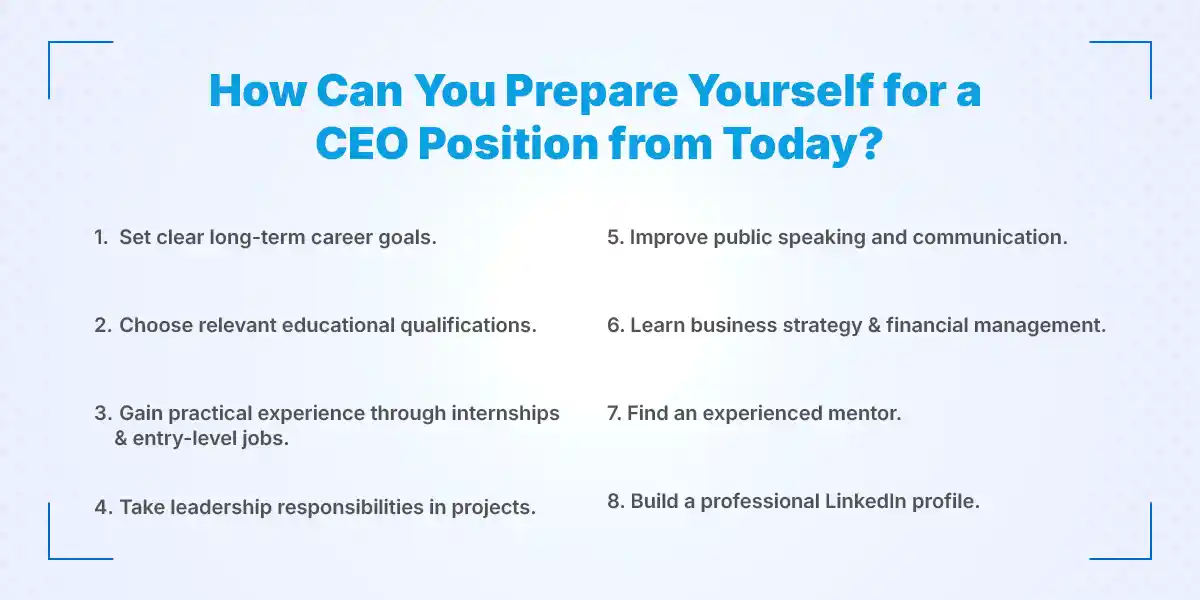
1. Set Clear Career Goals
Decide which industry you want to work in and set clear goals for your career growth. Create a step-by-step plan to move from an entry-level job to a leadership position.
2. Choose Relevant Educational Qualifications
Earn a degree in business, management, finance, or economics to build a strong foundation. Consider an MBA or a relevant master's degree to develop advanced business knowledge.
3. Gain Practical Work Experience
Start with internships or entry-level jobs to learn how businesses operate. Take on new responsibilities and gain experience that prepares you for management roles.
4. Develop Leadership Skills
Take responsibility for projects and learn how to guide a team toward shared goals. Practice problem-solving, decision-making, and conflict management.
5. Improve Communication Skills
Develop clear speaking, active listening, and professional writing skills. Strong communication helps you manage teams, negotiate effectively, and build business relationships.
6. Learn Business Strategy and Financial Management
Learn how to create business plans, manage budgets, and understand financial reports. These skills help you make informed decisions and support company growth.
7. Find an Experienced Mentor
Connect with experienced managers or business leaders who can guide your career development. Learn from their experiences, seek feedback, and apply their advice to your professional growth.
8. Build a Professional LinkedIn Profile
Create a professional LinkedIn profile that highlights your education, experience, skills, and achievements. Connect with industry professionals to discover networking and career opportunities.
Conclusion
Becoming a CEO in Nepal takes more than a degree or professional qualification. It requires years of practical experience, strong leadership skills, business knowledge, and the ability to make decisions that drive organizational growth. Whether you build your career in finance, marketing, HR, operations, or entrepreneurship, focus on developing measurable achievements and taking on greater responsibilities at every stage.
start building your CEO career today Explore the latest management jobs in Nepal on Kumari Job, discover career opportunities, and take your next step toward a leadership position. Visit KumariJob.com to find opportunities that match your career goals.
Frequently Asked Questions
Submit your comments

Get Our App On


How to Become a Growth Marketing Specialist in Nepal: Skills, Roles, and Career Path
VIEW DETAILS
How to Build a Digital Marketing Portfolio in Nepal with Zero Client Experience
VIEW DETAILS
Meta Ads Training Fees in Nepal: Complete Course Fee Guide
VIEW DETAILS
SEO Training for Working Professionals: Skills, Benefits and Career Growth
VIEW DETAILS


Loading Comments...