



Thinking of becoming a Health Assistant (HA) in Nepal? Or you're curious about how much they earn in 2026? Well, you're in the right place. Health Assistants play a significant role in Nepal’s healthcare system. They help doctors treat patients and manage health posts in rural areas. But many people still don’t know what their salary looks like.
In this blog, we’ll talk about the latest HA salary in Nepal, how much they earn at different stages, and what affects their pay. Whether you're a student planning your future or someone just looking for info, this guide will help.
In this blog
What is the Average HA Salary in Nepal in 2026?
The average salary of an HA in Nepal ranges from NPR 25,000 to NPR 60,000 per month in 2082. The exact salary depends on your experience, workplace, and whether you work in the government or private sector. Some may start with low pay during internships, while others with years of experience earn much more. The government jobs have also gotten extra benefits on top of their basic salary. Let's look at how the salary changes at different stages of an HA's career.

1. Intern HA
If you are working as an intern Health Assistant, your pay will often be low. Most interns get between NPR 5,000 and NPR 10,000 per month. Some organizations even offer unpaid internships, especially in rural areas. But don't panic, it is okay to have low pay for such fresher jobs. The main goal during this time is to get real experience and learn how hospitals or health posts work. You’ll be assisting senior HAs or doctors, handling basic tasks, and learning on the job. This phase is short, usually lasting a few months. And once it's over, you’ll be ready for a junior role with better pay.
2. Junior HA (0–2 Years)
As a junior HA with around 2 years of experience, your pay would be between NPR 15,000 and NPR 30,000. Your pay depends on where you work; large hospitals may provide you with more pay, whereas small clinics may not. You will be doing more than assisting here. You can treat minor illnesses, give health tips, or handle basic emergencies. Your responsibility grows, and so does your skill. Some private hospitals also offer bonuses or overtime, which can boost your income a bit. With time, experience, and good performance, your salary will increase. This is the stage where most HAs learn and grow the fastest.
3. Mid-Level HA (2–5 Years)
With 2 to 5 years of experience, you’re now seen as a skilled HA. The majority in this group earn between NPR 35,000 and NPR 50,000 monthly. You may be given more serious cases and even be responsible for junior staff. Some HAs in this group also get promoted or trained to move up. If you work in a busy hospital or in an NGO-managed health project, you may earn even more. You may also be given night shift or travel allowances. This level offers better pay and also a great platform for your future. You are no longer a fresher; you're now a member of the core medical team.
4. Experienced HA (5+ Years)
After gaining over 5 years of experience, you become an experienced HA. In this level, salaries start from NPR 50,000 and can go up to more than NPR 70,000 per month. Your experience commands respect, and you can handle sensitive patients, mentor junior staff, and oversee field health camps. Depending on whether you're in a senior role with an NGO, INGO, or hospital, your salary could be even higher. Some even get extra benefits like housing or transport allowances. Here, you're not a worker, you're a leader. This is where the majority of HAs look for higher education or government proposals to go further. Your work and capability surely pay you back here.
5. Government HA (Level 5 Officer)
If you are a government Health Assistant, you will get a fixed salary based on the latest salary scale of 2082 B.S. The basic salary is NPR 36,242 per month. But that’s not all. You also get a list of allowances, grade pay, medical allowance, uniform allowance, and many others. So putting all that together, your salary per month can go up to NPR 45,000 to NPR 60,000. Government jobs are also secure and come with other perks like pensions, insurance, and frequent promotions. You'll also be posted in rural areas, but the postings typically come with travel or risk allowances. If you want to have a stable and secure profession, the government career path is a great option.
Get Hired Faster with the Kumari Job App
Apply to top jobs in seconds! Get real-time alerts, verified listings, and track every application all from your mobile. Start your career journey now.
Government vs Private Sector: Where Do HAs Earn More?
One of the most common questions people ask is: Do Health Assistants earn more in government jobs or private hospitals? The answer isn’t simple. It depends on several factors, including location, job type, and experience level. Let’s break it down clearly.
1. Government HA Salary in Nepal (Latest Pay Scale 2082)
If you’re working as a Health Assistant in the government sector, your salary is fixed based on the official pay scale. As of 2082 B.S., a Health Assistant working under the 5th level gets a basic monthly salary of NPR 36,242. But that’s just the base amount. In a government job, you also receive various allowances. These can include:
- Grade Pay (extra pay based on your performance or time in service)
- Medical Allowance
- Uniform Allowance
- Dearness Allowance
- Remote Area Allowance (if you’re posted in a rural or risky area)
When all these are added, a government HA can earn around NPR 45,000 to NPR 60,000 per month. The good thing is, this income is regular and guaranteed. You also get job security, paid leave, festival bonuses, and even a pension after retirement. Promotions happen based on years of service and internal exams, so the income keeps increasing over time.
However, government HAs may have to work in rural or remote areas. Sometimes, facilities may be limited. But those locations also offer higher allowances to balance things out.
2. Private Hospital HA Salary in Nepal
Now let’s talk about the private sector. If you work in a private hospital, clinic, or NGO, your salary depends a lot on the organization’s size, location, and funding. There’s no fixed scale like in government jobs. Some small clinics may pay NPR 20,000 to NPR 30,000, especially for junior HAs. But large private hospitals or international NGOs can offer NPR 50,000 to NPR 70,000+ per month for experienced professionals. The range is wider, and in some cases, you can earn more than in a government job.
Another thing to note is that private jobs often include performance-based incentives. For example, if you work extra hours or meet certain targets, you may get a bonus. Some organizations also offer training, insurance, and travel allowances, but this is not guaranteed everywhere. The private sector is good for faster salary growth if you’re skilled and hard-working. But job security is usually lower. Contracts may be short-term, and there’s more pressure to perform.
Salary Summary: Government vs Private Sector
Here’s a quick table to help you compare:
| Category | Government HA | Private Sector HA |
|---|---|---|
| Starting Salary (Monthly) | NPR 36,242 basic + allowances | NPR 20,000 – NPR 30,000 |
| Experienced Salary (Monthly) | NPR 45,000 – NPR 60,000+ | NPR 50,000 – NPR 70,000+ (in NGOs, hospitals) |
| Allowances | Grade, Medical, Remote, Uniform, etc. | Depends on employer; not always included |
| Job Security | High (permanent job) | Low to medium (contract-based) |
| Bonuses/Incentives | Festival bonus, pension after service | Sometimes provided (performance-based) |
| Promotion | Based on service and exams | Based on performance and vacancy |
| Work Location | Often rural or semi-urban | Mostly urban or hospital-based |
What Factors Affect HA Salary in Nepal?
HA salary in Nepal is highly affected by experience, location, type of employer, and extra duties like night shifts or remote postings. Some Health Assistants earn more than others, even if they have the same job title. This is because different things can increase or reduce your monthly income. Where you work, how long you’ve worked, and even your daily tasks can make a big difference. Let’s look at the main reasons why HA salaries are not the same for everyone.
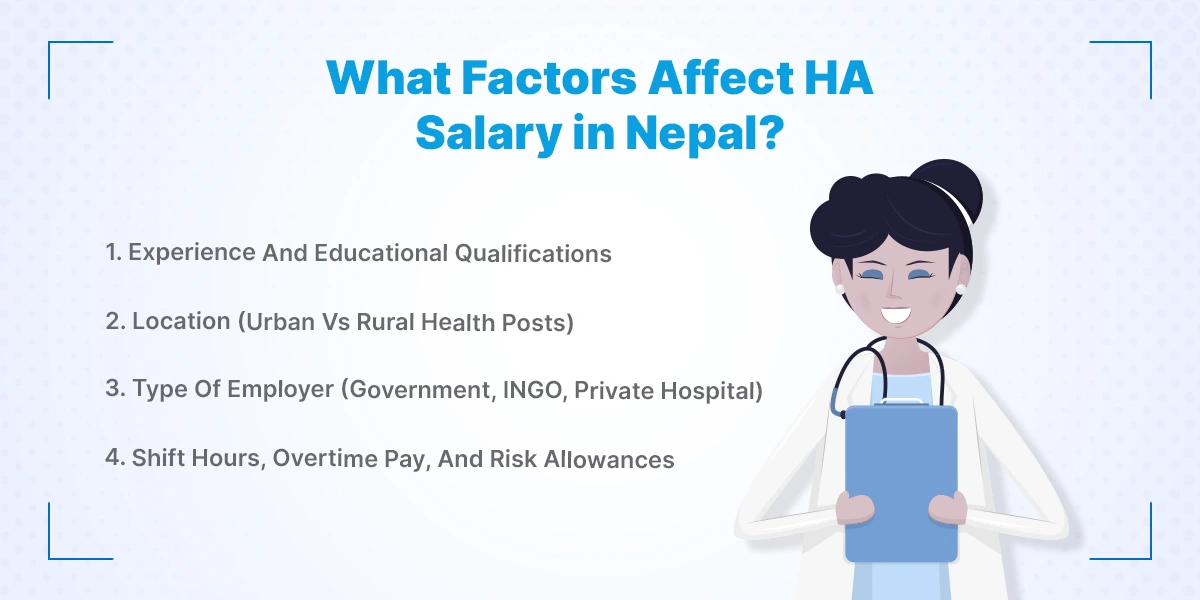
1. Experience And Educational Qualifications
The more experience you have, the better the salary. A fresh HA with less experience might earn NPR 20,000 to NPR 30,000. But someone with 5+ years of experience can easily get NPR 70,000 or more. Employers trust experienced staff more, so they offer better pay.
Your education also matters. If you’ve done extra training courses or have advanced certifications, you’ll stand out. Some HAs even move up to public health roles or leadership positions. So, if you keep learning and gaining experience, your salary will go up over time.
2. Location (Urban Vs Rural Health Posts)
Where you work also affects your income. In rural or remote areas, government HAs often get extra allowances. These include things like remote area allowance, which adds to the basic salary. Some even get housing support or food allowances if the place is far from the city.
On the other hand, private hospitals in urban areas might offer better salaries because they handle more patients and have more funding. But you might have to work longer hours. So, rural posts offer more allowances, while urban jobs offer better base pay. It depends on what matters more to you: money, comfort, or experience.
3. Type Of Employer (Government, INGO, Private Hospital)
Not all employers pay the same. Government jobs have fixed salaries, but they offer security and benefits. You get paid on time, and there are allowances and bonuses too. But promotions and salary hikes may take time.
Private hospitals and clinics can pay well, especially if they are big. But small clinics may offer less. INGOs or health-related projects usually pay the best. They might offer NPR 60,000 or more, especially for experienced HAs. However, these jobs are often contract-based. So, while you can earn more, the job may not be long-term.
4. Shift Hours, Overtime Pay, And Risk Allowances
If you work night shifts, weekends, or public holidays, you might get extra pay. This is common in both government and private hospitals. Some even pay overtime for working extra hours. This can really boost your monthly income.
In certain health posts, especially in high-risk areas, HAs get risk allowances too. This is an extra payment for working in tough or dangerous conditions. It’s like a bonus for taking on more responsibility or stress. The more hours or risks you take on, the more you can earn on top of your base salary.
Skills Needed to Become an HA in Nepal
Being a Health Assistant (HA) is not just about certification. You also need the proper skills to do the job well. With the proper skills, you can provide care to patients, work effectively in a team, and address real-world problems on a daily basis. Let us talk about the most important skills that every HA should have.
1. Medical Knowledge and Clinical Skills
To be a successful HA, you need to have good medical knowledge. This includes understanding the human body, diseases, and basic treatments. You should know how to check patients, take blood pressure, and administer first aid. These skills help you to make quick decisions in emergencies. You'll also want to understand how medicines work.
Physicians and patients will trust your medical advice if you are confident and clear. You don't have to know it all, but you must keep on learning. Clinical skills improve with practice, so don't be afraid to ask questions. The more you practice, the better you become. That's how great HAs are made.
2. Communication and Patient Counseling Skills
Talking to patients is an important part of the work. Most patients who come to the hospital are scared or confused. As an HA, your job is to talk to them in a calm and understandable way. You should know how to speak well and listen carefully. You should also speak in gentle and respectful words.
Sometimes patients fail to follow instructions simply because they don't understand. Proper communication has a big role to play here. You also have to talk to family members, doctors, and other staff. If you can speak well and be clear, everyone works in better sync. Patients also feel safer.
3. Decision-Making and Problem-Solving Skills
Every day, you will be faced with small or big challenges. Maybe the doctor is not available, and you have to handle a case alone. Or maybe there is a patient who has sudden pain or bleeding. You need to stay calm and think fast. Decision-making does not come naturally, but with time, it gets better.
You need to learn to evaluate the situation, think of the best thing to do, and act fast. Problem-solving also means not giving up when things get tough. You should also be aware of when to refer a patient to a doctor or hospital. A smart HA is aware of its/limitations. Practice and confidence allow you to make better decisions.
4. Technical Skills and Equipment Handling
HAs often use basic medical equipment like BP machines, thermometers, and glucose meters. You should know how to use them efficiently and safely. It's also your job to keep these tools clean and ready for use. On some occasions, you may assist with minor procedures or use general surgical packs.
Familiarization with equipment is a must. It also makes your work faster and more accurate. Patients also feel more at ease when they see you working confidently. Don't worry if you don't know everything at first. These are technical skills and come with practice and training. Never be afraid to seek assistance if you are uncertain.
5. Teamwork and Public Health Awareness
You will not be alone. HAs can work together with doctors, nurses, laboratory staff, and community workers. It is important to be a team player. If you cooperate with others, the whole health center runs more smoothly. You will also be involved in public health activities like vaccination camps or awareness campaigns. That includes talking to the individuals in the community about hygiene, prevention of diseases, and health tips. It is a small work, perhaps, but it helps a lot. Public health awareness is a major function of an HA. Each one in the team doing his or her part helps the whole community.
HA Salary Comparison With Other Medical Jobs in Nepal
Many people wonder how the HA salary in Nepal compares with other healthcare jobs. There are several similar roles, like Staff Nurse, CMA, and ANM, and each has a different pay range. Let’s look at how they compare in terms of earnings and overall value in the healthcare sector.
1. Health Assistant (HA)
Health Assistants usually earn between NPR 25,000 and NPR 60,000 per month, depending on their experience and workplace. Government HAs get a basic salary of around NPR 36,242, plus allowances. With time and promotions, the income can grow even more. HAs can work in hospitals, health posts, NGOs, and even lead field programs. Their role is both clinical and community-based, which makes them very important in rural areas. Many HAs also upgrade their career by studying further. It’s a solid job with good income and growth opportunities.
2. Staff Nurse
Staff Nurses generally earn a bit more than HAs, especially in the beginning. Their salary can range from NPR 30,000 to NPR 65,000+ per month. In government hospitals, they also receive allowances like grade pay, uniform, and festival bonus. Nurses work mostly in hospitals and care units. They handle patients full-time, give medications, and support doctors. It’s a highly respected job, but also physically and mentally demanding. Shift work is common, and night duties are regular. Nurses often earn well, especially in private hospitals and abroad.
3. CMA (Community Medical Assistant)
CMAs are usually paid less than HAs. Their monthly salary falls between NPR 20,000 and NPR 30,000 on average. They mostly work in local health posts or small clinics. Their duties include basic checkups, giving medicines, and assisting HAs or doctors. Since their training is shorter and less advanced, their income is lower too. Still, it's a good job for people starting out in healthcare. With more training, CMAs can later become HAs.
4. ANM (Auxiliary Nurse Midwife)
ANMs mainly work in maternal and child health. Their salary ranges from NPR 20,000 to NPR 35,000 per month. They work in rural health posts, birth centers, and outreach clinics. ANMs assist in deliveries, give prenatal advice, and care for mothers and newborns. The pay is decent, especially in government jobs. But it may not grow as much as HA or Staff Nurse roles. ANMs play a key role in public health, especially for women’s health in villages.
5. Value vs. Earning Potential
Each role is important in healthcare jobs. Staff Nurses and HAs usually earn more and have better growth chances. CMAs and ANMs earn less but still serve a big purpose, especially in remote areas. If you want better pay and promotion options, HA and Nurse roles offer more in the long run. But passion, interest, and location also matter when choosing a career in health.
Salary Comparison Table
| Medical Job | Monthly Salary Range (NPR) | Growth Potential | Main Work Areas |
|---|---|---|---|
| Health Assistant (HA) | 25,000 – 60,000+ | High | Hospitals, Health Posts, NGOs |
| Staff Nurse | 30,000 – 65,000+ | High | Hospitals, Clinics, Abroad |
| CMA | 18,000 – 30,000 | Low to Medium | Clinics, Health Posts |
| ANM | 20,000 – 35,000 | Medium | Birth Centers, Rural Health Posts |
Career Growth Opportunities for HAs in Nepal
Health Assistants in Nepal have good career development. Once they gain some years of experience, a majority of HAs are promoted to higher positions in health posts or government hospitals. Some even get to be in charge of rural health centers. If someone is working in the government sector, promotion is done on the basis of years of service and internal tests. In private hospitals and NGOs, the rise is more in relation to your skills and performance. So the more you work, the faster you get promoted. No matter where you start, there is always scope for promotion. A few HAs also take up further studies.
Some take up a Bachelor of Public Health (BPH) or even prepare to do MBBS. Others are in special training programs or bridge courses to move up in ranking. With higher studies, you can apply for better-paying jobs, leadership, or even overseas projects. Others become health officers or public health supervisors. So, if you are keen on growing, studying further is a great option. It opens up a lot of new possibilities. Besides promotion and further study, HAs can also work abroad. Japan, Australia, and Gulf nations offer job opportunities in the healthcare sector.
You might need more training or language tests, but it is possible. Jobs abroad offer higher remuneration and international experience. Even in Nepal, INGOs and big health projects look for skilled HAs. These job opportunities offer higher remuneration, travel, and training programs. So, with learning, effort, and time, your HA career can extend far, not only in Nepal but also elsewhere.
Conclusion
So, how much do HAs earn in Nepal in 2026? On average, they make between NPR 30,000 and NPR 60,000 per month, depending on where they work and how much experience they have. Government jobs offer more stable pay with benefits. Private jobs can pay well, too, but it depends on the hospital or clinic.
Being an HA isn’t just about salary, though. It’s a respected job with chances to grow, learn, and help people every day. If you’re planning to become an HA, it’s a solid choice in today’s market. The income is decent, the future is bright, and the demand is always there. In short, yes, being an HA in Nepal in 2026 is worth it.
Looking for more job options in Nepal? Explore popular career paths like digital marketing jobs that offer steady growth and good pay. Whether you want office work or something hands-on, there’s something for everyone.
Frequently Asked Questions
Submit your comments

Get Our App On



SEO Training for Freshers in Nepal: Skills, Career & Job Opportunities
VIEW DETAILS
SEO Training vs. Self-Learning: Which Is Right for You?
VIEW DETAILS
How to Choose Between Two Job Offers
VIEW DETAILS
Digital Marketing Training Interview Questions and Answers for Freshers
VIEW DETAILS


Loading Comments...