

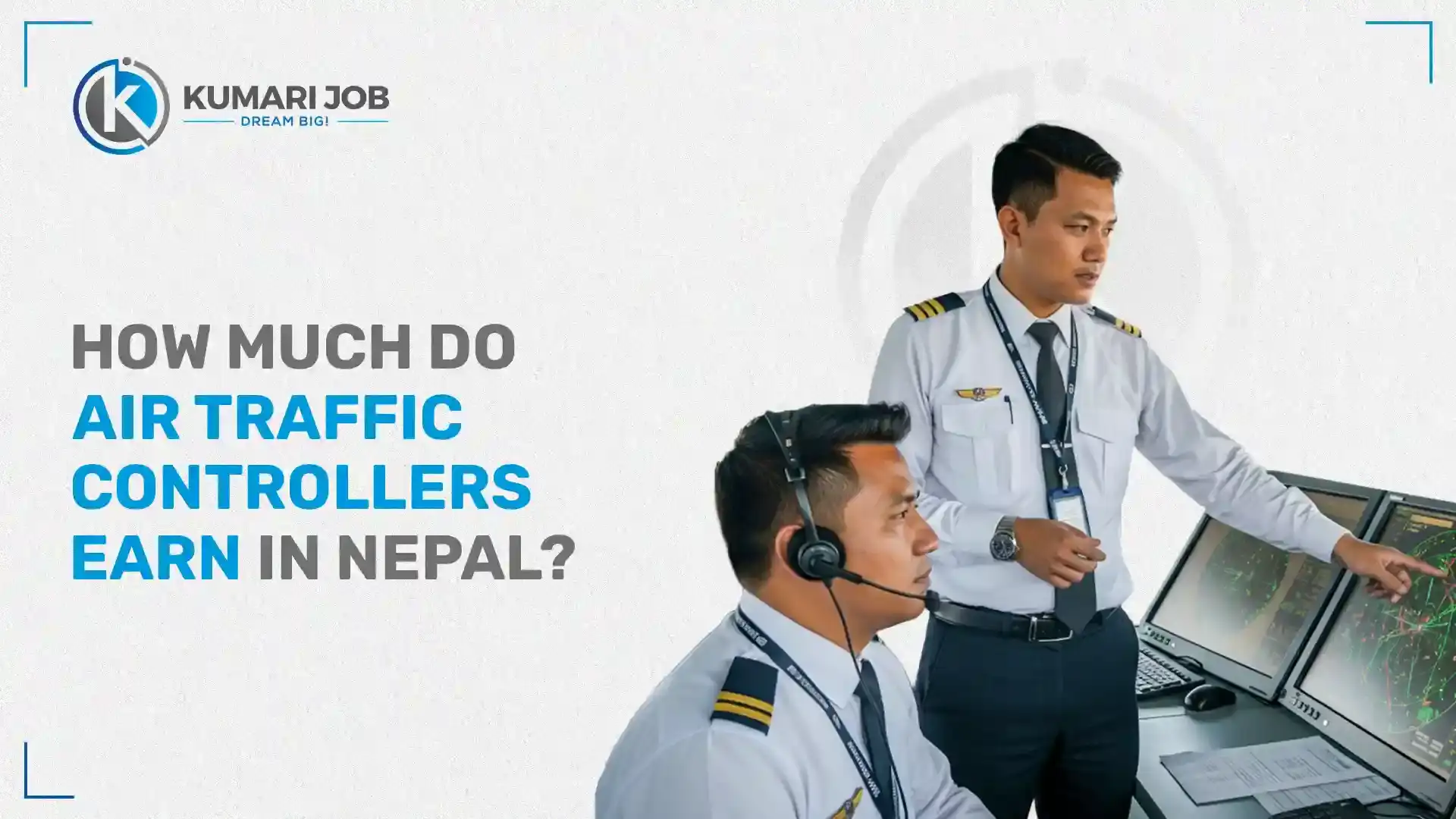

Picking a career in Nepal is tough because you want a job that pays well but also stays stable. If you are looking at aviation jobs, you probably know that finding the real salary numbers for an air traffic controller (ATC) is very hard. You want a respected job, but you need to know if the stress is actually worth the money.
In this post, we are going to talk about the air traffic controller salary in Nepal. We will look at what a beginner makes versus a senior officer, including all the extra allowances. By the end, you will clearly see if this career path fits your budget and your future.
In this blog
Who are Air Traffic Controllers and What do they do?
Air traffic controllers are the people on the ground who talk to pilots on the radio to tell them when to take off, land, and stay away from other planes. Think of an air traffic controller (ATC) as the person who manages all the traffic in the sky. While a pilot is busy flying one plane, the ATC is responsible for every plane in that area. In Nepal, these professionals work for the Civil Aviation Authority of Nepal (CAAN). You will see them working in the big glass towers at airports like Tribhuvan International (TIA) or sitting in front of radar screens in a dark room.
Their main job is to make sure planes don't hit each other. This is a very big responsibility in a country like Nepal because our mountains make flying difficult and the weather changes in a heartbeat. The ATC is the voice in the pilot's ear. They are the ones who give the OK to start the engines, tell the pilot which way to turn, and decide when it is safe to touch down on the runway.
What they do every single day:
- Manage the Runway: They tell pilots exactly when to move onto the runway and when to fly. They make sure two planes never try to use the same strip of ground at the same time.
- Give Directions: They use radios to tell pilots how high to fly and which direction to go so they stay on the right path.
- Handle Emergencies: If a plane has a mechanical problem or is low on fuel, the ATC clears the way so that the plane can land before anyone else.
- Update on Weather: they warn pilots about bad wind, heavy rain, or thick fog that makes landing risky.
This job is very high-pressure because you have to make fast choices. You cannot make a mistake. Because of this, an ATC has to stay 100% focused every second they are sitting at their desk.
What is the Average Salary of an Air Traffic Controller in Nepal?
The average take-home salary for an Air Traffic Controller in Nepal typically ranges from NPR 50,000 to NPR 70,000 per month for those in the early to middle stages of their career. In Nepal, the pay for an Air Traffic Controller (ATC) is based on the government scales set by the Civil Aviation Authority of Nepal (CAAN). While the basic starting salary might look similar to other government officer roles, the actual money you take home is much higher. This is because the job is very technical and stressful, so the government adds extra allowances to the base pay. Most controllers find that their bank balance grows steadily as they move from being a trainee to a licensed officer.
The total monthly income depends heavily on where you are posted and how many hours you work. For example, if you work at a busy airport like Kathmandu, you get more technical and shift allowances compared to someone at a smaller domestic airport. When you add up the basic salary, dearness allowance, and technical perks, a mid-level controller comfortably earns within the average range. It is considered one of the better-paying stable jobs available in the Nepali public sector today.
Air Traffic Controller Salary by Experience Level
In Nepal, the amount of money you make as an air traffic controller grows as you gain more experience. When you first start, you are mostly learning, so the pay is lower. As you get your licenses and move to bigger airports, your salary and allowances increase quickly. By the time you become a senior officer, you are among the highest-paid technical staff in the government sector.
1. Junior Air Traffic Controller Salary
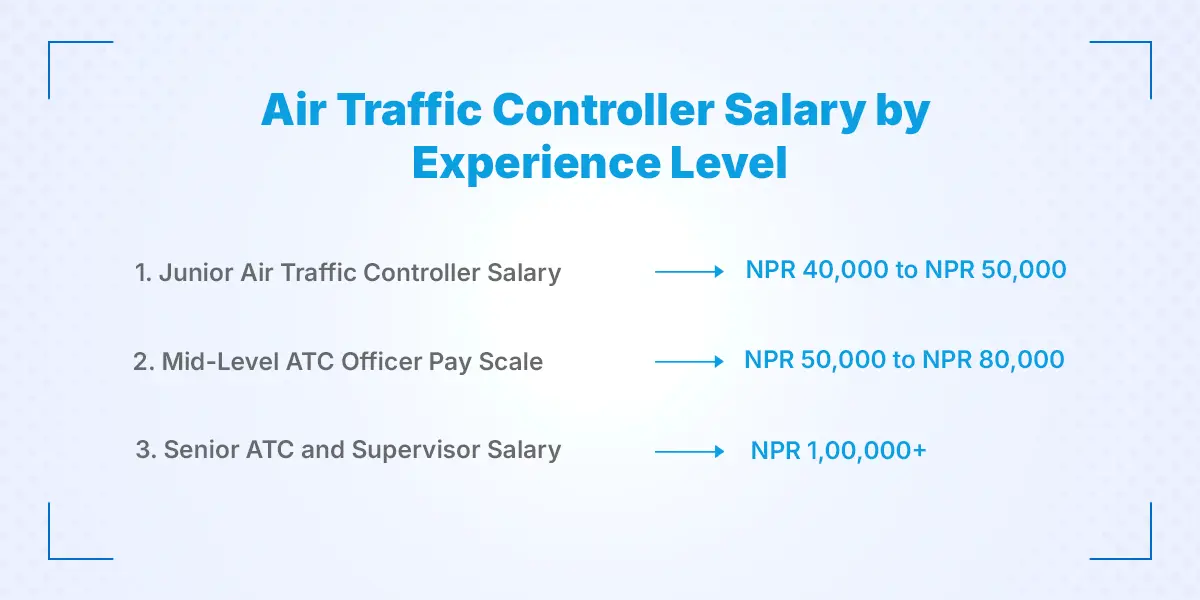
When you first join the Civil Aviation Authority of Nepal (CAAN), you start as a trainee or a junior officer. At this stage, your main job is to learn the rules and watch how senior controllers handle the radar. Your basic salary follows the standard government scale for an officer-level position. Since you don't have all your ratings yet, your technical allowances are a bit lower than the experts'. Most juniors take home between 40,000 and 50,000 rupees after basic taxes. It is a starting phase where you focus more on training than on high-level responsibilities. Once you pass your internal exams and get your first rating, your pay starts to climb. It is a good starting salary for a fresh graduate in Nepal compared to many other sectors.
2. Mid-Level ATC Officer Pay Scale
After working for a few years, you become a fully licensed ATC officer with more responsibilities. This is the stage where you start handling busy air traffic on your own without a supervisor watching every move. Because the job is stressful and requires a lot of focus, the government adds extra technical and shift allowances to your pay. You might be working at busier towers like Pokhara or Bhairahawa, which come with better perks. Your monthly take-home pay usually falls between 50,000 and 80,000 rupees, depending on your specific location. At this level, you also get better benefits like medical insurance and yearly bonuses for festivals. Most controllers find this to be a very comfortable income that covers all their family's needs. It is the middle ground where your experience really starts to pay off in your bank account.
3. Senior ATC and Supervisor Salary
Senior controllers are the veterans who have spent over a decade or two in the control tower. These officers are the ones in charge of the entire shift and make the final decisions during emergencies. Because they handle the most difficult radar sectors at Kathmandu airport, their technical allowance is very high. When you combine their high basic salary with seniority pay and all the extra perks, they easily earn more than 1,00,000 rupees a month. They also get invited to international training sessions and represent Nepal in aviation meetings abroad. At this level, the job is not just about a paycheck but also about the huge respect they get in the aviation industry. Even after they retire, their pension is quite high because of the senior grade they reached. It is a rewarding end-goal for anyone who stays dedicated to the profession.
Factors That Affect Air Traffic Controller Salary in Nepal
Not every Air Traffic Controller in Nepal gets the same paycheck at the end of the month. Your total salary depends on many things, like where you work and how many years you have been in the tower. The government has a basic pay scale, but extra allowances can make a big difference in your take-home money. Let’s look at the main reasons why one controller might earn more than another.
1. Experience and Seniority
In Nepal’s civil service, time is money. Every year you work at the airport, the government adds a small amount called a grade to your basic salary. This means a person who has worked for ten years will naturally have a higher base pay than someone who just joined. Seniority also helps you get promoted to higher officer levels faster. Most older controllers also get more respect and handle the toughest shifts. As you get more senior, your pension and retirement benefits also grow bigger. It is a career where staying loyal to the job really pays off in the long run.
2. Location and Airport Density
Where you are posted in Nepal matters a lot for your pocket. Working at a very busy airport like Tribhuvan International (TIA) in Kathmandu is much harder than working at a small grass strip in the mountains. Because Kathmandu has so many planes landing and taking off, the controllers there often get better technical allowances. Some remote postings might give you a remote area allowance, but the big money is usually in the high-traffic cities. The stress of managing a dense or crowded sky is why the pay varies by location. If you want the highest salary, you usually have to work in the busiest towers.
3. Licensing and Rating
To be a full ATC, you need special licenses called ratings. There are different levels, like Aerodrome Control, Approach Control, and Radar Control. Each time you pass an exam and get a new rating, your value to the airport goes up. The Civil Aviation Authority (CAAN) gives extra monthly money to those who hold advanced ratings, especially in Radar. It takes a lot of hard work and extra training to get these licenses. Think of it like a bonus for having specialized skills that others don't have. The more ratings you have on your license, the higher your monthly allowance will be.
4. Shift Work and Overtime
Airports never sleep, which means controllers have to work in shifts. You might have to work through the night, on Saturdays, or even during big festivals like Dashain and Tihar. Because you are working when others are resting, you get extra shift allowances and overtime pay. If the airport is short-staffed and you stay for extra hours, that money is added to your basic salary. During the busy tourist seasons, there are a lot of chances to earn extra income through these shifts. This is often why an ATC's bank balance looks much better than a regular 9-to-5 office worker.
5. Technical Skill and Stress Management
Being an ATC is not a regular desk job; it is a high-skill role. The government recognizes that managing the lives of hundreds of passengers is very stressful. Because of this high "mental load," they provide a Technical Allowance that regular government staff don't get. If you are skilled enough to handle high-pressure situations without making mistakes, you stay in the good books for promotions. Those who can handle the radar screen during bad weather are the ones who get picked for the best positions. Your ability to stay calm under pressure is literally written into your pay structure.
6. Position Level
Your rank or level in the CAAN hierarchy is the biggest factor for your basic pay. In Nepal, these are usually marked as Level 7, Level 8, or higher for officers. Each level has a fixed starting salary set by the government of Nepal. When you move from a Junior Officer to a Senior Officer, your basic pay jumps up significantly. Along with the higher pay, higher levels come with more responsibilities and bigger offices. Most people try to pass internal exams as fast as possible to jump to the next level. A higher position level is the most stable way to ensure a big paycheck every month.
Benefits and Perks Beyond Basic Salary
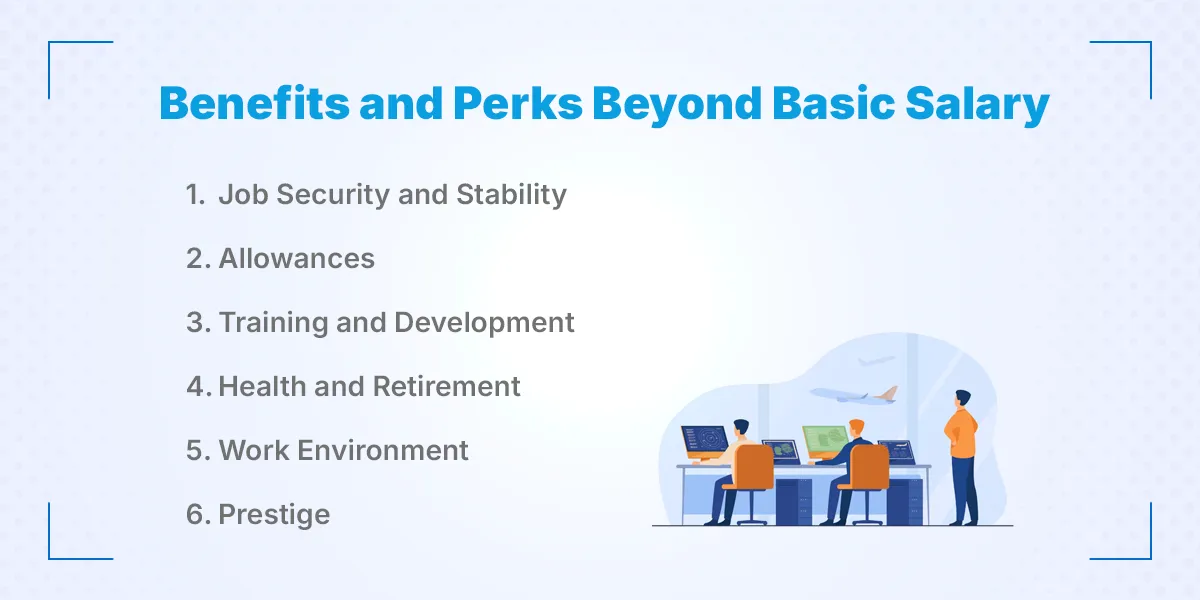
When you work as an Air Traffic Controller in Nepal, the basic salary is just the start. The extra benefits and perks are what really make this job one of the best in the country. Since it is a government-linked job under CAAN, you get many comforts that private jobs don't offer. Let’s look at the extra things you get besides your monthly paycheck.
1. Job Security and Stability
One of the best things about this job is that you don't have to worry about losing it. Since you work for a government body like CAAN, your position is very safe for life. Unlike private companies that might close down, the airport will always need controllers. This stability helps you plan your future, get home loans easily, and live without stress. It is a job for life if you follow the rules.
2. Allowances
On top of your basic pay, you get several extra allowances that add up quickly. You get a technical allowance for the specialized work and a dearness allowance to help with rising prices. There is also a festival bonus where you get an extra month's salary for Dashain every year. If you work at night or on holidays, you get even more money for those shifts. These extras can sometimes make your total pay feel much larger than you expected.
3. Training and Development
The aviation world is always changing, so the government invests a lot in your learning. You will often get the chance to go to the Civil Aviation Academy for free refresher courses. Sometimes, lucky controllers are even sent to countries like Thailand or Singapore for advanced training. These trips are fully paid for, and you get to learn from international experts. It is a great way to grow your skills while seeing the world.
4. Health and Retirement
Your health and your future are well taken care of in this career. You and your family usually get medical insurance or help with hospital bills if someone gets sick. When you get old and retire, you don't have to worry because you get a monthly pension for the rest of your life. There is also a provident fund where a part of your salary is saved and doubled by the employer. This ensures you have a huge pile of savings when you finally stop working.
5. Work Environment
The workplace for an ATC is very unique and modern compared to a dusty office. You work in high towers with great views or in clean, air-conditioned rooms with high-tech screens. Because the job is so important, the workspace is kept quiet and very organized. You also work with a small, close-knit team that feels like a family. It is a professional and "high-end" environment that makes you feel proud to show up every day.
6. Prestige
In Nepal, being an Air Traffic Controller is seen as a very big job. People respect you because they know you are responsible for the lives of thousands of passengers. It is a prestigious technical role, almost like being a pilot but on the ground. When you tell someone you work in the Airport Tower, they look at you with a lot of admiration. It is a career that brings a lot of honor to you and your family
How to Become an Air Traffic Controller in Nepal?
To become an Air Traffic Controller in Nepal, you must complete a Bachelor’s degree in Science, IT, or Engineering, pass a competitive Lok Sewa exam, and finish a one-year specialized training at the Civil Aviation Academy. This journey is a mix of academic success and intense practical training designed to prepare you for the high-pressure life in the tower. Once you pass all the steps, you are officially hired by the Civil Aviation Authority of Nepal (CAAN).
1. Complete Required Education
Before you can apply, you need to have a strong educational background. Most vacancy notices in Nepal require a Bachelor’s degree in Science (B.Sc.), Information Technology (IT), or Engineering. You usually need a minimum score of a CGPA of 2.5 or a Second Division to be eligible. Having a solid understanding of Physics and Mathematics is very helpful because the job involves a lot of technical calculations. This degree is the foundation that proves you have the mental ability to handle the complex systems at the airport.
2. Apply When Vacancies Are Announced
The CAAN vacancies do not open every day; they announce vacancies only once or twice a year based on their needs. You need to keep a close eye on the CAAN website or job portals like Kumari Job. When the vacancy is out, you must fill out an online application and pay a small fee. Make sure your documents, like your citizenship and transcripts, are ready to be uploaded. Missing the deadline means you might have to wait another whole year to apply.
3. Pass the Written Examination and Interview
This is the hardest part of the process. You will have to sit for a written exam conducted by the Public Service Commission (Lok Sewa Aayog), which covers subjects like English, Physics, and General Knowledge. If you pass the written test, you move on to a physical health check-up and a final interview. They check your eyesight, hearing, and how well you speak English, which is the international language of aviation. Only the top-ranking candidates on the final list are selected to move forward to the training phase.
4. Complete ATC Training Program
Once you are selected, you are sent to the Civil Aviation Academy of Nepal in Sanothimi, Bhaktapur. This training is very intense and usually lasts for about one year. You will learn about air laws, navigation, and how to use radar screens through both classroom lessons and simulators. You aren't a regular student here; you are a "Student ATC" being paid to learn. This period tests your focus and your ability to make fast decisions in a fake "tower" environment before you ever touch a real radio.
5. Obtain Certification and Begin Service
After finishing your training at the academy, you don't start working alone right away. You are given a Student ATC Certificate, which allows you to start "On-the-Job Training" at a real airport under the watchful eye of a senior instructor. After a few months of successful practice, you take a final exam to get your official ATC License and Ratings. Once you have this license, you are officially appointed as an officer and assigned to a tower. This is the moment your career truly begins, and you start earning your full salary and allowances.
Is an Air Traffic Controller a Good Career Choice in Nepal?
Yes, an air traffic controller is a good career choice in Nepal if you are looking for a job that makes your parents proud and keeps your bank account full. Unlike many other degrees where you struggle to find a job after graduation, the path to becoming an ATC is clear. Once you get into the Civil Aviation Authority of Nepal (CAAN), you are set for life. Though the salary might not be as good as the pilot’s salary, it is still high compared to most government and private jobs in Nepal
Stress Level vs. Compensation
It is true that the stress is high. You are responsible for thousands of lives every day. However, the compensation package is designed to handle this.
- Extra Pay: You get technical allowances that regular government officers don't get.
- Work-Life Balance: Even though the hours are intense, the shift system allows for several days off, giving you time to rest your mind.
- Security: Even during economic downs or pandemics, your job and salary remain 100% safe.
Future Demand in Nepal
With the new international airports in Pokhara and Bhairahawa, and the expansion of domestic flights, Nepal needs more ATCs than ever. You aren't just joining a dying industry; you are joining the backbone of Nepal's tourism and transport. For someone who can handle pressure and wants a prestigious life, the rewards far outweigh the stress.
Skills Needed to Become an Air Traffic Controller in Nepal
To be an air traffic controller (ATC) in Nepal, you need more than just a degree. You need a specific set of brain skills to keep the sky safe, especially because our mountains and unpredictable weather make flying very tricky. It is a job that requires you to be sharp every single second you are on duty.
1. Mental Alertness & Focus
When you are in the tower, you have to be 100% focused. You cannot look at your phone or let your mind wander even for a second. You are watching many moving dots on a screen and listening to different pilots at the same time. If you lose focus, even for a moment, it can lead to a very big mistake.
2. Stress Management
The control tower can get very loud and busy, especially when many planes want to land at once. You must be the kind of person who stays cool and calm even when things get hectic. Your voice on the radio needs to sound steady so the pilots feel safe. If you can handle stress well, you will be able to think clearly and avoid errors.
3. Rapid Decision Making
In the sky, things happen fast, and you don't have time to sit and think or ask for advice. You have to look at the situation and decide what to do in a split second. This means you must be confident and trust what you learned in your training. Being quick to act is what keeps the airport running without any accidents.
4. Strong Communication Skills
You need to speak very clearly so pilots can understand every word you say. Since you use a radio, your directions must be short and direct, without any confusing words. You will use aviation English, which is a special way of talking for pilots and controllers. Good talking skills make sure there are no mix-ups between the tower and the cockpit.
5. Spatial Awareness & Visualization
This is a fancy way of saying you need to see the sky in your head. Even though you are looking at a flat radar screen, you must understand how high and how far apart the planes really are. You need to be able to picture where the planes will be in five minutes. This helps you plan ahead so no two aircraft get too close to each other.
6. Technical Knowledge
You will be working with high-tech computers, radar screens, and radio sets every day. You also need to memorize many air rules about how flights should operate in Nepal. Being good with technology helps you use these tools to keep the traffic moving. It is a great job for people who like learning how modern machines work.
7. Basic Mathematics & Physics
You don't need to be a math genius, but you must be fast with simple numbers in your head. You will often calculate things like how fast a plane is going or how many minutes it will take to land. Understanding basic physics helps you know how wind and weather affect a plane’s flight. Being good with quick math makes your work much smoother when the airport gets busy.
Conclusion
Deciding to become an air traffic controller in Nepal is a big move. If you only look at the basic salary, it might seem like any other government officer job. But when you add up the technical allowances, the shift bonuses, and the absolute job security that comes with CAAN, it is clearly one of the best-paying technical roles in our country.
The real question isn't just about the money, but whether you can handle the responsibility. You are getting paid a premium because you are keeping the Nepali skies safe. For someone with a Science or Engineering background who wants a stable, high-status career without leaving Nepal, this is a fantastic choice. The investment in your education and the time spent in the Bhaktapur academy will pay off for decades in the form of a fat paycheck and a respected position in society.
Frequently Asked Questions
Submit your comments

Get Our App On



SEO Training for Freshers in Nepal: Skills, Career & Job Opportunities
VIEW DETAILS
SEO Training vs. Self-Learning: Which Is Right for You?
VIEW DETAILS
How to Choose Between Two Job Offers
VIEW DETAILS
Digital Marketing Training Interview Questions and Answers for Freshers
VIEW DETAILS


Loading Comments...