



Studying aerospace engineering takes years of hard work and costs a lot of money. But after graduation, a huge frustration hits: airlines in Nepal rarely talk openly about what they actually pay. You are left guessing if this tough career will even cover your bills.
The good news is that our local aviation industry is growing fast. With new flights and maintenance centers opening, airlines badly need skilled technical people to keep their planes flying safely.
So, what can you expect to earn? In this post, we break down the real aerospace engineer salary in Nepal. We will show you the starting pay for freshers, the top earnings of licensed experts, and how to increase your income.
In this blog
Who is an Aerospace Engineer?
An aerospace engineer is a highly trained professional who deals with machines that fly. Simply put, they are the brains behind airplanes, helicopters, drones, and even spacecraft. They figure out how to design, build, test, and maintain these vehicles so they can safely carry passengers and cargo through the air.
In many parts of the world, these engineers spend their time inventing new jets or planning space missions. However, the job looks a bit different depending on where you work. For example, in Nepal's busy aviation sector, an aerospace engineer mostly focuses on aircraft maintenance. Instead of building planes from scratch, they work hands-on at the airport to make sure every flight is 100% safe before takeoff.
Here is what a typical aerospace engineer actually does on the job:
- Checking for Safety: They run daily tests on engines, landing gear, and flight instruments to find and fix any hidden problems.
- Routine Maintenance: They replace old or broken parts and upgrade aircraft systems following strict global safety rules.
- Solving Technical Puzzles: When a pilot reports a strange noise or a warning light, the engineer is the one who steps in, finds the root cause, and solves it.
- Keeping Records: They write down every single repair and check-up, which is required by law.
Without these experts, airlines simply cannot operate. They hold a massive responsibility because hundreds of lives depend on their technical skills every single day. Their main goal is always the same: keeping flights safe in the sky.
What is the Average Aerospace Engineer Salary in Nepal?
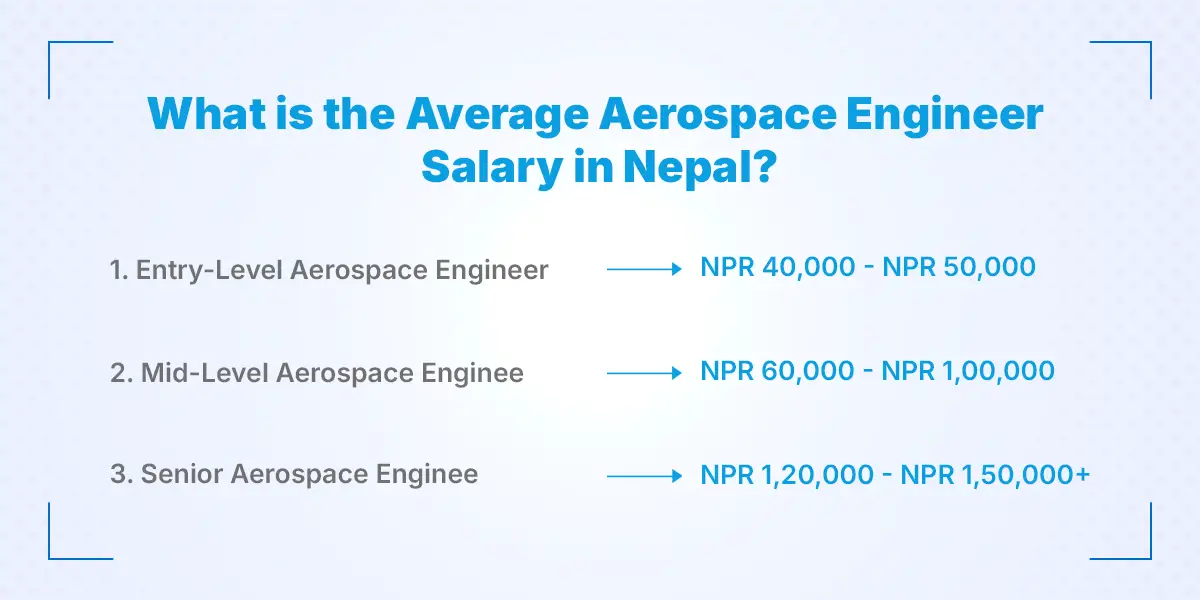
The average salary of an aerospace engineer in Nepal ranges from NPR 40,000 for beginners up to NPR 1,50,000+ per month for senior experts. How much you actually take home depends heavily on your practical experience, the licenses you hold, and the airline you work for. Let's break down what you can expect to earn at each stage of your career in the Nepali aviation industry.
1. Entry-Level Aerospace Engineer
When you first graduate and join an airline, you usually start as a trainee or junior technician. At this stage, your salary will be between NPR 40,000 and NPR 50,000 per month. This might seem a bit low after spending so much money on your degree. However, you are mostly learning on the job during these early years. You will work closely under the guidance of senior engineers to get real hands-on experience. Airlines treat this period as a training phase for your practical skills. You will not be signing off on flight safety documents just yet. Your main focus right now should be learning the rules and preparing for your basic licensing exams.
2. Mid-Level Aerospace Engineer
After working for a few years and passing some basic exams, you move up to a mid-level role. Here, your monthly pay jumps to somewhere between NPR 60,000 and NPR 1,00,000. By now, you have a solid grasp of how aircraft systems actually work on the tarmac. You take on way more responsibility and handle daily maintenance tasks with very little supervision. Many engineers at this stage are busy working towards their full Aircraft Maintenance Engineer (AME) license. Airlines rely heavily on mid-level workers because they complete a massive chunk of the daily hangar work. Getting special training for specific planes, like ATRs or small mountain aircraft, quickly pushes you toward the top of this pay scale.
3. Senior Aerospace Engineer
Reaching the senior level is where your years of hard work finally pay off. A senior aerospace engineer in Nepal easily makes between NPR 1,20,000 and NPR 1,50,000 or more every month. These are the fully licensed experts who make the final call on whether a plane is safe to fly. They hold full certifications from the Civil Aviation Authority of Nepal (CAAN) or other global aviation groups. Airlines are always trying hard to hire and keep these highly skilled professionals. Senior engineers manage whole teams of mechanics and sign the official legal documents before every single takeoff. Because they carry this huge responsibility, their salary packages come with excellent perks and bonuses. If you specialize in fixing helicopters or large international jets, your income can go well past that upper number.
Factors That Affect Aerospace Engineer Salary in Nepal
Not every engineer makes the exact same amount of money at the end of the month. The aerospace engineer's salary in Nepal can change a lot depending on a few key things. Airlines look at your background, your skills, and where you work before deciding your pay. Let's look at the main reasons why some people earn more than others in this field.
1. Education
Where you study and what degree you get play a big part in your starting pay. Airlines prefer hiring people who went to well-known universities or aviation schools. Having a master's degree can also help you ask for a higher starting rate. Sometimes, getting extra training certificates from foreign aviation boards makes your resume stand out. Companies are willing to pay extra for someone who already knows the global safety rules. So, spending a bit more time on your studies can easily boost your income later.
2. Work Experience
Just like in any job, the longer you work, the more money you make. Fresh graduates start with lower pay because they are still learning how things work in the real world. As you spend more years working on airplanes, you become much faster and better at your job. Once you have five or ten years of hands-on practice, companies will fight to hire you. Experienced workers can demand top salaries because they make fewer mistakes. Your past work history is the biggest proof of your value to an airline.
3. Technical Skills
Your daily pay goes up if you know how to do things that others cannot do. Fixing a small local plane is very different from repairing a huge international jet. If you learn how to fix complex engines or helicopter parts, you become very special. Getting a license to sign off on safety checks is the biggest skill you can get. Airlines always need people who can quickly find tricky mechanical problems. The more technical tasks you master, the more money the airline will happily pay you.
4. Employer Type
Who you work for changes your monthly income by a huge amount. Private airlines in Nepal usually pay a bit more to keep good workers from leaving. Government jobs might pay slightly less in cash, but they offer great job security and a pension. Some people work for companies that only fix helicopters, which often pays really well. International airlines that fly into Kathmandu also hire local engineers at very high rates. You have to decide if you want high cash right away or better long-term benefits.
5. Location and Global Opportunities
Where you live and work also affects how much money goes into your bank account. Working in Kathmandu usually pays more because the main airport and big companies are there. But if you take a job at a smaller airport in the mountains, you might get extra allowances. Many Nepali engineers also look for jobs outside the country to earn even more money. Countries in the Middle East often hire our skilled workers and pay them very high salaries. Having local experience first is a great stepping stone to grabbing these high-paying global jobs.
Top Employers That Offer Aerospace Engineering Jobs
Finding a good job after finishing your degree is the next big step in your career. In Nepal, the number of places looking for skilled aerospace engineers is actually growing every year. You can find work in a few different areas depending on what you like doing most. Let's look at the main types of companies that are ready to hire you right now.
1. Aviation and Airline Companies
Local airlines are the biggest group of employers for new and experienced engineers. Companies like Nepal Airlines, Buddha Air, and Yeti Airlines always need people to check their planes. Helicopter companies also hire many experts because flying in the mountains is very tricky. These companies pay you to do daily safety checks and fix broken parts quickly. Working here gives you the best hands-on practice you can get in the country.
2. Research and Aerospace Technology Organizations
Nepal is slowly starting to do more research about flying and space. Some universities and small tech labs are testing new things like heavy-duty drones. If you love designing and testing new ideas, this is a great place to work. You might not work on big airplanes, but you get to invent cool new tools. This area is still small here, but it is a very exciting choice for smart creators.
3. Government Aviation Authorities
The Civil Aviation Authority of Nepal, or CAAN, is the main government agency for flying. They hire engineers to make sure every single airline follows strict safety rules. Instead of fixing planes yourself, you spend time inspecting other people's work. Getting a job here means you get great job security and government benefits. It is a very respected role because you help keep the whole country's sky safe.
4. International Aerospace Companies Hiring Nepali Engineers
Many huge foreign companies also love to hire hard-working engineers from Nepal. Big global airlines that fly into Kathmandu need local experts to check their jets. Also, many trained workers go to the Middle East to work for big, wealthy airlines. These international jobs usually pay the highest salaries and offer amazing travel benefits. Getting experience at home first makes it very easy to grab these global spots later.
How to Become an Aerospace Engineer in Nepal?
To become an aerospace engineer in Nepal, you must study science in high school and pass the tough IOE entrance exam to join the four-year Bachelor's program at Pulchowk Campus. This path requires a lot of hard work, clear focus, and a true passion for airplanes. Let's look closely at exactly what you need to study and what skills you must learn to reach this goal.
1. Required Education and Degree Programs
Your journey starts in high school, where you must study Physics, Chemistry, and Mathematics (PCM). You need to score at least a 'C' grade or a 50% total mark in your 10+2 board exams. After high school, your biggest hurdle is passing the highly competitive Institute of Engineering (IOE) entrance exam. Once you pass, you can join the four-year Bachelor of Aerospace Engineering program. This degree is divided into eight semesters filled with heavy math, physics, and deep mechanical studies.
2. Aerospace Engineering Colleges and Universities
Right now, Tribhuvan University's Pulchowk Campus in Lalitpur is the only government college in Nepal offering a full aerospace engineering degree. They started this special program back in 2018 to help local aviation students. The competition is very high because the college only takes exactly 48 students every single year. Because seats are so limited, many Nepali students choose to study at universities in India or other foreign countries instead. Other local colleges like Kathmandu University offer mechanical engineering, which is a good backup plan, but not a pure aerospace degree.
3. Important Technical Skills (CAD, Aerodynamics, Simulation Tools)
Aerospace engineers spend a lot of time on computers designing aircraft parts before they ever touch real metal. You must become an expert at using Computer-Aided Design (CAD) software to draw highly accurate 3D models. You also need to understand aerodynamics deeply so you know how wind pushes and pulls against a flying plane. Engineers use complex simulation tools to test how their digital designs handle bad weather and heavy loads. Having very sharp math skills is a must because even a tiny calculation mistake can cause a huge disaster in the sky.
4. Certifications and Training for Aerospace Engineers
Getting your university degree is just the beginning of your learning phase. To legally work on commercial airplanes in Nepal, you must pass tough exams taken by the Civil Aviation Authority of Nepal (CAAN). Passing these exams gives you an official Aircraft Maintenance Engineer (AME) license. To get ready for these tests, students do long internships with local airlines like Buddha Air or Nepal Airlines to learn inside real hangars. Later in your career, you will also take special short training courses to learn how to fix one exact type of plane or helicopter model.
Skills That Can Increase an Aerospace Engineer's Salary
If you want to earn more money as an aerospace engineer, you need to learn extra skills. Airlines and companies pay top dollar to people who can do things that normal engineers cannot do. Just having a basic university degree will only get you an entry-level job with normal pay. Let us look at the specific skills you can learn to quickly increase your monthly salary.
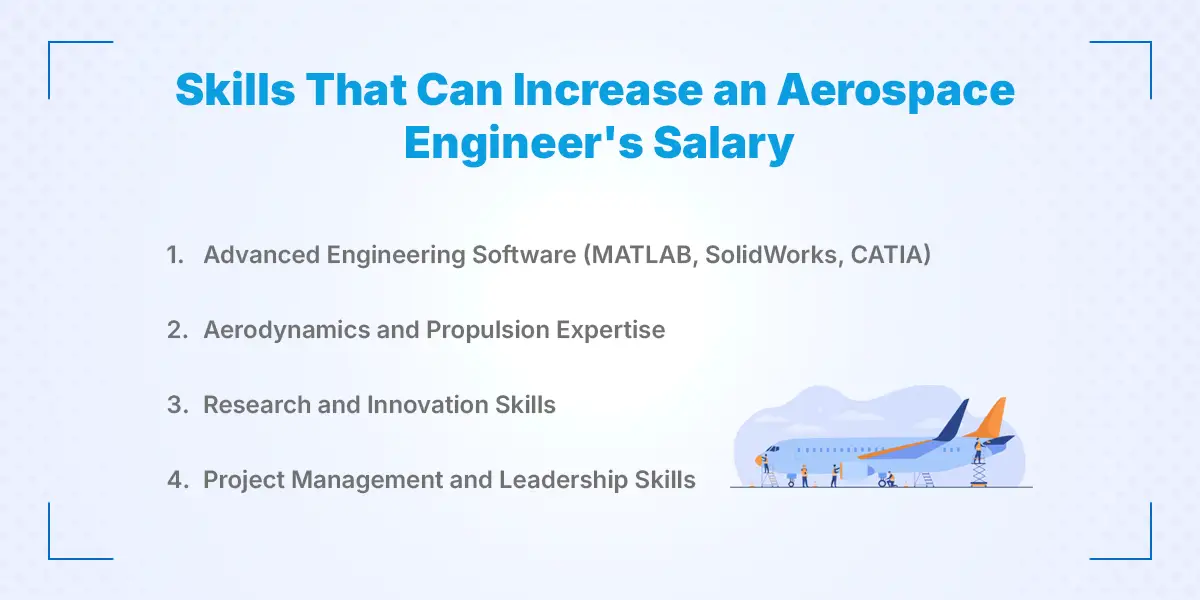
1. Advanced Engineering Software (MATLAB, SolidWorks, CATIA)
Knowing how to use computers to design airplane parts is a very big deal. Companies look for engineers who are experts in software like MATLAB, SolidWorks, and CATIA. These programs let you draw out tiny details of an engine before anyone builds it in real life. If you can test how a part works on a screen, you save the airline a lot of money and time. Most fresh graduates only know the very basics of these drawing tools. If you take short courses to master them, you easily stand out from the crowd. Bosses are always happy to pay a higher salary to someone who works fast on these heavy computer programs.
2. Aerodynamics and Propulsion Expertise
Aerodynamics is all about how wind moves around an airplane while it flies. Propulsion is the science of airplane engines and how they push the heavy plane forward in the air. Engineers who deeply understand these two things are very rare and highly respected in the job market. When you know exactly how to make a plane fly more smoothly, it burns much less fuel in the sky. Saving fuel saves the airline millions of rupees every single year. Because of this, airlines will gladly pay you a very large bonus just to keep you on their team. You can easily demand a much higher monthly salary if you prove you are an expert in engines and wind flow.
3. Research and Innovation Skills
The aviation world is always looking for new ways to make flying safer and cheaper. If you have a habit of finding new ideas, companies will really value your daily work. Research skills mean you like to read about new global technologies and bring those ideas to your local airline. Innovation simply means you find a smart, new way to fix an old mechanical problem in the hangar. Engineers who just follow old rule books usually earn a normal, flat salary. But if you invent a faster way to check a helicopter engine, your boss will notice you immediately. People who bring fresh ideas to the workplace almost always get promoted the fastest.
4. Project Management and Leadership Skills
Knowing how to fix an airplane is great, but knowing how to lead a team is even better. As you get older in this job, you cannot do all the heavy lifting by yourself. You need to learn how to manage big repair projects and tell other mechanics what to do safely. A good leader makes sure the whole team finishes checking the plane before the strict flight time. If you can talk well with people and handle stressful flight delays, you can easily become a manager. Managers and team leaders always take home the biggest paychecks in the aviation business. Taking a short leadership class can easily boost your income over a few short years.
Future Scope of Aerospace Engineering in Nepal
The future of aerospace engineering in Nepal looks brighter than ever before. For a long time, the country only had one main international airport and a few local airlines. But things are changing very fast today. The aviation market is expanding, which means companies will need a lot more engineers in the coming years.
Here are the main reasons why this job has a great future in Nepal:
- New Airports Opening: With new large airports now built in Pokhara and Bhairahawa, more flights are happening every day. These locations will soon need their own full-time engineers on the ground to check planes.
- More Helicopters: Because of our high mountains, helicopters are heavily used for tourist flights and emergency rescues. Fixing these machines is a huge, growing business that always needs fresh workers.
- Drone Technology: Nepal is starting to use heavy drones to deliver medicines to remote villages and to map out farmland. Engineers who know how to build and fix these complex drones will find jobs very easily.
- Local Repair Centers: Right now, airlines often send big planes to other countries for major, heavy repairs. The government wants to build large repair garages right here in Nepal. This will create hundreds of high-paying jobs for local experts.
Because of these big changes, an aerospace degree is no longer a risky choice. In the next ten years, local airlines will actively look to hire smart engineers. If you start studying today, you will step into a job market that has plenty of open spots waiting for you.
Conclusion
The salary for aerospace engineers in Nepal is still growing because the country's aerospace and aviation industry is small. Most new aerospace engineers earn a low salary at the start of their careers. However, as they gain more experience, skills, and special training, their pay can increase.
Many Nepali aerospace engineers also find high-paying jobs in international companies. This is why some choose to work abroad after getting their education or experience. Overall, aerospace engineering can be a good job for students who like aircraft, space technology, and aviation systems. With the right skills, education, and hard work, aerospace engineers from Nepal can have successful careers and earn good salaries over time.
Frequently Asked Questions
Submit your comments

Get Our App On



SEO Training for Freshers in Nepal: Skills, Career & Job Opportunities
VIEW DETAILS
SEO Training vs. Self-Learning: Which Is Right for You?
VIEW DETAILS
How to Choose Between Two Job Offers
VIEW DETAILS
Digital Marketing Training Interview Questions and Answers for Freshers
VIEW DETAILS


Loading Comments...