


Discover WHO Nepal jobs, internships, and talent programs. Learn eligibility, application steps, salary, benefits, and work culture to build a global career.
When it comes to shaping the future of public health in Nepal, few organizations hold the prestige and global impact of WHO Nepal. Working here isn’t just a job, it’s an opportunity to contribute to life-saving programs, influence health policies, and be part of a world-class team that truly makes a difference.
Yet, for many talented Nepalese professionals, the path to joining this remarkable institution can feel confusing and intimidating. From understanding which roles fit your skills to navigating UN-style applications and competitive selection processes, there’s a lot to consider.
In this guide, step by step, we’ll walk you through WHO Nepal vacancies, internships, staff categories, application tips, and salary insights, giving you the confidence and clarity to secure a career that’s meaningful, impactful, and recognized globally.
In this blog
About WHO
The World Health Organization (WHO) is the United Nations’ main agency for public health. It leads global efforts in attempts to assist people to live safer and healthier lives. In Nepal, WHO works with the government and partners to improve health services, control disease, prepare for emergencies, and support national health planning.
The WHO Nepal Country office has been assisting the country over the decades. It assists the Ministry of Health and Population in designing superior health policies, technical guidance, and strong health systems in Kathmandu and the local communities nationwide. This implies that the activity of WHO has a direct influence on the delivery of health care, disease prevention, and emergency response to the people in Nepal.
WHO hires the best working professionals as its services are complicated and require the highest standard. The organisation is actively fighting outbreaks, building health data, and aiding immunization. To operate all the responsibilities and take accountability of millions of lives, WHO should have qualified and enthusiastic individuals who are able to collaborate with others and introduce novel concepts.
A career is WHO Nepal could be your ideal if you are concerned about the enhancement of health in Nepal and the rest of the world.
WHO Nepal Vacancy: Common Job Openings
When you search for a WHO Nepal job vacancy, you’ll see roles in public health, emergency response, management, and operations. These jobs can range from epidemiologists tracking disease trends to officers who help run WHO programmes in Nepal. Below, we explain the main areas where WHO hires and what each team does, so you can find the right fit and understand what to expect next.
1. Public Health & Technical Roles
Public health and technical teams are at the heart of WHO’s work in Nepal. People in these roles help design and improve health programmes, such as disease surveillance, vaccination support, and health systems strengthening. For example, epidemiologists and health information officers collect data, watch for outbreaks, and support evidence-based decisions. They often work closely with the Ministry of Health and Population and partners to ensure timely responses and better planning. These roles require solid technical skills and a deep interest in improving health outcomes.
2. Emergency & Outbreak Response
Nepal is assisted by the emergency response team to prepare and respond to health threats such as an outbreak, flood, earthquake, or any other disasters. These experts are deployed alongside the health operations centers such as Health Emergency Operation Center (HEOC) assisting in the coordination of logistics, field operations, and crisis planning. They facilitate preparedness training, immediate evaluations and emergency deployment on the need basis. Put simply, in case you are fond of working purposefully and fast in situations where saving lives is needed in a moment, this sphere might be your vocation.
3. Management & Leadership Roles
Leadership and management roles at WHO Nepal include programme managers, policy advisors, and senior technical officers. These people guide the planning, implementation, and review of health initiatives. They help set strategies, work with government and partners, and ensure programmes deliver results. Clear communication, planning skills, and experience leading teams are key in this area.
4. Operations & Administration
Behind every WHO programme is a strong operations and administration team. This involves financial experts who handle budgets, human resources officers who facilitate the staffing process and IT and purchasing personnel who help the office to run efficiently. These operational positions are critical as they are the ones that ensure that technical and field teams are provided with what they require to accomplish their job properly. The most effective public health plan may not succeed without good operations support.
What Are WHO Staff Categories?
WHO mainly hires people as International Professional Staff, National Professional Officers (NPOs), and General Service Staff. These are the different staff categories that show how jobs are structured, each with a clear role and purpose. Understanding these staff categories in WHO Nepal helps you know where you fit and what to expect when applying:
1. International Professional Staff
International Professional Staffs are hired all over the world to introduce good technical competencies and leadership to the work of WHO. Typically these roles are higher-level (such as programme specialists, technical leads, or policy advisors) and typically need a university degree and related work experience. With time, professional personnel might be requested to work in various countries to aid in the mission of WHO wherever it is required. These are positions that suit the expert professionals who desire to work on international health matters and work on a broader scope.
2. National Professional Officer (NPO)
National Professional Officers (NPOs) are local professionals hired to work within their respective country: an example is Nepalese nationals working at WHO Nepal. The positions involve in-depth expertise of the local health structure, culture, and organizations, which makes NPOs invaluable mediators between the global vision of WHO and Nepal-specific demands. The qualifications are comparable to the work of international professionals except that they concentrate more on local health priorities and partnerships. Working as an NPO will provide an opportunity to apply local knowledge to the international standards.
2. General Service Staff
The workforce of the day-to-day running of WHO is made up of General Service Staff. These are administrative, technical and operational support positions that ensure running of offices and programmes in a smooth manner. The GS staff are involved in the provision of HR and finance support, office organization and logistics, so that the technical teams should be able to concentrate on the public health work. Such positions tend to be filled locally and these positions provide great opportunities to professionals who are fond of critical support work that make enormous impacts behind the scenes.
WHO Internships & Global Talent Programmes: Early‑Career Opportunities
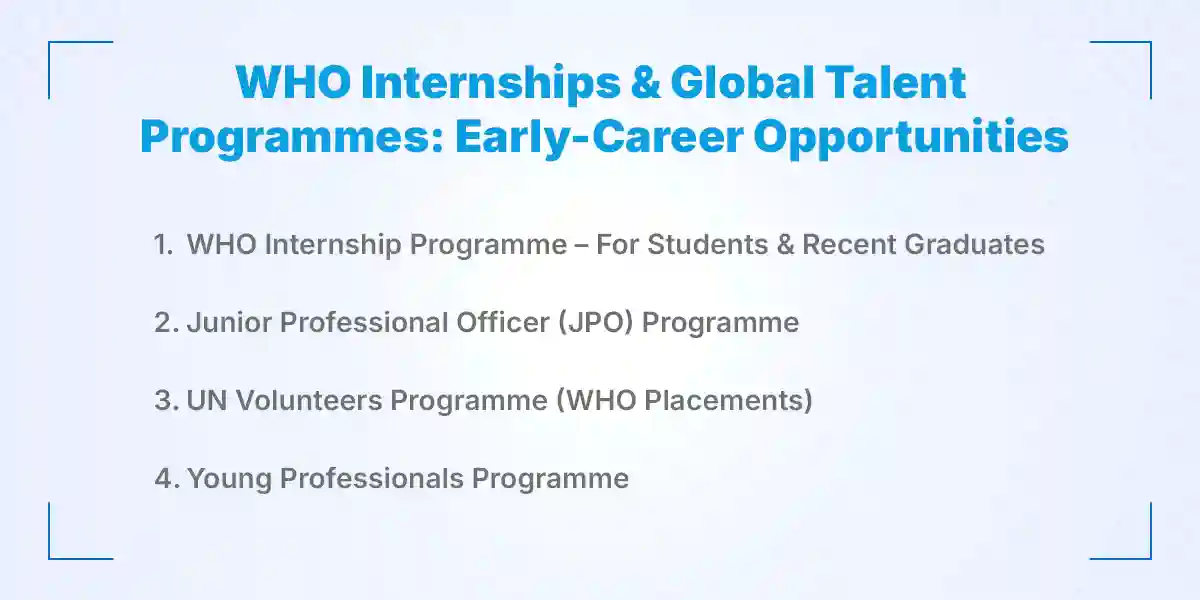
WHO offers structured pathways like internships, the Junior Professional Officer Programme, UN Volunteer placements, and the Young Professionals Programme for students and freshers. These opportunities help students and young professionals gain real experience, build skills, and step into global health careers. Below, we explain each path so you can see which one fits your goals best:
1. WHO Internship Programme
The WHO Internship Programme offers hands‑on experience in both technical and administrative areas of WHO’s work, helping interns learn how global health programmes run. Interns undertake actual tasks, work within teams and receive exposure to the functioning of public health, usually in supporting communication, health policy or programme functions.
To be eligible for an internship at WHO Nepal, you must be enrolled in a university degree programme or have recently graduated, and meet age and educational requirements. Internships at WHO are competitive and limited, but they provide valuable exposure that many young health professionals find useful for future applications.
2. Junior Professional Officer (JPO) Programme
JPO Programme aims at young professionals wishing to have an excellent commencement in international work in the area of public health. It allows participants to gain practical experience in technical cooperation, policy work, and health programmes under supervision, often at country offices, regional hubs, or headquarters.
JPOs typically require completion of postgraduate degree and two years of experience, and among the partner governments, placement is under special arrangements. Although a JPO program is not a guarantee of long-term contracts, it provides organised growth and learning to early career leaders.
3. UN Volunteers Programme (WHO Placements)
UN Volunteers bring their skills to support WHO’s work in member countries, including Nepal, and usually contribute to programme execution, local outreach, and technical support. Volunteer roles vary widely in content and location, offering chances to learn, build networks, and serve in meaningful public health work. These positions are ideal if you want to gain professional exposure while contributing directly to WHO efforts at the country or regional level.
4. Young Professionals Programme
Young Professionals Programme aims at capacity building of least developed countries by assigning talent youth to normal WHO positions with customized learning, mentoring and networking services. The participants are working in priority areas of population health, acquiring field experience and developing skills that enable them to assume leadership positions in the future. The programme enables a gradual shift to the long-term opportunities in global health which allows you to gain confidence and knowledge at the very start of your career.
How to Apply for WHO Nepal Vacancy?
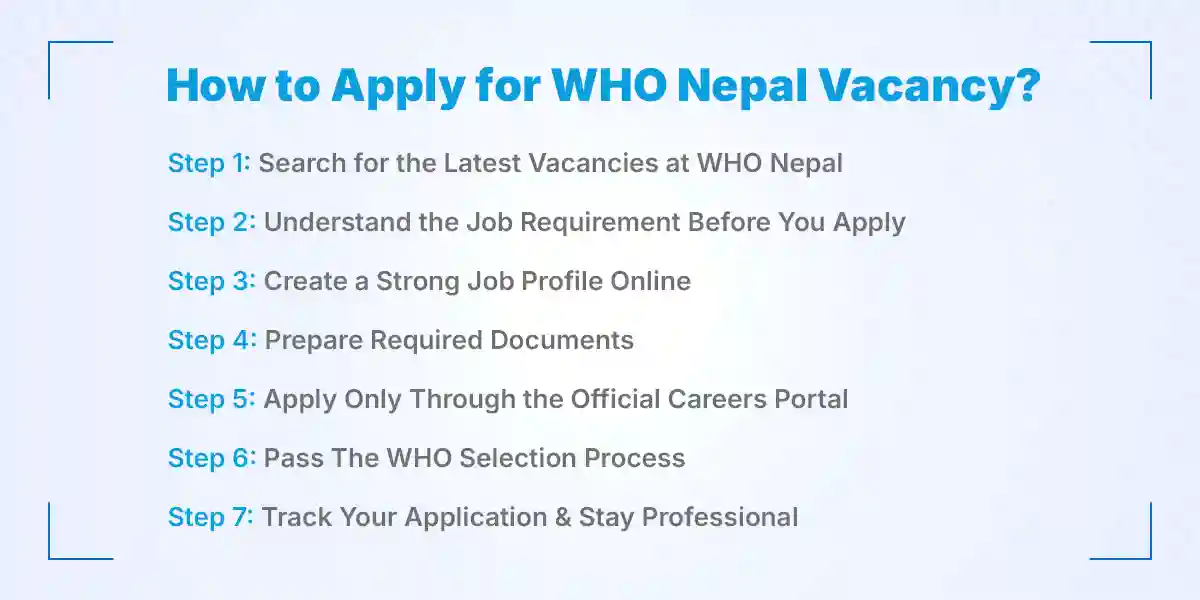
To apply for a WHO Nepal vacancy, you first need to search for the latest job openings, understand what each role needs, build a strong online profile, gather your documents, and submit your application through the official WHO careers portal. After that, you’ll go through WHO’s selection process and track your application professionally. Each step in this journey matters and can make the difference between a hopeful start and a successful career move. Below, we break down each step so you know exactly what to do and what to expect.
Step 1: Search for the Latest Vacancies at WHO Nepal
Start by checking the official WHO Careers page. This is the primary source for all WHO Nepal vacancies. You can filter roles by country or duty station to quickly find positions relevant to Nepal. In addition, the UN Careers portal and UN Talent platform often list WHO opportunities, especially for international professional roles, internships, and UN volunteer placements.
For Nepalese applicants, it’s also helpful to monitor local job portals like Kumari Job, which occasionally posts WHO and UN-related job updates when they open. Keeping an eye on multiple sources ensures you don’t miss deadlines or opportunities. Visiting these pages regularly gives you time to understand the roles and prepare a strong, thoughtful application rather than scrambling at the last minute.
Step 2: Understand the Job Requirement Before You Apply
Each vacancy announcement has a detailed job description, including tasks, required qualifications, years of experience, languages, and competencies. Take the time to read it carefully. This tells you exactly what WHO expects. Notice the difference between “required” and “desired” qualifications, because missing a required one may disqualify you. Understanding what's expected also helps you tailor your application so it matches the role closely.
Step 3: Create a Strong Job Profile Online
WHO uses an online recruitment system where you must complete your profile before applying. Fill out every section clearly and honestly. Don’t leave gaps in your education or work history. Use simple but strong language to describe what you did in past jobs, and include measurable results when possible (like “managed a team of 10” or “improved reporting accuracy by 30%”). Recruiters often shortlist based on keywords, so match your experience with terms from the job description.
Step 4: Prepare Required Documents
Along with your profile, you need documents like your CV, academic certificates, experience letters, and references. Make sure your CV supports what you’ve written in the online profile. Check that all dates match across documents and that scans are clear and easy to read. Having everything organized ahead of time saves last‑minute stress and keeps your application clean and professional.
Step 5: Apply Only Through the Official Careers Portal
WHO does not accept applications by email, social media, or in person. Use only the official WHO Careers portal or a trusted job portal to apply. Once you’ve completed your profile and uploaded your documents, double‑check all details before hitting submit — mistrakes can cost you a chance. Keep a copy of your submission confirmation so you can refer to it later if needed.
Step 6: Pass the WHO Selection Process
After you apply, WHO reviews all profiles to shortlist candidates. If selected, you may be asked for a technical assessment (like a written task or exercise) or a competency‑based interview. In these interviews, they ask about real situations from your past work to understand how you solve problems and work with others. Later stages can also include reference checks. Be honest, calm, and prepare examples that show your strengths clearly.
Step 7: Track Your Application & Stay Professional
You can check your application status through your profile on the WHO portal. Job portals also allow you to track your application updates once you create your personalised job profile. Sometimes it takes weeks before you hear back, so be patient and avoid frequent follow‑ups that could seem pushy. If you are contacted, respond quickly and professionally. This shows respect and keeps your candidacy strong as you move through the stages.
Salary, Compensation & Benefits at WHO Nepal
When you work at WHO Nepal, your pay and benefits follow the United Nations Common System, which is known for being fair and clear. Salaries are designed to match the responsibilities of each role, and staff receive additional support like insurance, paid leave, and pension contributions. In Nepal, this compensation is often stronger than many local jobs, and the benefits help make a global health career with WHO both stable and rewarding, even beyond salary alone. Below, let’s unpack what this really means in simple terms.
1. UN‑Based Salary Structure
WHO salaries are part of the UN system, where pay depends on job category and level. International staff are paid on a global scale, while national staff like National Professional Officers (NPOs) and General Service staff follow local salary scales that reflect Nepal’s market conditions. This system ensures consistency and fairness, and salaries are adjusted regularly to reflect cost of living and local standards.
2. National Officer Approximate NPR Range
For Nepalese nationals in NPO roles, annual salaries often start around NPR 2.35 million to over NPR 3.6 million per year, depending on experience and level of responsibility, before deductions like pension and health insurance. These figures usually include 30 days of annual leave and are competitive compared with many local professional careers.
3. Health Insurance
All WHO staff are generally covered by worldwide medical insurance, which often includes basic health care, dental, and sometimes optical care. This benefit helps you and your family stay protected, especially when compared with standard private insurance plans.
4. Leave Entitlements
WHO offers 30 days of paid annual leave per year for full‑time staff, which is more than many local employers provide. Plus, you also receive official holidays and sometimes additional types of leave like sickness or parental leave. This helps staff rest, recharge, and balance work with life.
5. Pension & Allowances
Staff members are typically enrolled in the United Nations Joint Staff Pension Fund (UNJSPF), which provides long‑term retirement benefits based on years of service and salary. In addition, depending on the role and duty station, you might get allowances like dependency, rental subsidy, or relocation support if eligible.
6. Duty‑Station Benefits & Staff Mobility
Some contracts include duty‑station allowances, which help adjust for living costs in places like Kathmandu. Also, WHO encourages mobility and internal career growth, meaning you can move to different roles, locations, or special programmes over time as you gain experience.
Overall, WHO Nepal’s compensation package is transparent and structured to support both your professional work and personal well‑being, making it an attractive choice for Nepalese professionals who want a meaningful, secure global health career.
Eligibility & Competency Requirements for WHO Nepal Jobs
To work at WHO Nepal, you need the right education, experience, technical skills, English proficiency, and strong behavioral competencies. WHO seeks people who can make an impact, deliver results, and collaborate effectively. Understanding these requirements helps you assess your fit and prepare a strong, tailored application that stands out in a competitive pool.
1. Education Qualifications
The majority of the WHO employment positions demand a university degree, such as a degree in such disciplines as public health, medicine, nursing, health sciences, management, or other related subjects. In case of technical and specialist jobs, higher degrees (such as a Master or PhD) are commonly sought. The educational requirement may differ with the job status. High positions tend to require increased qualifications. Nevertheless, never forget to consult the specific vacancy announcement to check the exact degree or certification required before applying.
2. Expectations of Experience Level.
WHO seeks professionals who have relevant work experience, which corresponds to the job position that they seek. Some experience or good academic projects can be used to enter at the entry levels or internship positions whereas mid-level and top positions typically require years of experience in the field of public health or any other related position. Prior work experience in the government, NGOs or UN agencies will be an advantage particularly in domains related to health systems, emergency response, or policy support. The trick is demonstrating that your previous employment had prepared you to deal with the duties enumerated in the job description.
3. English Proficiency
WHO is primarily English-speaking in its working language, particularly in the case of technical reports, communication and coordination with international stakeholders. The majority of job ads will indicate the minimum English proficiency level (some of them might also require other languages, based on the job). In case English is not your first language, the fact that you can write and speak clear English can help make your application stronger. Interviews usually require communication skills and, as such, you should be prepared to show confidence and clarity.
4. Technical Competencies
Job specific skills that enable you to carry out the core tasks well are known as technical competencies. As an example, epidemiologists are supposed to be well competent in data analysis and disease surveillance whereas programme managers require planning, monitoring and evaluation. WHO publishes a list of technical skills required so that it is obvious and concise in the vacancy announcement, thus, use it as a reference during application preparation. Relevant software and research experience or project leadership are examples of things that can distinguish you among other applicants.
5. Behavioral Competencies
Behavioral competencies are also equally important - they are the personal values and methods of work that WHO appreciates. They comprise team work, diversity, respect, initiative and outcome orientation. The competency-based questions mostly applied during interviews and tests help WHO to identify candidates who are not only familiar with their job but also suitable to work in its collaborative and mission-driven culture. Making some of your examples of prior work illustrating these qualities can increase your likelihood.
Simply put, WHO is looking for individuals who are well-qualified, experienced, effective communicators, strong in technical aspects, and behaviorally developed individuals, people who can advance global health objectives and make a positive change in Nepal and other places.
The WHO Work Environment – What You’re Really Stepping Into
Working at WHO Nepal is not just about the title or salary, it’s about joining a community where shared values, respect, and purpose come first. WHO follows UN work ethics and strives to create a safe, inclusive, and meaningful workplace for all staff. Knowing what the environment is like can help you decide if it fits your career goals and personal values. Below, we explain the core parts of WHO’s work culture so you have a clear picture of what to expect.
1. A Culture Built on Values (WHO DNA)
At WHO, its members are trusted to serve public health at all times. This means acting with honesty, reliability, and commitment, no matter the task. Staff are expected to strive for excellence and bring strong technical and ethical standards to their work. You’ll also find that collaboration is central here. The teams work across countries and disciplines, combining knowledge and effort to improve health outcomes. Ultimately, the focus is on people: helping communities stay healthy and safe through evidence‑based work and shared goals.
2. Safe, Respectful & Ethical Workplace
WHO has a strong focus on creating a safe and respectful work environment for everyone. There is a zero‑tolerance policy toward harassment, discrimination, and abuse of authority, meaning that inappropriate behavior is taken seriously and addressed promptly. The organization has clear reporting mechanisms and safeguards so staff feel protected and heard when issues arise. This also means that dignity, fairness, and mutual respect are not just words, they’re part of everyday practice.
3. Diversity, Equity & Inclusion at WHO
One of WHO’s core commitments is to be an inclusive workplace where diverse voices are welcomed and valued. The organization strives for gender balance, encourages women and youth to apply, and supports applicants from underrepresented countries and people with disabilities. This diversity strengthens teams, brings fresh perspectives, and ensures health solutions work for all populations. If you care about fairness and want to work in a space where different experiences are respected, WHO’s environment supports that aspiration.
In short, WHO Nepal is not just a prestigious workspace, it’s a principled community rooted in strong values, fairness, and inclusion, offering a nurturing environment for professionals who want to make a real and lasting difference.
Is WHO Nepal Right for You?
Working at WHO Nepal is a great fit if you are high-performing, ethical, and mission-driven. This is the kind of workplace where your efforts directly impact public health in Nepal and beyond, so passion and dedication matter more than just clocking in.
If you’re someone looking mainly for private-sector flexibility, endless remote work, or loosely defined targets, WHO might feel structured and demanding. The organization emphasizes accountability, results, and teamwork, and every role comes with clear responsibilities.
In short, WHO Nepal is ideal for professionals who want meaningful work, real impact, and a career built on purpose, not just a paycheck. It’s about contributing to something bigger than yourself while growing as a professional.
Conclusion
By now, you’ve seen how WHO Nepal offers a clear pathway for top talent. The internships and early-career programmes or professional and leadership roles, all positions at WHO demand an energy to serve and diligent brains. We’ve covered the types of positions, staff categories, eligibility requirements, salary and benefits, and even the unique work culture that makes WHO more than just a job. It’s a place where purpose, ethics, and results go hand in hand.
If you’re a Nepalese professional passionate about public health, this is your chance to make a real difference in communities across Nepal and beyond. Imagine contributing to life-saving programmes, emergency responses, and health policies that affect millions. That’s the kind of impact WHO staff have every day.
So, if you’re ready to grow, learn, and leave a lasting mark, don’t wait. Learn how to land a job at the UN. Explore the latest vacancies, and apply to WHO Nepal today!
Frequently Asked Questions
Submit your comments

Get Our App On



SEO Training for Freshers in Nepal: Skills, Career & Job Opportunities
VIEW DETAILS
SEO Training vs. Self-Learning: Which Is Right for You?
VIEW DETAILS
How to Choose Between Two Job Offers
VIEW DETAILS
Digital Marketing Training Interview Questions and Answers for Freshers
VIEW DETAILS


Loading Comments...