


Many professionals in Nepal look for international organization jobs for career growth and stability, seeking roles that offer both global prestige and local impact. Securing a position with a United Nations agency is often considered a top-tier career milestone due to the high standards of professional development and the competitive benefits provided.
UNFPA offers competitive roles in development, health, and humanitarian sectors, focusing specifically on reproductive health, gender equality, and population dynamics. These positions allow specialists to work at the intersection of policy-making and community-level intervention within Nepal’s federalized system.
This guide explains the latest UNFPA vacancies in Nepal, eligibility criteria, salary insights, and how to apply. Whether you are a seasoned public health expert or an administrative professional, understanding the specific "competency-based" recruitment process is the first step toward a successful UN career.
In this blog
What is UNFPA?
UNFPA (United Nations Population Fund) is the United Nations' specialized sexual and reproductive health agency, working globally to ensure that every pregnancy is wanted, every childbirth is safe, and every young person's potential is fulfilled. Operating in over 150 countries, the organization’s Strategic Plan for 2026–2029 focuses on three transformative goals: ending the unmet need for family planning, ending preventable maternal deaths, and ending gender-based violence (GBV) and harmful practices such as child marriage. By leveraging population data and evidence-based analysis, UNFPA addresses demographic shifts and ensures that marginalized populations can exercise their reproductive rights even in humanitarian settings.
In Nepal, UNFPA has maintained a continuous presence since 1971, partnering with the government to strengthen federalized health systems and policy frameworks. As Nepal prepares to graduate from Least Developed Country (LDC) status in 2026, the agency is prioritizing climate-resilient healthcare, digital innovation for population data, and specialized maternal health programs in high-need provinces like Madhesh and Karnali. Through these efforts, UNFPA Nepal acts as a semantic bridge between international human rights standards and local health delivery, ensuring that vulnerable women and adolescent girls remain the focus of national development strategies.
Latest UNFPA Vacancy in Nepal
Latest UNFPA vacancies in Nepal are primarily advertised for technical, operational, and consultancy roles through the official UN Global Quantum portal and the UNFPA Nepal website. In early 2026, the organization is actively seeking talent for the Global Internship Roster 2026 and specialized project-based roles such as Project Managers and Monitoring & Evaluation (M&E) Specialists. Most openings are stationed in Kathmandu, though provincial roles in locations like Janakpur and Surkhet frequently appear to support field-level health and gender initiatives.
Vacancies are classified into three main contract types: Fixed-Term Appointments (FTA) for long-term staff, Service Contracts (SC) for project-specific personnel, and Individual Consultancies (IC) for short-term technical experts. Application deadlines are strict, usually falling between 14 to 21 days from the date of posting. For 2026, applicants should keep a close eye on "Rolling Rosters" which allow UNFPA to maintain a pool of pre-qualified candidates for immediate deployment in humanitarian or development sectors.
Types of Jobs Available at UNFPA Nepal
UNFPA Nepal offers a diverse range of employment opportunities categorized into programmatic, administrative, and specialized consultancy tracks to support its reproductive health and gender equality mandate. These roles are designed to bridge the gap between high-level policy advocacy and grassroots service delivery, ensuring that Nepal’s federalized health system remains inclusive and data-driven. Whether based in the Kathmandu Country Office or provincial hubs, every position contributes to the "Three Transformative Results": ending preventable maternal deaths, ending unmet need for family planning, and ending gender-based violence.
1. Program & Technical Positions
Program and Technical positions at UNFPA Nepal are core leadership roles responsible for the design, strategic implementation, and appraisal of public health and human rights initiatives. These roles typically include Public Health Specialists, Gender-Based Violence (GBV) Experts, and Monitoring & Evaluation (M&E) Officers who track project impact across various districts. Policy Advisors and Research and Data Analysts also play a critical role in translating census and demographic data into actionable government policies. Most technical positions require an advanced university degree (Master's or higher) and several years of specialized experience in the development sector.
2. Administrative & Support Roles
Administrative and Support roles provide the essential operational backbone for UNFPA’s mission in Nepal, ensuring financial transparency, efficient logistics, and robust human resource management. Key positions include Finance Officers and Procurement Staff who manage multi-million dollar budgets, alongside Logistics Coordinators who handle the distribution of reproductive health commodities. HR Assistants manage the talent pipeline, while Communication Officers lead the agency’s public advocacy and media relations efforts. These General Service (GS) roles prioritize candidates with strong organizational skills, fluency in English and Nepali, and a deep understanding of UN administrative protocols.
3. Consultancy Opportunities
Consultancy opportunities at UNFPA Nepal are short-term, deliverable-based assignments tailored for independent experts who provide niche technical assistance for specific project cycles. These include Thematic Experts in areas like disability inclusion, Evaluation Specialists for end-of-project reviews, and Field Consultants who monitor localized interventions in remote provinces. In response to modern workplace shifts, UNFPA also offers Remote Consultancy Roles for data analysis or report writing, alongside traditional Short-term Project Consultants. Consultants are typically hired from a pre-vetted roster and are essential for providing high-level surge capacity during humanitarian emergencies or major policy shifts.
Where to Get UNFPA Vacancy Updates in Nepal?
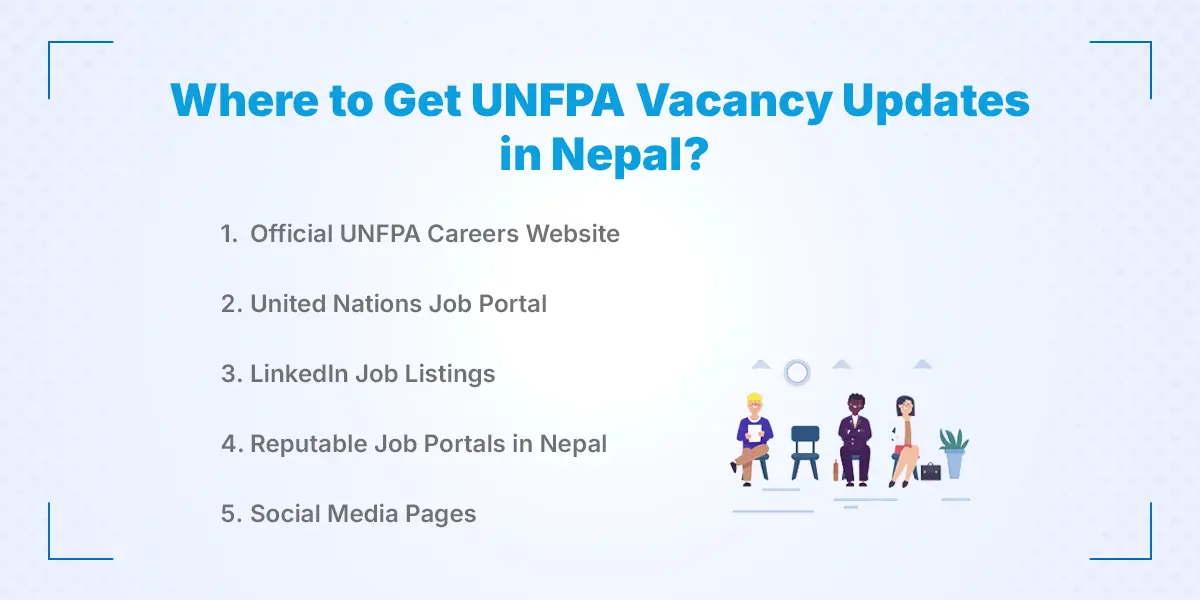
Candidates can find official UNFPA vacancy updates for Nepal on the global UNFPA Careers portal, the UN Nepal Information Platform, and reputable local job boards like Kumari Job. These platforms provide real-time access to the Quantum e-Recruit system, where applicants must manage their Personal History Profiles (PHP). Regularly monitoring these sources ensures you receive notice of new openings, which often have short application windows of 14 to 21 days.
1. Official UNFPA Careers Website
The global UNFPA Careers portal is the most authoritative source for all job openings, including international and national posts in Nepal. This site provides comprehensive job descriptions, required competencies, and direct links to the Quantum recruitment system. It is also the primary location to find specialized rosters, such as the Global Internship Roster 2026.
2. United Nations Job Portal
The UN Careers website and the UN Nepal Information Platform act as centralized hubs for vacancies across all UN agencies operating within the country. These portals allow users to filter jobs by agency (UNFPA), duty station (e.g., Kathmandu, Surkhet, or Janakpur), and functional area. Utilizing these platforms helps candidates compare roles across different agencies and understand broader UN development trends in Nepal.
3. LinkedIn Job Listings
UNFPA Nepal maintains an active presence on LinkedIn, where it frequently shares "featured positions" and urgent consultancy calls. Following the official UNFPA and UN Nepal LinkedIn pages allows professionals to receive vacancy alerts directly in their feed and engage with the organization’s advocacy work. This platform is also useful for networking with current UN personnel to understand the organizational culture.
4. Reputable Job Portals in Nepal
Local job sites such as Kumari Job serve as essential secondary mirrors for UNFPA vacancies, specifically targeting the Nepali workforce. Kumari Job often lists entry-level and mid-level roles like Programme Analysts and HR Assistants, providing localized context on salary expectations and duty stations. These portals are particularly helpful for candidates who prefer receiving email alerts from established domestic career services.
5. Social Media Pages
Official social media channels, including UNFPA Nepal’s Facebook and X (formerly Twitter) accounts, are used to broadcast vacancy announcements to a wider audience. These posts often highlight field-based roles and consultancy rosters that require immediate attention. Subscribing to these pages ensures that you never miss an update, even if you are not actively browsing the main career portals daily.
Eligibility Criteria for UNFPA Jobs in Nepal
To be eligible for a UNFPA position in Nepal, candidates must meet standardized UN requirements regarding academic background, professional experience, and language proficiency, alongside specific competency-based assessments. As a specialized agency, UNFPA prioritizes "principled and ethical" individuals who demonstrate a clear commitment to human rights and gender equality. While specific criteria vary by grade level (GS, NO, or P), the baseline for any national appointment requires Nepali citizenship and a profile that aligns with the organization's three transformative results: ending maternal deaths, family planning gaps, and gender-based violence.
1. Educational Qualifications
UNFPA requires all professional-level staff to hold an advanced university degree (Master's or higher) in fields such as Public Health, Sociology, International Development, or Gender Studies. For General Service (support) roles, a secondary education certificate is the minimum requirement, though a Bachelor’s degree is increasingly preferred to remain competitive. Academic credentials must be obtained from a "properly accredited" university, and specialized certifications in areas like Project Management (PMP) or Data Science are considered significant assets.
2. Work Experience
Professional experience requirements are strictly tied to the job grade, typically ranging from 2 years for entry-level National Officers (NO-A) to over 10 years for senior Technical Advisors (P-5). For mid-level Service Contract positions (SB-4), a Master's degree with 3 years of experience or a Bachelor's with 5 years is the standard benchmark. UNFPA highly values "progressive" experience, meaning your career should show increasing levels of responsibility within NGOs, INGOs, or government health sectors.
3. Language & Technical Skills
Fluency in both written and spoken English and Nepali is mandatory for all national positions in Nepal. Candidates must be able to draft complex technical reports in English and communicate effectively with local stakeholders in Nepali or other regional dialects. Beyond language, technical proficiency in the Microsoft Office Suite (Word, Excel, PowerPoint) is a baseline requirement, while technical roles often demand expertise in statistical software like SPSS, Stata, or R for population data analysis.
4. Competency-Based Requirements
UNFPA utilizes a Competency-Based Recruitment model that evaluates "Values" and "Core Competencies" rather than just technical knowledge. Candidates must demonstrate through real-world examples how they exemplify integrity, accountability, and diversity. The core framework focuses on your ability to achieve results, think strategically, and work effectively in multicultural teams, traits that are often tested through "behavioral" interview questions (e.g., "Describe a time you managed a conflict within a team").
UNFPA Salary and Benefits in Nepal
Salaries for UNFPA Nepal positions typically range from NPR 110,000 to NPR 290,000 per month for national staff, depending on the contract type and grade. This competitive structure ensures that professionals are rewarded well above local market rates.
UNFPA Nepal offers a comprehensive compensation package that positions it as a top-tier employer in the development sector, with salaries often exceeding local private sector rates by 30-50%. The remuneration structure is divided into two primary categories: Fixed-Term Appointments (FTA), which include full UN benefits like pension and dependency allowances, and Service Contracts (SC), which offer higher immediate take-home pay but fewer long-term benefits. In addition to financial compensation, staff receive world-class health insurance (typically CIGNA or Vanbreda) covering dependents, along with generous parental leave policies.
1. Competitive UN Salary Scale (Estimated)
Salaries at UNFPA are determined by the UN Common System and are pegged to the local cost of living in Kathmandu, with adjustments for inflation. The table below outlines the estimated annual net (take-home) salaries for common contract types in Nepal for 2026.
| Contract Type | Grade | Role Equivalent | Est. Monthly Net Salary (NPR) | Est. Annual Net Salary (NPR) |
|---|---|---|---|---|
| Service Contract | SB-3 | Admin/Finance Assistant | 110,000 – 145,000 | 1,320,000 – 1,740,000 |
| Service Contract | SB-4 | Project Officer | 180,000 – 240,000 | 2,160,000 – 2,880,000 |
| Fixed-Term (FTA) | G-5 | Programme Assistant | 135,000 – 160,000 | 1,620,000 – 1,920,000 |
| Fixed-Term (FTA) | NO-A | National Program Officer | 200,000 – 225,000 | 2,400,000 – 2,700,000 |
| Fixed-Term (FTA) | NO-B | Program Specialist | 245,000 – 280,000 | 2,940,000 – 3,360,000 |
Note: Fixed-Term (FTA) salaries are tax-exempt in Nepal, whereas Service Contract (SC) holders are responsible for their own income tax reporting, though a 1% Social Security Tax is typically deducted at source.
2. Contract-Based Payment Structure
- Fixed-Term Appointments (FTA): These are considered "Staff" positions. You receive a secure monthly salary, plus a Dependency Allowance (approx. NPR 46,000/year per child and NPR 12,000/year for a dependent spouse). The organization also contributes ~15.8% to the UN Joint Staff Pension Fund (UNJSPF), ensuring a secure retirement.
- Service Contracts (SC): Designed for project-based work, these contracts offer a "lump sum" salary. While they do not include membership in the UN Pension Fund, they typically include a Gratuity payment (8.33% of base salary) paid out at the end of the contract, functioning as a severance or savings buffer.
3. Health and Insurance Benefits
UNFPA provides one of the most robust insurance packages in Nepal.
- Medical Coverage: Staff and their eligible dependents (spouse and children up to 21 years) receive 100% coverage for preventive care and high percentages for hospitalization and dental care. This often includes access to top-tier hospitals in Kathmandu (e.g., Grande, Mediciti) via direct billing.
- Life & Disability Insurance: All staff are covered under a global Malicious Acts Insurance Policy (MAIP) and standard life insurance, providing financial security to families in case of service-incurred accidents.
4. Leave Policies
UNFPA prioritizes work-life balance to prevent burnout in the high-pressure humanitarian sector.
- Annual Leave: Staff accrue 2.5 days per month, totaling 30 days per year.
- Sick Leave: Generous provisions for certified and uncertified sick leave (typically up to 24 days/year).
- Parental Leave: In line with 2026 UN standards, maternity leave is fully paid for 26 weeks, while paternity leave has been extended to 4 weeks to encourage shared caregiving.
5. Career Growth Opportunities
Working at UNFPA Nepal is a gateway to the global UN system.
- Global Mobility: Staff with strong performance records can apply for Short-Term Assignments (STA) in other country offices or headquarters (New York, Geneva).
- Learning & Development: Employees get access to Agora, the UN’s learning platform, offering free courses on leadership, data analytics, and languages.
JPO & Leadership Tracks: High-performing National Officers are often groomed for International Professional (P-level) posts through mentorship programs.
How to Apply for UNFPA Vacancy in Nepal? Steps
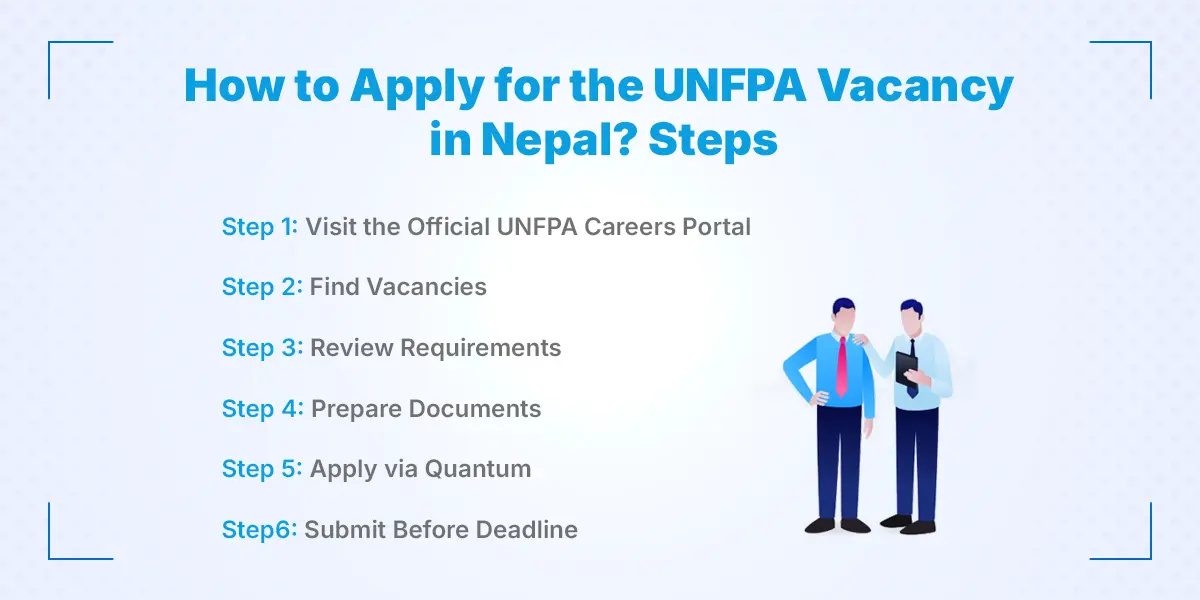
To apply for a UNFPA vacancy in Nepal, candidates must submit their application through the "Quantum" e-Recruit system, which has replaced the older recruitment platforms. This fully digital process requires you to create a candidate profile, search for specific "Nepal" duty stations (e.g., Kathmandu, Janakpur), and complete a competency-based questionnaire. Note that UNFPA never accepts applications via email or hard copy for standard fixed-term or service contract roles; only the Quantum portal submission is valid.
1. Visit the Official UNFPA Careers Portal
Access the global UNFPA Quantum Careers Site. This is the only official entry point for all international and national vacancies. Avoid third-party sites that ask for fees; the UNFPA application is always free.
2. Find Vacancies
Use the filter options on the left side of the screen. Set the Location to "Nepal" or search by keywords like "Kathmandu" or "Program Officer." This will filter the list to show only relevant open positions in the country.
3. Review Requirements
Click on the job title to view the full Terms of Reference (ToR). Carefully read the "Education" and "Experience" sections. Crucial Tip: Ensure your years of experience match exactly what is asked (e.g., if it says "2 years with Master's," a candidate with only a Bachelor's and 2 years will be automatically screened out).
4. Prepare Documents
Before starting the online form, have the following ready to upload:
- CV/Resume: tailored to the specific keywords in the job description.
- Cover Letter: (Often called a "Motivational Statement" in the system) – keep this under 1 page.
- Scanned Copies of your highest academic degree and citizenship card.
Note: The old "P11" form is largely replaced by the digital profile, but keep a copy just in case a specific consultancy requests it.
5. Apply via Quantum
- Registration: If you are a new user, you will need to register with a valid email. The system uses an email verification code (OTP) rather than a permanent password for security.
- Profile Building: Fill in your personal data, education, and employment history. This data is saved to your profile for future applications.
- Questionnaire: Answer the "screening questions" honestly (e.g., "Do you have a Master's degree?"). These are "knock-out" questions; answering "No" to a mandatory requirement will end your application.
6. Submit Before Deadline
Submit your application at least 24 hours before the deadline. The system often operates on New York Time (EST), not Nepal Time. A deadline of "5:00 PM" might be 2:45 AM the next day in Nepal, but it is safer to treat it as 5:00 PM Nepal time to avoid technical glitches.
- Final Check: You cannot edit your application after clicking "Submit." Review every section carefully.
Required Documents for Application
A complete UNFPA application requires a tailored CV, a role-specific cover letter, and verified academic credentials. While the Quantum system pulls data from your digital profile, you must attach specific files to validate your eligibility. Failing to upload a mandatory document (like a degree certificate) often leads to immediate disqualification during the longlisting phase.
- Updated CV/Resume: Must detail your "duties and achievements" rather than just listing job titles. Use bullet points that mirror the language in the vacancy announcement (e.g., "Managed $500k budget" if the job asks for financial oversight).
- Cover Letter (Motivational Statement): A succinct explanation (max 1 page or 2,000 characters) of why you are the best fit for the role. Connect your past experience directly to the UNFPA mission (e.g., "My experience in rural Karnali aligns with your goal of ending preventable maternal deaths...").
- Academic Certificates: Scanned high-resolution copies of your Master’s or Bachelor’s degree.
- Nepalese Citizenship: Proof of nationality is required for all National Officer (NO) and General Service (GS) posts.
- Performance Evaluations: If you have prior UN experience, you may be asked to attach your last two Performance Appraisal Reports (PER/PACE).
Experience Letters & References
- Experience Letters: While not always an initial upload, you must have "Service Certificates" from previous employers ready. These must clearly state your start/end dates and specific functional title to verify the years of experience claimed in your CV.
- References: You will need to provide contact details (email and phone) for three professional references in the Quantum system. Ensure at least one is a current or recent supervisor who can speak to your technical competencies.
Tips to Increase Your Chances of Getting Selected
To significantly increase their chances of being selected for a UNFPA role, candidates must tailor their applications to the specific "Values and Competencies" listed in the vacancy announcement. The UN recruitment process is highly structured; generic CVs are often filtered out by automated systems before they reach a human recruiter. Success requires demonstrating not just what you have done, but how your actions align with UNFPA's mission of reproductive rights and gender equality.
1. Tailor Your CV to UN Competency Standards
Do not use a standard corporate resume. Review the job description's "Required Competencies" section and integrate those exact keywords into your profile. If the role emphasizes "working in teams," describe a specific instance where you fostered collaboration in a multicultural setting. Use active verbs like "spearheaded," "negotiated," and "mobilized" to demonstrate leadership even in support roles.
2. Highlight Development Sector Experience
UNFPA prioritizes candidates who understand the complexities of the development and humanitarian landscape in Nepal. Explicitly mention your experience working with:
- Government Agencies: (e.g., Ministry of Health and Population, Provincial Health Directorates).
- INGOs/NGOs: (e.g., experience with USAID, DFID, or local partners).
- Field Work: Experience in remote or underserved areas (like Sudurpaschim or Karnali provinces) is a major asset.
3. Show Measurable Achievements
Vague claims like "responsible for project management" carry little weight. Quantify your impact to provide concrete evidence of your capabilities.
- Weak: "Managed a health program."
- Strong: "Managed a $500,000 reproductive health project in 3 districts, increasing adolescent access to services by 25% within one year."
4. Prepare for Behavioral Interviews
If shortlisted, you will face a "Competency-Based Interview" (CBI). This format assumes past behavior predicts future performance. Prepare your answers using the STAR Method:
- Situation: Briefly describe the context.
- Task: Explain the challenge you faced.
- Action: Detail the specific steps you took (focus on "I," not "We").
- Result: Share the positive outcome or lesson learned.
5. Apply Before the Deadline
Technical glitches are common on recruitment portals, especially near the closing time. Submit your application at least 24 to 48 hours before the deadline. Late applications are almost never accepted, regardless of the reason. Treating the deadline as "one day earlier" ensures your profile is safely in the system.
Why Work at UNFPA Nepal?
Working at UNFPA Nepal provides a unique opportunity to drive high-impact social change while enjoying the job security and global mobility of the United Nations system. Staff members directly contribute to Nepal’s development goals, such as ending preventable maternal deaths and gender-based violence, while accessing world-class professional training through the UN’s global learning platforms. Additionally, the organization fosters an inclusive, multicultural environment supported by a competitive remuneration package that includes comprehensive health coverage and family-friendly policies.
Conclusion
UNFPA vacancies in Nepal represent a premier opportunity for professionals dedicated to public health and social justice to build a global career while making a tangible difference at home. Success in this competitive landscape requires more than just qualifications; it demands a strategic approach to understanding the UN's competency framework and a commitment to its core mission of reproductive rights.
To ensure you never miss an opening, candidates should regularly monitor the official Quantum portal and trusted local resources. For the latest notifications on UN and development sector roles, following platforms like Kumari Job can provide a crucial advantage, delivering timely alerts and career insights directly to your feed so you can apply before the deadline.
Frequently Asked Questions
Submit your comments

Get Our App On



SEO Training for Freshers in Nepal: Skills, Career & Job Opportunities
VIEW DETAILS
SEO Training vs. Self-Learning: Which Is Right for You?
VIEW DETAILS
How to Choose Between Two Job Offers
VIEW DETAILS
Digital Marketing Training Interview Questions and Answers for Freshers
VIEW DETAILS


Loading Comments...