


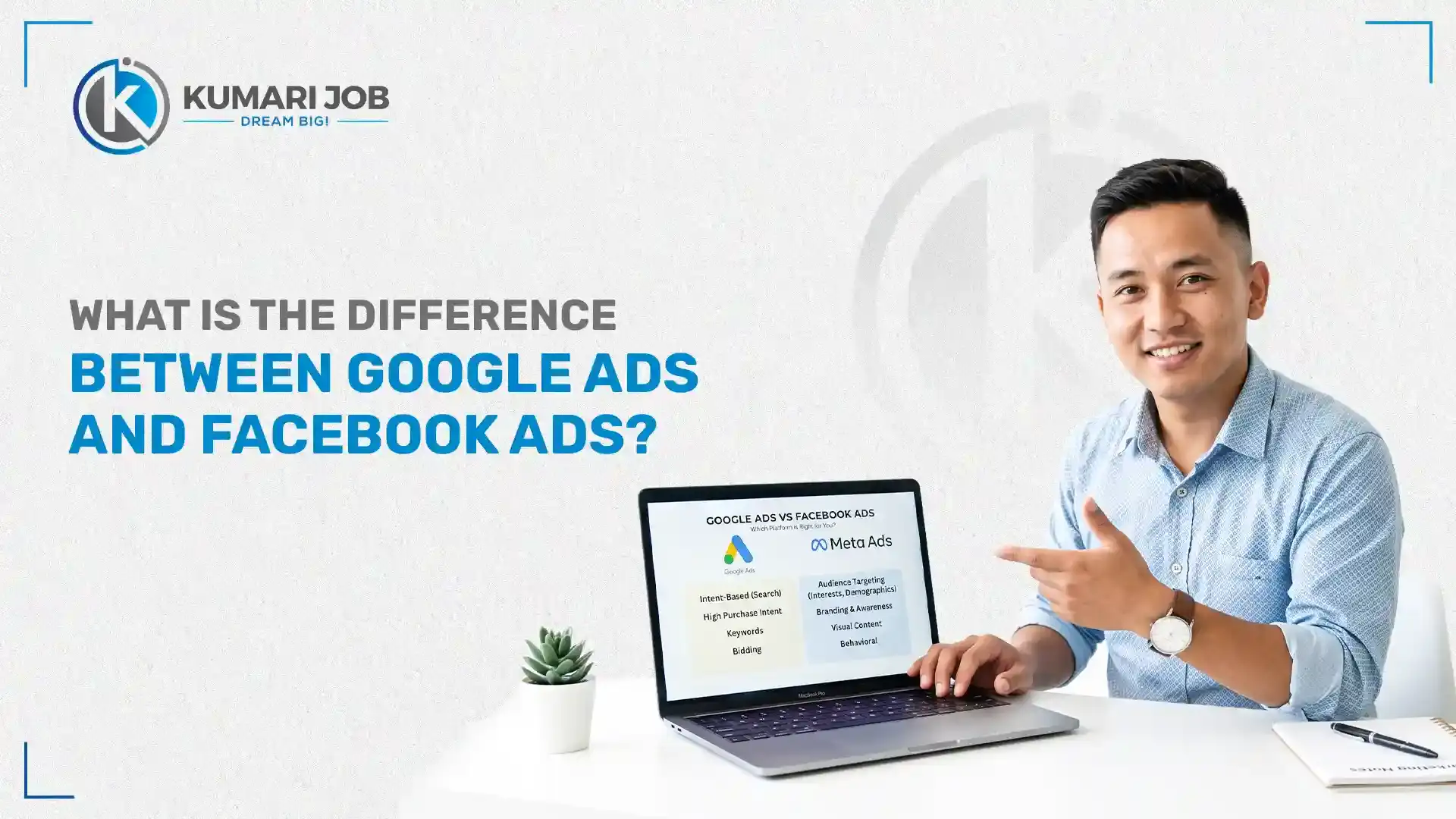

Most digital marketing training programs list Google Ads and Facebook Ads as core skills because almost every paid advertising job today expects both. Businesses no longer pick one platform and stick to it; they search ads to catch people who are already looking to buy and social ads to reach people before they start searching. This is why learning paid advertising early in your digital marketing career matters so much; it is one of the fastest ways to become job-ready and start earning through freelance projects or a full-time role.
In this guide, you will learn what Google Ads and Facebook Ads actually do, the eight key differences between them, and how digital marketing training teaches both platforms step by step. You will also see the specific skills each platform builds, the career roles that hire for these skills, and which type of business each platform suits best. By the end, you will know exactly why almost no serious training program teaches just one platform alone.
In this blog
What Is Google Ads?
Google Ads is Google's paid advertising platform that shows ads on search results, YouTube, Gmail, and millions of partner websites through the Google Display Network. It works on a real-time auction where advertisers bid on keywords tied to what people are actively typing into the search bar. Because advertisers pay only when someone clicks the ad, Google Ads falls under the pay-per-click (PPC) advertising model.
- How it works: Advertisers bid on keywords, and Google ranks ads using a mix of bid amount and Quality Score
- Campaign types: Search, Display, Shopping, Video, Performance Max, and App campaigns
- Skills you'll learn: keyword research, bid strategy, ad copywriting, landing page alignment, and conversion tracking
What Is Facebook Ads?
Facebook Ads is Meta's advertising platform that places ads across Facebook, Instagram, Messenger, and the Meta Audience Network. It runs on an interest and behavior-based targeting model rather than a keyword search model. Advertisers build audiences using demographics, interests, past behavior, or existing customer data, and then pay based on clicks, impressions, or specific results like leads or purchases.
- How it works: Advertisers select an objective in Meta Ads Manager, define an audience, and let the algorithm deliver ads to the users most likely to .act
- Campaign types: Awareness, Traffic, Engagement, Leads, App Promotion, Sales, and Store Visits
- Core skills taught: audience research, Facebook Pixel setup, custom and lookalike audiences, and creative testing. ing
What Is the Difference Between Google Ads and Facebook Ads?
Google Ads and Facebook Ads are both powerful online advertising platforms, but they serve different marketing purposes. Google Ads helps businesses reach people who are actively searching for products or services, while Facebook Ads focuses on targeting users based on their interests, behaviors, and demographics. The right platform depends on your business goals, target audience, and advertising strategy.
| Feature | Google Ads | Facebook Ads (Meta Ads) |
|---|---|---|
| 1. Search Intent vs Interest-Based Marketing | Targets users actively searching for products or services. | Targets users based on interests, behaviors, and demographics. |
| 2. Audience Targeting | Uses keywords, location, device, and audience signals. | Uses detailed demographic, interest, custom, and lookalike audiences. |
| 3. Ad Placements | Google Search, YouTube, Display Network, Gmail, Discover, and Shopping. | Facebook, Instagram, Messenger, Audience Network, and Reels. |
| 4. Campaign Objectives | Best for website traffic, leads, sales, and conversions. | Best for brand awareness, engagement, leads, and app promotion. |
| 5. Cost Per Click (CPC) | Usually higher due to keyword competition. | Often lower, depending on audience and industry. |
| 6. Conversion Potential | High because users already have purchase intent. | Good for generating demand and nurturing potential customers. |
| 7. Best Business Types | Ideal for local businesses, service providers, B2B, and eCommerce with high-intent buyers. | Ideal for eCommerce, startups, personal brands, events, and businesses focused on brand awareness. |
| 8. Return on Investment (ROI) | Typically delivers strong ROI for lead generation and direct sales. | Provides excellent ROI for brand awareness, customer engagement, and retargeting campaigns. |
How Does Digital Marketing Training Teach Google Ads and Facebook Ads?
Digital marketing training teaches Google Ads and Facebook Ads through hands-on campaign building inside real ad accounts rather than theory alone. Trainers typically start with account structure and keyword or audience research before moving into bidding, budgeting, and creative development. Students then practice reading performance reports and adjusting live campaigns, which mirrors the actual daily workflow of a paid media role.
- Creating and structuring ad campaigns
- Keyword research and audience research
- Audience targeting and segmentation
- Budget management and bid strategy
- Conversion tracking setup
- A/B testing of creative and copy
- Performance optimization and reporting
Google Ads Skills You Will Learn
A strong Google Ads module in any training program covers the platform end to end, from campaign setup to advanced optimization.
- Google Search Ads
- Display Ads
- Shopping Ads
- Performance Max Campaigns
- Keyword Planning and match types
- Conversion Tracking
- Google Analytics Integration
Facebook Ads Skills You Will Learn
A complete Facebook Ads module builds both the technical setup and the creative testing skills employers expect.
- Meta Ads Manager
- Audience Research
- Custom & Lookalike Audiences
- Facebook Pixel setup
- Instagram Ads
- Lead Generation Campaigns
- Retargeting Strategies
Why Do Most Digital Marketing Courses Teach Both Platforms?
Most digital marketing courses teach both Google Ads and Facebook Ads because employers expect marketers to run campaigns across the full customer journey, not just one channel. A marketer who understands only search intent misses the audience-building and retargeting skills that Facebook Ads provides. Combining both platforms in training also prepares students for freelance and agency work, where clients almost always request a multi-channel advertising strategy.
- A complete, job-ready digital marketing skillset
- Better overall campaign performance through cross-channel retargeting
- Higher employability across agencies, startups, and enterprise teams
- The ability to build a true multi-channel marketing strategy
Career Opportunities After Learning Google Ads and Facebook Ads
The most common career opportunity after learning Google Ads and Facebook Ads is a paid media role that manages both search and social campaigns for a business or agency. These roles exist across agencies, startups, and enterprise marketing teams because most companies run ads on both platforms at once. Below are the eight roles that most frequently hire for these exact skills.
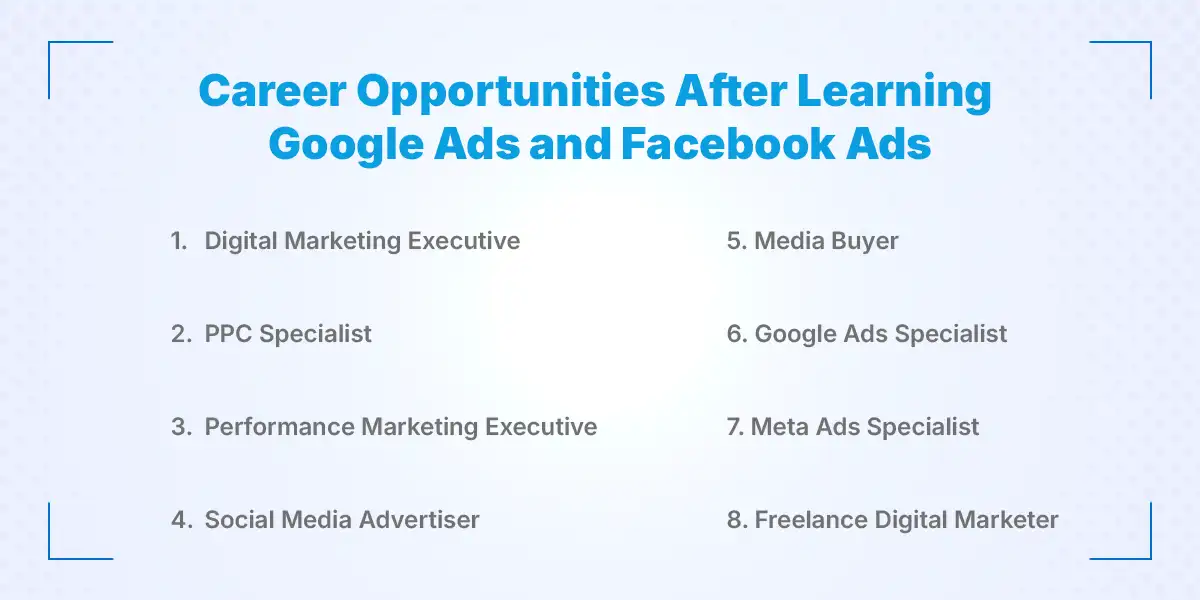
1. Digital Marketing Executive
A Digital Marketing Executive handles day-to-day campaign tasks across Google Ads, Facebook Ads, and often SEO or email as well. This role suits someone early in their career who wants broad exposure rather than deep specialization in one channel. Employers expect candidates to set up campaigns, monitor budgets, and report basic performance metrics. It is usually the first job title digital marketing training graduates apply for.
2. PPC Specialist
A PPC Specialist focuses primarily on paid search and paid social advertising, managing keyword bids, ad copy, and budget allocation. This role demands a deeper technical understanding of Google Ads auctions and Facebook Ads delivery than a general marketing executive role. Companies hire PPC Specialists specifically to lower cost per acquisition and improve conversion rates. Strong Excel and analytics skills are usually required alongside platform knowledge.
3. Performance Marketing Executive
A Performance Marketing Executive is measured directly on results such as leads, sales, or return on ad spend rather than general campaign activity. This role sits closer to the business side of marketing, since decisions are driven by data and revenue targets. Google Ads and Facebook Ads are the two primary tools used to hit these performance goals. E-commerce and D2C brands hire heavily for this role.
4. Social Media Advertiser
A Social Media Advertiser specializes in Facebook Ads, Instagram Ads, and increasingly TikTok Ads, focusing on creative testing and audience targeting. This role leans more on visual strategy and audience psychology than on keyword research. Companies with strong brand identities, such as fashion or lifestyle businesses, hire this role most often. Facebook Pixel and Meta Ads Manager expertise are core requirements.
5. Media Buyer
A Media Buyer manages advertising budgets across multiple platforms, including Google Ads and Facebook Ads, to get the best possible return on spend. This role often works with larger budgets than a typical executive position and requires strong negotiation and forecasting skills. Media Buyers are common in agencies handling several client accounts at once. Experience managing five- and six-figure monthly ad budgets is usually expected.
6. Google Ads Specialist
A Google Ads Specialist focuses exclusively on search, display, shopping, and Performance Max campaigns within the Google ecosystem. This role requires advanced knowledge of keyword match types, Quality Score, and bidding strategies. Businesses with strong existing search demand, like local services or B2B companies, hire this role directly. A Google Ads certification is often listed as a preferred qualification.
7. Meta Ads Specialist
A Meta Ads Specialist focuses exclusively on Facebook and Instagram advertising, including audience research and Pixel-based retargeting. This role requires strong creative testing skills, since ad performance depends heavily on visuals and copy variations. Consumer brands and e-commerce companies hire this role to manage cold, warm, and retargeting audience funnels. A Meta Blueprint certification strengthens candidacy for this position.
8. Freelance Digital Marketer
A Freelance Digital Marketer manages Google Ads and Facebook Ads campaigns independently for multiple small business clients. This role requires both platforms because most small business clients cannot afford to hire separate specialists for search and social. Freelancers who can run and report on both channels typically charge higher rates than single-platform freelancers. This path is common for digital marketing training graduates who want flexibility over a fixed job.
Which Is the Best Google Ads and Facebook Ads Training Institute?
If you're looking for the best institute to learn Google Ads and Facebook Ads, choose one that offers practical digital marketing training, live campaign experience, expert trainers, and hands-on projects instead of only theoretical lessons. A quality course should teach keyword research, audience targeting, campaign creation, budget management, conversion tracking, and ad optimization using the latest Google Ads and Meta Ads tools.
Kumari Job Digital Marketing Training is one of the best digital marketing training programs in Nepal for learning Google Ads and Facebook Ads. The course includes practical training, real-world projects, SEO, social media marketing, Google Analytics, and career-focused guidance, helping students, job seekers, freelancers, and business owners develop job-ready digital marketing skills.
Conclusion
The real skill in paid advertising is not choosing between Google Ads and Facebook Ads;s, it is knowing when to use each one and how to make them work together inside a single strategy. A marketer who only understands search intent will struggle with brand-building work, and a marketer who only understands interest-based targeting will struggle to close high-intent buyers. Training that forces you to run both, measure both, and report on both is what actually makes you hireable.
If you are ready to turn this knowledge into a job, Kumarijob lists current openings for PPC Specialists, Performance Marketing Executives, and Digital Marketing Executives where these exact Google Ads and Facebook Ads skills are required, so you can see what employers are asking for and apply directly.
Frequently Asked Questions
Submit your comments

Get Our App On


How to Become a Public Health Officer in Nepal?
VIEW DETAILS.webp)
What Is the Document Controller Salary in Nepal?
VIEW DETAILS
What is the Public Relations Officer Salary in Nepal
VIEW DETAILS
What Is the Salary of a Ticketing Officer in Nepal?
VIEW DETAILS


Loading Comments...