



Finding the right candidate can feel overwhelming. Companies often waste time sorting through hundreds of applications, while top talent may never see open positions. This mismatch slows growth and creates frustration for both employers and job seekers. Many businesses struggle to fill key roles quickly, and professionals miss opportunities that match their skills. Effective headhunting bridges this gap by connecting the right people with the right roles efficiently and discreetly.
In this blog, we explain job head-hunting in simple terms, showing how it works and why it matters. Readers will learn the process step by step, understand its value in today’s competitive job market, and see how both companies and professionals benefit. We will also cover the benefits of headhunting, the difference between headhunting and traditional recruitment, and why companies may choose headhunting over standard hiring methods. By the end, you will understand how targeted recruitment can save time, reduce hiring risks, and improve career growth opportunities.
In this blog
What Is Job Headhunting?
Job headhunting is a specialised recruitment process where recruiters actively seek out highly qualified candidates for specific roles rather than waiting for applications. Unlike traditional hiring, headhunters target professionals who may not be actively looking for a new job, ensuring companies access top talent quickly. This approach focuses on quality over quantity, connecting organisations with candidates who match precise skills, experience, and cultural fit.
Headhunting works through research, networking, and direct outreach. Recruiters identify potential candidates using databases, professional networks, and industry contacts. They approach candidates confidentially, presenting opportunities and assessing interest. After shortlisting, headhunters coordinate interviews and assist both parties through negotiation and onboarding. This method reduces hiring time, improves retention rates, and ensures the best fit for critical positions.
Hire Best Talents with Experienced Recruiters
Roles Commonly Filled Through Headhunting:
- Senior management positions such as CEOs, CFOs, and directors.
- Executive roles like Vice Presidents and department heads.
- Niche technical specialists with rare skills.
- High-demand IT or engineering experts.
- Key strategic roles in sales, marketing, or operations.
- Professionals with strong industry influence or networks.
- Positions requiring immediate impact and minimal training time.
What Is Recruiting?
Recruiting is the process of attracting, screening, and selecting candidates for job openings within an organisation. Its primary purpose is to ensure companies have the right people to meet operational goals, maintain productivity, and support growth. Recruiting helps organisations fill positions efficiently while maintaining a pipeline of qualified candidates for current and future needs.
Recruiting also strengthens employer branding by creating a positive candidate experience. Effective recruitment reduces turnover, improves team performance, and aligns talent with organisational strategy. Unlike headhunting, recruiting often focuses on filling multiple roles at once, combining active and passive candidate sourcing.
Types of Recruiting:
- Internal Recruiting: Promoting or transferring existing employees within the organisation
- External Recruiting: Hiring candidates from outside the organisation through job postings, referrals, or outreach
- Agency-Based Recruiting: Partnering with recruitment agencies to source and shortlist candidates
What’s the Difference Between Headhunting and Recruiting?
The difference between headhunting and recruiting is that headhunting targets specific, often passive candidates for senior or specialised roles, while recruiting focuses on active job seekers for broader positions. Headhunting uses direct outreach, is more time-consuming and costly, but often achieves higher success for critical roles. Recruiting is faster and cheaper but may not reach top-tier talent as effectively. Companies choose between the two based on role complexity and urgency.
| Aspect | Headhunting | Recruiting |
|---|---|---|
| Candidates | Targets passive professionals not actively seeking jobs; usually highly experienced or specialized. | Focuses on active job seekers responding to job postings or applications. |
| Approach & Outreach | Personalized outreach via networks, research, and direct contact; often confidential. | Broad approach using job boards, advertisements, referrals, and standard application processes. |
| Roles & Seniority | Ideal for senior, executive, or niche positions with strategic importance. | Suitable for entry-level to mid-management roles and general operational positions. |
| Time, Cost & Success Rate | Longer process and higher fees due to targeted search; higher success rate for critical roles. | Faster and lower-cost process; success depends on candidate volume rather than precision. |
| Candidate Fit | High focus on skills, experience, cultural fit, and potential impact. | Focuses on matching basic qualifications and availability; fit may vary. |
| Confidentiality | Often required for sensitive or replacement roles; discreet process. | Less emphasis on confidentiality; process is more transparent and public. |
Why Companies Use Headhunting Services?
Companies use headhunting services because they need specialised, high-quality candidates for critical roles that are hard to fill through traditional recruitment. Headhunting ensures access to top talent, speeds up the hiring process, and allows confidential searches for sensitive positions. It helps organisations secure the right fit for leadership and strategic roles while reducing hiring risks.
1. Hiring for Senior or Leadership Roles
Headhunting is especially useful for executive and leadership positions where experience, skills, and cultural fit are crucial. These roles often shape company strategy, so selecting the wrong candidate can be costly. Headhunters target professionals with proven track records, ensuring that companies hire individuals who can make immediate, significant contributions. They also provide insights into candidates’ leadership styles and industry reputation to help companies make informed decisions.
2. Access to Passive, High-Quality Talent
Many top-performing professionals are not actively seeking new roles, making them unreachable through standard job postings. Headhunters reach these passive candidates using industry networks, research, and personalised outreach. This approach allows companies to secure talent that competitors might not even know is available. By tapping into this hidden talent pool, organisations gain a competitive advantage in hiring.
Finding Top Talent for Senior Positions?
Our recruitment services connect your company with skilled professionals and trusted experts to fill leadership roles efficiently.
3. Confidential Hiring Needs
Some hires require discretion due to company restructuring, sensitive projects, or replacing existing employees. Headhunting allows confidential searches without alerting competitors or causing internal disruptions. Recruiters maintain privacy throughout the process, protecting both the company and the candidate. This ensures candidates feel secure while considering new opportunities, improving engagement and acceptance rates.
4. Faster and More Targeted Hiring
Headhunting focuses on quality over quantity, targeting only candidates who match the required skills and experience. This reduces time spent reviewing unqualified applications and accelerates the hiring process. Companies benefit from faster placements while ensuring the candidate is highly suitable for the role. It also minimises turnover risk by ensuring candidates are well-aligned with company needs and expectations.
How Job Headhunting Works?
Job headhunting works by identifying, approaching, and securing top talent for specific roles that are difficult to fill through standard recruitment. The process is highly targeted, focusing on quality over quantity, and involves understanding company needs, mapping talent in the market, and engaging candidates directly. Headhunters guide both companies and candidates through selection, negotiation, and placement to ensure the best fit. Each step is designed to save time, reduce hiring risks, and secure professionals with the right skills and experience.
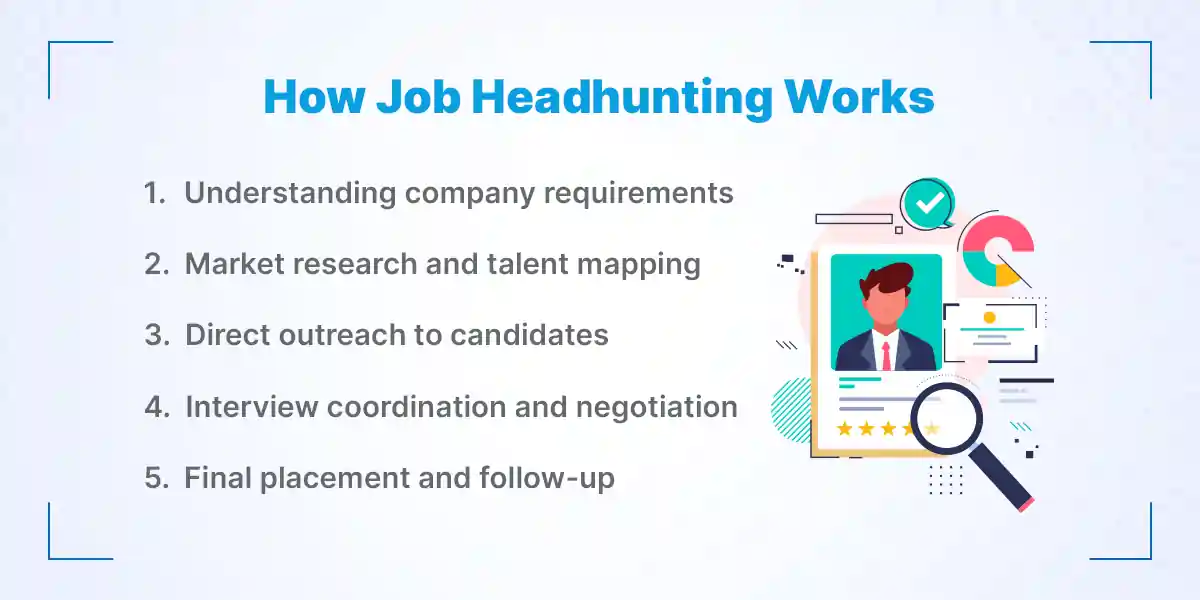
1. Understanding Company Requirements
Headhunters begin by analysing the company’s objectives, culture, and specific needs for the role. They define job responsibilities, required skills, experience level, and performance expectations. This step ensures the search is focused and aligned with strategic goals. Recruiters also clarify timelines and reporting structures to match candidates accurately.
2. Market Research and Talent Mapping
Once requirements are clear, headhunters conduct market research to identify potential candidates. They use professional networks, industry databases, and competitor analysis to map talent pools. This process helps locate high-performing professionals who meet the role’s criteria. Talent mapping also highlights availability, salary benchmarks, and career trajectories.
3. Direct Outreach to Candidates
Headhunters approach candidates directly, often targeting passive professionals who are not actively job hunting. Personalised communication explains the opportunity, assesses interest, and presents company value. Maintaining confidentiality is critical, especially for senior or sensitive roles. Effective outreach increases response rates and candidate engagement.
4. Interview Coordination and Negotiation
After shortlisting, headhunters coordinate interviews between the company and candidates. They provide guidance on expectations, prepare candidates, and gather feedback from both sides. Headhunters also handle negotiation of offers, salaries, and benefits to ensure mutually beneficial agreements. This step reduces friction and speeds up decision-making.
5. Final Placement and Follow-Up
Once the candidate accepts the offer, headhunters assist with onboarding and transition into the new role. They follow up to ensure satisfaction for both the company and the candidate. Continuous support helps improve retention and builds long-term relationships for future hiring needs.
Benefits of Job Headhunting
Job headhunting offers companies access to top-tier talent that may not be reachable through standard recruitment methods. It improves the quality of hires, reduces hiring risks, and accelerates filling critical positions. Headhunting also ensures candidates are well-matched to organisational culture and long-term goals, providing strategic value beyond simply filling vacancies.
1. Higher Quality Candidates
Headhunting focuses on identifying professionals with proven skills, experience, and achievements relevant to the role. Unlike traditional recruitment, which may rely on volume applications, headhunting targets candidates who can deliver immediate impact. This approach ensures that companies hire top-performing talent, improving overall team effectiveness and performance. It also allows companies to select candidates who align closely with long-term business goals.
2. Reduced Hiring Risk
By carefully screening and assessing candidates, headhunters minimise the risk of poor hires. They evaluate skills, experience, cultural fit, and career goals before presenting candidates to the company. This thorough approach decreases turnover, avoids costly hiring mistakes, and ensures candidates can succeed in their roles. Additionally, headhunters provide guidance on potential challenges, helping companies make informed decisions.
3. Faster Hiring for Critical Roles
Headhunting speeds up the recruitment process for senior or highly specialised positions. Recruiters use their networks, market insights, and direct outreach to identify qualified candidates quickly. This reduces downtime in key roles, keeping projects on schedule and maintaining business continuity. The process also shortens decision-making time by presenting pre-qualified candidates ready for interviews.
4. Access to Niche and Executive Talent
Headhunting enables companies to reach passive candidates and professionals with rare skills or specialised expertise. It is especially effective for executive, technical, or strategic roles where talent is limited. This access provides a competitive advantage, allowing organisations to secure top talent that competitors may overlook. It also helps build a strong talent pipeline for future strategic hiring needs.
When Should a Company Choose Headhunting Over Recruiting?
A company should choose headhunting over recruiting when filling roles that require highly specialised skills, seniority, or discretion. Headhunting is ideal for positions where top talent may not be actively seeking new opportunities and where quality, fit, and speed are critical. It also benefits organisations competing in tight talent markets or handling sensitive replacements. In these situations, recruitment companies deliver precision and strategic advantage that traditional recruiting cannot.
1. Executive and Leadership Hiring
Headhunting is particularly effective for senior management and executive roles such as CEOs, CFOs, or department heads. These positions have a significant impact on the company's strategy, culture, and performance. Recruiters proactively target candidates with proven leadership experience, industry reputation, and the ability to drive results. Traditional recruitment may not reach these professionals, making headhunting the preferred choice for high-stakes hires.
2. Specialised Technical Roles
Roles requiring rare or advanced technical skills benefit from headhunting because the talent pool is limited. Headhunters identify and approach individuals with specific expertise, often not actively looking for new opportunities. This targeted approach ensures companies secure candidates who can contribute immediately and reduce skill gaps that affect critical projects.
3. Confidential Replacement Hiring
When replacing executives or key employees, companies often need discretion to avoid internal disruption or alerting competitors. Headhunting maintains confidentiality throughout the process. This allows organisations to manage transitions smoothly while protecting sensitive business information and preserving employee morale.
4. Competitive Talent Markets
In industries with high demand and low supply of qualified candidates, headhunting gives companies a competitive edge. Recruiters proactively reach out to passive candidates who might not respond to standard job postings. This approach increases the chances of attracting top talent before competitors can engage them.
How to Choose the Right Headhunting Firm?
Choosing the right headhunting firm is essential to secure top talent efficiently and reliably. Companies should evaluate a firm’s industry expertise, proven success, confidentiality standards, candidate screening methods, and client feedback. The right partner ensures alignment with business goals and delivers high-quality candidates for critical roles.
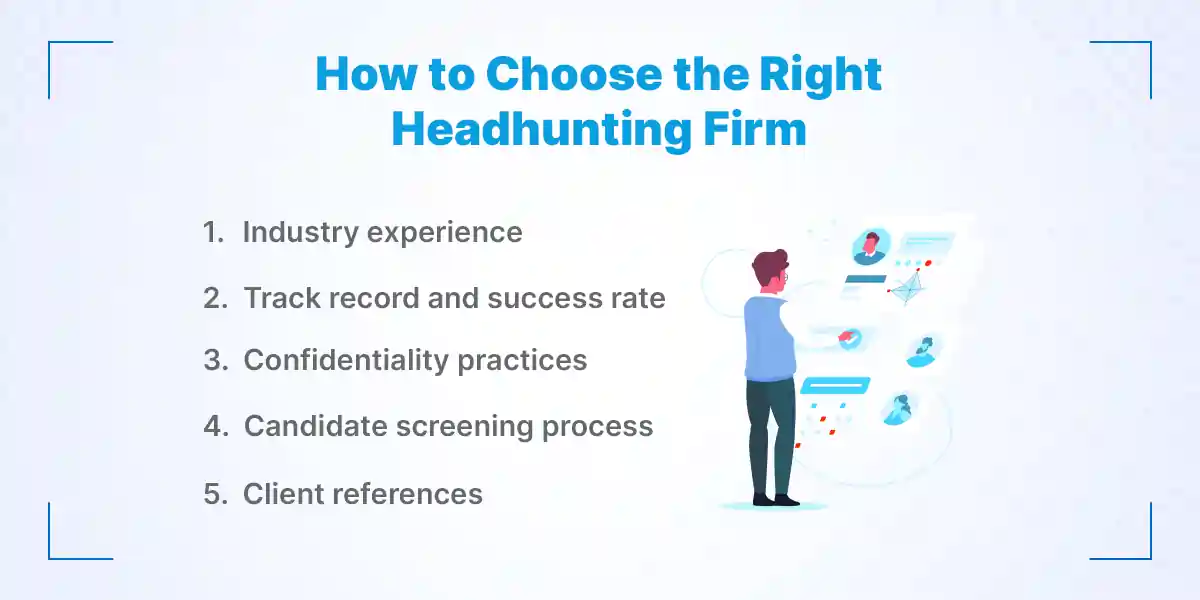
1. Industry Experience
A headhunting firm with experience in your industry understands market trends, key players, and skill demands. This knowledge allows them to identify and approach candidates with relevant expertise effectively. Industry familiarity also helps in assessing cultural fit and anticipating potential challenges in recruitment. Experienced firms can provide valuable market insights and salary benchmarks to guide hiring decisions.
2. Track Record and Success Rate
Evaluating a firm’s past placements and success rate provides insight into its ability to deliver results. Firms with consistent success in filling senior or specialised roles demonstrate reliability and efficiency. Reviewing case studies or statistics helps gauge how effectively they match candidates to company needs. A strong track record also indicates the firm’s capability to handle challenging or niche searches.
3. Confidentiality Practices
Maintaining discretion is critical, especially for executive or sensitive hires. A reputable headhunting firm ensures candidate and company information remains private throughout the process. Strong confidentiality practices protect internal operations, candidate trust, and corporate reputation. Firms with strict privacy policies help prevent leaks that could disrupt internal teams or alert competitors.
4. Candidate Screening Process
The firm should have a thorough and structured screening process to assess skills, experience, and cultural fit. This includes interviews, reference checks, and background verification. A robust process ensures that only highly qualified candidates are presented to the company. Comprehensive screening also minimises the risk of mismatched hires and future turnover.
5. Client References
Requesting references from past clients helps verify the firm’s performance and professionalism. Feedback on responsiveness, candidate quality, and overall experience provides confidence in selecting the right partner. Positive references indicate a firm’s ability to deliver consistent and successful placements. Strong client endorsements also suggest long-term reliability and trustworthiness in handling sensitive hires.
Which Is the Best Job Headhunting Company in Nepal?
Kumari Job is the best job headhunting company in Nepal because they specialise in connecting top-tier talent with leading organisations across industries, focusing on executive, senior, and niche roles. With a strong network of professionals and a deep understanding of Nepal’s job market, Kumari Job ensures companies find the right candidates efficiently and discreetly.
The firm follows a structured headhunting process, from understanding company requirements to talent mapping, direct outreach, and placement follow-up. They emphasise confidentiality, quality, and personalised service, making them a trusted partner for businesses looking to secure high-impact hires. Professionals also benefit from access to exclusive opportunities not advertised through traditional channels.
Conclusion
Job headhunting has become essential for companies seeking high-quality talent for critical and specialised roles. It allows organisations to reach passive candidates, reduce hiring risks, and secure professionals who can make immediate and meaningful contributions. Unlike traditional recruiting, headhunting focuses on precision, ensuring that each candidate closely matches the company’s requirements and culture.
Choosing between headhunting and recruiting depends on the role’s complexity, urgency, and the availability of talent. Headhunting suits executive, niche, or confidential positions, while recruiting works for broader and entry-to-mid-level roles. For strategic hiring, businesses should clearly define requirements, select the appropriate method, and collaborate with experienced headhunting firms. This targeted approach saves time, improves retention, and strengthens long-term organisational growth.
Frequently Asked Questions
Submit your comments

Get Our App On



SEO Training for Freshers in Nepal: Skills, Career & Job Opportunities
VIEW DETAILS
SEO Training vs. Self-Learning: Which Is Right for You?
VIEW DETAILS
How to Choose Between Two Job Offers
VIEW DETAILS
Digital Marketing Training Interview Questions and Answers for Freshers
VIEW DETAILS


Loading Comments...