



For many businesses, building and managing an in-house IT team has become increasingly expensive, time-consuming, and difficult. Companies often struggle with rising development costs, talent shortages, long hiring cycles, and the pressure to deliver projects faster while maintaining quality. These challenges push businesses to look for smarter, more flexible ways to handle their IT needs.
This is where IT outsourcing comes in, and Nepal is quickly emerging as a strong outsourcing destination. With a growing pool of skilled developers, competitive costs, strong English communication, and experience working with international clients, Nepal offers a practical solution for businesses that want quality IT services without the overhead of full in-house teams.
In this blog, we’ll explore what IT outsourcing is, how it works in Nepal, the services commonly outsourced, costs, benefits, challenges, and how to choose the right IT outsourcing partner, helping you decide whether outsourcing to Nepal is the right move for your business.
In this blog
What is IT Outsourcing?
IT outsourcing is the practice of hiring an external company or team to handle specific IT services or technology-related tasks instead of managing them in-house. Businesses outsource IT to reduce costs, access specialized skills, speed up delivery, and focus more on core operations rather than technical management.
There are three main types of IT outsourcing: onshore outsourcing (working with a provider in the same country), nearshore outsourcing (partnering with a provider in a nearby region), and offshore outsourcing (outsourcing to a distant country like Nepal). Offshore IT outsourcing is especially popular because it offers significant cost advantages while still providing access to highly skilled professionals and modern technology expertise.
It’s important to understand the difference between IT outsourcing and general outsourcing. General outsourcing can include non-technical services such as HR, payroll, customer support, or accounting, whereas IT outsourcing focuses specifically on technology and digital services. In short, all IT outsourcing is a form of outsourcing, but not all outsourcing involves IT services.
Hire the Best IT Team with Our Outsourcing Services
How IT Outsourcing Works in Nepal
IT outsourcing in Nepal works through a structured, step-by-step process where businesses delegate specific IT tasks or entire projects to a local outsourcing partner, from planning and vendor selection to execution and long-term support. This model allows companies to access skilled professionals, reduce costs, and scale teams efficiently without building in-house infrastructure.
Nepali IT outsourcing companies follow globally accepted workflows, communication tools, and delivery standards, making the process smooth for international and local clients. Below is a clear breakdown of how IT outsourcing typically works in Nepal.
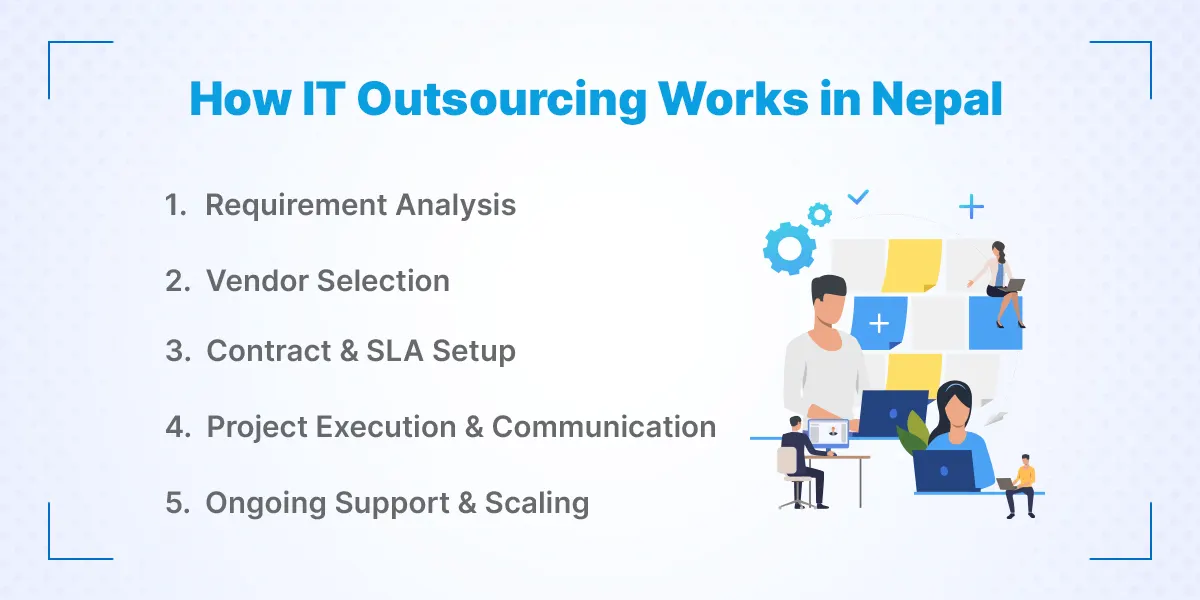
1. Requirement Analysis
The process begins with a detailed requirement analysis between the client and the outsourcing provider. During this stage, the outsourcing company works closely with the client to understand project goals, technical requirements, timelines, budget, and expected outcomes. This includes defining the tech stack, scope of work, team size, and delivery milestones. A clear requirement analysis helps avoid misunderstandings later and ensures both parties are aligned. This step lays the foundation for a successful outsourcing engagement.
2. Vendor Selection
Once requirements are clear, businesses evaluate and select the right IT outsourcing vendor in Nepal. Selection is usually based on experience, technical expertise, portfolio, communication capability, and past client success. Many companies also assess cultural fit and time-zone compatibility at this stage. Choosing the right vendor is critical, as it directly impacts quality, timelines, and long-term collaboration. A strong vendor acts as a technology partner, not just a service provider.
3. Contract & SLA Setup
After vendor selection, both parties formalize the engagement through contracts and Service Level Agreements (SLAs). This step defines responsibilities, deliverables, timelines, pricing models, confidentiality clauses, and data security measures. SLAs also outline performance metrics, communication frequency, and issue-resolution processes. Having a clear contract protects both the client and the outsourcing company. It ensures transparency, accountability, and trust throughout the project lifecycle.
4. Project Execution & Communication
Project execution starts once contracts are signed and teams are assigned. Nepali outsourcing companies typically use agile or hybrid development models, with regular updates, sprint reviews, and progress reports. Communication is handled through tools like email, Slack, Zoom, Jira, or Trello to ensure transparency and real-time collaboration. Clear communication helps manage expectations and keeps projects on track. Continuous feedback during this phase improves quality and delivery speed.
5. Ongoing Support & Scaling
After initial delivery, most IT outsourcing engagements continue with ongoing support, maintenance, and scaling. Outsourcing partners handle bug fixes, updates, performance optimization, and system monitoring. As business needs grow, teams can be scaled up or down without long hiring cycles. This flexibility is one of the biggest advantages of IT outsourcing in Nepal. Long-term support ensures stability, cost efficiency, and sustained project success.
Looking for Skilled & Flexible IT Team Without High Costs?
Partner with Nepal’s best IT professionals for software development, project execution, ongoing support, and faster delivery, all without the overhead of an in-house setup.
IT Services Commonly Outsourced in Nepal
Nepal offers a wide range of IT outsourcing services backed by skilled professionals, cost advantages, and growing global exposure. Companies outsource these services to Nepal to reduce costs, access talent, and scale teams efficiently.
1. Software Development
Software development is one of the most outsourced IT services in Nepal. Companies hire Nepali teams for custom software, enterprise solutions, SaaS platforms, and system integrations. Developers are experienced in modern programming languages, frameworks, and agile development practices. This makes Nepal suitable for both startups and large enterprises.
2. Web & Mobile App Development
Web and mobile app development services are widely outsourced to Nepal for both local and international projects. Teams work on responsive websites, eCommerce platforms, and mobile apps for iOS and Android. Outsourcing helps businesses launch products faster while maintaining quality and scalability. Many companies choose Nepal for long-term development partnerships.
3. QA & Testing Services
Quality assurance and testing services are commonly outsourced to ensure software reliability and performance. Nepali QA teams handle manual testing, automation testing, performance testing, and bug tracking. This helps companies reduce product risks and improve user experience before launch. Outsourced QA also lowers overall development costs.
4. Cloud & DevOps Services
Cloud computing and DevOps services are increasingly outsourced to Nepal. Teams support cloud infrastructure setup, CI/CD pipelines, containerization, and system monitoring. Outsourcing DevOps helps businesses improve deployment speed, security, and scalability. Skilled engineers work with platforms like AWS, Azure, and Docker-based environments.
5. IT Support & Maintenance
IT support and maintenance services are outsourced for ongoing system stability and technical assistance. This includes helpdesk support, server monitoring, application maintenance, and issue resolution. Outsourcing support ensures round-the-clock assistance without maintaining an in-house team. Many companies rely on Nepal for long-term IT support services.
And many more IT services, such as data services, cybersecurity support, UI/UX design, and remote IT staffing, are also commonly outsourced to Nepal, depending on business needs.
Benefits of IT Outsourcing in Nepal
IT outsourcing in Nepal offers multiple strategic advantages for global businesses looking to reduce costs, access talent, and scale efficiently without compromising quality.
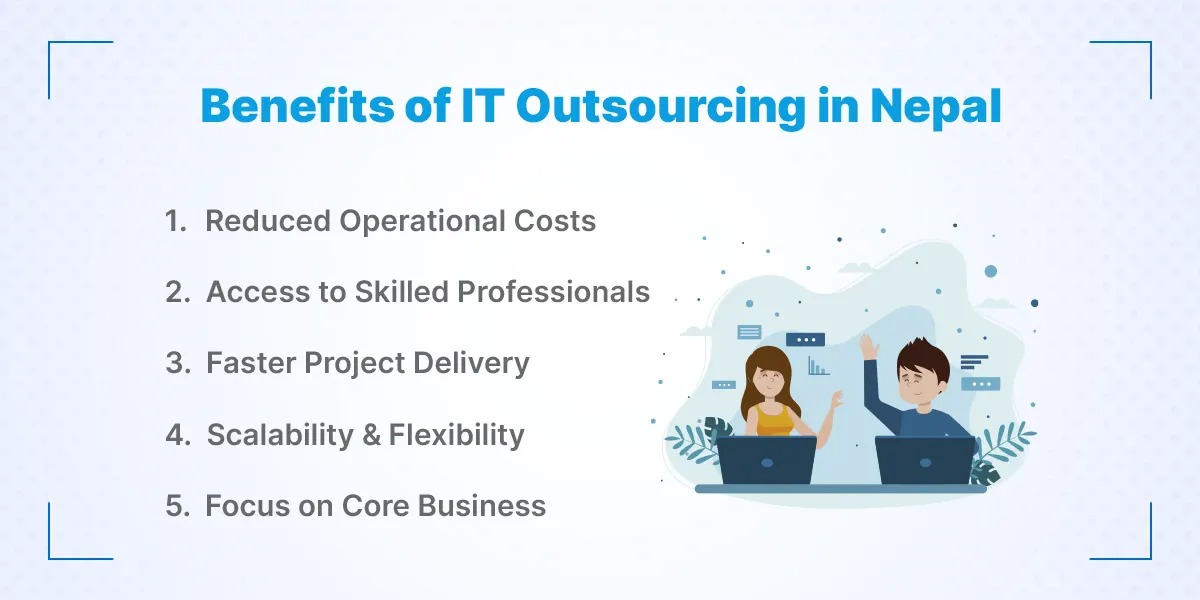
1. Reduced Operational Costs
One of the biggest benefits of IT outsourcing in Nepal is significant cost savings. Businesses can reduce expenses related to salaries, infrastructure, recruitment, and training. Compared to many other outsourcing destinations, Nepal offers high-quality IT services at a more affordable rate. This allows companies to allocate budgets more efficiently while maintaining strong output.
2. Access to Skilled IT Professionals
Nepal has a growing pool of skilled software developers, engineers, designers, and IT specialists. Many professionals are experienced in modern technologies, frameworks, and global project standards. Outsourcing gives businesses immediate access to this talent without long hiring cycles. This is especially valuable for niche or in-demand technical skills.
3. Faster Project Delivery
IT outsourcing teams in Nepal are structured to work efficiently and meet tight deadlines. With dedicated teams focused solely on project execution, development cycles become faster. Time zone overlap with many regions also helps with smoother collaboration. Faster delivery helps businesses launch products and updates more quickly.
4. Scalability and Flexibility
Outsourcing allows companies to scale teams up or down based on project needs. Whether you need a single developer or a full development team, outsourcing provides flexibility without long-term commitments. This adaptability is ideal for startups, growing businesses, and companies with fluctuating workloads. Scaling becomes simpler and less risky.
5. Greater Focus on Core Business Activities
By outsourcing IT tasks, businesses can focus more on strategy, growth, marketing, and customer experience. Technical responsibilities are handled by experts, reducing management overhead. This leads to better productivity and improved business outcomes. Outsourcing helps leadership concentrate on what matters most.
Related Blog: Benefits of HR Outsourcing in Nepal
Challenges of IT Outsourcing (and How to Overcome Them)
While IT outsourcing offers many advantages, businesses may also face certain challenges. The good news is that these challenges can be effectively managed with the right approach and partner.
- Communication gaps: Differences in time zones, language, or communication styles can sometimes cause misunderstandings. This can be overcome by setting clear communication channels, using collaboration tools (Slack, Zoom, Jira), and scheduling regular meetings.
- Quality control: Inconsistent quality may occur if expectations are not clearly defined. To avoid this, businesses should establish clear requirements, milestones, and performance benchmarks from the beginning, along with regular code reviews and testing.
- Data security concerns: Sharing sensitive data with an external team can raise security risks. This challenge can be managed by signing NDAs, implementing strict access controls, and ensuring the outsourcing partner follows international security standards.
- Managing remote teams: Coordinating work across remote teams can be challenging without proper processes. Using project management tools, defining roles clearly, and maintaining transparent reporting help ensure smooth collaboration and accountability.
How Much Does IT Outsourcing Cost in Nepal?
The cost of IT outsourcing in Nepal depends on several factors, including the project scope, technology stack, team size, and level of expertise required. Simple projects or maintenance work typically cost less, while complex software development, cloud solutions, or enterprise systems require higher budgets due to skilled resources and longer timelines.
Nepalese IT companies usually offer hourly pricing or project-based pricing. Hourly rates are suitable for long-term or flexible projects, while fixed project pricing works best for clearly defined requirements. Compared to other outsourcing destinations like India, Eastern Europe, or Southeast Asia, Nepal offers high-quality services at a more affordable cost, making it an attractive option for startups and global businesses seeking cost efficiency without compromising quality.
How to Choose the Right IT Outsourcing Partner in Nepal?
To choose the right IT outsourcing partner in Nepal, businesses should focus on proven experience, strong technical capability, clear communication, and long-term reliability, not just low cost. The right partner should understand your business goals, deliver consistent quality, and act as an extension of your in-house team rather than just a vendor. A careful evaluation helps reduce risks, improve project outcomes, and ensure smooth collaboration throughout the outsourcing journey.
1. Experience & Portfolio
An experienced IT outsourcing partner brings practical knowledge gained from real-world projects. Reviewing their portfolio helps you understand the types of industries, technologies, and project sizes they have handled. A strong track record indicates reliability and problem-solving ability. Experience also means the partner is better prepared to handle unexpected challenges during development.
2. Technical Expertise
Technical expertise is critical when outsourcing IT services. The partner should have skilled professionals across relevant technologies, frameworks, and platforms. They should be able to advise on the right tech stack and best practices, not just follow instructions. Strong technical depth ensures better code quality, scalability, and performance.
3. Communication & Transparency
Clear and consistent communication is essential for successful outsourcing. The right partner maintains transparency in timelines, progress updates, pricing, and potential risks. Regular meetings, clear documentation, and defined communication channels prevent misunderstandings. Good communication builds trust and keeps projects on track.
Explore Kumari Job's Outsourcing Services
4. Security and Compliance
Data security should be a top priority when outsourcing IT services. A reliable partner follows secure development practices, confidentiality agreements, and industry-standard security protocols. They should be familiar with data protection requirements and compliance standards relevant to international clients. Strong security measures protect your intellectual property and sensitive information.
5. Client Reviews & References
Client reviews and references provide insight into the outsourcing partner’s reliability and performance. Feedback from past clients highlights strengths, weaknesses, and overall service quality. Speaking directly with references can help you understand how the company handles deadlines, support, and long-term partnerships. Positive reviews indicate trustworthiness and consistent delivery.
Which is the Best IT Outsourcing Company in Nepal?
The best IT outsourcing company in Nepal is Kumari Job, based on experience, service quality, and long-term outsourcing support rather than just brand recognition. A truly “best” outsourcing partner is one that understands business goals, delivers consistent technical quality, maintains clear communication, and supports clients beyond project delivery.
With over 10+ years of experience, Kumari Job stands out by providing reliable IT outsourcing solutions backed by skilled professionals, structured processes, and transparent engagement models. Their focus on quality delivery, security, and long-term partnership makes them a strong choice for businesses looking to outsource IT services to Nepal with confidence.
IT Outsourcing vs In-House Development
IT outsourcing is often the better option for businesses looking to reduce costs, scale quickly, and access specialized skills without long-term overhead. In-house development offers more direct control, but it usually requires higher investment in hiring, infrastructure, and ongoing management.
Below is a clear comparison showing why IT outsourcing is generally the smarter and more flexible choice, especially for startups and growing enterprises.
| Factor | IT Outsourcing | In-House Development | Better Option |
|---|---|---|---|
| Cost | Lower costs, pay only for required services | High costs (salaries, benefits, infrastructure) | IT Outsourcing |
| Flexibility | Easy to scale team up or down | Hard to scale quickly | IT Outsourcing |
| Control & Management | Managed by an outsourcing partner | Full internal control required | Depends on need |
| Access to Skills | Immediate access to diverse tech expertise | Limited to hired staff | IT Outsourcing |
| Time to Start | Faster project kickoff | Slower due to the hiring process | IT Outsourcing |
| Best For | Startups, SMEs, global businesses | Large enterprises with stable teams | IT Outsourcing |
Conclusion
Nepal has emerged as a strong and reliable IT outsourcing destination due to its cost efficiency, growing pool of skilled IT professionals, flexible engagement models, and improving technology ecosystem. Businesses around the world are increasingly choosing Nepal to outsource software development, QA, DevOps, and IT support services while maintaining quality, speed, and scalability.
If you’re planning to outsource IT services, the key is choosing the right long-term partner that understands your business goals, offers transparent communication, and delivers consistent results. Ready to start your IT outsourcing journey? Partner with Kumari Job to access skilled talent, reduce costs, and build scalable tech solutions with confidence.
Frequently Asked Questions
Submit your comments

Get Our App On



SEO Training for Freshers in Nepal: Skills, Career & Job Opportunities
VIEW DETAILS
SEO Training vs. Self-Learning: Which Is Right for You?
VIEW DETAILS
How to Choose Between Two Job Offers
VIEW DETAILS
Digital Marketing Training Interview Questions and Answers for Freshers
VIEW DETAILS


Loading Comments...