



Do you dream of reporting the news in Nepal but feel completely stuck on where to begin? Maybe you have sent out your CV to media houses but never got a reply, or you worry you don't have the right degree. It is frustrating to have a passion for storytelling but no clear path to follow.
But do not lose hope. Journalism is a strong career option if you love news, research, and media. Nepal’s media sector is growing fast, and good jobs are opening up every day in newspapers, online portals, TV, and radio.
In this blog, we will show you exactly how to get journalist jobs in Nepal. We will cover the skills you need, the right qualifications, expected salaries, and simple job search tips to help you land your first job.
In this blog
What does a Journalist do in Nepal?
In simple words, a journalist is a storyteller who brings the truth to the public. Whenever something important happens in Nepal, whether it is about politics, local events, sports, or the economy, a journalist is the person who finds out the details and shares them with everyone else. Their main job is to keep people informed about what is going on around them.
A journalist does not just sit in an office all day. The job involves a lot of action and responsibility. Here are some of the common daily duties of a journalist in Nepal:
- Reporting the news: Going directly to the spot where an event is happening and collecting live updates.
- Researching stories: Looking deeply into a topic to find hidden facts and understand the real issue.
- Interviewing people: Talking to locals, leaders, experts, or eye-witnesses to get their opinions and quotes.
- Writing articles: Putting all the gathered information together into a clear, easy-to-read news report or blog post.
- Verifying facts: Checking and double-checking every single detail to make sure the news is true before sharing it.
- Creating public awareness: Highlighting social issues to help people understand important topics that affect their daily lives.
Today, the role of a journalist has grown a lot. You will find them working in print media like daily newspapers and magazines. You will also see them on television and hear them on local FM radio stations. With the rise of the internet, many journalists now work for online news portals and digital platforms, creating multimedia content to reach people right on their phones.
Why Choose Journalism as a Career in Nepal?
Choose journalism if you want a powerful career where you can tell true stories, expose wrongs, and bring positive changes to Nepali society. It is a job that gives you a loud voice and a chance to make a real difference in people's lives every single day. Plus, with so many new online platforms and TV channels opening up, you will find plenty of paths to build a stable and exciting future.
- A meaningful and impactful profession: Being a journalist means your daily work directly helps society by fighting corruption and solving local problems. When you write a good story, it can force leaders to take action and help the public.
- Inform the public and highlight important issues: People rely on you to know what is happening in the country, from new laws to daily market prices. You get to shine a light on hidden struggles and share stories that no one else is talking about.
- Career options in different media organizations: You are not stuck in just one type of job because you can work for daily newspapers, local FM radios, or national television stations. If you prefer the internet, you can join fast-growing online news portals or digital media companies.
- Great for writers and communicators: This is the perfect field if you naturally love talking to people, asking questions, and writing down your thoughts. It turns your daily interest in current affairs and public speaking into a full-time, paying job.
- Growing role of digital media in Nepal: The internet has completely changed how Nepalis read the news, creating many fresh jobs in digital reporting and social media. Because online news is so fast and popular now, young journalists have more chances to grow quickly in their careers.
What is the Scope of Journalist Jobs in Nepal?
The career scope for journalists in Nepal is wider than ever before. While traditional newspapers and TV channels are still very strong, the real explosion is happening in digital media. With over 1,000 registered online news portals, there is a massive demand for fresh talent who can write, report, and manage social media content. Whether you want to be a field reporter, a news anchor, or a digital content creator, there are plenty of open doors for you.
Beyond just reporting, journalism skills are now highly valued in many other sectors. Large companies, NGOs, and government offices in Nepal are constantly looking for people who can handle public relations, corporate communication, and professional writing. This means that even if you don't work in a traditional newsroom, your ability to tell stories and verify facts can lead to a stable and well-paying career in many different industries across the country.
Which Types of Journalist Jobs are Available in Nepal?
The media industry in Nepal is huge and offers many different roles for you to explore. Whether you like talking on camera, writing quietly at a desk, or traveling to new places, there is a perfect spot for you. You don't just have to be a traditional news writer to work in this exciting field. Let's look at the most common types of journalist jobs you can find in Nepal right now.
- News reporter: A news reporter gathers facts and writes stories about daily events happening in the country. They usually work in an office and make calls or check sources to build a full news report.
- Field reporter: This job requires you to go outside and visit the exact places where the news is happening. You will talk to locals, take quick notes, and send live updates back to your newsroom.
- TV journalist: TV journalists report the news directly in front of a camera for television channels. They need to speak clearly, look confident, and explain visual stories to the audience watching at home.
- Radio journalist: Working for local FM stations or national radio means your voice is your most important tool. You will read the news, interview guests over the phone, and host live talk shows.
- News anchor: A news anchor sits in a studio and presents the daily news bulletins to the public. They read from a screen, introduce other reporters, and keep the broadcast running smoothly.
- Content writer for media house: Media houses need writers to create engaging articles, blog posts, and background stories that are not hard news. You will focus on writing lifestyle, entertainment, or educational pieces for their websites.
- Sub-editor: A sub-editor checks the stories written by reporters to fix mistakes and make them better before publishing. They also write catchy headlines and decide where the story should be placed on a page or a website.
- Copy editor: The main job of a copy editor is to check grammar, spelling, and sentence structure very carefully. They make sure every single article is easy to read and follows the style rules of the media company.
- Investigative journalist: This is a tough job where you spend weeks or months digging into hidden secrets, crimes, or corruption. You need to be very brave and smart to uncover the truth that some people want to hide.
- Digital journalist: Digital journalists work mostly for online news portals and social media pages. They write quick updates, create internet-friendly content, and know how to use digital platforms to reach more readers.
- Photojournalist: A photojournalist tells the news using powerful pictures instead of just words. They travel to events, protests, or festivals to capture the perfect image that explains exactly what is happening.
- Freelance journalist: Freelancers do not work full-time for just one media company. Instead, they find good stories on their own and sell their articles, photos, or videos to different newspapers and websites.
How to Get Journalist Jobs in Nepal: Step-by-Step
To get a journalist job in Nepal, you need to complete your basic education, build real reporting skills, gain field experience through internships, make a strong work portfolio, and apply actively through job platforms. Following these exact steps will help you move safely from a total beginner to a working professional in the media industry. Let us look at each step closely so you know exactly what to do next to start your new career.
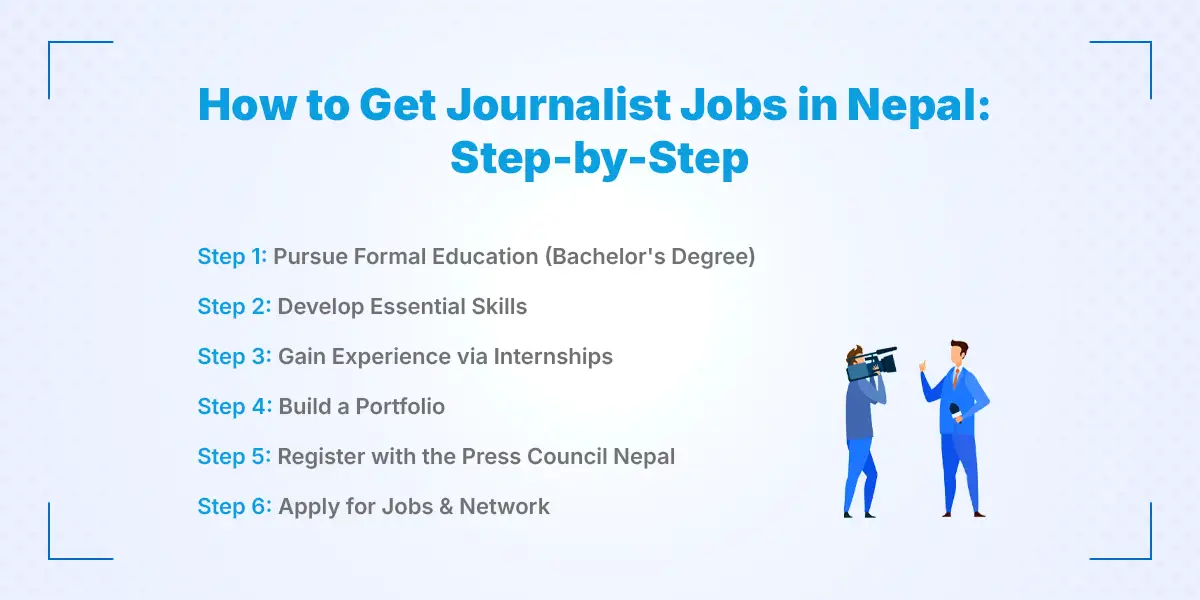
1. Pursue Formal Education (Bachelor's Degree)
The first step is to get the right education after finishing your plus two exams. Joining a Bachelor's degree in journalism or mass communication gives you a very strong start. Colleges in Nepal will teach you the basic rules of news writing and media ethics. You will also learn how the media industry works from the inside during your regular classes. Having this formal degree makes media houses trust you more when you apply for their jobs. Even if you study another subject, taking short media training courses can still help you enter this field.
2. Develop Essential Skills
Education alone is not enough, so you must build real reporting and writing skills yourself. You need to practice writing clear and true stories every single day at home. Learning how to talk to people politely and ask the right questions is very important for your future interviews. You must also know how to use digital tools like social media and basic video editing software. A good journalist always double-checks facts before writing anything down for the public. Building these practical habits early will make you fully ready for the fast pace of a real newsroom.
3. Gain Experience via Internships
Real newsrooms want people who know how to work, which is why internships are an absolute must. You should join a local daily newspaper, FM radio station, or online news portal as a trainee. During this time, you will go to the field and see exactly how senior reporters do their daily jobs. You will learn how to handle tight deadlines and write fresh stories very quickly. Most internships in Nepal do not pay much money, but the daily learning experience is totally worth it. Many hard-working interns actually get hired as full-time staff members in the exact same media company later.
4. Build a Portfolio
A portfolio is simply a collection of the absolute best news stories or videos you have ever made. Editors will always ask to see your past work before they give you a real job interview. You should safely save all the articles you published during your college days or your internship period. If you do not have any published work yet, you can start a free blog and write your own news reports there. Make sure to include different types of writing, like hard news, local interviews, and longer feature stories. Showing a neat and clean portfolio proves to editors that you are a serious and capable writer.
5. Register with the Press Council Nepal
To become an official journalist in Nepal, you need to follow the simple rules set by the government. You will eventually need to register yourself and your media work with the Press Council Nepal. Getting an official press pass from the Department of Information makes your daily reporting job much easier. This official ID card allows you to safely enter government offices and special closed events for news reporting. It also proves your real identity and protects you legally while you are doing your job in the field. Your media house will usually help you apply for this card once you become a regular staff member.
6. Apply for Jobs & Network
Once you are fully ready, it is time to actively look for open job positions in the local market. You can find many daily media openings by regularly checking the top job portals in Nepal. Make sure your resume is fully updated and clearly shows all your new skills and field experiences. Building a strong network by talking to senior journalists will also open many hidden doors for you. You should attend local media events, join active journalist groups on social media, and make new professional friends. Keep applying with full confidence, and soon you will land the perfect reporting job you want.
Qualifications Needed to Become a Journalist in Nepal
You do not need a mountain of certificates to start your journey in journalism. While having a degree is a big plus, many newsrooms in Nepal value your curiosity and writing ability even more. To build a strong foundation, you should focus on a mix of formal study and real-world practice. Here are the main qualifications that will help you land a journalist job in Nepal.
1. +2 or equivalent education
Completing your high school or +2 is the first basic step to enter this field. Most students choose the Humanities stream because it covers subjects like English, Nepali, and Social Studies, which are very helpful for reporting. However, even if you come from a Science or Management background, you can still transition into journalism later. This level of education helps you develop the basic reading and writing skills you will need every day.
2. Bachelor’s Degree in Journalism, Mass Communication, or Related Field
A Bachelor’s degree is highly recommended if you want to work for major media houses or national TV channels. Colleges under Tribhuvan University, Kathmandu University, and Purbanchal University offer great programs in Journalism and Mass Communication (BJMC). During these four years, you will learn about media laws, ethics, and how to structure a professional news story. Having this degree proves to employers that you are serious about the profession and understand the rules of the media world.
3. Media Training and Short Courses
If you have a degree in another subject but want to switch to news, short-term media training is a fantastic option. Institutes like the Nepal Press Institute (NPI) offer courses that last a few months and focus on specific skills like radio hosting or news anchoring. These classes are very practical and teach you how to use microphones, cameras, and editing software. It is a quick way to gain professional confidence without spending years in a classroom.
4. Internship and Field Experience
In journalism, what you can do is often more important than what you know. Doing an internship at a local newspaper, FM station, or online portal gives you "field experience" that you cannot get from books. You will learn how to handle tight deadlines, how to talk to strangers for interviews, and how a real newsroom functions. Most successful journalists in Nepal started as unpaid interns who proved their worth by being hardworking and reliable.
Skills Needed to Get Journalist Jobs in Nepal
Having a degree is good, but having the right skills is what actually gets you hired in a Nepali newsroom. Editors are looking for people who can jump right into the action and bring back a solid story. You need a mix of old-school writing and new-age digital tricks to stay ahead of the competition. Let’s look at the most important skills you should work on right now.
- Strong writing and reporting skills: You must be able to write news stories that are clear, short, and easy for everyone to understand. Good reporting means you can take a complicated event and explain it simply to your readers.
- Communication and interviewing skills: Being a journalist means talking to all kinds of people, from shopkeepers to government officials. You need to be polite but firm so you can ask the right questions and get honest answers.
- Research and fact-checking ability: Before you share any news, you have to make sure every single detail is 100% true and accurate. This involves looking through documents and talking to multiple sources to confirm the facts.
- Confidence and curiosity: You should never be afraid to go into new places or ask "why" when something doesn't seem right. A curious mind helps you find great stories that other people might just walk past.
- Knowledge of current affairs: You need to keep up with what is happening in Nepal and the rest of the world every single day. Reading the news daily helps you understand the background of the stories you will be covering.
- Nepali and English language skills: Since most news in Nepal is reported in Nepali, you need to be very good at writing and speaking it correctly. Knowing English is a huge bonus because it helps you read international news and translate information.
- Digital media and social media understanding: Almost everyone in Nepal gets their news from Facebook, TikTok, or Twitter these days. You need to know how to post updates, engage with followers, and make your stories go viral.
- Video editing, script writing, or multimedia skills: Modern journalists often have to record their own videos and edit them quickly on a phone or laptop. Learning how to write scripts for YouTube or TV will make you much more valuable to employers.
- Time management and deadline handling: News moves very fast, and you will often have to finish a story in just an hour or two. Being able to work quickly without making mistakes is one of the most important parts of the job.
- Ethical reporting and accuracy: A good journalist always follows the rules, stays honest, and never takes sides in a story. Your reputation depends on being fair to everyone and always telling the truth, no matter what.
Where to Find Journalist Jobs in Nepal?
You can find journalist jobs in Nepal by checking local job portals, media websites, social media groups, and professional networks. The internet has made it very easy to connect directly with big newsrooms and local FM stations. If you know exactly where to look, you will discover plenty of open roles waiting for fresh talent like you.
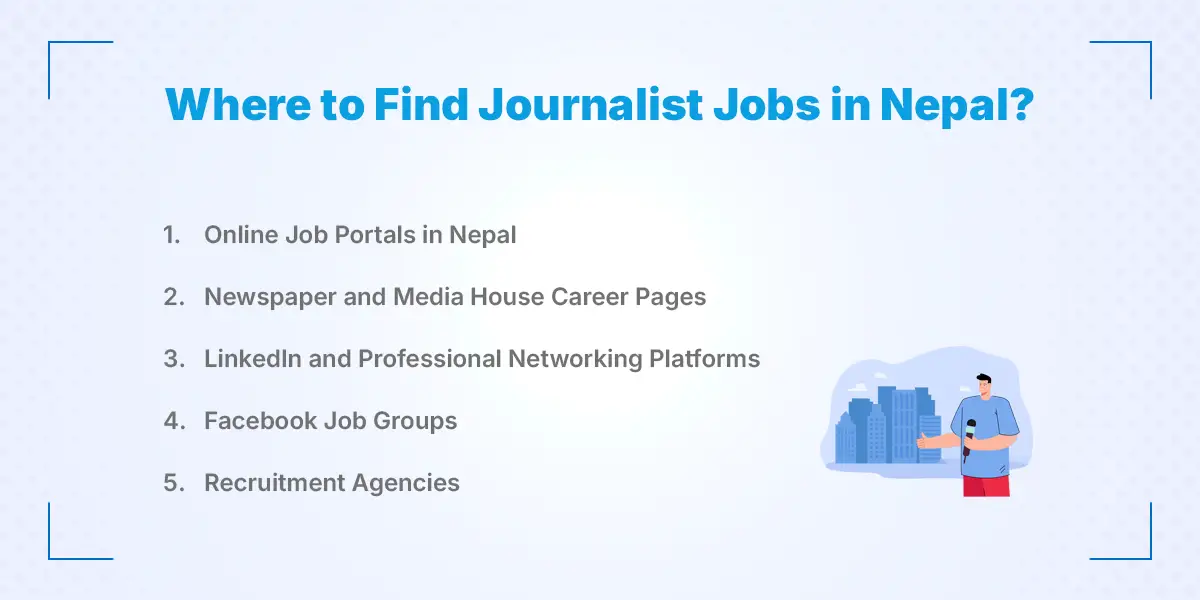
1. Online Job Portals in Nepal
The fastest way to find media jobs is by using the top job websites in the country. Platforms like Kumari Job list hundreds of daily openings for reporters, writers, and TV anchors. You can easily create a free profile there and upload your latest resume. These websites allow you to filter jobs by your city and your preferred salary. You will also get email alerts whenever a new media house posts a vacancy. This saves you a lot of time because you do not have to walk door to door asking for work.
2. Newspaper and Media House Career Pages
Big newspapers and television channels often post open jobs directly on their own websites. You should make a list of your favorite media houses in Nepal. Visit their official websites every week and look for a page called "Careers" or "Work With Us." They usually provide an email address where you can send your CV and your best writing samples. Applying directly shows the editor that you really want to work for their specific company. Sometimes, they do not advertise these jobs anywhere else, so you have a better chance of getting hired.
3. LinkedIn and Professional Networking Platforms
LinkedIn is a very powerful online tool for making professional connections in the media industry. Many senior editors and news directors in Nepal use this platform every single day. You can create a neat profile that clearly shows your reporting skills and field experience. If you follow local media companies, you will see their job updates right on your screen. You can even send a polite direct message to editors asking if they have any open spots. Sharing your published news stories on LinkedIn also helps you get noticed by big employers.
4. Facebook Job Groups
Almost everyone in Nepal uses Facebook, and it is actually a great place to find local work. There are many active Facebook groups created just for media professionals and freelance writers. You can search for groups using words like "Journalism Jobs Nepal" or "Media Vacancies Kathmandu." Group members often share urgent job openings that need to be filled very quickly. You can also write a short post introducing yourself and asking if anyone needs a reporter. Just make sure to chat safely and check if the company is real before sending your details.
5. Recruitment Agencies
Recruitment agencies are companies that help other businesses find the perfect workers. Some large media houses hire these agencies to find good reporters and news anchors for them. You can submit your CV to these local agencies for free. They will read your details and match you with a media job that fits your exact skills. The agency will also call you to set up the actual job interview with the newsroom. This is a very helpful option if you are completely new and do not have any media contacts yet.
Salary of Journalist Jobs in Nepal
One of the first questions people ask is how much money they can make. In Nepal, a journalist's salary is not the same for everyone. It depends heavily on the media house you join, your specific daily role, the city you work in, and your current skills. A TV anchor working in Kathmandu will usually earn more than a print reporter in a smaller town. However, here is a simple breakdown of what you can expect to earn at different stages of your career.
1. Entry-Level Salary
When you first start as a trainee or junior reporter, your salary will usually be between NPR 20,000 and NPR 40,000 per month. This starting pay is modest, but this early phase is mostly about learning the job and gaining real field experience.
2. Mid-Level Salary
After working hard for 3 to 5 years, your salary will grow to around NPR 40,000 to NPR 80,000 per month. At this stage, you are doing more important work, handling big news stories alone, and maybe even leading a small team.
3. Higher Salary Potential
Senior journalists, main editors, and top TV anchors can earn anywhere from NPR 70,000 to over NPR 150,000 per month. Working for large national TV channels or highly popular digital news platforms usually pays the absolute best money in this field.
4. Freelance Journalism Income Possibility
If you do not want a full-time boss, you can work as a freelance journalist and earn money by selling your stories to different media. A good freelancer can make a very high income, sometimes earning much more than a regular salary if they write for international websites too.
Is Journalism a Good Career in Nepal?
Yes, journalism is a very good career in Nepal, but it is not for everyone. It is the perfect job if you really enjoy writing, reporting, researching, and talking to the public every day. However, it is also a field that requires a lot of hard work and patience. You will not become rich overnight, but you will build a deeply respected and meaningful career over time.
Here is why you should consider journalism as your daily career:
- Exciting daily work: You will rarely be bored because you get to cover fresh stories, meet different people, and visit new places every single day.
- Real public impact: Your honest reporting can actually help solve local problems and bring highly positive changes to Nepali society.
- Many job options: You can easily choose to work in print media, local radio, national television, or fast-growing online news portals.
To be truly successful in this field, you need much more than just a college degree. Your career growth depends heavily on your reporting skills, your daily consistency, and your ability to build a strong network of contacts. You have to get real, practical exposure by working in the field and facing tight deadlines.
It is important to be realistic and know that the media industry in Nepal is quite competitive right now. Starting salaries can be low, and the working hours are often very long. But if you stay honest, keep improving your digital skills, and work hard, your career and salary will definitely grow over time.
Conclusion
Getting a journalist job in Nepal is not just about having a paper degree; it is about showing you can hunt for the truth. To get hired, you simply need to build strong writing skills, talk to people without fear, and understand how digital media works.
Your best path is to start with a basic internship, learn how a real newsroom operates, and collect your best printed or video stories into a solid portfolio. There is a huge demand for fresh talent in TV, radio, daily newspapers, and online portals right now. You just need to take the first practical step. Make sure your resume is ready, search for the latest media openings on Kumari Job today, and launch your exciting reporting career!
Frequently Asked Questions
Submit your comments

Get Our App On



SEO Training for Freshers in Nepal: Skills, Career & Job Opportunities
VIEW DETAILS
SEO Training vs. Self-Learning: Which Is Right for You?
VIEW DETAILS
How to Choose Between Two Job Offers
VIEW DETAILS
Digital Marketing Training Interview Questions and Answers for Freshers
VIEW DETAILS


Loading Comments...