



Most students in Nepal think that you need a very hard university degree or a lot of computer coding skills to get a good office job. You might be worried that because you don't know "programming," you can't work in the tech world. This is a common problem, but the truth is that many successful people in Kathmandu started exactly where you are today, with just a laptop and a desire to learn.
In this blog, I will show you a very simple plan to change your life. You will learn what an SEO expert actually does, why every business in Nepal wants to hire one, and how you can start earning a good salary in just a few months.
In this blog
What Does an SEO Expert Do?
An SEO expert is a professional who improves website visibility by aligning content and technical performance with search engine algorithms. They bridge the gap between what people are searching for and the solutions a business provides, ensuring the right audience finds the website organically.
Beyond just "ranking," an expert focuses on the quality of traffic and the user experience to turn visitors into customers. In Nepal, these specialists are essential for businesses that want to grow without spending a massive budget on daily paid advertisements.
1. Keyword Research and Competitor Analysis
Keyword research is the process of finding the specific words and phrases that people in Nepal type into Google. An SEO expert uses tools to see which words have high search volume and which ones are most likely to bring in customers. This step also involves looking at what other successful businesses are doing to see how they got to the first page. By understanding the "search intent," an expert ensures that the content actually solves the user's problem. Doing this correctly saves time because the business focuses only on keywords that actually lead to sales or inquiries.
2. Strategic On-Page Optimization
On-page optimization means fixing the content and structure inside your website so Google can understand it easily. The expert places the main keywords in important areas like the page title, the main heading (H1), and the first paragraph. They also write "meta descriptions," which are the short summaries you see on Google that encourage people to click. This process includes making sure the content is high-quality and easy to read for the visitors. Proper on-page SEO acts like a roadmap that guides search engine bots through your website's information.
3. Technical SEO Basics
Technical SEO is the "behind-the-scenes" work that makes a website run smoothly and fast. An expert checks if the website loads quickly on mobile phones, which is very important for users in Nepal with slow internet. They fix broken links and ensure that Google's robots can "crawl" and "index" every important page without getting stuck. This also includes setting up a secure connection (HTTPS) to protect user data and build trust with search engines. If the technical part of a site is broken, even the best content will fail to rank high.
4. Link Building and Authority
Link building is the practice of getting other respected websites to link back to your site. Google treats these links like "digital votes," where more votes from good sites make your website look more trustworthy and authoritative. An SEO expert reaches out to bloggers, news sites, and local directories to earn these links naturally. This is not about getting a high number of links, but rather getting links from high-quality and relevant sources. Strong link building is often the final push that moves a website from the second page to the top of the first page.
5. Performance Tracking and Reporting
Performance tracking is how an expert measures if the SEO work is actually helping the business grow. They use free tools like Google Search Console and Google Analytics to see how much organic traffic is coming in and which keywords are winning. Every month, the expert creates a report to show the business owner exactly how many people visited and how many became customers. This data helps the expert decide which parts of the strategy are working and which parts need to be changed. Without tracking, you are just guessing instead of making smart, data-driven decisions.
Why SEO Is a Growing Career in Nepal
SEO has become a top career choice in Nepal because local businesses are shifting their budgets from traditional flyers and radio ads to organic search. With the rapid rise of digital marketing agencies in Kathmandu and the growth of local eCommerce platforms, there is a massive demand for experts who can bring in free traffic. Startups now realize that ranking on the first page of Google is the most sustainable way to build a brand, creating a constant need for skilled SEO professionals in the local job market.
Another major reason for this growth is the high demand for remote and freelance SEO specialists who can work for international companies while living in Nepal. Since SEO is a global skill, many Nepali experts are now earning in foreign currency by managing websites for clients in the US, UK, and Australia. This flexibility allows for a high-income lifestyle and global work opportunities, making SEO a future-proof career that offers much more than a typical 9-to-5 office job.
Step-by-Step Guide to Becoming an SEO Expert in Nepal
Becoming an SEO expert in Nepal is a practical journey that combines structured learning with real-world application. By following a clear roadmap, you can transform from a complete beginner into a high-demand professional within a few months. This step-by-step approach ensures you build a deep understanding of how search engines work while gaining the hands-on experience needed to handle actual clients.
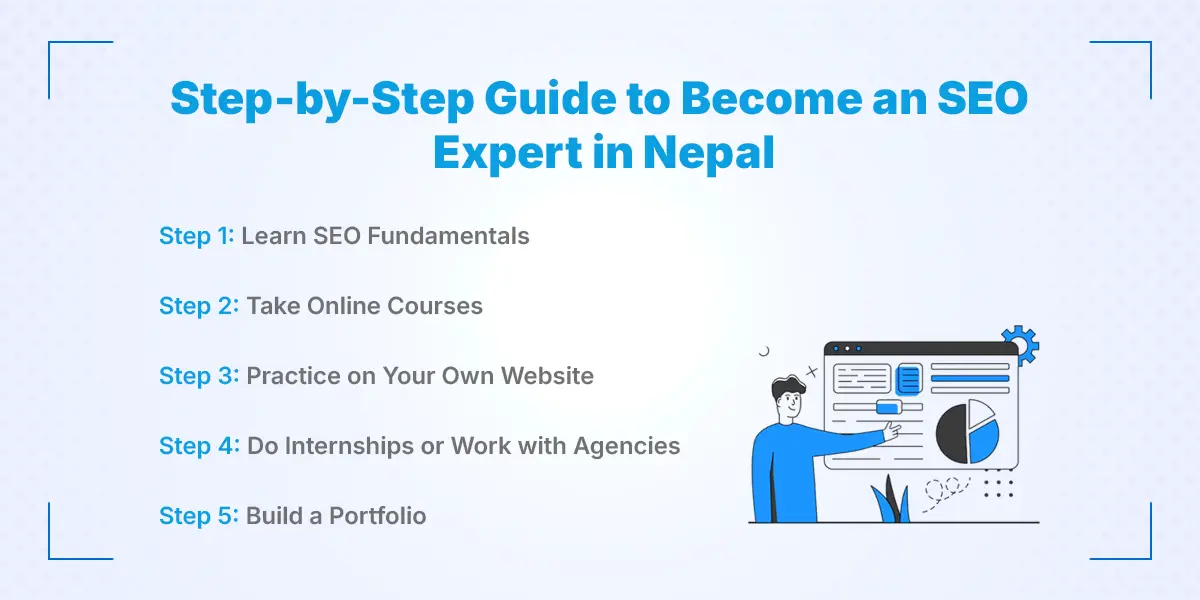
1. Learn SEO Fundamentals
You must start by understanding how search engines like Google find, read, and rank content to help users. This stage involves learning about crawling, indexing, and the primary pillars of SEO, which are On-page, Off-page, and Technical optimization. An expert knows that "search intent" is the most important part because you must provide exactly what the user is looking for. Understanding these core concepts ensures you build a strong foundation before moving on to more complex strategies. By mastering the basics, you will be able to explain the "why" behind every optimization you make on a website.
2. Take Online Courses
Taking structured courses helps you learn SEO in a logical order and prevents you from getting confused by random information. You can find excellent free and paid resources on platforms like Coursera, Udemy, and Google Digital Garage that offer recognized certifications. In Nepal, joining an advanced SEO Training course is highly recommended because it provides local mentorship and updated 2026 strategies. These courses often give you access to premium tools and community support that you cannot get through YouTube alone. Completing a course proves to employers that you have the discipline and technical knowledge required for the job.
3. Practice on Your Own Website
The best way to learn SEO is to build your own WordPress blog or a niche website and try to rank it on Google. You will learn much more by fixing real errors on your own site than by just reading theory or watching videos. Practicing on your own project allows you to experiment with different keywords and see how your changes affect your ranking over time. It serves as a "live laboratory" where you can test new tactics safely before applying them to a client’s business. Most successful experts in Nepal started by ranking their own small projects first.
4. Do Internships or Work with Agencies
Doing an internship in Nepal at an SEO agency is the best way to see how professionals manage many clients at the same time. During your internship in Nepal, you work under senior experts who show you how to handle real-world problems for different types of businesses. You will learn how to talk to clients, finish your work on time, and use expensive SEO tools that you might not be able to afford at home. This stage is very important because it teaches you the professional rules and workflows used in the Nepali market. Most agencies are happy to hire interns as full-time employees if they show they can actually grow a website's traffic.
5. Build a Portfolio
A portfolio is a collection of your work that proves to employers and clients that you can actually deliver results. Instead of just showing certificates, you should show screenshots of ranking improvements, traffic growth charts, and successful keyword strategies. Your portfolio should explain the problems you found on a website and the specific steps you took to solve them. Having a strong, data-backed portfolio is your most powerful tool for negotiating a higher salary or landing high-paying freelance clients. In the SEO world, real results are much more valuable than any university degree.
Ready to become an SEO expert in Nepal?
Join our job-oriented digital marketing training to gain practical SEO skills, real project experience, and career guidance to land a high-paying job faster.
Skills You Need to Become an SEO Expert
Becoming a successful SEO specialist requires a unique blend of technical knowledge and creative strategy. While you do not need to be a computer scientist, you must master specific digital skills to help search engines understand and trust your website content.
In the 2026 digital landscape, these skills are the foundation of every high-ranking website and are essential for any professional working in the Nepali market.
1. Keyword Research Skills
Keyword research is the most fundamental skill because it determines the entire direction of your SEO strategy. You must learn how to identify the exact words and phrases your target audience uses to search for products or services. This involves analyzing search volume, competition levels, and "search intent" to ensure you are targeting words that will actually lead to business growth. An expert uses these insights to build a content map that answers the specific questions of their customers. Mastering this skill ensures that your marketing efforts are never wasted on the wrong audience.
2. Basic HTML and Website Structure Knowledge
While you do not need to be a programmer, you must understand the basic HTML tags that influence how a website is ranked. You need to know how to locate and optimize title tags, meta descriptions, and header tags (H1-H6) within the website’s code. Understanding website architecture is also important because it helps you create a logical hierarchy that makes it easy for Google to crawl your site. This knowledge allows you to communicate effectively with web developers when technical changes are needed. Being comfortable with the "back-end" of a site gives you much more control over its search performance.
3. Content Optimization
Content optimization is the skill of writing and organizing text so that it is both engaging for humans and readable for search engine bots. You must learn how to naturally integrate keywords into your articles without making them look like "spam" to the reader. This also includes optimizing images with alt-text and ensuring that your paragraphs are short and easy to scan on mobile devices. A skilled expert knows how to structure a page so that it provides the best possible answer to a user's query. Good content optimization is what keeps visitors on your site longer and reduces your "bounce rate."
4. Analytical Skills (Google Analytics & Search Console)
Analytical skills allow you to turn raw data into a clear plan for improving your website's performance. You must be proficient in using Google Search Console to monitor your site's health and Google Analytics 4 (GA4) to track user behavior. These tools show you exactly which pages are winning, where you are losing traffic, and how users are interacting with your content. An SEO expert looks at these numbers to identify trends and prove the ROI of their work to clients or employers. Without strong analytical skills, you are essentially "flying blind" and cannot make data-driven improvements.
5. Link-Building and Outreach Strategies
Link-building is a social and strategic skill that involves getting other high-quality websites to link to your own. You must learn how to identify reputable websites in your niche and reach out to them with valuable content or partnership ideas. This requires strong communication and "digital PR" skills to build relationships with bloggers, journalists, and industry influencers. Links act as "votes of confidence" for Google, and knowing how to earn them ethically is what truly builds a website's authority. Mastering outreach ensures your website gains the trust it needs to stay at the top of the search results for the long term.
Want to take your SEO skills to the next level?
Enroll in our advanced digital marketing training to master SEO strategies, work on live projects, and get career support that accelerates your professional growth.
Where to Learn SEO in Nepal?
In Nepal, you can master SEO through classroom-based training at local institutes, flexible online platforms, or by gaining direct experience through internships and personal projects. While many free resources exist, most successful experts in 2026 prefer a mix of structured training and hands-on practice to stay ahead of changing search algorithms.
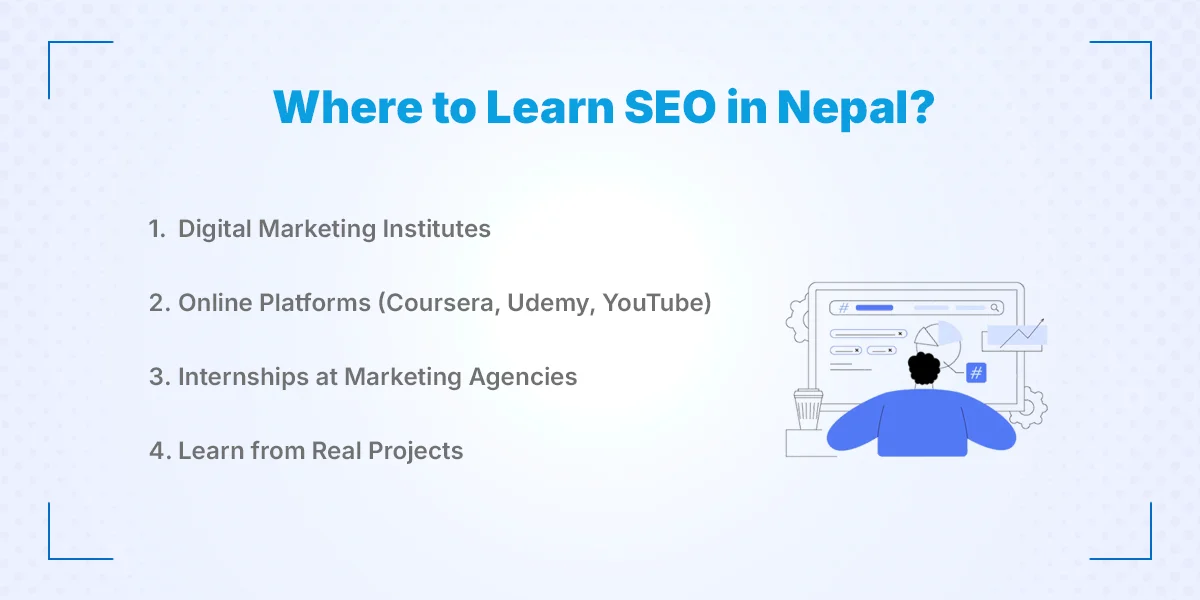
1. Digital Marketing Institutes
Enrolling in a local institute is the most effective way for beginners to get a structured education with direct mentorship. In Nepal, Kumari Job is a leading choice that provides Job-Oriented Digital Marketing Training specifically designed to make you hireable. Their program stands out because it offers 100% job placement assistance, ensuring you move directly from the classroom into a professional role. For those who already have a baseline understanding, they also offer Advanced Digital Marketing Training that focuses on complex technical audits and advanced data analytics.
2. Online Platforms (Coursera, Udemy, YouTube)
Online platforms provide an affordable and flexible way to learn the latest global SEO trends from international experts. Websites like Coursera and Udemy offer comprehensive specializations that provide recognized certificates upon completion. If you are on a budget, YouTube channels from industry leaders like Ahrefs or Brian Dean are excellent for staying updated with 2026 algorithm changes. While these platforms are great for theory, you must be disciplined enough to practice the lessons on your own to truly understand how they work.
3. Internships at Marketing Agencies
Internships at digital marketing agencies in Kathmandu allow you to see how professional SEO campaigns are managed for real clients. During an internship, you will assist senior experts with tasks like keyword tracking, link-building outreach, and technical site audits. This environment teaches you the "agency workflow" and how to meet deadlines in a fast-paced professional setting. Most interns in Nepal gain enough confidence and proof of work during their 3-month tenure to secure a full-time position as a Junior SEO Executive.
4. Learn from Real Projects
Nothing beats the experience of building your own website and trying to rank it for competitive keywords. By working on a real project like a personal travel blog or a local news site, you encounter real-world technical issues that textbooks cannot simulate. You will learn to navigate CMS platforms like WordPress and see exactly how your optimizations impact your Google Search Console data. Successfully ranking a personal project serves as the ultimate proof of your expertise when you are ready to apply for high-paying jobs or freelance contracts.
How Much Can an SEO Expert Earn in Nepal?
In Nepal, an SEO expert's salary typically ranges from NPR 15,000 to over NPR 150,000 per month, depending on their experience and the type of company they work for. Freshers usually start with a lower local salary between NPR 15,000 and NPR 30,000, while mid-level specialists with 2 to 5 years of experience can earn between NPR 45,000 and NPR 85,000. As of 2026, the income potential has grown because businesses are moving away from paid ads toward organic search to save costs and build long-term value.
The most lucrative opportunities come from freelancing and remote work, where specialists can earn between NPR 50,000 and over NPR 300,000 per month. Freelancers often handle multiple local or international clients simultaneously, while remote experts secure roles with companies in the US or Europe that pay in dollars (ranging from $800 to $2,500+). This path allows you to earn a global-level wage while living in Nepal, making SEO one of the most financially rewarding digital careers available today.
Tools Every SEO Expert Should Learn
To stay competitive in the 2026 digital market, an SEO expert must master a specific set of tools that handle everything from tracking data to auditing website health. These tools act as your "eyes and ears" on the internet, showing you exactly how Google sees your site and where your competitors are winning. Mastering these five essential tools will move you from guessing what works to making data-backed decisions that guarantee ranking growth.
1. Google Search Console
Google Search Console is the most important free tool because it provides first-party data directly from Google about your website's health and performance. It shows you exactly which keywords are bringing people to your site and if there are any technical errors stopping your pages from being indexed. You should use it daily to check for "manual actions" or security issues that could hurt your rankings. It is the only tool that gives you a 100% accurate view of how Googlebot crawls and perceives your website.
2. Google Analytics (GA4)
While Search Console shows you how people find your site, Google Analytics 4 (GA4) shows you what they do once they arrive. This tool tracks user behavior, such as how long they stay on a page, which buttons they click, and if they actually buy something or fill out a form. An expert uses GA4 to understand which content is high-quality and which pages are making users leave too quickly. Mastering the event-based tracking in GA4 is essential for proving that your SEO work is actually helping the business grow.
3. Ahrefs / SEMrush
Ahrefs and SEMrush are premium "all-in-one" SEO platforms that are used for deep competitor research and backlink analysis. Ahrefs is often preferred for its massive database of links, while SEMrush is famous for its "Keyword Magic Tool" and detailed PPC data. These tools allow you to see exactly which keywords your competitors are ranking for and where they are getting their backlinks from. Using these platforms helps you find "keyword gaps" where you can create content to steal traffic away from other businesses in your industry.
4. Google Keyword Planner
Google Keyword Planner is a free tool inside Google Ads that helps you find new keyword ideas and see how many people search for them each month. Although it is built for advertisers, it is a "goldmine" for SEO experts because the data comes directly from Google’s own search database. You can see the "competition level" for specific terms and get suggestions for related keywords you might have missed. It is the best place for beginners in Nepal to start their keyword research journey without spending any money on paid software.
5. Screaming Frog
Screaming Frog is a desktop-based "website crawler" that mimics how Google’s robots look at your site to find technical problems. It can quickly scan thousands of pages to find broken links, missing meta descriptions, and duplicate content that could be hurting your SEO. Unlike online tools, it gives you a very detailed "under-the-hood" look at your website's skeleton and technical architecture. Mastering Screaming Frog is a requirement for anyone who wants to become a professional technical SEO specialist or conduct deep site audits.
Common Mistakes Beginners Make
Many beginners in Nepal fail in SEO because they treat it like a "quick trick" rather than a long-term business strategy. Avoiding these common traps is what separates a professional expert from someone who just makes a website's ranking worse. Understanding these mistakes early will save you months of wasted effort and help you build a career based on real, lasting results rather than temporary hacks.
1. Expecting Quick Results
SEO is a marathon, not a sprint, and it usually takes 3 to 6 months to see significant ranking changes. Beginners often get frustrated and quit after just a few weeks because they don't see their website on the first page immediately. Google needs time to trust your site and verify that your content is better than what is already there. If you try to "force" rankings with shortcuts, you risk getting your website penalized or banned entirely. Patience is the most important skill an SEO expert can have.
2. Ignoring Technical SEO
Many new marketers focus only on writing keywords and completely forget about the "health" of the website. If your site is extremely slow, not mobile-friendly, or has broken links, Google will not rank it—no matter how good your content is. In Nepal, where internet speeds can vary, a website that isn't technically optimized will lose visitors instantly. Technical SEO is the foundation of your house; if the foundation is weak, the rest of your work will eventually collapse.
3. Copying Content (Plagiarism)
One of the biggest mistakes is copying articles from other websites and pasting them onto your own. Google's algorithm is incredibly smart at detecting "duplicate content" and will stop showing your site in search results if it thinks you are stealing work. Even "spinning" or slightly changing words in an existing article is a bad strategy that leads to poor rankings. You must provide Information Gain, which means sharing your own unique thoughts, local Nepali data, or better explanations than what already exists.
4. Not Tracking Performance
You cannot improve what you do not measure, yet many beginners never check their data. Working on SEO without using tools like Google Search Console or GA4 is like driving a car with your eyes closed. You need to know which keywords are working, which pages are failing, and where your traffic is coming from to make smart decisions. Without tracking, you might be spending hours on a strategy that isn't actually helping the business grow.
Who is the Best SEO Expert in Nepal?
Sujit Chaulagain, Sachin Shrestha, and Bipin Kunwar are widely regarded as the best SEO experts in Nepal because they have moved beyond traditional keyword strategies to master specialized high-growth sectors. Their work is characterized by a "future-ready" approach that integrates AI-driven search (like Google's AI Overviews), technical automation, and high-converting content funnels.
1. Sujit Chaulagain – SaaS & International SEO Specialist
Sujit Chaulagain is a top-tier SEO specialist in Nepal with over 5 years of experience scaling global brands. He is known for his ability to compete in high-difficulty international markets, specifically for SaaS and B2B tech companies.
Proven Expertise: He has a track record of driving high-intent product demos and software sign-ups through deep topical authority.
Modern Tactics: Sujit focuses heavily on AEO (Answer Engine Optimization) and ranking in "Position 0" to ensure visibility in modern AI-powered search results.
Technical Edge: He utilizes Python for SEO automation and deep performance analysis, making him a go-to expert for complex technical audits.
2. Sachin Shrestha – SaaS & Content Strategy Expert
With over 3 years of experience, Sachin Shrestha has carved out a niche as an expert in the intersection of content marketing and SaaS growth. He specializes in creating content that doesn't just rank but serves as a lead-generation engine.
Content Focus: He is an expert in Search-Intent-Driven Writing, ensuring that every piece of content aligns with the user's stage in the buying journey.
Full-Funnel Approach: Sachin integrates WordPress development with SEO to ensure high-performing site speed and seamless user experiences.
Industry Versatility: While he excels in SaaS, he has worked across diverse sectors, helping startups and established companies attract the "right" audience rather than just generic traffic.
3. Bipin Kunwar – Local SEO & Link Building Expert
Bipin Kunwar, the founder of SEOwithBipin, is recognized as a leading Local SEO expert in Nepal. He is particularly specialized in helping niche-specific businesses—like travel, trekking, and sports agencies—dominate local search results.
Link Building Specialist: Bipin is known for ethical and effective link-earning strategies, such as guest posting and internal linking, that build long-term domain authority.
Local Market Mastery: He helps businesses improve their Google Business Profiles and local citations to capture high-intent "near me" traffic.
Strategic Growth: He focuses on building topical authority and utilizing data-driven SEO to help brands grow their online visibility in specific local industries.
Conclusion
SEO is a powerful and high-growth career opportunity in Nepal for anyone willing to master the 2026 digital landscape. It is a field that rewards skill and consistency over formal degrees, making it the perfect path for students, freshers, and career-switchers alike.
By starting small, practicing on real websites daily, and focusing on measurable results, you can build a stable and high-paying professional life. The journey from a beginner to an expert requires patience, but the rewards, including global work flexibility and high salary potential, are well worth the effort.
Take the first step toward your professional future today. Join our Job-Oriented and Advance Digital Marketing Training at Kumari Job to get 100% job placement assistance and learn from industry-leading experts!
Frequently Asked Questions
Submit your comments

Get Our App On



SEO Training for Freshers in Nepal: Skills, Career & Job Opportunities
VIEW DETAILS
SEO Training vs. Self-Learning: Which Is Right for You?
VIEW DETAILS
How to Choose Between Two Job Offers
VIEW DETAILS
Digital Marketing Training Interview Questions and Answers for Freshers
VIEW DETAILS


Loading Comments...