


Is studying BA in Nepal still worth it in today’s competitive job market? Or is it just another “safe” degree people choose without thinking much about the future? Many students hear mixed opinions, some say BA has limited opportunities, while others quietly build successful careers in government offices, media houses, banks, and NGOs. The truth lies somewhere in between, and it depends largely on how you plan your journey after graduation.
In this blog, we’ll explore the BA scope in Nepal in detail, from career opportunities and salary expectations to government jobs, private sector roles, and higher study options. Whether you’re a +2 graduate confused about choosing BA or a current student wondering what comes next, this guide will give you a clear picture of what the future can look like after a BA in Nepal.
In this blog
Who is a BA Graduate?
A BA graduate is a student who has completed a Bachelor of Arts degree in subjects related to the humanities, social sciences, or liberal arts. This typically includes fields such as English, Sociology, Political Science, Economics, Psychology, History, or Mass Communication. The program focuses on developing analytical thinking, communication skills, and a deeper understanding of society and human behaviour. Unlike technical degrees, BA emphasises conceptual clarity and critical thinking over practical lab-based training.
In Nepal, a BA graduate is often someone preparing for diverse career paths rather than a single fixed profession. Many choose BA as a foundation for government jobs, teaching careers, journalism, banking, or NGO work. Others use it as a stepping stone toward higher studies like MA, MBA, or even law. Simply put, a BA graduate is not limited by one job title, the direction depends on the skills they build and the choices they make after graduation.
BA Scope in Nepal
The BA scope in Nepal is broader than many students initially assume. While BA is often seen as a general degree, it opens doors to multiple career paths in government, private companies, education, media, and development sectors. The demand for graduates with strong communication, analytical, and social understanding skills is steadily increasing. With the right specialisation and additional skills, BA graduates can build stable and rewarding careers. The key lies in understanding where opportunities exist and how to prepare for them.
1. Growing Demand for Humanities and Social Science Graduates
There is a steady demand for professionals who understand society, culture, governance, and human behaviour. Subjects like Sociology, Political Science, and Economics are increasingly relevant in policymaking and development work. Organisations need individuals who can analyse social trends and community issues. Research institutions and development agencies often recruit graduates from humanities backgrounds. As Nepal continues to evolve socially and politically, the relevance of social science graduates continues to grow.
2. Expanding Media, Education, and NGO Sectors
Nepal’s media industry, private schools, colleges, and NGOs are expanding rapidly. BA graduates with backgrounds in English, Journalism, or Social Sciences find opportunities in teaching, content creation, reporting, and project coordination. The NGO and INGO sector particularly values graduates with strong communication and research skills. Development projects require field officers, documentation officers, and program assistants. This growth directly increases the career scope for BA graduates in Nepal.
3. Government and Public Service Opportunities
One of the strongest areas in the BA scope in Nepal is government employment. Many BA graduates prepare for Lok Sewa (Public Service Commission) exams to secure government jobs in Nepal. Positions in administrative services, revenue offices, and local government units are common career goals. The degree provides a solid foundation for subjects tested in competitive exams. With proper preparation, government service offers stability and long-term career growth. For many students, this remains one of the most attractive career paths.
4. Increasing Demand in Private Sector and Corporate Roles
Private companies in banking, insurance, marketing, and human resources also hire BA graduates. Communication skills, report writing, and analytical ability are highly valued in corporate settings. Entry-level roles such as administrative officer, HR assistant, and customer service executive are common starting points. With experience and professional certifications, career growth becomes achievable. The private sector now offers more opportunities than it did a decade ago.
5. Opportunities for Higher Studies in Nepal and Abroad
BA also serves as a strong academic foundation for postgraduate studies. Graduates can pursue MA, MBA, MPA, LLB, or other specialised degrees. Higher education significantly improves career prospects and salary potential. Some students also apply for international scholarships for further study. A master’s degree often opens doors to senior-level positions. Therefore, the scope of BA in Nepal expands considerably with continued education.
Career Opportunities After BA in Nepal
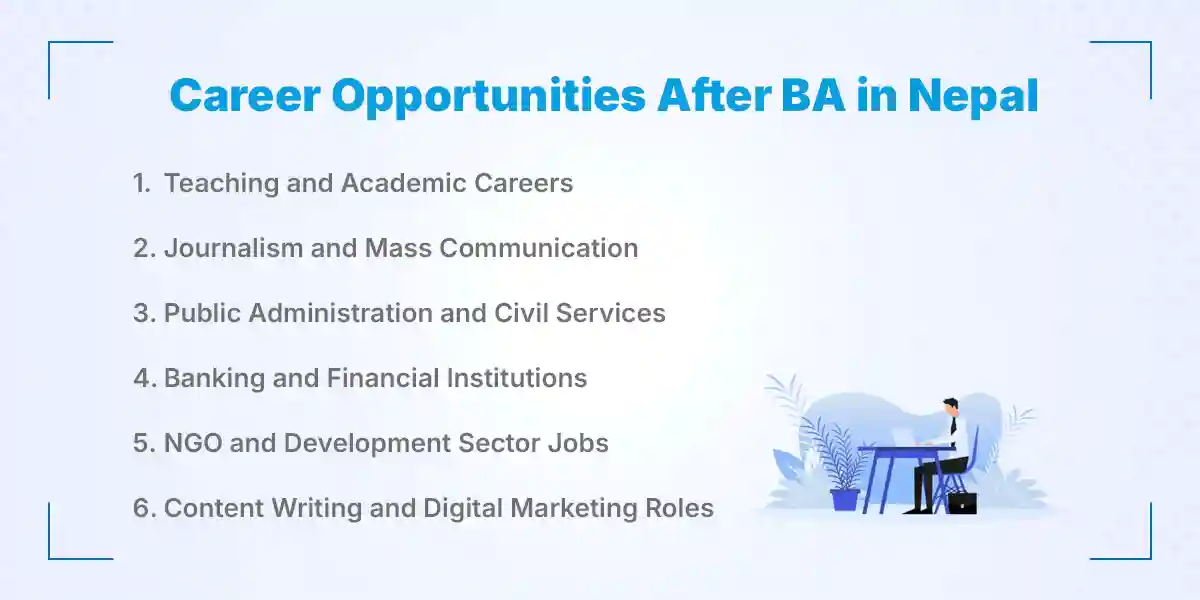
Career opportunities after BA in Nepal are diverse and flexible, depending on the subject specialisation and skills developed during study. Unlike technical degrees that lead to one fixed path, BA allows graduates to explore multiple sectors. From government offices and banks to media houses and NGOs, opportunities exist across industries. The key is to combine academic knowledge with practical skills and experience. Let’s look at some of the most common career options available.
1. Teaching and Academic Careers
Many BA graduates choose teaching as their primary career path. After completing BA, students can pursue B.Ed. or MA to qualify for secondary school or college-level teaching. Subjects like English, Social Studies, and Economics are in steady demand in private schools and colleges. Teaching offers job stability and long-term career growth. With higher qualifications, one can become a lecturer or academic researcher. It remains one of the most popular and respected careers after BA in Nepal.
2. Journalism and Mass Communication
BA graduates with strong writing and communication skills often enter journalism and media. They may work as reporters, editors, content creators, or news analysts. Nepal’s growing digital media platforms have increased demand for skilled communicators. Those specialising in English, Political Science, or Mass Communication have an added advantage. Media careers require creativity, awareness of current affairs, and strong analytical skills. With experience, opportunities in television, radio, and online platforms expand further.
3. Public Administration and Civil Services
Public administration is a major career goal for many BA graduates. Preparing for Lok Sewa examinations is common among students from humanities backgrounds. Subjects studied during BA often align with civil service exam syllabi. Successful candidates can secure positions in administrative services, revenue offices, and local government bodies. Government jobs offer job security and structured career progression. For students seeking stability and public impact, this path is highly attractive.
4. Banking and Financial Institutions
BA graduates can also enter the banking and financial sector. Entry-level roles such as assistant, customer service officer, or relationship officer are common. Banks value communication skills, analytical thinking, and administrative ability. Additional certifications in finance or management can improve career prospects. Over time, experience leads to promotions into supervisory or managerial roles. The financial sector in Nepal continues to provide steady employment opportunities.
5. NGO and Development Sector Jobs
Nepal has a strong presence of NGOs and INGOs working in education, health, and community development. BA graduates often work as program assistants, field officers, or documentation officers. Social science knowledge is particularly useful in development projects. Strong reporting and research skills are valued in this sector. Career growth depends on experience and project performance. For those interested in social impact, this field offers meaningful opportunities.
6. Content Writing and Digital Marketing Roles
With the rise of digital platforms, content writing and digital marketing have become emerging career options. BA graduates with strong English and research skills can explore opportunities to get content writer jobs in Nepal, as well as roles like social media managers or SEO executives. Many start as freelancers before joining companies. Digital skills such as SEO, blogging, and social media strategy increase employability. The online industry continues to grow in Nepal, offering flexibility and strong income growth potential for skilled individuals.
Job Roles for BA Graduates in Nepal
BA scope in Nepal becomes clearer when we look at specific job roles graduates commonly pursue. A BA degree does not limit students to one profession; instead, it prepares them for multiple entry-level and mid-level positions across sectors. From education and government services to media and corporate offices, job roles vary depending on specialisation and additional qualifications. Practical skills and competitive exam preparation often determine career direction. Below are some common roles BA graduates take up in Nepal.
1. School Teacher or Lecturer
Many BA graduates begin their careers as school teachers, especially after completing B.Ed. or MA. Subjects like English, Social Studies, and Economics are widely taught in schools across Nepal. Teaching at the secondary level offers a stable income and long-term career growth. Graduates who want to get teacher job in Nepal often pursue additional certifications and teaching licenses. With higher qualifications and experience, they can also become lecturers at colleges. Academic careers allow opportunities for research and professional development, making them one of the most preferred job roles after BA.
2. Administrative Officer
Administrative officers work in offices, institutions, and corporate organizations managing daily operations. BA graduates with good communication and organisational skills fit well in such roles. Responsibilities include documentation, coordination, reporting, and office management. Many start in entry-level administrative positions and grow with experience. Strong computer and management skills increase promotion chances. This role provides exposure to both public and private sector environments.
3. Journalist or Content Creator
Graduates with strong writing skills often pursue careers in journalism or digital content creation. They may work in newspapers, television channels, online media, or as freelance writers. Awareness of current affairs and analytical thinking is essential in this field. Content creators also work in marketing agencies and corporate communication departments. As digital media expands in Nepal, opportunities continue to grow. Experience and networking play a key role in career advancement.
4. Human Resource Officer
BA graduates can work as HR officers in private companies and institutions. This role involves recruitment, employee coordination, documentation, and performance management. Communication and interpersonal skills are highly important in human resources. Many professionals pursue additional certifications in HR or management to advance their careers. With experience, HR officers can move into managerial positions. The corporate sector increasingly values organised and people-oriented professionals.
5. Social Worker or Development Officer
Many BA graduates join NGOs and INGOs as social workers or development officers. They work on community projects related to education, health, women's empowerment, and rural development. The role often involves field visits, reporting, and coordination with stakeholders. Social science knowledge is particularly useful in understanding community needs. Career growth depends on project performance and experience. This role suits individuals interested in social impact and grassroots development.
6. Government Officer (Through Lok Sewa)
One of the most attractive career paths after BA is becoming a government officer through Lok Sewa. BA subjects align well with competitive exam syllabi, especially in public administration and general knowledge. Successful candidates secure positions in administrative services, revenue departments, and local government offices. Government jobs offer job security, structured promotion systems, and social respect. Preparation requires dedication and consistent study. For many students, this remains the ultimate goal within the BA scope in Nepal.
Salary After BA in Nepal
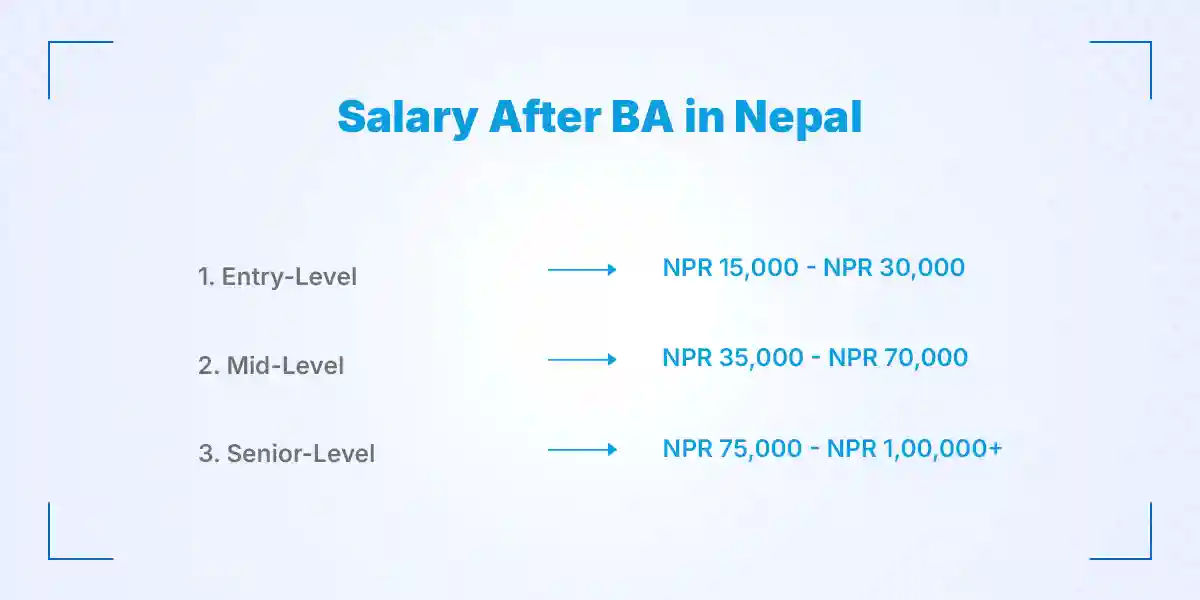
Salary after BA in Nepal depends largely on the sector, job role, skills, and experience level. While entry-level positions may offer modest starting pay, growth becomes noticeable with experience and higher qualifications. Government jobs, private sector roles, and NGO positions each follow different pay structures. Understanding the average salary in Nepal helps set realistic expectations at the beginning of a career. BA scope in Nepal becomes financially stronger when graduates invest in skill development and further education. Let’s break down the typical salary range at different career stages.
1. Entry-Level Salary
Fresh BA graduates usually start with entry-level salaries ranging from NPR 15,000 to NPR 30,000 per month. Positions such as administrative assistant, junior teacher, office staff, or customer service representative fall into this range. Private schools and small organisations often offer salaries on the lower end. Skills like computer proficiency and communication can slightly increase starting pay. Experience during internships can also make a difference. Though modest, this stage helps build practical experience.
2. Mid-Level Salary
With 3-5 years of experience, salaries generally increase to NPR 35,000 - NPR 70,000 per month. Mid-level professionals may work as senior teachers, HR officers, journalists, or government officers. Promotion within private companies or NGOs also leads to salary growth. Additional qualifications, such as MA, MBA, or professional certifications, significantly improve earning potential. Performance and leadership skills play a key role at this stage. Income becomes more stable and sustainable.
3. Senior Level Salary
At senior levels, experienced professionals can earn NPR 75,000 to NPR 1,00,000 or more per month. Senior lecturers, department heads, NGO project managers, and government officers fall into this category. Salary varies based on organisation size and responsibility level. Those in leadership or management roles tend to earn higher compensation. International NGOs and large private institutions may offer competitive packages. Career growth at this level depends heavily on expertise and long-term experience.
Skills Required to Succeed After BA in Nepal
BA scope in Nepal does not depend on the degree alone, it depends heavily on the skills you build alongside it. A BA program develops theoretical understanding, but career success requires practical competencies. Employers in Nepal look for graduates who can communicate clearly, think critically, and adapt to changing work environments. Strengthening key professional skills can significantly improve job opportunities and salary growth. Below are the most important skills BA graduates should focus on.
1. Communication and Presentation Skills
Strong communication skills are essential in almost every field after BA. Whether working in teaching, banking, NGOs, or corporate offices, clear verbal and written communication matters. Presentation skills are particularly important for meetings, reporting, and public speaking roles. Confidence in expressing ideas can set you apart from other candidates. Good communication also improves networking and professional relationships. In many cases, it becomes the deciding factor in job interviews. Strong communication builds trust and professional credibility in the workplace.
2. Critical Thinking and Analytical Skills
Critical thinking allows BA graduates to analyze problems and make informed decisions. Subjects in humanities and social sciences naturally develop this ability. Employers value individuals who can evaluate information logically and propose solutions. Analytical skills are especially important in government jobs, research roles, and corporate positions. The ability to assess data and understand social trends is highly useful. These skills enhance professional credibility and career growth. Strong analytical ability also improves performance in competitive exams like Lok Sewa.
3. Writing and Research Abilities
Writing and research skills are core strengths of BA graduates. Many careers, including journalism, teaching, and development work, rely on report writing and documentation. Clear and structured writing reflects professionalism. Research abilities help in gathering accurate information and presenting evidence-based conclusions. Strong writing also opens opportunities in content creation and digital media. Continuous practice improves both speed and quality of work. Well-developed research skills also strengthen academic and postgraduate study prospects.
4. Leadership and Teamwork Skills
Leadership and teamwork are important for career advancement. Even entry-level roles require collaboration with colleagues and supervisors. The ability to work effectively in a team improves productivity and workplace harmony. Leadership skills become crucial at mid-level and senior positions. Taking initiative and managing responsibilities build professional reputation. Employers often promote individuals who demonstrate reliability and leadership potential. Strong teamwork skills also help in project-based and organisational roles.
5. Digital and Technical Skills
In today’s job market, digital skills are no longer optional. Basic computer proficiency, MS Office knowledge, and internet research skills are essential. Familiarity with tools like Excel, digital communication platforms, and social media can increase employability. Those interested in digital marketing or content creation need SEO and social media management skills. Continuous learning in IT skills helps BA graduates stay competitive. Digital literacy significantly expands career opportunities in Nepal. Professionals with technical skills often have higher income growth potential.
Where Can BA Graduates Work in Nepal?
BA graduates in Nepal can work in education, government offices, NGOs, banks, corporate sectors, and media organisations. The BA scope in Nepal is not restricted to one industry; instead, it spans multiple sectors depending on specialisation and skill development. From public service to private companies, opportunities exist in both urban and rural areas. Career direction often depends on additional qualifications, competitive exam preparation, or professional experience. Let’s explore the main sectors where BA graduates commonly find employment.
1. Schools and Colleges
Many BA graduates begin their careers in schools and colleges. After completing B.Ed. or MA, they can teach subjects like English, Social Studies, or Economics. Private schools across Nepal regularly hire humanities graduates. Colleges also recruit lecturers with postgraduate qualifications. Teaching offers structured career growth and long-term stability. Academic institutions remain one of the most consistent employment sectors for BA graduates. With experience, teachers can also move into academic leadership roles such as coordinators or principals.
2. Government Offices and Public Institutions
Government offices provide stable and respected career opportunities. Many BA graduates prepare for Lok Sewa exams to enter civil services. Positions may include administrative officer, section officer, or revenue officer. Public institutions also hire staff for documentation, coordination, and planning roles. Government jobs offer job security and pension benefits. For many students, this remains a primary focus within the BA scope in Nepal. Promotion systems within government services provide long-term career progression.
3. NGOs and INGOs
Nepal has a large number of NGOs and INGOs working in development sectors. BA graduates often work as field officers, program assistants, or project coordinators. Social science backgrounds are especially valuable in community-based projects. Reporting, documentation, and communication skills are highly valued in this sector. Work may involve both office-based tasks and field visits. This sector suits individuals interested in social impact and development work, especially those seeking ngo ingo jobs in Nepal. International NGOs may also provide opportunities for exposure to global projects.
4. Banks and Corporate Offices
Banks, insurance companies, and corporate offices also hire BA graduates. Entry-level roles may include customer service officer, administrative assistant, or HR staff. Strong communication and computer skills are essential in corporate environments. With experience and additional training, promotion opportunities increase. The private sector has grown significantly in Nepal over the past decade. This growth has expanded employment options for BA graduates. Performance-based promotions can lead to supervisory and managerial roles over time.
5. Media Houses and Online Platforms
Media houses, news portals, and digital platforms offer growing opportunities for BA graduates. Those with strong writing and analytical skills can work as journalists, editors, or content creators. Online platforms have increased demand for digital content and social media management. Awareness of current affairs is crucial in this field. Freelancing opportunities are also available in content writing and blogging. The digital media industry continues to expand in Nepal. Experienced professionals may eventually move into editorial or media management positions.
Is BA a Good Career Choice in Nepal?
Yes, BA is a good career choice in Nepal if students are clear about their goals and willing to build additional skills. The BA scope in Nepal is flexible and offers multiple career pathways in government, education, private sector, and development fields. However, success depends more on skill development and career planning than the degree alone.
- BA provides a strong foundation for Lok Sewa and government exams.
- It opens pathways to careers in teaching, journalism, banking, and NGOs.
- Higher studies, such as an MA, MBA, or law degree, significantly improve career prospects.
- Digital and professional skills increase employability in the private sector.
- Career growth is steady for those who actively plan and upgrade their skills.
How to Build a Successful Career After BA in Nepal?
To build a successful career after BA in Nepal, you must combine your degree with strategic planning, skill development, and practical experience. The BA scope in Nepal becomes stronger when graduates actively prepare for competitive exams, pursue higher education, and gain real-world exposure. A BA alone may not guarantee success, but the right steps after graduation can significantly improve career growth. Focus, consistency, and continuous learning play a crucial role. Let’s look at the key strategies.
1. Preparing for Lok Sewa and Government Exams
Many BA graduates aim for government jobs through Lok Sewa. Since BA subjects often align with exam syllabi, it provides a strong academic foundation. Consistent preparation, mock tests, and understanding past question patterns are essential. Government service offers job stability, structured promotion, and social respect. Discipline and long-term dedication are necessary for success. Clearing competitive exams can significantly elevate career prospects.
2. Pursuing Master’s Degree (MA, MBA, MPA, etc.)
Higher education greatly expands career opportunities after BA. Graduates can pursue MA in their specialisation or shift toward professional degrees like MBA or MPA. A master’s degree increases eligibility for senior roles and higher salary scales. It also strengthens academic and research capabilities. Many students also apply for scholarships abroad for postgraduate study. Advanced education often accelerates career growth.
3. Learning In-Demand Skills and Certifications
Skill development is crucial in today’s competitive job market. Certifications in digital marketing, accounting software, HR management, or computer applications increase employability. Short-term professional courses can complement a BA degree effectively. Digital literacy, communication, and technical skills are highly valued in private companies. Continuous learning keeps graduates competitive. Practical skills often make the difference during job selection.
4. Internships and Work Experience
Internships provide valuable real-world exposure after BA. Working in schools, NGOs, corporate offices, or media houses helps build confidence and professional networks. Even short-term experience strengthens a CV significantly. Employers prefer candidates who understand workplace responsibilities. Choosing the right internship in Nepal also helps students identify their strengths and career interests. Early work experience can speed up long-term career progression.
Conclusion
The BA scope in Nepal is broader than many students initially believe. While BA may not promise instant high salaries like some technical degrees, it offers flexibility, stability, and multiple career pathways. From government services and teaching to banking, NGOs, and media, opportunities exist for those who plan wisely. The degree acts as a strong foundation, but the real growth begins after graduation through skill development, competitive exam preparation, and higher studies.
If you are willing to invest time in building practical skills and gaining experience, a BA can absolutely lead to a successful and respected career in Nepal. The key is not just earning the degree, but using it strategically to explore jobs in Nepal that match your interests and strengths. With focus, patience, and continuous learning, a BA graduate can build a stable and rewarding professional future.
Frequently Asked Questions
Submit your comments

Get Our App On



How to Make a Police Report (Police Clearance Certificate) in Nepal?
VIEW DETAILS
Types of SEO and How They Work: Complete Beginner's Guide
VIEW DETAILS
Government Restricts New Lok Sewa Vacancy Requests 2083/84 — Or Not?
VIEW DETAILS
How to Apply for Tattoo Artist Jobs in Nepal?
VIEW DETAILS


Loading Comments...