

Blockchain technology is no longer just a buzzword in Nepal's IT industry. Over the past three years, fintech companies, remittance platforms, digital payment startups, and international outsourcing agencies have begun actively hiring blockchain developers, making it one of the fastest-growing technical career paths in the country.
For students, fresh graduates, and aspiring developers, blockchain development offers a compelling combination of high salaries, remote work opportunities, and long-term career growth. Unlike many other tech roles, blockchain skills remain scarce in Nepal, which means qualified developers face significantly less competition and command high salary packages than their peers in more saturated fields like basic web development.
This guide explains exactly how to find blockchain developer jobs in Nepal, what skills companies are looking for, which platforms to use, what salaries to expect, and how to build a career in this field from the ground up, whether you are a complete beginner or an experienced developer looking to transition into blockchain work.
In this blog
What is a blockchain developer?
A blockchain developer is a software professional who builds, maintains, and improves systems based on blockchain technology. Blockchain is essentially a distributed digital ledger that records transactions across multiple computers in a way that makes the data transparent, secure, and tamper-resistant. Developers who work with this technology are responsible for creating the systems, applications, and protocols that make blockchain networks function reliably.
In practical terms, this means writing code for decentralized systems, building smart contracts that execute automatically when certain conditions are met, and integrating blockchain features into existing software platforms.
The day-to-day work of a blockchain developer in Nepal typically includes designing and developing smart contracts, building decentralized applications known as DApps, integrating cryptocurrency payment systems into business platforms, managing backend blockchain infrastructure, writing and auditing code for security vulnerabilities, and collaborating with frontend developers and product teams to deliver complete blockchain-powered solutions.
Many companies in Nepal also expect blockchain developers to document their code, conduct testing, and stay updated with new blockchain protocols and development tools as the industry evolves rapidly.
Why Are Blockchain Developer Jobs in Nepal Growing?
Blockchain developer jobs in Nepal are growing because the country's digital economy is expanding faster than its supply of qualified technical talent. Fintech adoption, international outsourcing demand, government digitization initiatives, and a rapidly maturing startup culture are all converging at the same time, creating consistent and growing demand for blockchain professionals across multiple industries.
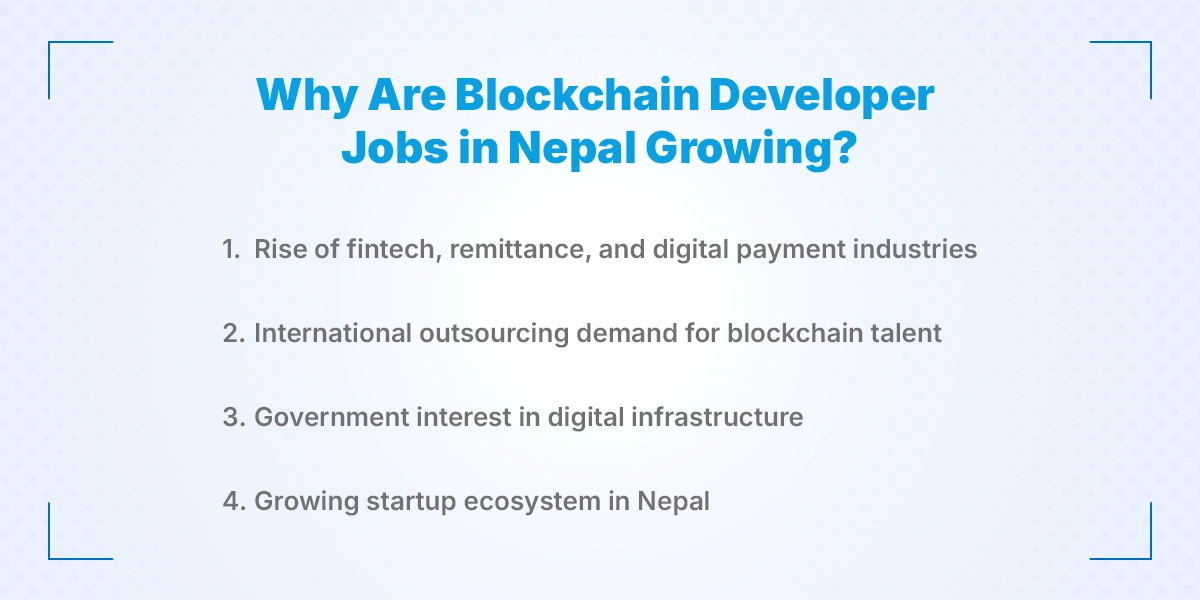
1. Rise of Fintech, Remittance, and Digital Payment Industries
Nepal's economy depends heavily on remittances, with billions of dollars flowing into the country every year from Nepali workers abroad. Traditional remittance channels are slow, expensive, and dependent on multiple intermediaries that charge fees at every step. Blockchain technology directly solves this problem by enabling faster, cheaper, and more transparent cross-border transfers without relying on traditional banking infrastructure.
Beyond remittances, digital payment platforms like eSewa, Khalti, and ConnectIPS are expanding their services and exploring blockchain-based solutions for transaction security, fraud prevention, and interoperability.
2. International Outsourcing Demand for Blockchain Talent
Nepal has established itself as a reliable software outsourcing destination for international clients, particularly from the USA, Australia, and Europe. As blockchain adoption grows globally, international companies are increasingly outsourcing smart contract development, DApp building, and blockchain integration work to Nepali IT firms because they can access skilled developers at competitive rates without compromising on quality.
This outsourcing demand is particularly significant because it creates blockchain job opportunities inside Nepal-based IT companies that may not be building blockchain products themselves but are delivering blockchain solutions for foreign clients.
3. Government Interest in Digital Infrastructure
Nepal's government has been actively pursuing digital transformation across multiple sectors, including land records management, public health data systems, supply chain transparency, and financial inclusion initiatives. Blockchain technology is increasingly being evaluated as a solution for these projects because of its ability to create tamper-resistant records, improve transparency in government processes, and reduce corruption through automated and auditable systems.
Nepal Rastra Bank has also been exploring digital currency frameworks and blockchain-based financial infrastructure that align with global central bank digital currency trends. As these government-level discussions translate into funded projects and procurement decisions, demand for blockchain professionals who can work on public sector digital infrastructure will grow meaningfully alongside private sector opportunities.
4. Growing Startup Ecosystem in Nepal
Kathmandu's startup ecosystem has matured significantly over the past five years. Co-working spaces, startup accelerators, angel investor networks, and technology incubators have created an environment where young entrepreneurs are building ambitious digital products across fintech, healthtech, edtech, and logistics. A growing number of these startups are building Web3 applications, token-based platforms, and decentralized services that require blockchain development expertise from the ground up.
Unlike established companies that add blockchain features to existing systems, startups typically need blockchain developers who can architect entire systems from scratch, which creates higher-value and more technically challenging opportunities for skilled professionals.
Types of Blockchain Developer Jobs Available in Nepal
Types of blockchain developer jobs available in Nepal are junior blockchain developer roles, senior blockchain developer positions, smart contract developer jobs, DApp developer roles, blockchain consultant positions, and freelance blockchain development projects, each offering different responsibilities, skill requirements, and earning potential.
1. Junior Blockchain Developer Jobs
Junior blockchain developer jobs are entry-level positions designed for fresh graduates and developers who are transitioning from web or backend development into blockchain work. These roles typically involve writing simple smart contracts, supporting senior developers with testing and debugging, learning the company's existing blockchain architecture, and gradually taking on independent development tasks as experience grows.
2. Senior Blockchain Developer Roles
Senior blockchain developer roles involve advanced responsibilities including system architecture design, performance optimization, security auditing, and team leadership. Companies expect senior developers to independently manage complex blockchain projects, mentor junior developers, and make technical decisions that affect the entire system.
3. Smart Contract Developer Jobs
Smart contract developer jobs specialize in writing, testing, deploying, and auditing self-executing contracts on blockchain platforms like Ethereum. These developers primarily use Solidity as their main programming language, though Rust is increasingly used for Solana-based contracts.
4. DApp Developer Jobs
Decentralized application developer jobs focus on building user-facing applications that interact with blockchain networks on the backend. DApp developers typically combine frontend skills in React or Vue.js with blockchain integration tools like Web3.js or Ethers.js to create complete applications that users can interact with through a standard web browser.
5. Blockchain Consultant Roles
Blockchain consultant roles involve advising businesses on how to implement blockchain solutions for their specific needs. Rather than hands-on development, consultants analyze business processes, identify where blockchain technology adds value, design solution architectures, and guide development teams through implementation.
6. Freelance Blockchain Development Projects
Freelance blockchain development is a strong income pathway for Nepal-based developers because international clients consistently seek blockchain talent at competitive rates. Freelancers typically work on smart contract development, DApp building, blockchain integration, and security auditing for clients across the USA, Europe, and Southeast Asia.
Skills Needed to Get Blockchain Developer Jobs in Nepal
Skills needed to get blockchain developer jobs in Nepal include blockchain fundamentals, smart contract development, programming languages such as Python and JavaScript, Ethereum and Web3 knowledge, database and backend skills, and strong communication and teamwork abilities that allow you to work effectively with both local teams and international clients.
1. Blockchain Fundamentals
Before writing a single line of blockchain code, developers need a solid understanding of how blockchain technology works. This includes distributed ledger concepts, consensus mechanisms like Proof of Work and Proof of Stake, cryptographic hashing, public and private key infrastructure, and how transactions are validated and recorded across a decentralized network.
2. Smart Contract Development
Smart contract development is one of the most in-demand blockchain skills in Nepal's current job market. Developers should learn Solidity for Ethereum-based contracts and ideally also understand Rust for Solana development. Writing, testing, and deploying smart contracts using development environments like Hardhat or Truffle is expected knowledge for most blockchain roles.
3. Programming Languages
Blockchain developers in Nepal are expected to be proficient in at least one general-purpose programming language alongside their blockchain-specific skills. Python is widely used for blockchain scripting, automation, and testing. JavaScript is essential for DApp frontend development and Web3 integration. Go is used in Hyperledger Fabric development. C++ is relevant for core blockchain protocol work.
4. Ethereum and Web3 Knowledge
Ethereum remains the most widely used smart contract platform, and Web3 knowledge is essential for most blockchain developer roles in Nepal. Developers should understand how to interact with Ethereum nodes using Web3.js or Ethers.js, how to connect applications to MetaMask and other wallet providers, how to read and write data from smart contracts through frontend interfaces, and how token standards like ERC-20 and ERC-721 work.
5. Database and Backend Skills
Blockchain developers in Nepal are frequently expected to combine blockchain knowledge with traditional backend development skills. This includes RESTful API integration, database management using PostgreSQL or MongoDB, server-side programming, and understanding how off-chain data connects with on-chain systems.
6. Communication and Teamwork Skills
Blockchain projects in Nepal often involve cross-functional teams including product managers, frontend developers, security specialists, and business stakeholders. Strong communication helps developers articulate technical decisions, understand project requirements accurately, and collaborate effectively without creating misunderstandings that slow down delivery. If you are proficient in all of these, then you can command a good salary in Nepal.
How to Find Blockchain Developer Jobs in Nepal
Find blockchain developer jobs in Nepal by applying through job portals, building a strong developer portfolio, joining blockchain and IT networking communities, searching company career pages directly, using LinkedIn for recruiter visibility, and attending hackathons and tech events where hiring companies actively look for technical talent.
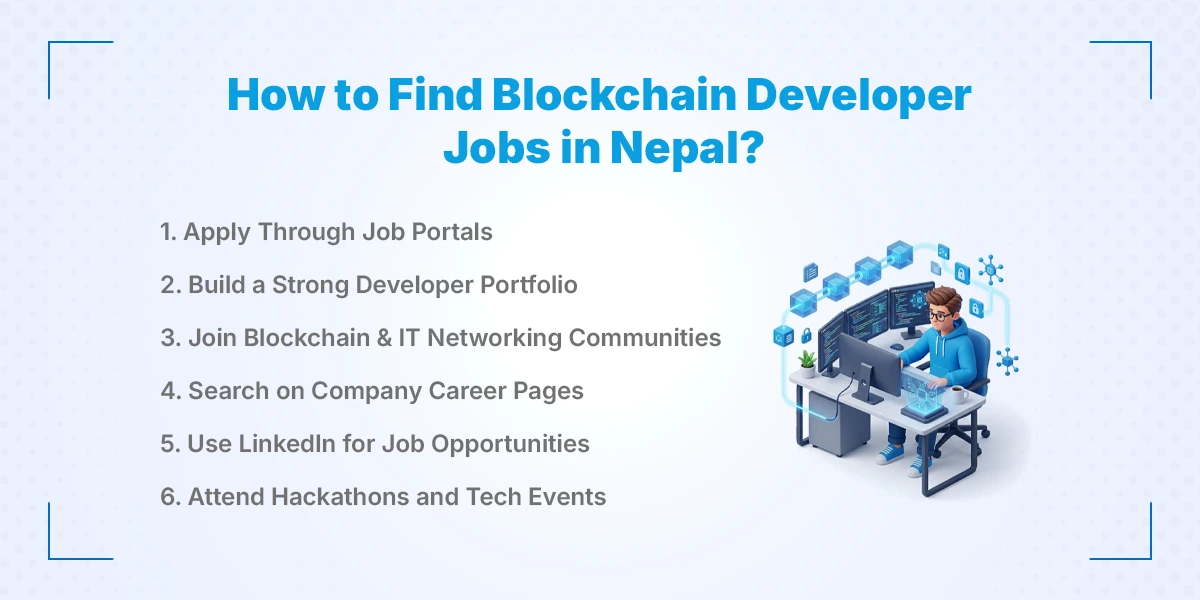
1. Apply Through Job Portals
Job portals remain one of the most practical starting points for finding blockchain developer jobs in Nepal. Platforms like Kumari Job regularly publish IT vacancies, including backend developer, Web3 developer, and blockchain engineer roles. Candidates should search using multiple related keywords, including "blockchain developer," "smart contract developer," "Web3 developer," and "backend engineer," to capture all relevant listings.
2. Build a Strong Developer Portfolio
A strong developer portfolio is the single most important asset a blockchain developer can have in Nepal's job market. Employers and freelance clients want to see real deployed smart contracts, functional DApps, GitHub repositories with clean commit histories, and clear project documentation that explains what each project does and what technologies were used.
Your portfolio should include at least two to three complete blockchain projects such as a token contract, a simple DeFi protocol, or an NFT minting application. Hosting live demos and linking them directly from your resume dramatically increases your chances of receiving interview calls.
3. Join Blockchain and IT Networking Communities
Blockchain networking communities in Nepal are smaller than general IT communities, which actually works in your favor because active members become well-known quickly. Joining the Nepal Blockchain Community, attending developer meetups in Kathmandu, participating in Web3 Discord servers, and engaging in blockchain discussions on LinkedIn and Facebook tech groups all help build your visibility among recruiters and project leaders.
Many blockchain job opportunities in Nepal are never publicly advertised. They are filled through referrals and community connections, making active participation in these spaces a genuine job search strategy rather than just a networking exercise.
4. Search on Company Career Pages
Several software companies and fintech startups in Nepal that work on blockchain projects post their vacancies directly on their own career pages before listing them on job portals. Developers who regularly check the career sections of companies like Leapfrog Technology, Cotiviti Nepal, and various fintech startups can often apply earlier and with less competition.
5. Use LinkedIn for Job Opportunities
LinkedIn has become an essential platform for blockchain developers in Nepal because international recruiters and remote hiring managers actively search for blockchain talent on the platform. An optimized LinkedIn profile with clear skill tags including Solidity, Web3, Ethereum, and smart contracts, combined with visible portfolio projects and GitHub links, significantly improves your discoverability.
6. Attend Hackathons and Tech Events
Blockchain hackathons are one of the most underused job discovery strategies for developers in Nepal. Participating in blockchain hackathons, whether local events or international online competitions, gives you real project experience under time pressure, a tangible addition to your portfolio, and direct exposure to companies and investors who sponsor or judge these events.
Many blockchain companies in Nepal and internationally use hackathons as an informal talent pipeline, offering internships or job opportunities to participants who demonstrate strong technical ability and teamwork during the event.
Salary of Blockchain Developers in Nepal
Blockchain developer salaries in Nepal are among the highest in the IT sector, ranging from NPR 20,000 to NPR 60,000 per month at the entry level, NPR 70,000 to NPR 120,000 at the mid-level, and NPR 130,000 to NPR 250,000 or more for senior and lead developers, with freelance and remote blockchain developers earning up to NPR 400,000 or more depending on project complexity and client location.
| Experience Level | Monthly Salary (NPR) |
|---|---|
| Entry-Level / Junior | NPR 20,000 – NPR 60,000 |
| Mid-Level (2–4 years) | NPR 70,000 – NPR 120,000 |
| Senior / Lead Developer | NPR 130,000 – NPR 250,000+ |
| Freelance / Remote | NPR 150,000 – NPR 400,000+ |
Disclaimer: Figures are approximate and vary based on company type, project complexity, skills, and whether the role is local or remote.
1. Entry-Level Blockchain Developer Salary
Entry-level blockchain developers in Nepal typically earn between NPR 20,000 and NPR 60,000 per month. These roles are designed for freshers and career-switchers who have foundational blockchain knowledge and some project experience. Growth at this level depends heavily on consistent skill development, particularly in Solidity and Web3 integration.
2. Mid-Level Blockchain Developer Earnings
Mid-level blockchain developers with two to four years of experience typically earn between NPR 70,000 and NPR 120,000 per month. At this stage, developers handle independent blockchain modules, smart contract deployment, and API integration work. Many mid-level developers also supplement their income through freelance projects, which can significantly increase total monthly earnings.
3. Senior Blockchain Developer Salary Range
Senior blockchain developers and lead engineers in Nepal typically earn between NPR 130,000 and NPR 250,000 or more per month. Developers with strong remote international client relationships, DeFi specialization, or security auditing expertise often earn toward the higher end of this range or beyond it through combined local and freelance income.
Use this research to establish a realistic average salary in Nepal for yourself, with a target number and a minimum acceptable figure.
What Qualifications Are Needed for Blockchain Developer Jobs?
Qualifications needed for blockchain developer jobs in Nepal include a computer science or IT background, recognized blockchain certifications such as the Certified Blockchain Developer or Ethereum Developer Certification, internship or project experience in a professional development environment, and practical smart contract projects that demonstrate real coding ability to employers and clients.
1. Computer Science or IT Background
A computer science or IT degree provides a strong foundation in programming fundamentals, data structures, algorithms, and software architecture, all of which are directly relevant to blockchain development. However, many successful blockchain developers in Nepal are self-taught and have built their qualifications through online courses, certifications, and independent projects.
2. Blockchain Certifications
Recognized blockchain certifications significantly strengthen a developer's profile, particularly for candidates who lack formal IT degrees. Widely respected certifications include the Certified Blockchain Developer from the Blockchain Council, the Ethereum Developer Certification, and the Certified Hyperledger Fabric Developer program. These credentials demonstrate verified knowledge to employers and international clients.
3. Internship or Project Experience
Internship experience gives beginner developers real exposure to professional blockchain development environments. Many IT companies and fintech startups in Nepal offer internship programs where trainees contribute to live blockchain projects under senior developer supervision. This experience is often the deciding factor between two candidates with similar technical knowledge.
4. Practical Smart Contract Projects
Practical smart contract projects are the most compelling qualification a blockchain developer can present. Employers want to see deployed contracts on testnets, GitHub repositories with real code, and portfolio projects that solve genuine problems. Developers who can walk through their own smart contract during a technical interview consistently outperform candidates who only have theoretical knowledge.
Why Do Companies Prefer Skilled Blockchain Developers?
Companies prefer skilled blockchain developers because they can deliver transparent and secure systems that meet growing business demands, support fintech and remittance industry growth, attract international outsourcing contracts, and build smart contract automation that reduces manual errors and operational costs across industries.
1. Transparency and Security Demand
Businesses across Nepal's banking, insurance, and supply chain sectors are under increasing pressure to improve transparency and data security. Blockchain provides a tamper-resistant audit trail that meets these demands, and skilled developers who can implement these systems are highly sought after.
2. Fintech and Remittance Industry Growth
Nepal's remittance-dependent economy creates strong demand for blockchain solutions that reduce transfer costs, eliminate intermediaries, and speed up cross-border transactions. Fintech companies need developers who can build and maintain these systems reliably and securely.
3. International Outsourcing Opportunities
Many international companies outsource blockchain development to Nepal because of lower costs and growing technical talent. Skilled blockchain developers who communicate well and deliver quality work consistently attract long-term outsourcing contracts that provide stable income for both individual developers and IT companies.
4. Smart Contract Automation
Businesses are increasingly interested in automating processes through smart contracts to reduce manual errors, lower operational costs, and improve execution speed. Developers who can design, write, and audit smart contracts for real business use cases are valued across multiple industries.
Common Challenges in Getting Blockchain Developer Jobs
Common challenges in getting blockchain developer jobs in Nepal include limited blockchain awareness among local employers; a high technical entry barrier that requires deep knowledge before writing production-quality code; a lack of local blockchain projects to build real experience; and the constant pressure of keeping up with rapidly evolving technology, tools, and industry standards.
1. Limited Blockchain Awareness in Nepal
Many HR managers and hiring teams in Nepal's traditional companies have limited understanding of blockchain technology, which sometimes makes it difficult for developers to find local opportunities. This challenge is gradually reducing as fintech adoption grows, but it remains a real barrier, particularly outside Kathmandu's startup ecosystem.
2. High Technical Entry Barrier
Blockchain development has a steeper learning curve than standard web development because it requires understanding cryptography, distributed systems, and consensus mechanisms before writing production-quality code. Beginners who rush into job applications without solid fundamentals often struggle during technical interviews.
3. Lack of Local Blockchain Projects
The number of active blockchain projects being built in Nepal is still limited compared to markets like India or Southeast Asia. This means developers sometimes need to build their own projects independently or contribute to international open-source projects to gain the portfolio experience that employers expect.
4. Keeping Up With Rapidly Evolving Technology
Blockchain technology evolves faster than most other IT fields. New protocols, programming languages, development tools, and industry standards emerge regularly. Developers who do not maintain consistent learning habits quickly find their skills becoming outdated in a field where staying current is a professional requirement.
Remote and Freelance Blockchain Developer Opportunities
Remote and freelance blockchain developer opportunities in Nepal are growing as international companies outsource smart contract development, DApp building, and blockchain integration work to skilled Nepali developers who offer competitive rates without compromising on quality, with platforms like CryptoJobsList, Web3.career, Upwork, and LinkedIn providing consistent access to both short-term projects and long-term remote contracts.
1. Remote Blockchain Development Jobs
Remote blockchain development jobs allow Nepal-based developers to work with companies in the USA, Europe, and Asia without relocating. These roles typically involve smart contract development, DApp building, blockchain integration, and security auditing for companies that prioritize skills over geography.
Remote positions generally pay in USD or equivalent currencies, making them significantly more lucrative than local employment for developers with strong technical abilities and good English communication skills.
2. International Freelance Blockchain Projects
International freelance blockchain projects are available consistently on specialized platforms and through developer networks. Freelance clients typically need smart contract development, token creation, DApp building, and blockchain security audits, all areas where Nepal-based developers can compete effectively on quality while offering competitive rates.
3. Benefits of Remote Blockchain Work
Remote blockchain work offers financial advantages through international pay rates, professional flexibility through self-directed scheduling, and career diversity through exposure to global projects and clients. It also allows Nepal-based developers to build international reputations that open doors to higher-value opportunities over time.
4. Platforms for Remote Blockchain Developer Jobs
Developers seeking remote blockchain work should actively use CryptoJobsList, Web3.career, LinkedIn remote job filters, Upwork, and Toptal alongside direct networking through blockchain Discord communities and GitHub project interactions. Building a visible presence across multiple platforms increases the frequency of inbound opportunity over time.
Future Scope of Blockchain Developer Careers in Nepal
The future scope of blockchain developer careers in Nepal is strong and expanding, driven by the growth of fintech and digital payments, increasing government interest in digital infrastructure projects, the global rise of DeFi and NFT platforms creating international remote opportunities, and a maturing startup ecosystem that will generate sustained long-term demand for skilled blockchain professionals across multiple industries.
1. Growth of Fintech and Digital Payments
Nepal's fintech sector is expanding rapidly as smartphone penetration increases and digital payment adoption grows across urban and rural areas. Blockchain technology is central to the next generation of secure, transparent, and low-cost financial services, creating sustained long-term demand for skilled blockchain developers in the country.
2. Government Digital Infrastructure Projects
Nepal's government has initiated multiple digital transformation programs, including land registration digitization, healthcare record management, and supply chain transparency projects. As these initiatives mature, blockchain-based solutions will increasingly be considered for their security and transparency advantages, creating public sector demand for blockchain professionals.
3. Rise of DeFi and NFT Platforms
Decentralized finance and NFT platforms continue to grow globally, and Nepal-based developers are well-positioned to serve international clients building in these spaces. As regulatory clarity around cryptocurrency improves in Nepal, local DeFi and Web3 projects will also begin to emerge, creating domestic opportunities alongside international freelance work.
4. Long-Term IT Career Opportunities
Blockchain development offers clear long-term career progression from junior developer to senior engineer, technical lead, blockchain architect, and eventually to consulting or founding roles in the Web3 space. Developers who build deep expertise early in Nepal's blockchain market will have a significant competitive advantage as the industry matures and demand intensifies in the coming years.
Conclusion
Blockchain developer careers in Nepal offer genuine opportunities for technical professionals who are willing to invest in building real skills, visible portfolios, and strong professional networks. The combination of growing local demand, strong international outsourcing interest, and limited qualified talent in the market creates favorable conditions for developers who enter the field prepared and committed.
Success in blockchain development depends on more than learning Solidity or understanding Ethereum. It requires consistent project building, active community participation, strong communication, and a commitment to staying current in a technology landscape that evolves quickly.
If you are a student, fresher, or experienced developer in Nepal who wants to build a blockchain career, start with the fundamentals today. Deploy your first smart contract this week. Add it to your GitHub. Then keep building from there. You can contact Kumari Job if you want to switch your career or get a new job in the blockchain field.
Frequently Asked Questions
Submit your comments

Get Our App On



How to Make a Police Report (Police Clearance Certificate) in Nepal?
VIEW DETAILS
Types of SEO and How They Work: Complete Beginner's Guide
VIEW DETAILS
Government Restricts New Lok Sewa Vacancy Requests 2083/84 — Or Not?
VIEW DETAILS
How to Apply for Tattoo Artist Jobs in Nepal?
VIEW DETAILS


Loading Comments...