
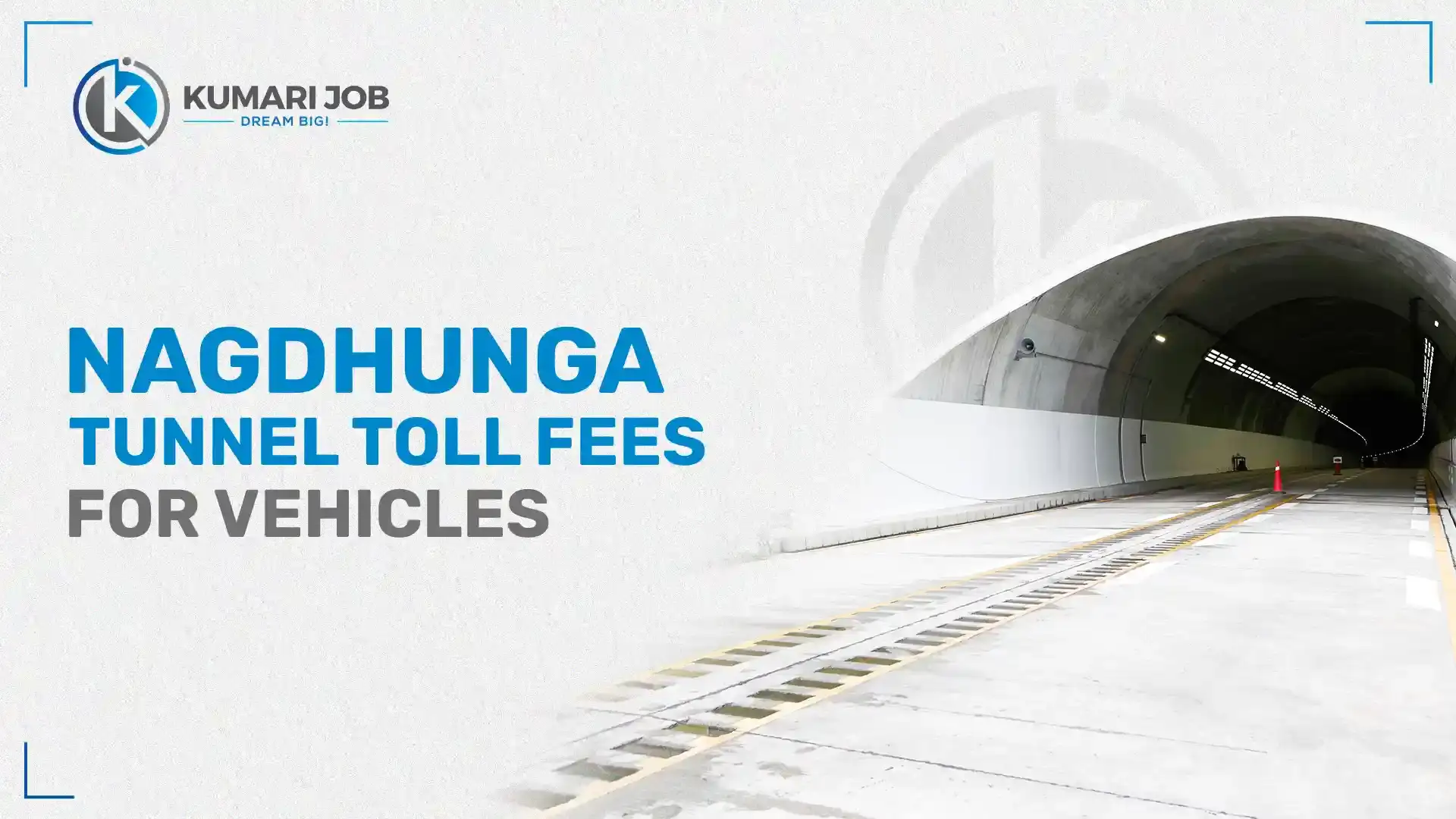

Drivers heading toward Kathmandu on the Tribhuvan Highway now face a genuinely new decision at Naubise: take the old winding hill road, or use the newly opened Nagdhunga Tunnel. Many arrive at the tunnel gate assuming a single flat toll applies to every vehicle, only to discover a fee that changes by direction and a vehicle they assumed was allowed, most often a motorcycle, turned back at the checkpoint. That mix-up costs time on a personal trip, and for a transport company running a daily fleet schedule, it can throw off deliveries across an entire route.
This guide lays out the official 2026 toll fees for every vehicle category, explains exactly which vehicles the tunnel permits and bans, and covers payment methods, in-tunnel driving rules, and the reasoning behind the fee structure. Every figure here is checked against the government's gazette notification and the tunnel's official traffic operation directive, so readers planning a trip through Nepal's first road tunnel get numbers they can rely on.
In this blog
What Is the Nagdhunga Tunnel?
The Nagdhunga Tunnel is Nepal's first road tunnel, a 2,688-metre bore connecting Nagdhunga in Kathmandu with Sisnekhola in Dhading district along the Tribhuvan Highway. Built with Japanese assistance at a cost of roughly Rs 22 billion, it bypasses the steep, landslide-prone Naubise hill section and shortens the Kathmandu-Naubise route by about 3 kilometres.
- Project overview: Constructed by Japan's Hazama Ando Corporation with support from the Japan International Cooperation Agency (JICA); formally inaugurated on July 27, 2026.
- Tunnel length: The main tunnel runs 2,688 metres, with a parallel emergency escape tunnel measuring 2,557 metres.
- Location: Connects Nagdhunga in Chandragiri, Kathmandu, with Sisnekhola in Dhunibesi, Dhading district.
- Purpose: Replaces the narrow, congested, and landslide-exposed Nagdhunga-Naubise hill crossing with a flat, direct route.
- Importance for Nepal's highway network: Sits on the Tribhuvan Highway, Kathmandu Valley's main gateway to western Nepal, the Terai, and border crossings into India.
Why Was the Nagdhunga Tunnel Built?
The Nagdhunga Tunnel was built to eliminate the bottleneck at the old Nagdhunga-Naubise hill crossing, one of the most congested and accident-prone stretches on Nepal's road network. This single corridor carries most of the traffic entering and leaving Kathmandu Valley from the west, including freight bound for the Terai and the Indian border. The tunnel replaces a steep, landslide-exposed climb with a flat, direct route, and it was designed to solve several of the corridor's problems at once.
1. Reducing Thankot congestion
Traffic backed up for kilometres near Thankot and Nagdhunga during peak hours before the tunnel opened. The narrow, winding hill section could not handle the volume of vehicles entering and leaving Kathmandu Valley each day. The tunnel diverts a large share of that traffic onto a flat, direct route, easing the queue at the old checkpoint. Officials expect the tunnel to carry around 60 percent of the roughly 8,000 vehicles that previously used the Nagdhunga-Naubise road daily.
2. Improving road safety
The old hill route sits on unstable slopes prone to landslides, particularly on the Dhading side. Sharp bends and steep gradients made the stretch a frequent site of accidents, especially for buses and trucks. A tunnel through solid rock removes exposure to slope failures and cuts out most of the sharp turns that caused crashes. Strict entry rules, including a ban on two-wheelers and hazardous cargo, further lower the accident risk inside the bore.
3. Reducing travel time
The tunnel shortens the Kathmandu-Naubise route by roughly 3 kilometres. Drivers who once needed 25 to 30 minutes to climb and descend the old hill can now cross in a fraction of that time. That saving compounds across thousands of daily trips, easing overall pressure on the corridor. Faster crossings also mean fewer vehicles idling on the old road at any given moment, which reduces congestion there too.
4. Reducing fuel consumption
Vehicles climbing the old hill route burned noticeably more fuel fighting the steep gradient. A flatter tunnel route lets engines run at a steadier, more efficient pace. Toll planners cited fuel savings directly when calculating the fee structure, since the tunnel cuts real operating costs for transporters. Lower fuel use also trims emissions along one of Kathmandu Valley's busiest highway approaches.
5. Improving trade and logistics
The Nagdhunga-Naubise corridor carries most freight moving between Kathmandu and the Terai, and onward to India. Delays and accidents on the old hill route regularly disrupted delivery schedules for transporters. A faster, safer tunnel crossing helps logistics companies plan more predictable delivery windows. That predictability matters most for perishable goods and time-sensitive commercial shipments moving through the valley.
6. Improving connectivity between Kathmandu and western Nepal
The tunnel forms part of the Tribhuvan Highway, Nepal's original road link toward the Indian border. It strengthens the connection between Kathmandu Valley and districts across western Nepal that depend on this corridor. Better connectivity supports commuters, students, and traders who travel regularly between the capital and western towns. Over time, planners expect the tunnel to support more balanced economic activity along the wider highway network.
Nagdhunga Tunnel Toll Fees for Vehicles (Official Rates)
The Nagdhunga Tunnel charges four vehicle categories, with a higher toll for entering Kathmandu than for leaving it. Cars, jeeps, vans, pickups, tractors, and microbuses pay Rs 65 to enter and Rs 60 to exit, while multi-axle trucks and heavy equipment pay Rs 600 to enter and Rs 250 to exit.
These rates were endorsed by the Cabinet on August 10, 2025, and formally published through a Nepal Gazette notification issued in April 2026. Reports from the Roads Board Nepal indicate the structure is fixed for an initial period and may be reviewed after that, so travelers and transport operators should check for updates periodically rather than assuming the rates are permanent. Tolls differ by travel direction because the government based the fee on the documented fuel and time savings for each direction rather than a flat per-kilometre charge, since the inbound drive avoids an uphill climb while the outbound drive is downhill.
Which Vehicles Are Allowed to Use the Nagdhunga Tunnel?
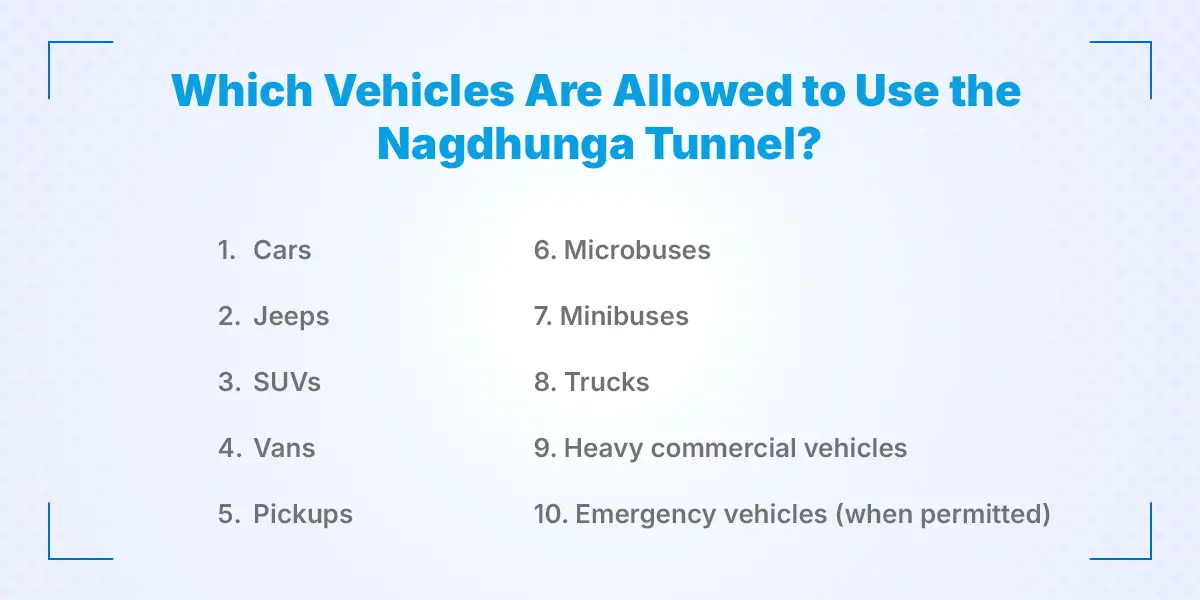
The Nagdhunga Tunnel allows all standard four-wheeled passenger and commercial vehicles that meet its size and cargo restrictions, from private cars to multi-axle trucks. Permitted vehicles include:
- Cars
- Jeeps
- SUVs
- Vans
- Pickups
- Microbuses
- Minibuses
- Trucks and mini-tippers (excluding fuel tankers and hazardous cargo)
- Heavy commercial vehicles and equipment carriers, within the permitted size limits
- Emergency vehicles, including ambulances, fire engines, and security force vehicles, which were the only vehicles allowed during the tunnel's initial trial phase
Which Vehicles Are NOT Allowed in the Nagdhunga Tunnel?
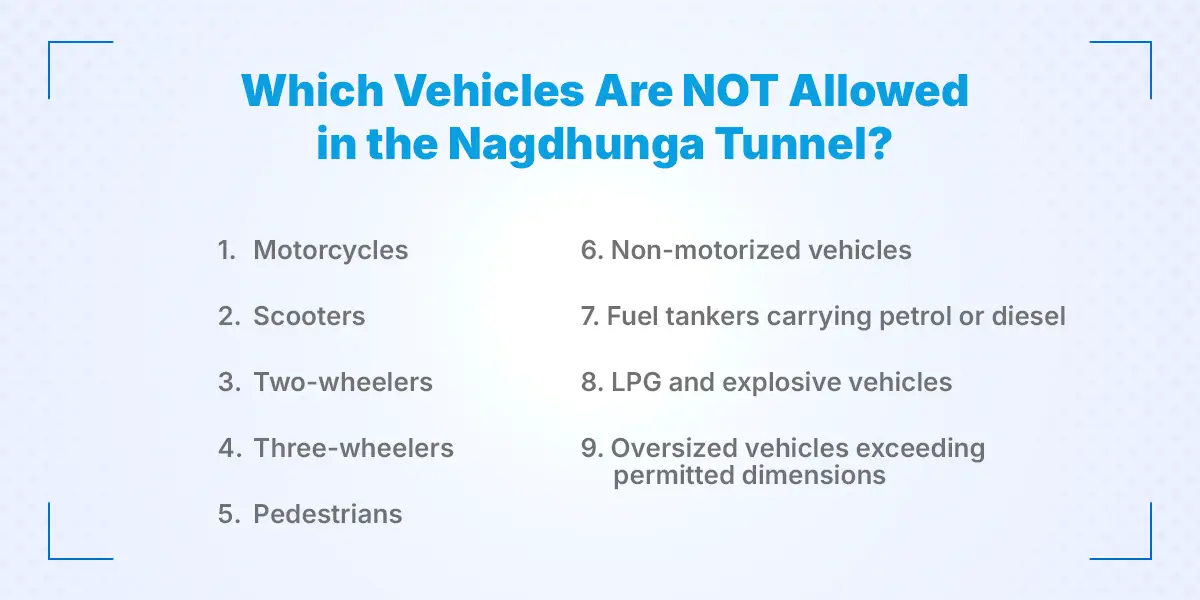
Motorcycles, scooters, three-wheelers, pedestrians, and non-motorized vehicles are banned from the Nagdhunga Tunnel, along with fuel tankers, LPG and explosive-carrying vehicles, and any vehicle exceeding the tunnel's permitted dimensions. These restrictions come from the Nagdhunga-Sisnekhola Tunnel Traffic Operation Directive, which governs who may use the bore. Two-wheelers alone account for a large share of the roughly 8,000 vehicles that used the old Nagdhunga-Naubise road daily, which is why their exclusion is one of the most common surprises for first-time tunnel users.
- Motorcycles
- Scooters
- Two-wheelers generally
- Three-wheelers (auto-rickshaws, tempos)
- Pedestrians
- Non-motorized vehicles, such as bicycles and hand carts
- Fuel tankers carrying petrol or diesel
- LPG and other explosive-material vehicles
- Oversized vehicles: anything longer than 18 metres, wider than 2.5 metres, or taller than 4.25 metres
- Overloaded vehicles exceeding standard cargo transport limits
These bans exist because the tunnel is a confined, curved space with limited shoulder room and controlled ventilation. Two-wheelers and pedestrians move at speeds and in patterns that do not mix safely with fast-moving trucks and buses inside a bore with nowhere to pull over. Fuel tankers and explosive cargo pose a serious fire risk in an enclosed tunnel, so the operation directive routes them back onto the older surface road instead.
How Are Nagdhunga Tunnel Toll Fees Determined?
Nagdhunga Tunnel toll fees are set by vehicle classification, size, and weight, with separate rates for the entry and exit direction, all fixed through a Cabinet-approved gazette notification. The Department of Roads proposed the rate structure before it went to the Ministry of Physical Infrastructure and Transport and then to Roads Board Nepal for review. The final numbers reflect both the operating and maintenance costs of the tunnel concession and the documented fuel and time savings each vehicle type gains by using it.
- Vehicle classification into four official categories
- Vehicle size, measured against the tunnel's permitted length, width, and height
- Weight category, based on axle count and load class
- Direction of travel, since entering Kathmandu costs more than leaving it
- Government-approved rates, finalized by Cabinet decision and published in the Gazette
How Can You Pay the Nagdhunga Tunnel Toll?
Drivers can pay the Nagdhunga Tunnel toll in cash, by scanning a QR code, or through an RFID-enabled electronic sticker linked to a prepaid account, with a receipt issued for every transaction. The sticker system, branded as an N-Tag, is distributed through partner banks and deducts the toll automatically as a vehicle passes through the booth.
- Cash payment collected manually at the toll booth
- QR code payment through mobile banking or digital wallet apps
- Electronic toll collection via a windshield-mounted N-Tag sticker, available through Global IME Bank, Kumari Bank, Nabil Bank, Nepal Investment Mega Bank, and Sanima Bank
- A dedicated sticker-based prepaid system built for frequent commercial and commuter use
- A printed or digital receipt issued for every payment, useful for transport and logistics companies tracking trip costs
What Rules Must Drivers Follow Inside the Tunnel?
- Speed limits: The posted speed limit inside the tunnel is capped at 60 km/h for all vehicle categories.
- Lane discipline: Drivers must stay within their marked lane and avoid weaving between lanes inside the bore.
- No overtaking: Overtaking is restricted given the confined width and limited visibility around the tunnel's curves.
- Headlights: Vehicles must keep headlights on for the full length of the tunnel, as required for tunnel driving nationwide.
- No stopping: Stopping inside the tunnel is prohibited except in a genuine emergency, since a stalled vehicle can block the only route through.
- Emergency procedures: Drivers experiencing a breakdown or accident should move toward the shoulder or a cross-passage where possible and use the emergency call points and escape tunnel provided.
- Vehicle condition requirements: Vehicles should be roadworthy and free of visible fuel or fluid leaks before entering, given the fire-risk restrictions that apply throughout the tunnel.
Why Are Entry and Exit Toll Fees Different?
Entry and exit toll fees differ because the tunnel saves more fuel and time on the uphill approach into Kathmandu than on the downhill exit toward Dhading. Every vehicle category pays more to enter the valley than to leave it, a gap the project's own engineers built into the rate structure rather than treating the toll as a flat per-crossing charge. That structure reflects a fuel-saving calculation: climbing the old hill road burned considerably more fuel than descending it, so the tunnel's inbound saving is larger and the toll charged for that direction is higher. It also supports operational cost recovery, since the concession company still needs steady revenue from the lighter, cheaper exit trips to cover round-the-clock lighting, ventilation, and staffing costs.
How Much Time and Fuel Can the Tunnel Save?
The Nagdhunga Tunnel is expected to cut travel time on the Kathmandu-Naubise route from roughly 25 to 30 minutes down to under 10 minutes for vehicles that use it instead of the old hill road. That saving comes from a shorter physical distance, a flatter gradient, and far less exposure to the queues that used to build up at Thankot and Nagdhunga.
- Reduced travel distance of about 3 kilometres compared with the old hill route
- Reduced congestion at the Thankot-Nagdhunga bottleneck, since the tunnel is expected to carry roughly 60 percent of daily corridor traffic
- Fuel savings from avoiding the steep climb and descent on the old road
- Faster freight movement for trucks and commercial vehicles moving goods between Kathmandu and the Terai
- Clear benefits during peak hours, when the old hill road saw the worst queues and the highest accident risk
Common Mistakes Drivers Should Avoid
- Assuming motorcycles or scooters are allowed, then getting turned back at the tunnel checkpoint
- Entering with prohibited cargo, such as fuel, gas cylinders, or other flammable material
- Ignoring lane rules or attempting to overtake inside the bore
- Overspeeding past the posted 60 km/h limit
- Stopping inside the tunnel for photos, phone calls, or non-emergency reasons
Looking for Driver Jobs in Nepal?
Nepal's transport sector is expanding fast alongside projects like the Nagdhunga Tunnel, and demand for qualified drivers and logistics staff is growing with it. Job seekers can find current openings across categories including:
- Car driver jobs
- Bus driver jobs
- Truck driver jobs
- Heavy equipment operator jobs
- Delivery driver jobs
- Logistics vacancies
- Commercial driving careers
Looking for driving jobs in Nepal? Explore the latest driver vacancies on Kumari Job and apply online.
Conclusion
The Nagdhunga Tunnel changes the calculation for anyone travelling between Kathmandu and western Nepal, but only for vehicles that qualify. Cars, jeeps, vans, buses, and trucks within the permitted size and cargo limits can use the government's official toll rates, ranging from Rs 60 for light vehicles leaving the valley to Rs 600 for multi-axle trucks entering it, while motorcycles, three-wheelers, fuel tankers, and oversized loads must continue using the old surface road.
Because the tunnel opened only in July 2026 and rolled out in phases, from emergency vehicles first to the full range of eligible traffic, toll rates, payment systems, and operating rules could still see adjustments as the concession settles in. Readers planning a route through the tunnel should check for official updates before travel, and if the trip involves a career move rather than just a commute, transport, logistics, and driver jobs across Nepal are listed and updated regularly on Kumari Job.
Frequently Asked Questions
Submit your comments

Get Our App On


What Is the Salary of a Flight Dispatcher in Nepal?
VIEW DETAILS
What Is the Salary of a Solar Technician in Nepal?
VIEW DETAILS
What Does a Digital Marketing Course Syllabus in Nepal Cover?
VIEW DETAILS
How to Find Lab Assistant Jobs in Nepal?
VIEW DETAILS


Loading Comments...