

Finding a legitimate and secure pathway into Nepal's highly competitive aviation sector frustrates many aspiring professionals. Candidates spend months scouring unreliable job boards, only to submit poorly formatted applications that get rejected by airline human resources departments without any feedback.
This comprehensive guide breaks down the exact process to secure a position at Sita Air, one of Nepal's established domestic carriers. Readers will learn the precise eligibility requirements, the step-by-step application workflow, available career tracks, and actionable strategies to ensure an application stands out to aviation recruiters.
In this blog
What Is a Sita Air Vacancy?
A Sita Air vacancy is an official job opening announced by Sita Air to recruit qualified candidates for various aviation roles such as cabin crew, ground staff, technical staff, and administrative positions in Nepal. These opportunities allow individuals to join the domestic airline and support its flight operations, passenger services, and organizational management.
These vacancies provide a structured career path within Nepal’s aviation sector, where selected candidates receive professional training and industry-standard benefits. Working at Sita Air also involves contributing to safe air travel, efficient airport operations, and overall service quality across the airline’s network.
Why Are Sita Air Jobs Popular in Nepal?
Sita Air jobs are highly sought after in Nepal because they offer competitive salaries, comprehensive travel benefits, and long-term job security in a prestigious industry. Employees gain exposure to professional training programs that significantly enhance their career trajectory within the global aviation market. The dynamic work environment also appeals to young professionals seeking alternatives to traditional desk jobs.
- Attractive Salary and Benefits: The airline provides competitive monthly compensation alongside health insurance, paid leaves, and performance-based allowances.
- Travel and Career Exposure: Employees frequently receive travel privileges and gain firsthand experience operating within Nepal's unique geographical flight routes.
- Professional Work Environment: Aviation demands strict discipline, teamwork, and adherence to international safety regulations, fostering a highly professional workplace.
- Growth Opportunities: Entry-level staff can advance through internal promotions, continuous training, and skill development programs designed to build future aviation leaders.
Types of Jobs Available at Sita Air
1. Cabin Crew and Flight Attendants
Flight attendants serve as the primary face of the airline, responsible for passenger safety, emergency management, and in-flight service. They undergo rigorous training to handle medical emergencies, secure the cabin, and deliver clear safety demonstrations before takeoff. Candidates pursuing this role must maintain specific physical standards, including height and weight proportions, alongside fluency in English and Nepali. Success in this position requires a calm demeanor, high stamina, and the ability to work flexible schedules.
2. Ground Staff Operations
Ground staff personnel manage the crucial pre-flight and post-flight operations at airport terminals across Nepal. Their daily responsibilities include checking in passengers, verifying travel documents, handling baggage logistics, and managing boarding gates. These professionals must possess strong problem-solving skills to manage flight delays, frustrated passengers, and sudden schedule changes effectively. Prior experience in customer service provides a significant advantage for applicants targeting these high-stress, fast-paced terminal roles.
3. Flight Operations Staff
Flight operations personnel work behind the scenes to coordinate flight schedules, monitor weather conditions, and communicate with air traffic control. They ensure that pilots receive accurate flight plans and load manifests before every departure. This department acts as the central nervous system of the airline, requiring meticulous attention to detail and strong analytical capabilities. Errors in flight operations can cause massive delays, making this role critical for maintaining the airline's daily efficiency.
4. Technical and Engineering Staff
Aviation engineers and technicians perform mandatory maintenance, inspections, and repairs on the airline's fleet of Dornier aircraft. They strictly follow maintenance manuals and aviation authority regulations to guarantee that every aircraft remains airworthy. This department demands specialized degrees in aeronautical or mechanical engineering, alongside official certifications and prior hands-on experience. Their precise work directly prevents mechanical failures, making them the ultimate safeguard for passenger and crew safety.
5. Administrative Roles
Corporate administrative teams handle human resources, finance, marketing, and legal compliance from the airline's headquarters. They process payroll, recruit new talent, manage public relations, and ensure the company remains profitable and legally compliant. These roles require standard corporate qualifications, such as degrees in business administration, accounting, or management. Professionals in these positions provide the structural support necessary for the operational teams to function without interruption.
6. Cargo and Logistics Staff
Cargo handlers manage the safe loading, securing, and unloading of freight transported on domestic flights. They calculate weight distribution to ensure the aircraft maintains its center of gravity, which is vital for safe flight operations. This role requires physical strength, an understanding of load limitations, and knowledge of hazardous materials regulations. Efficient cargo logistics directly contribute to the airline's revenue stream and support supply chains reaching Nepal's remote airports.
Eligibility Requirements for Sita Air Vacancy
Meeting the baseline eligibility criteria is the first hurdle in the airline recruitment process. Failure to meet these standards results in immediate application rejection.
- Educational Qualifications: Roles range from requiring a 10+2 (Intermediate) certificate for cabin crew to specialized Bachelor's degrees for engineering and management positions.
- Age Limits: Cabin crew applicants typically must fall between 18 and 25 years old, while technical and administrative roles often have broader age allowances.
- Communication Proficiency: Exceptional spoken and written fluency in both Nepali and English is mandatory across all customer-facing and operational departments.
- Physical Fitness: Flight attendants must pass strict medical examinations, meet minimum height requirements (often 5'2" for females), and have no visible tattoos.
- Prior Experience: While cabin crew positions often accept fresh graduates, engineering, pilot, and senior management roles demand documented industry experience.
- Customer Service Acumen: Ground staff and ticketing officers must demonstrate strong interpersonal skills and a proven ability to handle public inquiries.
How to Apply for Sita Air Vacancy?
To apply for a Sita Air vacancy, candidates must gather their updated documents and submit them directly to the official corporate email address or designated physical office before the stated deadline. The process involves monitoring official announcements, structuring a professional aviation CV, and ensuring all required certificates are accurately attached. Following the exact submission instructions outlined in the specific job advertisement guarantees the application reaches the human resources screening committee.
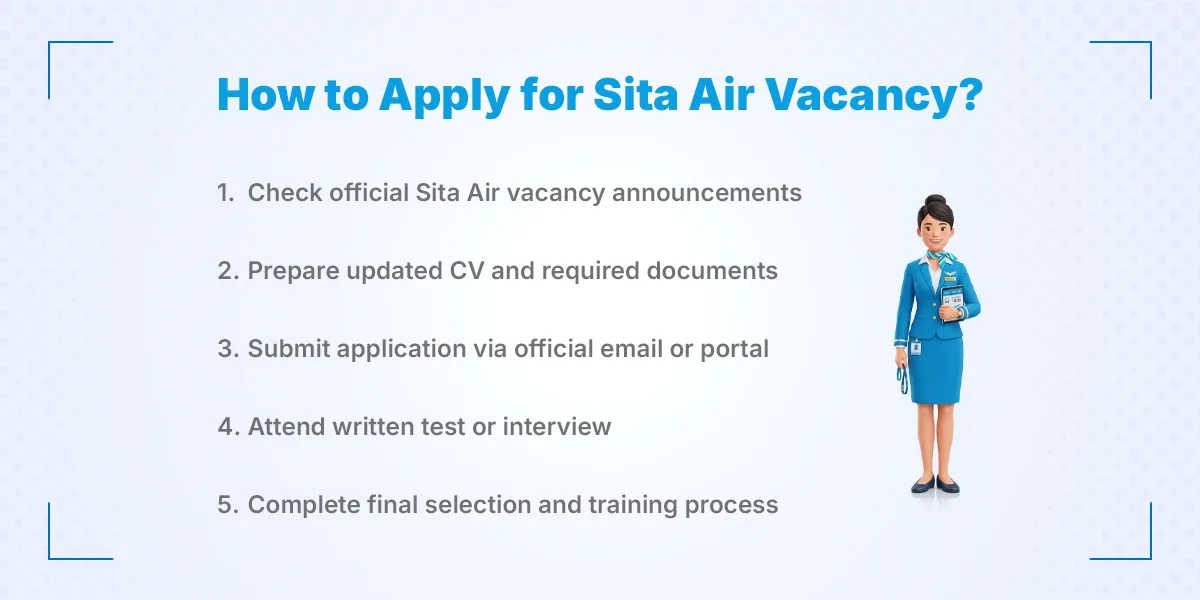
1. Check Official Announcements
Candidates must regularly monitor the official Sita Air website, national daily newspapers, and trusted Nepalese job portals for authentic vacancy notices. Relying on unverified social media posts often leads to missed deadlines or falling victim to employment scams. Reading the official job description thoroughly ensures the applicant understands the exact role requirements and submission guidelines. Setting up job alerts on major career platforms helps job seekers receive immediate notifications when new aviation positions open.
2. Prepare Required Documents
Compiling a complete and accurate document portfolio prevents automatic disqualification during the initial human resources screening phase. Applicants must update their resume to highlight relevant customer service, technical skills, or language proficiencies tailored to the aviation sector. Taking fresh passport-sized and full-length photographs in professional business attire is especially critical for cabin crew applications. Converting all documents into clear, appropriately named PDF files ensures they remain readable and professional when submitted digitally.
3. Submit the Application
Most airline job applications in Nepal require candidates to send their document portfolio to a specific corporate email address. The email subject line must clearly state the position applied for, such as "Application for Cabin Crew," to ensure proper routing. Writing a concise, formal cover letter in the email body demonstrates professionalism and strong written communication skills. Submitting the application well before the deadline prevents technical issues from ruining a candidate's chances at the last minute.
4. Attend the Assessments
Shortlisted candidates receive invitations to attend a series of written examinations, physical assessments, or initial screening interviews. Arriving early to the testing venue in formal business attire sets a positive first impression with the recruitment team. The assessments test an applicant's general knowledge, situational judgment, language proficiency, and ability to handle high-stress scenarios. Passing these initial hurdles proves the candidate possesses the baseline competencies required to function in a demanding aviation environment.
5. Complete Final Selection
The final stage involves a comprehensive panel interview where airline executives evaluate a candidate's personality, career motivations, and cultural fit. Successful candidates receive a formal job offer detailing their salary, benefits, and the terms of their employment contract. Upon acceptance, new hires enter a rigorous, mandatory training program specific to their department before beginning active duty. Passing this final training period is mandatory to secure the permanent position and officially join the airline's workforce.
Documents Required for Sita Air Recruitment
Compiling the correct paperwork is a non-negotiable step in the aviation hiring process.
- Updated CV or Resume: A professionally formatted document detailing education, work history, and contact information.
- Photographs: Recent passport-sized headshots and formal full-length photographs, primarily required for flight attendant applicants.
- Academic Certificates: Clear copies of mark sheets, transcripts, and degree certificates starting from the SEE (Secondary Education Examination) level onwards.
- Citizenship Certificate: A clear photocopy of the applicant's official Nepali citizenship card to verify age and nationality.
- Experience Letters: Official letters from previous employers proving past work history, mandatory for technical and mid-level roles.
- Medical Fitness Certificate: An official health clearance from an authorized medical practitioner confirming physical fitness for flight duties.
Selection Process for Sita Air Jobs
Understanding the recruitment pipeline helps candidates prepare effectively for each specific stage of the selection process.
| Selection Stage | Primary Objective | Key Activities |
|---|---|---|
| Application Screening | Verify basic eligibility | HR reviews CV, citizenship, age, academic certificates, and filters unqualified applicants. |
| Written Examination | Test general aptitude | Candidates take exams on English, logical reasoning, and basic aviation knowledge. |
| Physical/Medical Test | Ensure occupational health | Doctors evaluate eyesight, height-weight ratio, and overall physical fitness. |
| Panel Interview | Assess personality and job fit | Face-to-face interview to evaluate communication skills, confidence, and situational responses. |
| Final Training | Provide operational readiness | Selected candidates undergo structured aviation, safety, and operational training. |
Salary and Benefits of Sita Air Employees
Sita Air offers a competitive salary structure in Nepal’s aviation sector, with pay varying based on role, experience, and responsibility level. Entry-level cabin crew and ground staff typically earn around NPR 25,000 to 60,000 per month, while experienced technical staff and engineers can earn NPR 80,000 to 150,000+ depending on qualifications and certifications.
Along with salary, employees receive attractive benefits such as travel privileges, flight allowances, health and medical insurance, paid leave, and career development opportunities. These benefits make Sita Air jobs financially stable and highly rewarding within Nepal’s growing aviation industry.
Common Mistakes to Avoid
Many applicants fail during the initial screening phase due to easily preventable errors.
- Submitting Incomplete Applications: Forgetting to attach citizenship copies or academic transcripts guarantees immediate rejection by the recruitment software or HR team.
- Ignoring Eligibility Criteria: Applying for a role without meeting the strict age, height, or educational requirements wastes both the applicant's and the recruiter's time.
- Poor CV Formatting: Using chaotic layouts, spelling errors, or unprofessional email addresses makes the candidate appear careless and unsuited for aviation discipline.
- Lack of Interview Preparation: Failing to research the airline's history, fleet size, or destinations shows a lack of genuine interest in the company.
- Missing Deadlines: Airlines operate on strict schedules; submitting an application even one hour past the stated deadline usually results in disqualification.
- Weak Communication: Mumbling, avoiding eye contact, or failing to speak clear English during interviews eliminates candidates for customer-facing positions.
Tips to Increase Your Chances of Getting Hired
Improving your preparation and presenting yourself professionally can significantly increase your chances of getting selected in Sita Air recruitment.
- Strong communication skills in English and Nepali are essential for cabin crew and ground staff roles, so practice speaking, pronunciation, and confidence regularly.
- A professional CV should be clean, structured, and tailored to aviation roles, highlighting relevant education, skills, and customer service experience.
- Gaining experience in hospitality, retail, or customer service helps build practical skills like teamwork, handling passengers, and working under pressure.
- Maintaining physical fitness is important, especially for cabin crew positions, as airlines require candidates to meet medical and appearance standards.
Where to Find Sita Air Vacancy Announcements?
Candidates can find authentic Sita Air vacancy announcements directly on the airline's official website under the careers or notices section. Major national daily newspapers and established Nepalese digital job portals frequently publish these verified recruitment advertisements. Aviation training institutes also receive direct notifications from airlines, making them a reliable source for discovering upcoming hiring drives.
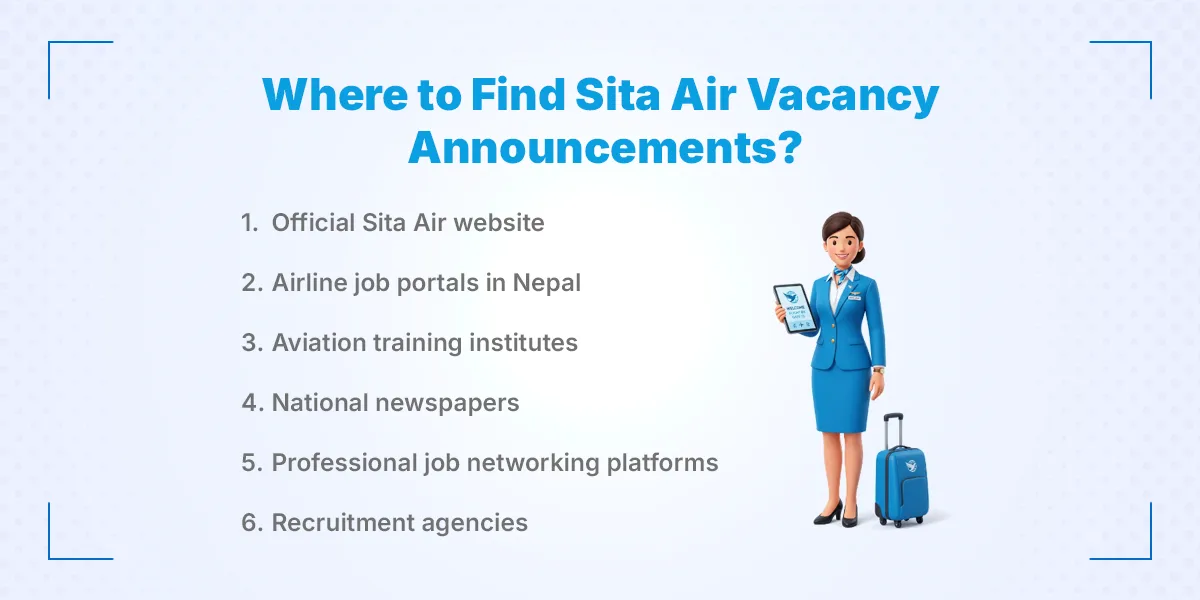
- Official Sita Air Website: The most authoritative source for current openings, detailed job descriptions, and direct application instructions.
- Airline Job Portals in Nepal: Websites like Kumari Job regularly host verified vacancy listings for the aviation sector.
- Aviation Training Institutes: Academies offering cabin crew or ticketing courses often share exclusive recruitment news with their enrolled students.
- National Newspapers: Major publications like The Kantipur or The Himalayan Times remain traditional platforms for corporate hiring notices.
- Professional Networking Platforms: Following the airline and its human resources managers on LinkedIn provides real-time updates on corporate expansion and recruitment.
Conclusion
Landing a position at Sita Air requires strict attention to detail, adherence to specific eligibility criteria, and a highly professional approach to the application process. Candidates who invest time in preparing a flawless document portfolio, mastering their communication skills, and understanding the demands of the aviation sector significantly outperform their competition. The domestic airline industry remains a highly rewarding career path for those willing to embrace its rigorous standards.
Take the next step in your professional journey by ensuring your resume is optimized for aviation recruiters. Register and build your professional profile on Kumari Job today to receive immediate alerts for airline vacancies, access expert CV formatting tools, and apply directly to Nepal's top employers.
Frequently Asked Questions
Submit your comments

Get Our App On


How to Make a Police Report (Police Clearance Certificate) in Nepal?
VIEW DETAILS
Types of SEO and How They Work: Complete Beginner's Guide
VIEW DETAILS
Government Restricts New Lok Sewa Vacancy Requests 2083/84 — Or Not?
VIEW DETAILS
How to Apply for Tattoo Artist Jobs in Nepal?
VIEW DETAILS


Loading Comments...