



A master's graduate weighing a career in academia often runs into the same wall: job postings for lecturer or assistant professor rarely list a salary figure, and the ones that do vary so much they raise more questions than they answer. Current lecturers face a similar problem when deciding whether to pursue a PhD, since nobody can tell them clearly how much that extra degree will actually add to their paycheck.
This guide lays out the average university professor salary in Nepal across academic ranks, from lecturer to full professor, along with the factors, qualifications, and career steps that move someone up the pay scale. Read on for salary ranges by position, a comparison of government versus private institutions, and where to find open teaching roles in Nepal
In this blog
What Is the Average University Professor Salary in Nepal?
The average university professor salary in Nepal typically ranges from NPR 40,000 to NPR 90,000 or more per month, depending on academic rank, institution type, and qualifications, with lecturers starting near NPR 35,000–45,000 and full professors at established universities earning NPR 90,000 and above. There is no single fixed salary for all university professors, since public universities follow government-set pay scales while private colleges set their own rates based on budget and reputation. Basic salary is only part of total compensation, since most positions add allowances for research, administration, or teaching load on top of the base figure.
Approximate monthly earnings by rank generally look like this:
- Lecturer: NPR 35,000–45,000
Assistant Professor: NPR 45,000–60,000
Associate Professor: NPR 60,000–80,000
Professor: NPR 80,000–1,20,000+
These ranges shift depending on whether the position sits at a public university, a community college, or a private institution, which the sections below break down in more detail.
How Much Does a University Lecturer Earn in Nepal?
A university lecturer in Nepal typically earns between NPR 35,000 and NPR 45,000 per month at the start of their career. Starting salaries sit at the lower end for lecturers with only a master's degree and limited teaching experience, while those with an MPhil or partial PhD, or several years in the classroom, negotiate toward the higher end. Pay also depends on the university type, academic qualification, teaching experience, subject specialization, and weekly teaching workload.
Lecturers can add to this base income through:
Research projects and grant-funded work
Thesis or dissertation supervision
Consultancy work in their field of expertise
Part-time teaching at a second institution
Textbook writing or academic editing
Subject specialization matters more than many new lecturers expect. A lecturer teaching a high-demand subject such as computer science, finance, or engineering typically commands a higher rate than one teaching a subject with lower private-sector demand, since colleges compete harder to retain faculty in those departments.
What Factors Affect University Professor Salary in Nepal?
University professor salary in Nepal changes mainly based on academic qualification, academic rank, and years of teaching experience. The type of university, whether public, community, or private, also plays a major role, since each follows a different pay structure and budget. Research output and any administrative responsibilities a professor takes on further shift where they land within their rank's salary band.
The main factors, grouped together, include:
- Academic qualification — master's degree, MPhil, or PhD
Academic rank — lecturer, assistant professor, associate professor, or professor
Years of teaching experience — within the current rank and overall career
Type of university — public/government, community, or private
Subject and specialization — high-demand fields often pay more
Research publications and academic contributions — stronger publication records support faster promotion
Administrative responsibilities — department head or coordinator roles add allowances
Allowances and benefits — housing, research, and other institution-specific add-ons
A PhD holder with a strong publication record and a few years of administrative experience will typically sit well above the midpoint of their rank's salary band, even at the same university as a peer without those credentials.
Government vs Private University Professor Salary in Nepal
Government and private universities in Nepal pay differently, and the gap goes beyond just the base salary. Public universities generally follow a standardized pay scale set by the government, which gives professors predictable step-based raises tied to rank and years of service. Private universities set their own compensation, which means pay can run higher for in-demand specialists but comes with less standardization and, in many cases, less job security.
| Aspect | Government/Public University | Private University |
|---|---|---|
| Basic Salary | Fixed, standardized pay scale | Varies by institution and negotiation |
| Allowances | Set housing, research, and teaching allowances | Varies; sometimes higher for niche subjects |
| Job Security | Generally high, especially after permanent appointment | Lower; often contract-based |
| Benefits | Provident fund, pension-linked benefits in many cases | Varies; fewer standardized long-term benefits |
| Workload | Regulated teaching hours | Often higher, especially at growing institutions |
| Promotion Structure | Rank-based, follows university service rules | Varies; can be faster for high performers |
Experienced professors sometimes move from public to private institutions specifically because private colleges pay a premium for reputation and specialization, even though it means trading long-term security for a higher current salary. For readers exploring stable public-sector roles more broadly, KumariJob's guide to government jobs in Nepal covers pay scales and hiring processes across sectors.
What Qualifications Do You Need to Become a University Professor in Nepal?
Becoming a university professor in Nepal requires a relevant bachelor's and master's degree at minimum, with an MPhil or PhD required for higher academic ranks such as associate professor and professor. Teaching experience and a record of research and publications become increasingly important as candidates move up from lecturer toward professor. Requirements vary by university and by specific position, so a candidate should always check the exact criteria listed in a given vacancy announcement.
Typical qualification requirements by stage include:
Relevant bachelor's degree in the subject area
Master's degree, usually a minimum requirement for a lecturer position
MPhil or PhD, generally required for assistant professor and above at most universities
Demonstrated teaching experience, often starting as a teaching assistant or part-time lecturer
Research output and academic publications, which carry more weight at senior ranks
Qualifications directly shape both academic rank and earning potential. A candidate who completes a PhD early in their career typically reaches associate professor faster than one who stops at a master's degree, which compounds into a meaningfully higher salary over a full academic career.
How Can You Become a University Professor in Nepal?
To become a university professor in Nepal, you generally need relevant higher education, teaching experience, research skills, academic publications, and the qualifications required by the university or faculty.
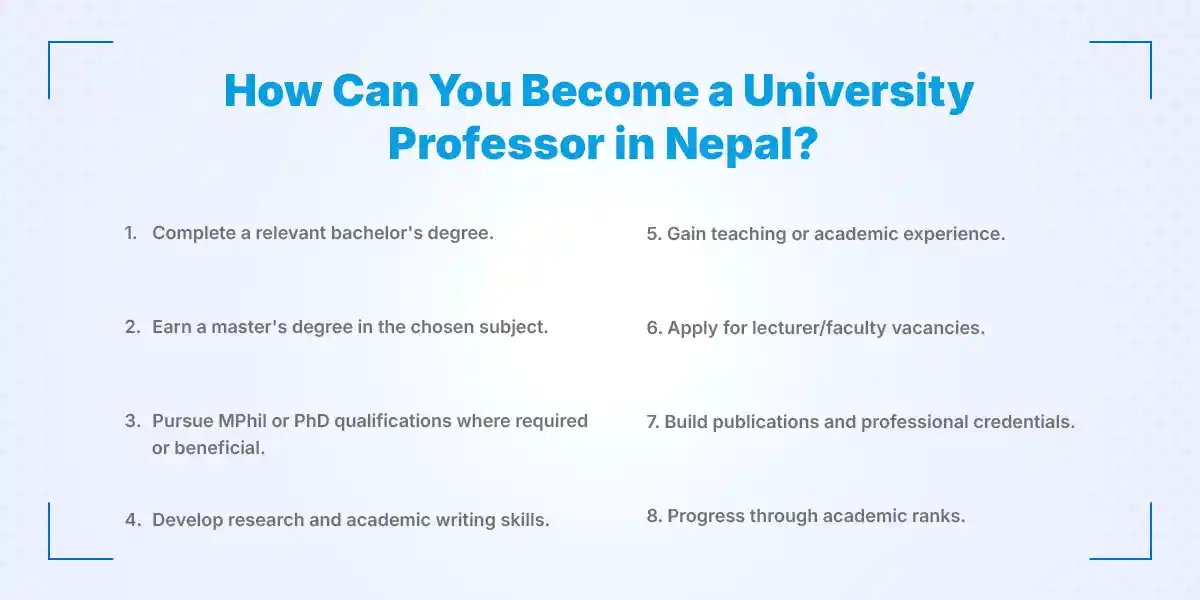
1. Complete a Relevant Bachelor's Degree
Choose a bachelor's degree in the subject you want to teach at the university level.
2. Earn a Master's Degree
Complete a master's degree in your chosen subject, as it is commonly required for university-level teaching positions.
3. Pursue an MPhil or PhD
An MPhil or PhD can strengthen your academic profile and may be required or preferred for higher-level faculty and professor positions.
4. Develop Research and Academic Writing Skills
Build strong research, academic writing, presentation, and subject-specific skills to succeed in teaching and research.
5. Gain Teaching or Academic Experience
Gain experience through lecturer, teaching assistant, research, or other academic roles to develop university-level teaching skills.
6. Apply for Lecturer or Faculty Vacancies
Look for lecturer and faculty vacancies at universities and colleges and apply when you meet the stated eligibility requirements.
7. Build Publications and Professional Credentials
Publish research papers in relevant journals, attend academic conferences, and develop professional credentials to strengthen your academic career.
8. Progress Through Academic Ranks
With experience, qualifications, teaching performance, research, and publications, you can progress from lecturer to higher academic positions such as associate professor and professor.
University Professor Salary in Nepal by Academic Position
| Academic Position | Key Salary Factors |
|---|---|
| Lecturer | Entry-level academic teaching and general experience |
| Assistant Professor | Qualification level, teaching experience, and early research output |
| Associate Professor | Seniority, publication record, and administrative responsibilities |
| Professor | Highest academic rank, extensive experience, and sustained research contribution |
Exact pay scales vary by institution and by the regulations that apply to that university, whether it is public, community, or private. The figures throughout this guide are salary estimates based on general market patterns, not officially published institutional pay scales, so candidates should confirm exact numbers directly with the university they are applying to.
What Benefits Do University Professors Receive in Nepal?
University professors in Nepal typically receive a base salary plus a set of allowances and benefits that vary by institution type. Public universities generally offer more standardized long-term benefits, including retirement-related provisions, while private universities may offer fewer standardized benefits but sometimes higher direct pay. The specific benefits package often matters as much as the base salary when comparing two offers.
Common benefits include:
Salary and regular allowances (housing, research, or teaching load allowances)
Provident fund or retirement-related benefits, where applicable
Leave benefits, including annual and research leave
Research opportunities and access to funded projects
Professional development support, including academic conferences and training
Promotion opportunities tied to rank and performance
Job stability, particularly in eligible public institutions
Additional remuneration for selected academic responsib
What Is the Career Growth of a University Professor in Nepal?
Career growth for a university professor in Nepal generally follows a clear rank progression: lecturer, then assistant professor, then associate professor, then professor. Experience and higher qualifications both support advancement, since most universities require a minimum number of years at each rank along with demonstrated research output before approving a promotion. Academic performance, teaching experience, and professional development all factor into how quickly someone moves through these ranks.
Advancement typically depends on:
Research publications and their impact within the field
Consistent academic performance and student outcomes
Years of teaching experience at the current rank
Ongoing professional development and training
Meeting the specific institutional requirements for each promotion
Beyond the standard rank progression, long-term opportunities open up in research leadership, academic administration, consulting, and university governance. A professor with a strong research record and administrative experience can move into roles like department head, dean, or research center director, which typically come with additional compensation on top of the standard academic salary.
What Skills Help University Professors Earn More?
The skills that help university professors earn more in Nepal go beyond subject-matter expertise alone. Research and analytical skills, combined with strong academic writing, directly influence how competitive a professor's publication record looks during promotion review. Skills that improve teaching quality and institutional contribution, such as curriculum development and student mentoring, also factor into performance evaluations that affect raises and rank advancement.
Skills worth developing include:
- Subject-matter expertise
Research and analytical skills
Academic writing
Communication and presentation
Digital teaching skills
Curriculum development
Student mentoring
Research project management
Leadership and administration
Publication and conference experience
Professors who combine strong teaching with visible research output and some administrative involvement consistently earn more than peers who focus on only one of these areas.
Where Can You Find University Teaching Jobs in Nepal?
University and college career pages, along with government and public institution vacancy announcements, are the most reliable places to find university teaching jobs in Nepal. Academic networks and professional associations often share openings before they appear on general job portals, which makes staying connected within a subject community genuinely useful. General job portals, including KumariJob, also list lecturer, assistant professor, and professor vacancies across public and private institutions.
Candidates searching for a specific rank should adjust their search accordingly. Someone looking for a lecturer position should focus on university career pages and government notices, while someone targeting an assistant or associate professor role should also watch academic association listings, since senior positions are advertised less frequently and often filled through networks. For a broader look at academic openings and how to apply, KumariJob's dedicated guide to Teaching Jobs in Nepal walks through the process in more detail, and KumariJob's own listings are a practical starting point for comparing current academic vacancies in one place.
Conclusion
Academic salary in Nepal rewards depth over speed. A professor's pay tracks their qualifications, research output, and institutional contribution far more closely than years alone, which means the fastest way to move up the pay scale is to combine a completed PhD with a consistent publication record and some administrative involvement, rather than waiting passively for years of service to accumulate.
For anyone ready to act on that path, KumariJob lists current lecturer, assistant professor, and professor vacancies across Nepal's public and private universities. Browse open academic positions on KumariJob to compare institutions and apply directly.
Frequently Asked Questions
Submit your comments

Get Our App On



What Is the Average Talent Acquisition Specialist Salary in Nepal?
VIEW DETAILS.webp)
What Are the 5 Mistakes That Slow Down Hiring in Nepal?
VIEW DETAILS
What Is the Salary of a Hydropower Plant Operator in Nepal?
VIEW DETAILS
What Is the Average Audiologist Salary in Nepal in 2026?
VIEW DETAILS


Loading Comments...