


Many job seekers interested in accounting, finance, and human resource careers often wonder whether a payroll officer role offers good earning potential and long-term career growth in Nepal. Understanding salary expectations can be challenging because compensation varies across industries, experience levels, and company sizes.
This guide explains Payroll Officer salary in Nepal in 2026, including salary ranges by experience, industry, and location. You will also learn what payroll officers do, the factors affecting earnings, career growth opportunities, and how to become a payroll professional in Nepal.
In this blog
What Does a Payroll Officer Do?
A Payroll Officer manages employee salaries, deductions, taxes, and payroll records to ensure workers receive accurate and timely payments. They play an important role in maintaining compliance, employee satisfaction, and financial accuracy within an organization.
Payroll officers work closely with HR, finance, and management teams to process payroll efficiently. They also help organizations comply with labor laws, tax regulations, and internal payroll policies.
1. Salary Processing
Payroll officers calculate employee earnings, allowances, overtime payments, and deductions before salaries are released. Accuracy is critical because even small payroll errors can affect employee trust and organizational credibility. They verify salary structures and ensure payment schedules are followed consistently. Many organizations use payroll software to streamline and automate this process.
2. Tax and Compliance Management
Payroll officers calculate income tax deductions and ensure statutory contributions are applied correctly. They stay updated with government regulations and compliance requirements affecting payroll operations. Proper compliance helps organizations avoid penalties and legal complications. They also assist during audits by maintaining accurate payroll records.
3. Attendance and Leave Verification
Payroll calculations often depend on attendance records, leave balances, and overtime hours. Payroll officers review attendance reports before processing salaries. They coordinate with HR departments to verify employee leave and absence information. Accurate verification helps prevent payroll discrepancies and payment disputes.
4. Payroll Reporting
Organizations rely on payroll reports to monitor labor costs and financial performance. Payroll officers prepare monthly, quarterly, and annual payroll reports for management. These reports support budgeting, workforce planning, and compliance activities. Detailed payroll reporting also improves transparency and decision-making.
5. Employee Salary Support
Employees frequently have questions regarding salaries, deductions, taxes, and benefits. Payroll officers provide guidance and resolve payroll-related concerns promptly. Their support helps maintain employee confidence in payroll systems. Effective communication is an important part of this responsibility.
What Is the Salary of a Payroll Officer in Nepal?
The average Payroll Officer salary in Nepal typically ranges from NPR 25,000 to NPR 60,000 per month, while experienced professionals can earn NPR 1,20,000 or more. Salary levels depend on experience, qualifications, industry, company size, and job responsibilities.
Entry-level professionals generally start with lower salaries while gaining practical experience. Senior payroll professionals and managers receive higher compensation because of their broader responsibilities and compliance expertise.
Payroll Officer Salary in Nepal by Experience Level
Experience remains one of the most important factors influencing payroll salaries. As professionals gain expertise in payroll systems, compliance, taxation, and reporting, their earning potential increases significantly.
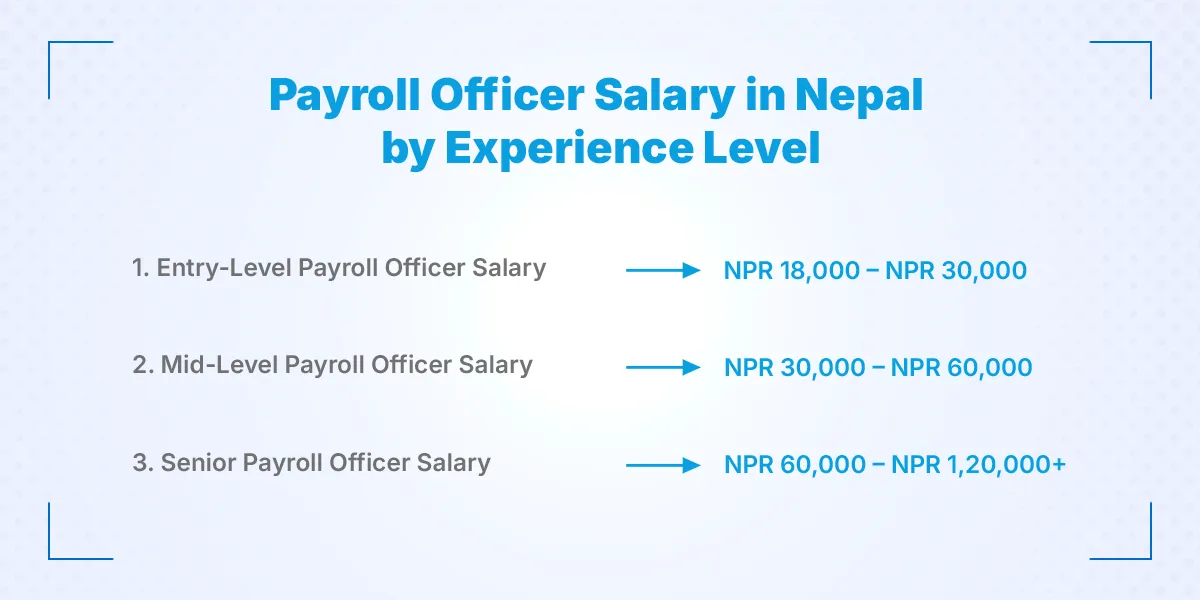
1. Entry-Level Payroll Officer Salary
Entry-level Payroll Officers typically earn between NPR 18,000 and NPR 30,000 per month. These professionals usually have less than two years of experience in payroll, accounting, or HR operations. Their responsibilities often include payroll data entry, attendance verification, and payroll support activities. This stage provides valuable practical experience and foundational payroll knowledge.
2. Mid-Level Payroll Officer Salary
Mid-level Payroll Officers generally earn between NPR 30,000 and NPR 60,000 per month. They often manage payroll processing independently and handle compliance-related tasks. Organizations expect them to possess strong knowledge of payroll systems and reporting procedures. Their increased expertise contributes directly to higher compensation packages.
3. Senior Payroll Officer Salary
Senior Payroll Officers commonly earn between NPR 60,000 and NPR 1,20,000 or more per month. They oversee complex payroll operations, policy implementation, and compliance management. Many organizations rely on them for payroll audits, reporting, and process improvements. Their specialized expertise commands significantly higher salaries.
4. Payroll Manager Salary Progression
Payroll Managers can earn NPR 1,20,000 or more per month depending on organizational size and responsibilities. They lead payroll teams and establish payroll policies and procedures. Strategic planning, compliance oversight, and workforce cost management become major responsibilities at this level. Large organizations often offer additional benefits and performance incentives.
Payroll Officer Salary in Nepal by Industry
Different industries offer varying salary levels because payroll complexity, workforce size, and compliance requirements differ considerably. Industries with larger employee bases and stricter regulations often provide better compensation.
1. Banking and Financial Institutions
Banks and financial institutions generally offer some of the highest payroll-related salaries in Nepal. Payroll professionals in this sector manage highly regulated compensation structures and compliance requirements. Accuracy and confidentiality are critical because payroll data involves sensitive financial information. Strong compensation packages reflect these responsibilities.
2. IT and Software Companies
IT companies frequently offer competitive salaries to payroll professionals managing diverse employee compensation structures. These organizations often use advanced payroll technologies and automated systems. Payroll officers must understand various benefits, incentives, and performance-based compensation models. Growing technology companies continue creating demand for skilled payroll professionals.
3. Manufacturing and Industrial Sector
Manufacturing organizations employ large workforces that require complex payroll administration. Payroll officers often handle shift allowances, overtime calculations, and attendance-based payroll processing. Compliance requirements can also be extensive in industrial environments. As a result, experienced payroll professionals are highly valued.
4. Hospitality and Tourism Industry
Hotels, resorts, and tourism businesses require payroll management for diverse employee categories. Payroll officers manage salaries, service charges, overtime payments, and seasonal workforce compensation. Payroll complexity often increases during peak tourism periods. Experienced professionals can earn competitive salaries within large hospitality organizations.
5. NGOs and INGOs
NGOs and INGOs often provide attractive compensation packages for payroll and finance professionals. Payroll officers may handle donor-funded projects and multiple salary structures. Strong compliance and reporting skills are especially important in these organizations. International organizations frequently offer additional benefits alongside salaries.
Payroll Officer Salary in Nepal by Location
A payroll officer's salary can vary based on local economic activity, employer concentration, and industry presence. Major business centers generally provide better compensation opportunities.
1. Kathmandu Valley
Kathmandu Valley offers the highest payroll salary opportunities in Nepal. Most large corporations, banks, INGOs, and multinational organizations operate within the valley. Payroll officers here typically earn between NPR 30,000 – NPR 1,20,000+ per month, depending on experience and organization size. Competition for skilled payroll professionals remains strong due to growing business activity. Higher living costs also contribute to increased salary levels.
2. Pokhara
Pokhara provides growing opportunities for payroll professionals in tourism, hospitality, education, and service industries. Payroll salaries in Pokhara generally range from NPR 25,000 – NPR 70,000 per month based on experience. Salaries are generally competitive but may be lower than Kathmandu. The city's expanding business environment continues creating new employment opportunities. Experienced payroll professionals remain in demand across several sectors.
3. Biratnagar
Biratnagar is an important industrial and commercial hub in eastern Nepal. Payroll officers here typically earn around NPR 28,000 – NPR 75,000 per month, depending on organizational size and industry. Manufacturing companies and trading businesses create consistent demand for payroll professionals. Salaries vary depending on organizational structure and workload complexity. Experienced candidates often secure attractive compensation packages.
4. Bharatpur and Other Cities
Bharatpur and other developing cities continue generating payroll-related job opportunities. Payroll salaries in these areas usually range from NPR 22,000 – NPR 60,000 per month. Growing healthcare, education, retail, and service sectors contribute to demand. Salary levels are generally moderate compared to larger metropolitan areas. Career growth opportunities remain promising as businesses expand.
What Factors Affect Payroll Officer Salary in Nepal?
Payroll Officer salaries in Nepal are influenced by qualifications, experience, industry, company size, and technical expertise. Professionals who combine payroll knowledge with compliance and software skills generally earn higher salaries.
Employers increasingly value payroll professionals who can manage complex systems and regulatory requirements. Continuous skill development often leads to better career advancement opportunities.
1. Education and Qualifications
Educational background plays an important role in determining salary potential. Degrees in accounting, finance, business administration, or management are commonly preferred. Employers often prioritize candidates with relevant academic credentials. Strong educational foundations support career advancement and salary growth.
2. Professional Certifications
Professional certifications demonstrate specialized payroll and accounting expertise. Employers often view certified professionals as more capable and reliable. Certifications can improve job prospects and salary negotiations. Continuous professional development also strengthens long-term career growth.
3. Work Experience
Experience remains one of the strongest salary determinants in payroll careers. Experienced professionals handle payroll challenges more efficiently and accurately. They often possess stronger compliance knowledge and reporting capabilities. Employers reward this expertise through higher compensation.
4. Industry Type
Industries with larger payroll operations generally offer higher salaries. Banking, IT, manufacturing, and INGOs often require advanced payroll management skills. Complex payroll environments increase the value of experienced professionals. Industry specialization can significantly improve earning potential.
5. Company Size
Large organizations typically offer better compensation than small businesses. Bigger companies often manage larger workforces and more complex payroll structures. They also invest more heavily in payroll systems and compliance processes. This creates opportunities for higher salaries and career progression.
How to Become a Payroll Officer in Nepal?
To become a Payroll Officer in Nepal, individuals typically complete relevant education, develop payroll knowledge, gain practical experience, and apply for payroll-related positions. Building technical and compliance skills can significantly improve employment opportunities.
Many payroll professionals begin their careers through accounting, finance, or HR support roles. Practical experience and software proficiency are often essential for advancement.
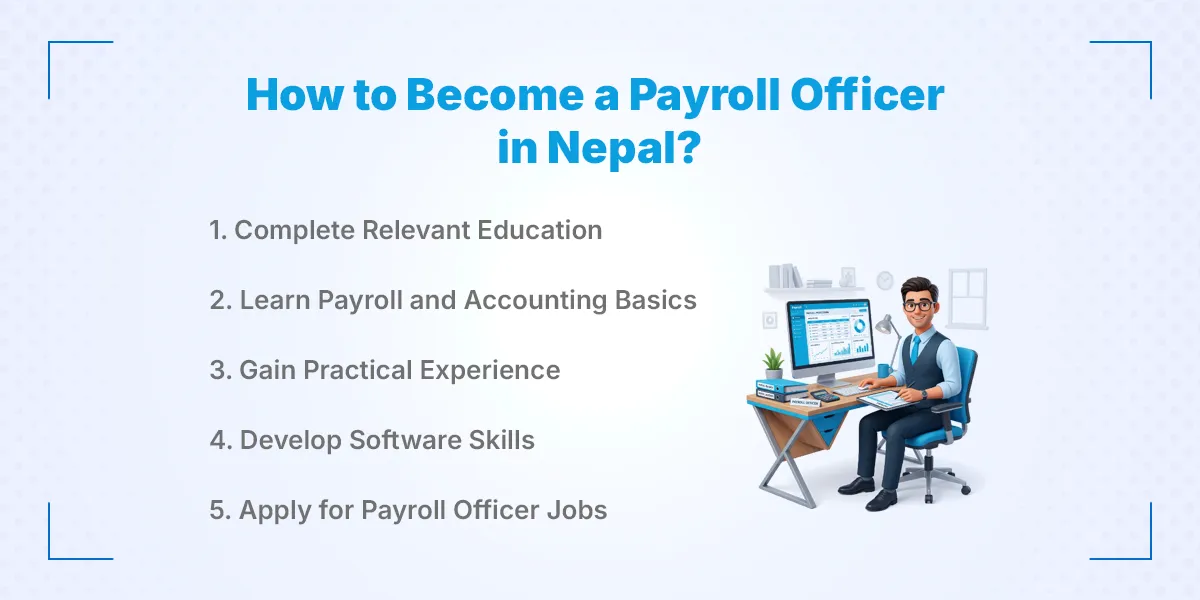
1. Complete Relevant Education
A bachelor's degree in accounting, finance, business administration, or management is commonly preferred. Academic studies provide essential knowledge of financial and business principles. Strong educational qualifications improve employability and career prospects. Employers often use educational credentials as an initial screening criterion.
2. Learn Payroll and Accounting Basics
Understanding payroll calculations, taxation, and compliance requirements is essential. Candidates should develop knowledge of salary structures and payroll processes. Learning labor regulations can also provide a competitive advantage. Strong foundational knowledge supports long-term career growth.
3. Gain Practical Experience
Practical experience helps professionals understand real payroll operations. Internships and entry-level positions provide valuable exposure to payroll systems and procedures. Employers often prefer candidates with hands-on experience. Practical knowledge also improves confidence and problem-solving abilities.
4. Develop Software Skills
Modern payroll operations depend heavily on payroll and accounting software. Familiarity with spreadsheet tools and payroll platforms increases efficiency. Employers actively seek candidates with strong software capabilities. Technical proficiency can also improve salary prospects.
5. Apply for Payroll Officer Jobs
Candidates can apply for payroll officer opportunities through job portals, company websites, and professional networks. Preparing a strong resume improves interview opportunities. Consistent skill development helps candidates remain competitive. Targeting organizations with structured payroll departments can accelerate career growth.
Benefits and Career Growth Opportunities for Payroll Officers
Payroll professionals enjoy strong career stability because every organization needs accurate salary administration. Businesses cannot operate efficiently without reliable payroll systems and compliance management.
The role also offers clear career progression pathways. Professionals can advance to Senior Payroll Officer, Payroll Manager, Compensation and Benefits Specialist, HR Manager, Finance Manager, or broader administrative leadership positions.
Payroll skills are highly transferable across industries. Banking, IT, manufacturing, hospitality, healthcare, education, NGOs, and INGOs all require payroll expertise, creating diverse employment opportunities.
Payroll Officer Salary in Nepal: Expected Future Demand
Demand for payroll professionals in Nepal is expected to grow steadily as organizations adopt digital payroll systems and stronger compliance practices. Businesses increasingly require skilled professionals who can manage payroll accurately and efficiently.
Automation is changing payroll operations, but it is not eliminating payroll jobs. Instead, organizations need professionals who understand payroll software, compliance requirements, reporting standards, and workforce management.
As Nepal's private sector continues expanding, payroll expertise will remain valuable across multiple industries. Professionals who develop technical, analytical, and compliance skills are likely to enjoy strong career prospects in the coming years.
Conclusion
Payroll Officer is a promising career option for individuals interested in finance, accounting, HR, and compliance. The profession offers stable employment, competitive salaries, and clear opportunities for career advancement across multiple industries.
Salary levels in Nepal continue to increase as organizations place greater emphasis on payroll accuracy, compliance, and digital payroll systems. Professionals who build strong technical skills and gain industry experience can significantly improve their earning potential.
If you are searching for Payroll Officer jobs, finance careers, or HR opportunities in Nepal, explore the latest vacancies through Kumari Job to find positions that match your skills and career goals.
Frequently Asked Questions
Submit your comments

Get Our App On



How to Make a Police Report (Police Clearance Certificate) in Nepal?
VIEW DETAILS
Types of SEO and How They Work: Complete Beginner's Guide
VIEW DETAILS
Government Restricts New Lok Sewa Vacancy Requests 2083/84 — Or Not?
VIEW DETAILS
How to Apply for Tattoo Artist Jobs in Nepal?
VIEW DETAILS


Loading Comments...